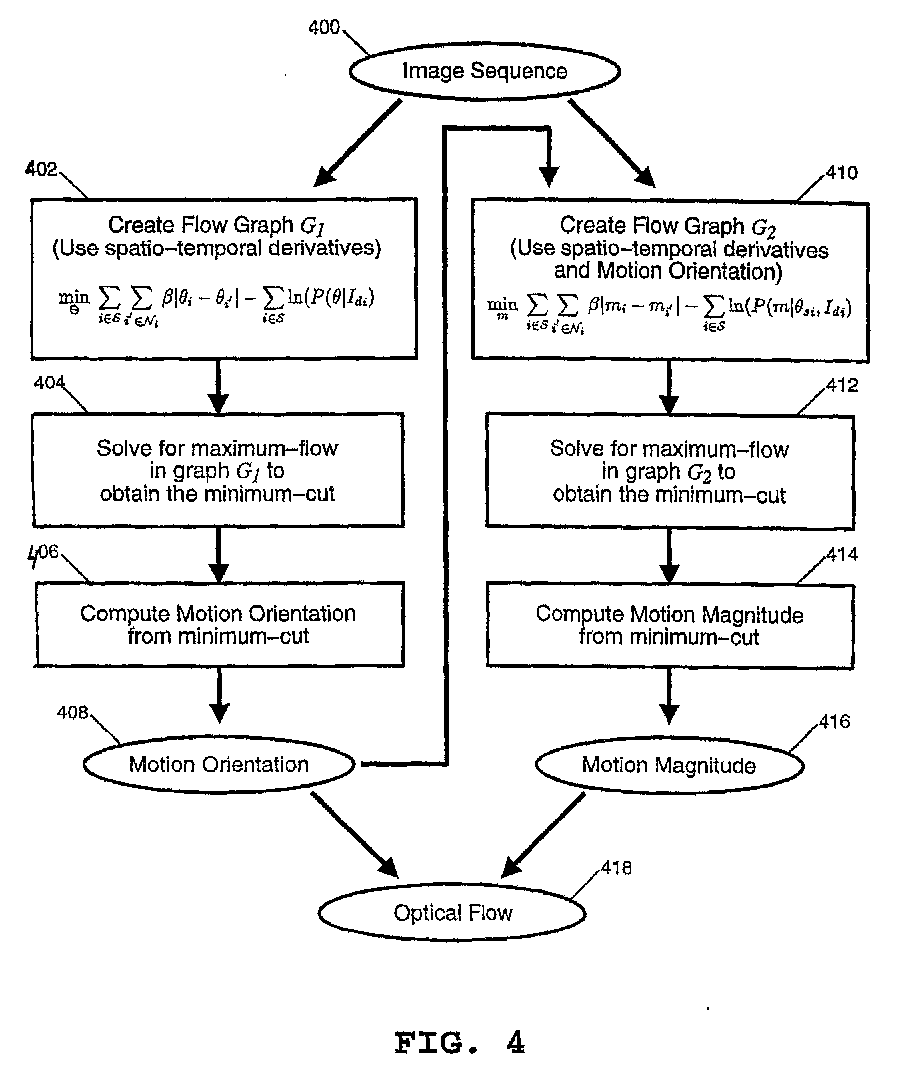
(57) A method for estimating the optical flow between a plurality of images is provided.
The method includes obtaining a motion orientation component and a motion magnitude
component. Determining the motion orientation component includes creating, a first
graph using spatio-temporal derivatives of the plurality of images, solving for a
first maximum-flow in the first graph to thereby obtain a first minimum-cut therefrom,
and computing the motion orientation component from the first minimum-cut. Determining
the motion magnitude component includes creating a second graph using spatio-temporal
derivatives of the plurality of images and the motion orientation component, solving
for a second maximum-flow in the second graph to thereby obtain a second minimum-cut
therefrom, and computing the motion magnitude component from the second minimum-cut.
The motion orientation component and the motion magnitude component together comprise
the estimate of the optical flow between the plurality of images. The method properly
models errors in the measurement of image derivatives while enforcing a brightness
constraint, and efficiently provides a globally optimal solution to the optical flow
in the context of the model.
|
|
