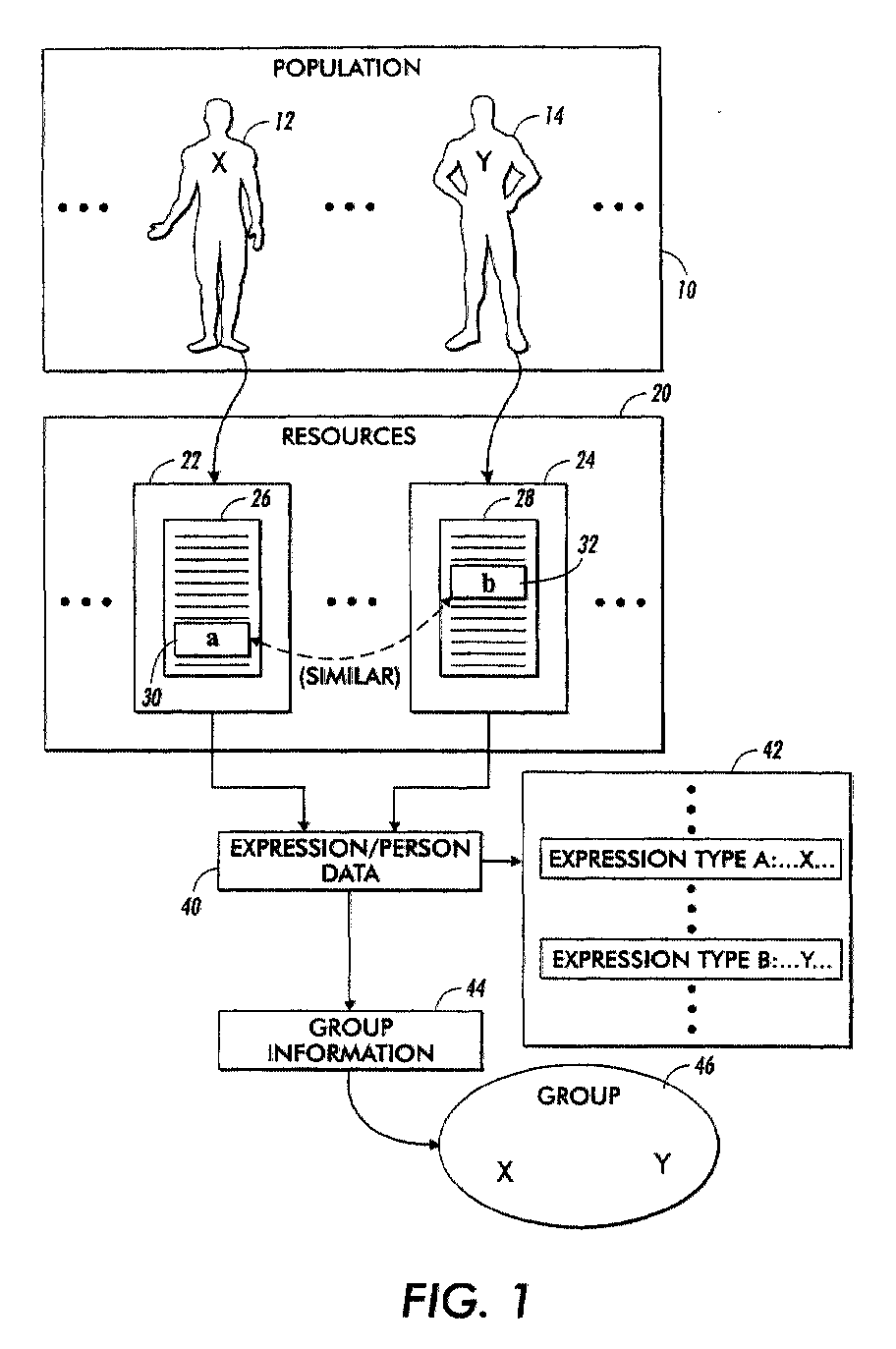
(57) Expression/person data are obtained and, in turn, are used to obtain information
about groups of people in a population. The people access resources that include linguistically
analyzable content, such as Web pages that include text. The expression/person data
identify, for each of a set of expression types that occur in the resources, people
who have accessed resources that include that type. The group information indicates
a group of people who have accessed resources that include instances of expression
types that have similar conceptual content. For example, an item of expression/person
data can be obtained when a person accesses a Web page in an acquisition mode, by
performing linguistic analysis in the background. An expression type can be indicated,
for example, by a syntactic relation and a pair of normalized words that occur in
the syntactic relation in the analyzed text. The expression/person data can be stored
in a database. When a user provides a query that includes a set of words or other
expressions, a list of conceptually similar expressions and identifiers of people
who have accessed Web pages that include them can be presented on a display.
|
|
