| (19) |
 |
|
(11) |
EP 1 053 183 B2 |
| (12) |
NEW EUROPEAN PATENT SPECIFICATION |
| (45) |
Date of publication and mentionof the opposition decision: |
|
10.01.2007 Bulletin 2007/02 |
| (45) |
Mention of the grant of the patent: |
|
03.04.2002 Bulletin 2002/14 |
| (22) |
Date of filing: 04.11.1997 |
|
| (51) |
International Patent Classification (IPC):
|
| (86) |
International application number: |
|
PCT/NL1997/000602 |
| (87) |
International publication number: |
|
WO 1998/019927 (14.05.1998 Gazette 1998/19) |
|
| (54) |
VALVE BAG
VENTILSACK
SAC A VALVE
|
| (84) |
Designated Contracting States: |
|
AT BE CH DE DK ES FI FR GB GR IE IT LI NL SE |
| (30) |
Priority: |
04.11.1996 NL 1004420
|
| (43) |
Date of publication of application: |
|
22.11.2000 Bulletin 2000/47 |
| (73) |
Proprietor: Mondi Packaging Maastricht N.V. |
|
6219 AD Maastricht (NL) |
|
| (72) |
Inventor: |
|
- JANSSEN, Paulus, Johannes, Maria
NL-6418 HX Heerlen (NL)
|
| (74) |
Representative: Kruit, Jan |
|
c/o Octrooibureau Vriesendorp & Gaade,
P.O. Box 266
2501 AW The Hague
2501 AW The Hague (NL) |
| (56) |
References cited: :
EP-A- 0 160 357
DE-A- 3 414 199
DE-C- 2 932 726
|
DE-A- 3 108 663
DE-C- 829 548
GB-A- 1 449 879
|
|
| |
|
|
|
|
| |
|
[0001] The invention relates to a method for closing a valved sack and to a closed valved
sack according to the preambles of claims 1 and 6, respectively.
[0002] Such valved sacks are generally known and are formed of one or more layers of flexible
material such as paper or plastic. The valved sack is provided with a filling opening,
which is formed by opposite layers of material which are not joined when manufacturing
the sack. Valved sacks are filled with bulk cargo, for instance building material
like cement, or foodstuffs like flour, which is brought into the valved sack through
the filling opening. The filling opening is shaped such that the opposite layers of
material are pressed onto one another after filling the valved sack, in order to prevent
the contents of the valved sack from streaming out. The filling opening thus acts
as a one-way valve. In practice, however, it turned out that for many kinds of bulk
cargo streaming out is not prevented to a sufficient extent. In those cases the valved
sacks are closed by bringing the opposite layers of material against each other and
joining them undetachably. With plastic valved sacks the connection is usually effected
by thermo-welding or by applying glue, for instance a hotmeltglue. With paper valved
sacks the opposite layers of material are usually glued to each other, or welded together
by heat when they are provided with a (plastic) coating. Thus the filling opening
cannot be opened and closed again after closing.
[0003] A disadvantage of these known methods is that in the case or welding heat is supplied,
which may be detrimental to the quality of the contents of the valved sack, for instance
foodstuffs. In the cage of gluing it is the glue itself which may be detrimental to
the quality of the contents. In both cases it is so that while filling remnants of
the contents may be left behind in the filling opening, because of which the attachment
of the heat weld or the glue can be insufficient for a good closing of the valved
sack. The supply of glue or a (plastic) coating to a paper valved sack also has the
disadvantage that the valved sack cannot be entirely recycled just like that.
[0004] It is an object of the invention to provide an improved closing of valved sacks.
[0005] To that end according to a first aspect of the invention a method is provided according
to claim 1.
[0006] By mechanically joining the layers of material which are on top of one another, neither
heat nor material alien to paper such as glue or a (plastic) coating has to be supplied.
The mechanical connection can be quickly effected. By the plastic deformation remnants
of the contents are either pushed away or included in the deformed layers of material,
without notably influencing the closing function of the connection. Because hardly
any forces which would open the filling opening act on a closed filling opening, plastic
deformation of the layers of material offers a sufficiently firm connection for the
desired closing of the valved sack. When knurling (compare to the German "prägen")
a relief is pressed into the material, resulting in a mechanical connection between
the layers of material which are on top of one another.
[0007] Preferably the filling opening is closed by joining the material layers which are
on top of one another with a connection in the form of a band along substantially
the entire width of the filling opening. In this way the valved sack is closed entirely.
[0008] The connection in the form of a band is advantageously obtained by corrugating the
layers of material on the spot, in which the corrugations provide a firm plastic deformation,
which can be applied easily.
[0009] Preferably the valved sack is provided with a tube of flexible material such as paper
or plastic arranged in the filling opening, which tube partially protrudes after filling
the valved sack, in which after filling the valved sack the sides of the protruding
portion of the cube that are on top of one another are joined by plastic deformation.
After filling the protruding portion of the tube can be easily engaged by a machine.
[0010] More preferably the valved sack is a valved hexagonal bottom sack, of which the protruding
portion of the tube is closed by plastic deformation, after filling the valved sack.
[0011] According to a second aspect of the invention a valved sack is provided according
to claim 6.
[0012] In this way a valved sack is provided, which without the supply of heat or adding
material alien to paper provides a good closing against the streaming out of the contents
of the valved sack. With paper sacks the valved sack remains entirely recyclable.
[0013] Preferably the plastic deformation extends in the form of a band along substantially
the entire width of the filling opening, in which preferably a corrugated profile
is applied and preferably the plastic deformation is effected by pressure welding
or knurling.
[0014] According to a advantageous embodiment the valved sack is provided with a tube of
flexible material such as paper or plastic, arranged in the filling opening, which
tube partially protrudes after filling the valved sack, in which the tube is closed
by plastic deformation of its sides which are on top of one another, and preferably
the valved sack is a valved hexagonal bottom sack.
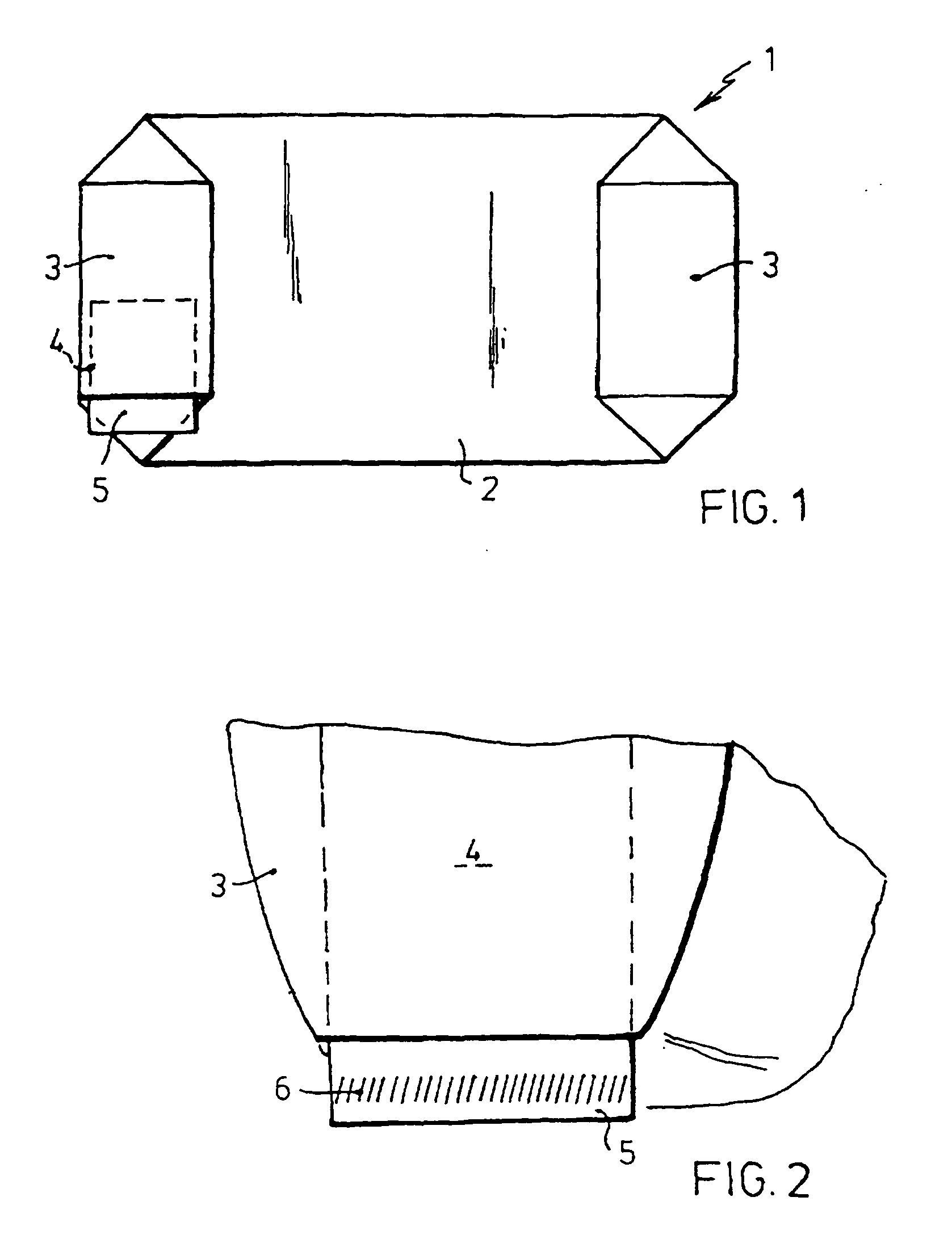
[0015] The invention will be elucidated below on the basis of drawings.
Figure 1 shows an unfilled valved hexagonal bottom sack with a partially protruding
tube.
Figure 2 shows on a larger scale a portion of the valved hexagonal bottom sack according
to figure 1 in filled condition with closed tube, seen on the hexagonal bottom with
the tube.
Figure 1 shows a valved hexagonal bottom sack 1 consisting of a sack body 2 and two
hexagonal bottoms 3, in which in one of the hexagonal bottoms 3 a filling opening
is left pen, in which a tube 4 is arranged. The tube 4 is mainly incorporated in the
hexagonal bottom (the portion indicated by dots) and has a protruding portion 5 which
protrudes outside of the hexagonal bottom. The valved hexagonal bottom sack 1 is shown
flat folded in figure 1.
[0016] During the filling of the valved hexagonal bottom sack the tube 4 serves as supply
valve for bulk cargo with which the valved sack is filled.
[0017] After filling the valved hexagonal bottom sack the protruding portion 5 of the tube
4 protrudes outside the filled body of the valved sack. This is shown in figure 2.
The protruding portion 5 of the tube is provided with a plastically deformed band
6, where the sides of the tube which are on top of one another are joined by plastic
deformation of the material of the tube. The mechanical deformation is applied in
the form of a corrugated profile, which extends along the entire width of the tube
4. It will be clear that instead of a corrugated profile a band with a pointed profile
can be opted for as well, and that instead of mechanical deformation in the form of
a band a mechanical deformation in discrete places of the protruding portion 5 of
the valve 4 can also be opted for in orderto obtain a good closing of the protruding
portion 5.
[0018] When filling the sacks the valved sack with the tube 4 is engaged at the top, the
(flat folded) valve 4 is opened and a filling pipe is stuck into the tube, through
which the bulk cargo is brought into the valved sack. After filling and removing the
filling pipe the filled valved sack drops on a conveyor belt or the valved sack is
positioned such that the protruding portion 5 of the tube 4 can easily be engaged
by a closing machine, which presses both sides of the protruding portion 5 onto one
another and joins them by plastic deformation. Subsequently the sacks can be transported
to a palletization device, which stacks the filled valved sacks onto a pallet.
[0019] Joining by plastic deformation is in itself known in another area of the art, for
instance in the manufacturing of paper coffee filterbags, but has never been applied
in the area of art regarding valved sacks.
[0020] Joining both sides of the protruding portion 5 of the tube 4 by plastic deformation
provides a good closing of the valved sack, which can be effected in a simple way,
without having to supply heat or glue.
[0021] The invention has been described on the basis of a valved hexagonal bottom sack,
which preferably is made out of paper. It will be clear that the invention is also
applicable to a valved sack in which the filling opening is arranged in a longitudinal
seam of the valved sack, and also to valved sacks without a tube, wh en the valved
sack has a filling opening which is formed by opposite layers of material, which together
can be engaged to effect a plastic deformation. The invention is also applicable to
plastic valved sacks.
1. Method for closing a valved sack (1) of one or more layers of flexible material such
as paper or plastic, in which the valved sack (1) has a filling opening (4,5) which
is closed after filling the valved sack, in which the filling opening is formed by
opposite layers of material, which when closing the valved sack are on top of one
another and are undetachably joined, characterized in that the filling opening is closed by joining the layers of material which are on top
of one another by mechanically plastic deformation without having to supply heat or
glue, the plastic deformation being obtained by knurling ("Prägen") the layers of
material which are on top of one another.
2. Method according to claim 1, characterized in that the filling opening (4,5) is closed by joining the layers of material which are on
top of one another with a connection in the form of a band along substantially the
entire width of the filling opening.
3. Method according to claim 2, characterized in that the connection in the form of a band (6) is obtained by corrugating the layers of
material on the spot.
4. Method according to any one of the preceding claims, characterized in that the valved sack (1) is provided with a tube of flexible material such as paper or
plastic arranged in the filling opening, which tube partially protrudes after filling
the valved sack, in which after filling the valved sack the sides of the protruding
portion of the tube that are on top of one another are joined by plastic deformation.
5. Method according to claim 4, characterized in that the valved sack is a valved hexagonal bottom sack, of which the protruding portion
of the tube is closed by plastic deformation after filling the valved sack.
6. Valved sack (1) of one or more layers of flexible material such as paper or plastic,
provided with a filling opening (4,5) formed by opposite layers of material, which
valved sack is closed after filling, in which the opposite layers of material are
on top of one another and are undetachably joined, characterized in that the layers of material which are on top of one another are joined by mechanically
plastic deformation without having to supply heat or glue, the plastic deformation
being effected by knurling ("Prägen").
7. Valved sack according to claim 6, characterized in that the plastic deformation extends in the form of a band (6) along substantially the
entire width of the filling Opening, in which preferably a corrugated profile is applied.
8. Valved sack according to claim 6 or 7, characterized in that the valved sack (1) is provided with a tube of flexible material (5) such as paper
or plastic, arranged in the filling opening, which tube partially protrudes after
filling the valved sack, in which the tube is closed by plastic deformation of its
sides which are on top of one another.
9. Valved sack according to claim 8, characterized in that the valved sack is a valved hexagonal bottom sack.
1. Verfahren zum Schließen eines Ventilsacks (1) aus einer oder mehreren Schichten flexibeles
Materials wie Papier oder Kunststoff, wobei der Ventilsack (1) eine Einfüllöffnung
(4, 5) hat, die nach dem Füllen des Ventilsacks geschlossen wird, wobei die Einfüllöffnung
durch gegenübereinander liegende Materialschichte, die bei dem Schließen des Ventilsacks
aufeinander liegen und miteinander nicht trennbar verbunden werden, gebildet ist,
dadurch gekennzeichnet, daß die Einfüllöffnung geschlossen wird durch die aufeinander liegenden Materialschichte
durch mechanische und plastische Verformung miteinander zu verbinden, ohne Zufuhr
von Hitze oder Klebstoff, wobei die plastische Verformung durch Prägen der aufeinander
liegenden Materialschichte erhalten wird.
2. Verfahren gemäß Anspruch 1, dadurch gekennzeichnet, daß die Einfüllöffnung (4, 5) geschlossen wird, durch die aufeinander liegenden Materialschichte
über hauptsächlich die ganze Breite der Einfüllöffnung bandförmig (6) miteinander
zu verbinden.
3. Verfahren gemäß Anspruch 2, dadurch gekennzeichnet, daß die bandförmige (6) Verbindung erhalten wird, durch die Materialschichte zur Stelle
rillenförmig zu profilieren.
4. Verfahren gemäß einem der vorhergehenden Ansprüche, dadurch gekennzeichnet, daß der Ventilsack (1) mit einer in der Einfüllöffnung angeordneten Hülse aus flexibelem
Material wie Papier oder Kunststoff versehen ist, welche Hülse nach dem Füllen des
Ventilsacks teilweise heraussteckt, wobei die nach dem Füllen des Ventilsacks aufeinander
liegenden Seiten des heraussteckenden Teils der Hülse durch plastische Verformung
miteinander verbunden werden.
5. Verfahren gemäß Anspruch 4, dadurch gekennzeichnet, daß der Ventilsack ein Kreuzbodenventilsack ist, wovon das heraussteckende Teil der Hülse
nach dem Füllen des Ventilsacks durch plastische Verformung geschlossen wird.
6. Ventilsack (1) aus einer oder mehreren Schichten flexibeles Materials, wie Papier
oder Kunststoff, mit einer durch gegenübereinander liegende Materialschichte gebildeten
Einfüllöffnung (4, 5), welcher Ventilsack nach dem Füllen geschlossen wird, wobei
die gegenübereinander liegenden Materialschichte aufeinander liegen und miteinander
nicht trennbar verbunden sind, dadurch gekennzeichnet, daß die aufeinander liegenden Materialschichte durch mechanische und plastische Verformung
miteinander verbunden sind ohne Zufuhr von Hitze oder Klebstoff, wobei die plastische
Verformung durch Prägen zustande gebracht ist.
7. Ventilsack gemäß Anspruch 6, dadurch gekennzeichnet, daß die plastische Verformung sich bandförmig (6) über hauptsächlich die ganze Breite
der Einfüllöffnung erstreckt, wobei vorzugsweise eine rillenförmige Profilierung angeordnet
ist.
8. Ventilsack gemäß Anspruch 6 oder 7, dadurch gekennzeichnet, daß der Ventilsack (1) mit einer in der Einfüllöffnung angeordneten Hülse aus flexibelem
Material (5) wie Papier oder Kunststoff versehen ist, welche Hülse nach dem Füllen
des Ventilsacks teilweise heraussteckt, wobei die Hülse durch das plastische Verformen
ihrer aufeinander liegenden Seiten geschlossen ist.
9. Ventilsack gemäß Anspruch 8, dadurch gekennzeichnet, daß der Ventilsack ein Kreuzbodensack ist.
1. Procédé de fermeture d'un sac à valve (1) comportant une couche ou davantage d'un
matériau souple, tel que du papier ou du plastique, dans lequel le sac à valve (1)
présente une ouverture de remplissage (4, 5) qui est fermée après le remplissage du
sac à valve, dans lequel l'ouverture de remplissage se compose de couches de matériau
opposées qui, lors de la fermeture du sac à valve, se trouvent l'une au-dessus de
l'autre et sont jointes de manière non détachable, caractérisé en ce que l'ouverture de remplissage est fermée en joignant les couches de matériau qui sont
l'une au-dessus de l'autre par déformation méchanique et plastique sans alimentation
de la chaleur ou de la colle, la déformation plastique étant obtenue par moletage
(Prägen) des couches de matériau qui se trouvent l'une au-dessus de l'autre.
2. Procédé selon la revendication 1, caractérisé en ce que l'ouverture de remplissage (4, 5) est fermée en joignant les couches de matériau
qui se trouvent 1' une au-dessus de l'autre au moyen d'une jonction se présentant
sous la forme d'une bande (6) sensiblement le long de toute la largeur de l'ouverture
de remplissage.
3. Procédé selon la revendication 2, caractérisé en ce que la jonction se présentant sous la forme d'une bande (6) est obtenue en ondulant les
couches de matériau sur place.
4. Procédé selon l'une quelconque des revendications précédentes, caractérisé en ce que le sac à valve (1) est muni d'un tube de matériau souple, tel que du papier ou du
plastique, disposé dans l'ouverture de remplissage, ledit tube faisant partiellement
saillie après le remplissage du sac à valve, dans lequel, après le remplissage du
sac à valve, les côtés de la partie du tube faisant saillie qui se trouvent l'un au-dessus
de l'autre sont joints par déformation plastique.
5. Procédé selon la revendication 4, caractérisé en ce que le sac à valve est un sac à valve à fond hexagonal, dont la partie du tube faisant
saillie est fermée par déformation plastique après remplissage du sac à valve.
6. Sac à valve (1) comportant une couche ou davantage d'un matériau souple, tel que du
papier ou du plastique, muni d'une ouverture de remplissage (4, 5) formée par des
couches de matériau opposées, ledit sac à valve étant fermé après remplissage, dans
lequel les couches de matériau opposées se trouvent l'une au-dessus de l'autre et
sont jointes de manière non détachable, caractérisé en ce que les couches de matériau qui se trouvent l'une au-dessus de l'autre sont jointes par
déformation méchanique et plastique sans alimentation de la chaleur ou de la colle,
la déformation plastique étant réalisée par moletage (Prägen).
7. Sac à valve selon la revendication 6, caractérisé en ce que la déformation plastique s'étend sous la forme d'une bande (6) sensiblement le long
de toute la largeur de l'ouverture de remplissage, à laquelle est conféré un profil
de préférence ondulé.
8. Sac à valve selon la revendication 6 ou 7, caractérisé en ce que le sac à valve (1) est muni d'un tube de matériau souple (5), tel que du papier ou
du plastique, disposé dans l'ouverture de remplissage, ledit tube faisant partiellement
saillie après le remplissage du sac à valve, dans lequel le tube est fermé par déformation
plastique de ses côtés qui se trouvent l'un au-dessus de l'autre.
9. Sac à valve selon la revendication 8, caractérisé en ce que le sac à valve est un sac à valve à fond hexagonal.