| (19) |
 |
|
(11) |
EP 1 061 162 B2 |
| (12) |
NEW EUROPEAN PATENT SPECIFICATION |
|
After opposition procedure |
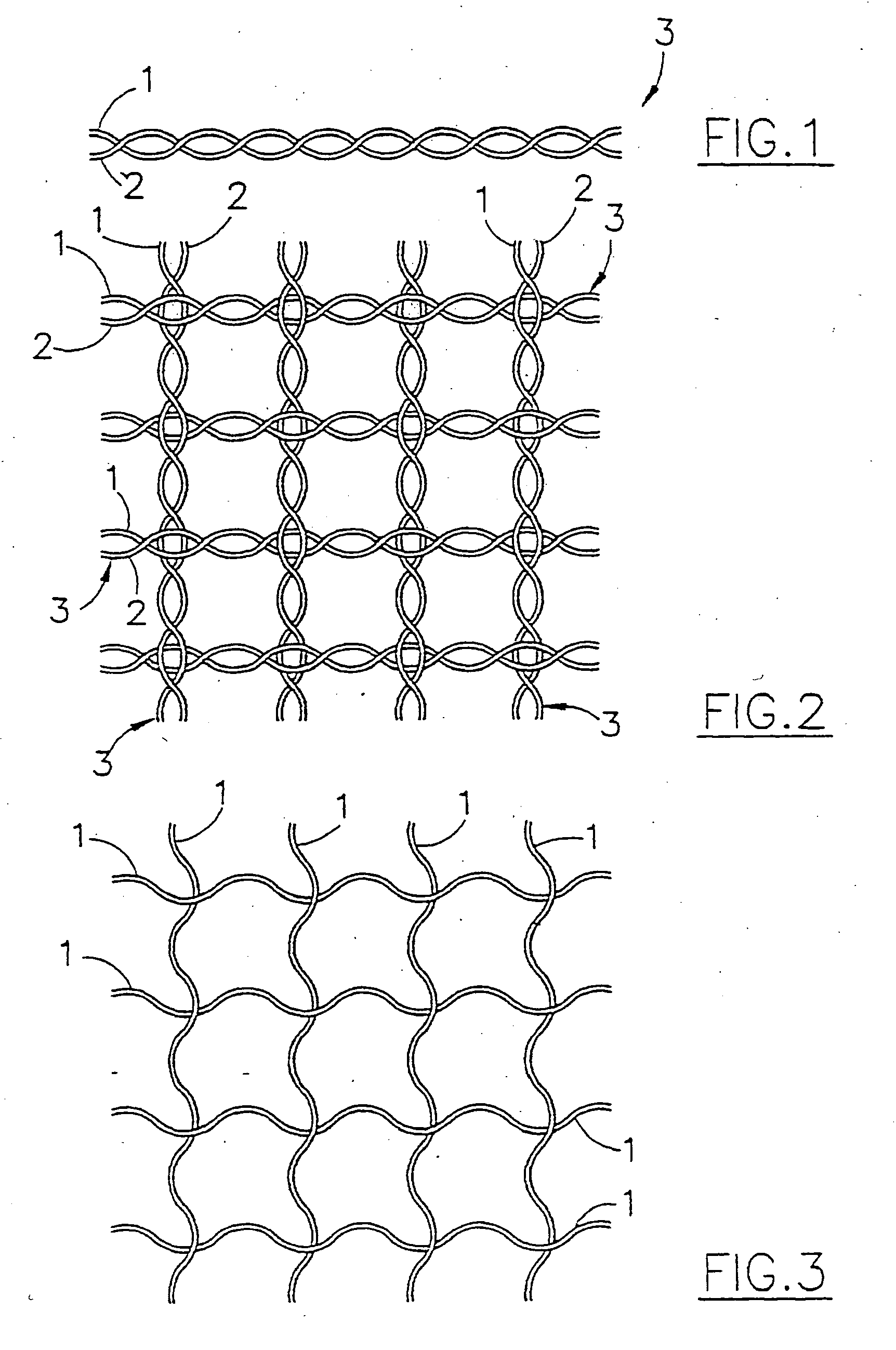
| (45) |
Date of publication and mentionof the opposition decision: |
|
10.02.2010 Bulletin 2010/06 |
| (45) |
Mention of the grant of the patent: |
|
18.09.2002 Bulletin 2002/38 |
| (22) |
Date of filing: 27.03.2000 |
|
| (51) |
International Patent Classification (IPC):
|
|
| (54) |
Process for the manufacture of a pure cashmere textile article
Verfahren zum Herstellen eines reinen Kaschmirtextilartikels
Procédé de fabrication d'un article textile pur cachemire
|
| (84) |
Designated Contracting States: |
|
AT BE CH CY DE DK ES FI FR GB GR IE IT LI LU MC NL PT SE |
| (30) |
Priority: |
15.06.1999 IT MI991332
|
| (43) |
Date of publication of application: |
|
20.12.2000 Bulletin 2000/51 |
| (73) |
Proprietor: Geraldini, Jacopo |
|
20122 Milano (IT) |
|
| (72) |
Inventor: |
|
- Geraldini, Jacopo
20122 Milano (IT)
|
| (74) |
Representative: Mittler, Enrico |
|
Mittler & C. s.r.l.
Viale Lombardia, 20
20131 Milano
20131 Milano (IT) |
| (56) |
References cited: :
EP-A1- 0 636 716
GB- - 1 068 662
IT-B- 1 240 487
JP-A- 49 101 666
JP-A- 55 098 936
|
DE-A- 4 239 341
GB-A- 2 267 711
JP-A- 48 098 135
JP-A- 53 126 336
JP-C- 182 178
|
|
| |
|
|
- DATABASE WPI Derwent Publications Ltd., London, GB; AN 1980-81772C XP002148247 & JP
55 128040 A ((TORO)TORAY IND INC)
- 'IWS Product Development', KURARAY CO.
- JIAM'99 THE INTERNATIONAL SYMPOSIUM FOR THE NEW FIBER & TEXTILE TECHNOLOGY 09 May
1999,
- WOOLMARK NEWS January 1998, pages 1 - 4
- CRIMP WOOL AND TECHNOLOGY no. 77, February 1977,
- 'Technical Sheet of Kuralon K-II by F.IIi Citterio S.p.A.' 08 June 1999,
- IWS WOOLMARK MONTHLY no. 385, 10 November 1998, pages 3 - 4
- 'Webster's Third New International Dictionary', 1961 page 347
- KURALON-POLYVINYL ALCOHOL FIBRE
|
|
| |
|
|
|
Remarks: |
|
The file contains technical information submitted after the application was filed
and not included in this specification |
|
[0001] The present invention refers to a process for the manufacture of a textile article
made of pure cashmere, whether a literally called fabric or a knitted fabric or a
jersey fabric.
[0002] The cashmere is known to be a valuable material that is highly demanded by high level
customs.
[0003] At the same time it is also a material that at its pure state and at a count higher
than a determined maximum value has such a low mechanical strength to make its weaving
impossible.
[0004] The known technique, as described in the
Italian patent application No. 1 306 232 in the name of the applicant, which was laid open to public inspection on 28 October
1999, provides that a very thin yarn of cashmere is assisted by a vegetable support
yarn, as for instance cotton, that is then eliminated by a devouration operation by
means of an acid development salt.
[0005] The devouration does not allow to eliminate the residues of the vegetable thread
completely when working in selvedge.
[0006] In addition the use of a vegetable reinforcement thread involves supply and costs
problems.
[0007] In view of the state of the art herein described, purpose of the present invention
is to realise a process that allows to obtain a high count pure cashmere textile article
at a low price.
[0008] According to the present invention, such purpose is attained by means of a process
as defined in claim 1.
[0009] The characteristics and the advantages of the present invention will become evident
from the following detailed description of an embodiment thereof that is illustrated
as a non limiting example in the enclosed drawings, in which:
Figure 1 shows a doubled cashmere and synthetic yarn before the weaving;
Figure 2 shows a portion of cloth weave obtained by weaving coupled yarns as the one
in Figure 1;
Figure 3 shows the same portion of cloth after the operation of dissolution has been
performed.
[0010] The yarn of cashmere has a count varying from 85 dtex (50000 Nm) to 200 dtex (120000
Nm), size beyond which the yarn of cashmere has a sufficient strength to allow its
weaving without any support yarn. According to a currently preferred embodiment of
the present invention the yarn of cashmere being used has a count of 130 dtex (80000
Nm).
[0011] The synthetic fibre yarn can be of the type known by the trade name of Kuralon K-II,
having the followings characteristics:
| Technical Characteristics |
Values |
| Flock |
|
| Fineness |
3.2 ± 0.3 dtex |
| Length: |
|
| square cut |
38 and 51 |
| oblique cut (CV 35%) |
85 |
| Strength |
8.5 ± 1.5 cN/dtex |
| Elongation |
11 ± 4 % |
| Bale |
|
| Fineness |
2.2 ± 0.3 dtex |
| Cut (diagonal) |
85 ± 30 mm |
| Weight |
20 g/m |
| Solubility in water |
|
| Fibre as such |
80 ± 10 °C |
| Mixed in fabric |
90 ± 10 °C |
| Vaporisation |
|
| Temperature: |
|
| cardboard tubes |
90 °C max |
| plastic tubes |
80 °C max |
| Dissolution |
|
| Water temperature: |
|
| soak ( for ca. 30 min) |
85 - 95 °C |
| rinse ( for ca. 10 min) |
40 °C |
| Water/fabric ratio |
50/1 by weight |
| Water acidity |
4 - 4.5 pH |
[0012] The doubling operation is carried out in a sense opposite to the one of the individual
yarn, that is with S torsion.
[0013] The doubled yarn 3 thus obtained undergoes an operation of weaving according to the
known art, for example in order to obtain a cloth weave as the one shown in Figure
2.
[0014] Other types of weave can be used, as for instance Batavia 2/2, Saglie, etc., up to
Jacquard. In addition it is possible to provide for a knitted or jersey weaving.
[0015] The synthetic yarn is eliminated in a slightly acid liquid solution, having a pH
comprised between 4 and 4.5, when the temperature of the solution reaches 85 °C by
means of an operation that is defined of dissolution.
[0016] This is made possible owing to the dissolution characteristics provided by Kuralon
K-II.
[0017] Said synthetic material does not leave any kind of residue in the fabric thus obtained
even if working in selvedge thus guaranteeing much higher quality standard than the
ones that can be obtained by the known techniques.
[0018] The fabric thus obtained is then submitted to a dyeing process, for example comprising
soaking in a neutral bath for 10 min at 80 °C, dyeing with acid colours for 100 min
at 80 °C and fulling with wet enzymatic detergents at room temperature for 25 min.
[0019] Finally the article thus obtained is dried and submitted to vapour.
[0020] It is clear that the above described process is characterized by two fundamental
operations, to associate cashmere fibres with synthetic fibres and to dissolve such
synthetic fibres by means of a slightly acid liquid solution at high temperature.
[0021] The association of the two types of fibres is carried out by an doubling operation
of a yarn of cashmere with a synthetic yarn, as previously described with reference
to the drawings.
1. Process for the manufacture of a textile article of high count pure cashmere,
characterized in that it comprises the following sequence of steps:
(a) doubling of a first yarn (1) of high count pure cashmere having a count comprised
between 85 dtex and 200 dtex with a second yarn (2) of synthetic fibres dissolvable
in slightly acid liquid solution at high temperature, the doubling operation being
carried out in a sense opposite to the one of the individual yarn, that is with S
torsion;
(b) weaving of the doubled yarns (1,2);
(c) dissolution of said second yarns (2) by means of a slightly acid liquid solution
having a pH of 4-4.5 and a temperature of 85-95°C.
2. Process according to claim 1, characterized in that the yam (1) of pure cashmere has a count of 130 dtex.
3. Process according to claim 1, characterized in that the yam (2) of synthetic fibres has a bale fineness of 2.2 ± 0.3 dtex, a square cut
length of 38 and 51 mm, an oblique cut length of (CV 35%) 85 mm, a strength of 8.5
± 1.5 cN/ dtex and an elongation 11 ± 4%.
4. Process according to claim 1, characterized in that the yam (2) of synthetic fibres has a bale fineness 2.2 ± 0.3 dtex, a diagonal cut
of 85 ± 30 mm and a weight of 20 g/ m.
5. Process according to claim 3, characterized in that the yarn (2) of synthetic fibres has a temperature of solubility in water of 80 ±
10 °C as yarn per se and of 90 ± 10 °C as yam mixed to fabric.
6. Process according to claim 3, characterized in that the yam (2) of synthetic fibres has a vaporisation temperature of 90 °C max for cardboard
tubes and of 80 °C max for plastics tubes.
7. Process according to claim 3, characterized in that it uses for the dissolution a water temperature of 85- 95 °C for the soaking operation
(for around 30 min), and of 40 °C for the rinse operation (for around 10 min), a water/fabric
ratio of 50/ 1 by weight and a pH of 4- 4.5 as acidity of the water.
8. Process according to claim 1, characterized in that the dissolution is preceded by processes of soaking, dyeing and fulling of the fabric.
9. Process according to claim 8, characterized in that the soaking of the fabric is carried out in a neutral bath.
10. Processes according to claim 8, characterized in that the dyeing is carried out by means of acid colours.
11. Process according to claim 8, characterized in that the fulling is carried out by means of wet enzymatic detergents.
1. Verfahren zum Herstellen einer Textilie aus reinem Kaschmir,
dadurch gekennzeichnet, dass es die folgende Schrittfolge aufweist:
(a) Doublierbehandlung eines ersten Garns (1) aus reinem Kaschmir, weiches eine Dichte
hat, die zwischen 85 dtex und 200 tdex liegt, mit einem zweiten Garn (2) aus synthetischen
Fasern, welche in einer geringfügig sauren flüssigen Lösung bei hoher Temperatur löslich
sind, wobei die Doublierbehandlung in einer Richtung ausgeführt wird, die entgegengesetzt
zu der Richtung des einzelnen Garns gerichtet ist, d.h. mit einer s-Tordierung;
(b) Weben der doublierten Garne (1, 2);
(c) Auflösen der zweiten Garne (2) mit Hilfe einer geringfügig sauren, flüssigen Lösung,
die einen pH von 4 - 4,5 hat, und bei einer Temperatur von 85°C bis 95°C.
2. Verfahren nach Anspruch 1, dadurch gekennzeichnet, dass das Garn (1) aus reinem Kaschmir eine Dichte von 130 dtex hat.
3. Verfahren nach Anspruch 1, dadurch gekennzeichnet, dass das Garn (2) aus synthetischen Fasern eine Ballenfeinheit von 2,2 ± 0,3 dtex, eine
quadratische Schnittlänge von 38 bis 51 mm und eine Schrägschnittlänge (CV 35%) 85
mm, eine Festigkeit von 8,5 ± 1,5 cN/dtex und eine Dehnung von 11 ± 4 % hat.
4. Verfahren nach Anspruch 1, dadurch gekennzeichnet, dass das Garn (2) aus synthetischen Fasern eine Ballenfeinheit von 2,2 ± 0,3 dtex, eine
Diagonalschnittlänge von 85 ± 30 mm und ein Gewicht von 20 g/m hat.
5. Verfahren nach Anspruch 3, dadurch gekennzeichnet, dass das Garn (2) aus synthetischen Fasern eine Löslichkeitstemperatur in Wasser von 80
± 10°C beim Garn als solchem und von 90 ± 10°c bei dem zum Gewebe verarbeiteten Garn
hat.
6. Verfahren nach Anspruch 3, dadurch gekennzeichnet, dass das Garn (2) aus synthetischen Fasern eine Verdampfungstemperatur von 90°c maximal
für Kartonrohre, und von 80°C maximal für Kunststoffrohre hat.
7. Verfahren nach Anspruch 3, dadurch gekennzeichnet, dass zur Lösung eine Wassertemperatur von 85°C bis 95°C, für die Tauchbadbehandlung (eine
Zeit von etwa 30 Minuten) und 40°C für die Spülbehandlung (für etwa 10 Minuten), ein
Wasser/Gewebeverhältnis von 50/1 gewichtsbezogen und ein pH von 4 - 4,5 als Säurestärke
des Wassers genommen werden.
8. Verfahren nach Anspruch 1, dadurch gekennzeichnet, dass die Lösung durch die Tauchbadbehandlungen, die Färbebehandlung und Walkbehandlungen
des textilen Materials fortgesetzt wird.
9. Verfahren nach Anspruch 8, dadurch gekennzeichnet, dass die Tauchbadbehandlungen des textilem Material in einem neutralen Bad vorgenommen
wird.
10. Verfahren nach Anspruch 8, dadurch gekennzeichnet, dass die Färbebehandlung mit Hilfe von sauren Farbstoffen vorgenommen wird.
11. Verfahren nach Anspruch 8, dadurch gekennzeichnet, dass die Walkbehandlung mit Hilfe von nassen enzymatischen Detergenzien vorgenommen wird.
1. Procédé de fabrication d'un article textile en pur cachemire de haut titre
caractérisé en ce qu'il comprend la suite d'étapes suivante :
(a) doublage d'un premier fil (1) de pur cachemire de haut titre ayant un titre compris
entre 85 dtex et 200 dtex avec un second fil (2) de fibres synthétiques pouvant être
dissoutes dans une solution liquide légèrement acide à haute température, l'opération
de doublage étant réalisée dans un sens opposé à celui du fil individuel, c'est-à-dire
avec torsion S ;
(b) tissage des fils doublés (1,2) ;
(c) dissolution desdits seconds fils (2) au moyen d'une solution liquide légèrement
acide ayant un pH de 4 - 4,5 et une température de 85 - 95°C.
2. Procédé selon la revendication 1, caractérisé en ce que le fil (1) de pur cachemire a un titre de 130 dtex,
3. Procédé selon la revendication 1, caractérisé en ce que le fil (2) de fibres synthétiques a une finesse de balle de 2,2 ± 0,3 dtex, une longueur
de coupe rectangulaire de 38 et 51 mm, une longueur de coupe oblique de 85 mm (CV
35%), une résistance mécanique de 8,5 ± 1,5 cN/dtex et un allongement de 11 ± 4 %.
4. Procédé selon la revendication 1, caractérisé en ce que le fil (2) de fibres synthétiques a une finesse de balle de 2,2 ± 0,3 dtex, une coupe
diagonale de 85 ± 30 mm et une masse de 20 g/m.
5. Procédé selon la revendication 3, caractérisé en ce que le fil (2) de fibres synthétiques a une température de solubilité dans l'eau de 80
± 10 °C en tant que fil en soi et de 90 ± 10 °C en tant que fil mélangé à une étoffe.
6. Procédé selon la revendication 3, caractérisé en ce que le fil (2) de fibres synthétiques a une température de vaporisation de 90 °C max.
pour des tubes en carton et de 80 °C max. pour des tubes en matière plastique.
7. Procédé selon la revendication 3, caractérisé en ce qu'il utilise pour la dissolution une température de l'eau de 85 - 95 °C pour l'opération
de trempage (pendant environ 30 min), et de 40°C pour l'opération de rinçage (pendant
environ 10 min), un rapport eau/étoffe de 50/1 en masse et un pH de 4 - 4,5 comme
acidité de l'eau.
8. Procédé selon la revendication 1, caractérisé en ce la dissolution est précédée par des procédés de trempage, de teinture et de foulage
de l'étoffe.
9. Procédé selon la revendication 8, caractérisé en ce que le trempage de l'étoffe est réalisé dans un bain neutre.
10. Procédé selon la revendication 8, caractérisé en ce que la teinture est réalisée au moyen de colorants acides.
11. Procédé selon la revendication 8, caractérisé en ce que le foulage est réalisé au moyen de détergents enzymatiques humides.
REFERENCES CITED IN THE DESCRIPTION
This list of references cited by the applicant is for the reader's convenience only.
It does not form part of the European patent document. Even though great care has
been taken in compiling the references, errors or omissions cannot be excluded and
the EPO disclaims all liability in this regard.
Patent documents cited in the description