|
(11) | EP 1 068 177 B1 |

| (12) | EUROPEAN PATENT SPECIFICATION |
|
|
| (54) |
PREPARATION OF QUINONEIMINES FROM HYDROXYPHENYLAMINES USING A HYPOCHLORITE AS AN OXIDATION AGENT VERFAHREN ZUR HERSTELLUNG VON CHINONIMINEN AUS HYDROXYPHENYLAMINEN UNTER VERWENDUNG VON HYPOCHLORIT ALS OXIDATIONSMITTEL PREPARATION DE QUINONEIMINES A PARTIR D'HYDROXYPHENYLAMINES PAR UTILISATION D'HYPOCHLORITE COMME AGENT D'OXYDATION |
|
|
|||||||||||||||||||||||||||||||
| Note: Within nine months from the publication of the mention of the grant of the European patent, any person may give notice to the European Patent Office of opposition to the European patent granted. Notice of opposition shall be filed in a written reasoned statement. It shall not be deemed to have been filed until the opposition fee has been paid. (Art. 99(1) European Patent Convention). |
[0001] This invention relates to a process for preparing para-quinoneimines from their corresponding para-hydroxyphenylamines using a hypochlorite as an oxidation agent.
Background of the Invention
[0002] The class of cyclic enones is well known in organic chemistry. Best known examples of cyclic enones are quinones such as, for example, the benzoquinones, naphthoquinones, anthraquinones, phenanthraquinones, and the like. 1,4-Benzoquinone is commonly referred to as quinone. Quinones are generally brightly colored compounds and have versatile applications in chemical synthesis, biological uses, as redox materials, as well as in industry. There are several review articles on the chemistry and applications of quinones including, for example, Kirk-Othmer Encyclopedia of Chemical Technology, Third ed., Vol. 19, pages 572-605, John Wiley & Sons, New York, 1982. The synthesis of quinones is well documented. See, for example, J. Cason, Synthesis of Benzoquinones by Oxidation, in Organic Synthesis, Vol. IV, page 305, John Wiley & Sons, New York (1948). Quinones generally are prepared by oxidizing the appropriately disubstituted aromatic hydrocarbon derivatives, the substituents being hydroxyl or amino groups in the ortho or para positions. 1,4-Benzoquinone, for example, can be made from the oxidation of hydroquinone, p-aminophenol or p-phenylenediamine, or from quinic acid. The reagents generally used for the oxidation are dichromate/sulfuric acid mixture, ferric chloride, silver (II) oxide or ceric ammonium nitrate. In these cases, oxidation of the aminoaromatic compound is accompanied by hydrolysis to the corresponding quinone. Some processes may take several hours for completion of the reaction.
[0003] Thus, some of the prior art processes utilize a catalytic agent to achieve an acceptable reaction rate while other processes proceed without catalysts. The process according to the present invention utilizes a hypochlorite reagent which provides extremely high conversion, high selectivity, and fast reaction rates to prepare a quinoneimine.
A prior art process which utilizes a catalyst in the preparation of a quinoneimine compound is disclosed by Desmurs, et al. in U.S. Patent No. 5,189,218. The process of Desmurs, et al., which converts N-(4-hydroxyphenyl)aniline into N-phenylbenzoquinone-imine, utilizes a manganese, copper, cobalt, and/or nickel compound as a catalyst in an oxidation type reaction.
[0004] The above process of Desmurs, et al., which uses a metal catalytic component, along with any other processes which utilize a metal catalyst, have several drawbacks. Not only are the metal catalysts relatively expensive, they raise important environmental concerns. For example, effluent streams and products can be contaminated by the metals. Further, recovery of the catalyst for reuse can be prohibitively expensive.
Other processes are known which use oxidizing agents to convert phenylenediamines into their corresponding quinonediimines. For example, EP 708,081 (Bemhardt et al), which describes the conversion of phenylenediamines to phenylenediimines by oxidation of the diamine in an alkali/alcoholic solution, gives a general description of such processes in its background. The EP '081 process suffers from various disadvantages including long reaction times and low yields.
An oxidation process for the catalytic oxidation of hydroxy containing aromatic compounds to form their respective quinone compounds is described by Parker in U.S. Patent No. 5,091,545. Parker teaches the use of catalytic cobalt, a primary aliphatic amine and an alcohol to convert a hydroxy containing aromatic compound to the corresponding quinone compounds.
[0005] R. Lanta et al. 'Bulletin de la Société Chimique de France', vol. 37, No.4, 22/05/1925 pages 890-901 discloses a process for the production of orthoquinoneimines from the sodium salt of orthohydroxynapthylamine in an alcohol solution.
[0006] Additional oxidation conversion processes are described by Wheeler in U.S. Patent No. 5,118,807, by GB 1,267,635, and by Haas et al, in EP 708,080. However, the use of a hypochlorite as an oxidizing agent in the conversion of hydroxyphenylamine compounds to give highly selective yields of N-substituted-quinoneimine compounds has not heretofore been suggested.
As such, the current invention is based on the problem of providing a simple and economic process for the preparation of N-substituted-para-quinoneimines in high yields and with high selectivity.
Summary of the Invention
[0007] It has been discovered that para-hydroxyphenylamine compounds can be converted with extremely high selectivity into the corresponding para-quinoneimine by reaction of the hydroxyphenylamine with a hypochlorite oxidant. Conditions are revealed in which nearly quantitative yields have been obtained.
In contrast to prior art, an advantage of the present invention is that the conversion of para-hydroxyphenylamine to the corresponding para-quinoneimine is nearly quantitative. Thus, very little waste material remains upon completion of the reaction.
Another advantage comes from the use of the hypochlorite oxidizing agent. The hypochlorite oxidizing agent avoids the drawbacks associated with metal catalysts which include high cost, product contamination and environmental waste concerns.
An addtional advantage is that the hypochlorite oxidizing agents, as set forth herein, provide an extremely high conversion, high selectivity and faster more complete reaction compared to prior art processes.
Still further advantages of the present invention will become apparent to those skilled in the art upon reading and understanding the following detailed description of the preferred embodiments.
Detailed Description of the Invention
[0008] The object of the present invention is to provide an effective process for converting para-hydroxyphenylamines into their corresponding para-quinoneimines.
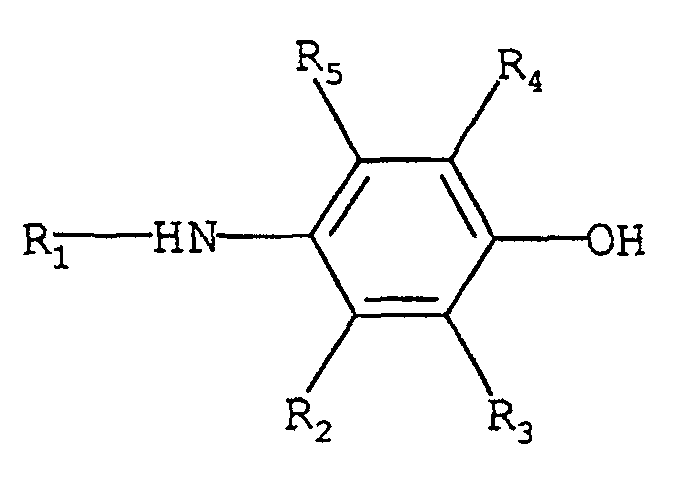
In accordance with the object of the invention, a para-hydroxyphenylamine according to Formula I.
wherein R1 is selected hydrogen, hydroxyl, alkyl, alkoxy, aryloxy, alkenyl, cycloalkyl, aryl, aralkyl, alkaryl, alkylamino, arylamino, heterocycle, acyl, aroyl, cyano, halogen, thiol, thioalkyl, thioaryl, amino, nitro, sulfonate, sulfone, sulfonamide, carboxylic acid, alkyl ester and, aryl ester, wherein the alkyl moieties in the R1 groups may be linear or branched and each of the R1 groups may be further substituted where appropriate; further wherein R2, R3, R4, and R5 are the same or different and are selected from hydrogen, hydroxyl, alkyl, alkoxy, aryloxy, alkenyl, cycloalkyl, aryl, aralkyl, alkaryl, alkylamino, arylamino, heterocycle, acyl, aroyl, cyano, halogen, thiol, thioalkyl, thioaryl, amino, nitro, sulfonate, sulfone, sulfonamide, carboxylic acid, alkyl ester and, aryl ester, wherein the alkyl moieties in the R2, R3, R4, and R5 groups may be linear or
branched and each of the R2, R3, R4, and R5 groups may be further substituted where appropriate, further wherein adjacent R2, R3, R4, and R5 groups may join to form a poly-cyclic ring system; is reacted with a hypochlorite oxidizing agent.
[0009] In a preferred embodiment R1, R2, R3, R4 and R5 are selected from isopropyl, sec-butyl, cyclohexyl, phenyl, tolyl, 1,4-dimethylpentyl, naphthyl, 1-ethyl-3-methylpentyl, 1-methylheptyl and hydrogen.
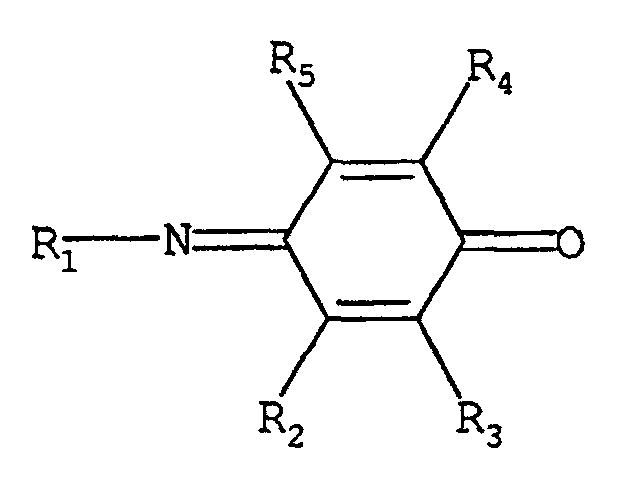
[0010] The reaction produces a corresponding para-quinoneimine according to Formula II
wherein R1, R2, R3, R4, and R5 are the same as in the compound according to Formula la or lb.
The reaction is represented as follows:
Reaction Scheme 1
[0011] More particularly, the R1 variables are selected from hydrogen, hydroxyl, C1-C50 alkyl, C1-C50 alkoxy, C6-C40 aryloxy, C2-C50 alkenyl, C3-C20 cycloalkyl, C6-C40 aryl, C7-C50 aralkyl, C7-C50 alkaryl, C1-C20 alkylamino, C6-C40 arylamino, C3-C30 heterocyclic containing one or more N, O, S, or P atoms, C1-C50 acyl, aroyl, cyano, halogen such as F, Br, I, or Cl, thiol, C1-C50 thioalkyl, C6-C40 thioaryl, amino, nitro, sulfonate having the formula SO3X wherein X is selected from sodium, C1-C50 alkyl, or C6-C40 aryl, sulfone, sulfonamide, carboxylic acid, C1-C50 alkyl ester and, C6-C40 aryl ester, wherein the alkyl moieties in the R1 groups may be linear or branched and each of the R1 groups may be further substituted where appropriate; further wherein R2, R3, R4, and R5 are the same or different and are selected from hydrogen, hydroxyl, C1-C50 alkyl, C1-C50 alkoxy, C6-C40 aryloxy, C2-C50 alkenyl, C3-C20 cycloalkyl, C6-C40 aryl, C7-C50 aralkyl, C7-C50 alkaryl, C1-C20 alkylamino, C6-C40 arylamino, C3-C30 heterocyclic containing one or more N, O, S, or P atoms, C1-C50 acyl, aroyl, cyano, halogen such as F, Br, I, or Cl, thiol, C1-C50 thioalkyl, C6-C40 thioaryl, amino, nitro, sulfonate having the formula SO3X wherein X is selected from sodium, C1-C50 alkyl, or C6-C40 aryl, sulfone, sulfonamide, carboxylic acid, C1-C50 alkyl ester and, C6-C40 aryl ester, wherein the alkyl moieties in the R2, R3, R4, and R5 groups may be linear or branched and each of the R2, R3, R4, and R5 groups may be further substituted where appropriate; further wherein the adjacent R2, R3, R4, and R5 groups may join to form poly-cyclic ring systems including aryl ring systems such as naphthyl, anthracyl, and heteroaryl ring systems containing one or more N, O, S, or P atoms.
Examples of satisfactory radicals for R1, R2, R3, R4, and R5 are linear or branched alkyls such as methyl, ethyl, propyl, butyl, pentyl, hexyl, heptyl, octyl, nonyl, decyl, dodecyl, aryls such as phenyl, naphthyl, anthracyl, tolyl, ethylphenyl, 1-ethyl-3-methylpentyl, 1-methylheptyl ; cycloalkyls such as cyclobutyl, cyclopentyl, cyclohexyl, cyclooctyl. Other examples include allyl and isobutenyl; 1,3,5-sym-triazinyl, 2-benzothiazolyl, 2-benzimidazolyl, 2-benzoxazolyl, 2-pyridyl, 2-pyrimidinyl, 2,5-thiadiazolyl, 2-pyrazinyl, adipyl, glutaryl, succinyl, malonyl, acetyl, acrylyl, methacrylyl, caproyl, 3-mercaptopropionyl, benzoyl, phthaloyl, terephthaloyl, aminocarbonyl, carbethoxy, carbonyl, formyl.
These are merely exemplary radicals and are in no way intended to limit the scope of the invention.
Hypochlorite agents include, but are not limited to, metal salts of hypochlorite, chlorate, perchlorate as well as organic hypochlorites such as t-butyl hypochlorite.
In reaction scheme 1, as set forth above, M is selected from various metals such as sodium (Na), potassium (K), and calcium(Ca), or various organic groups such as alkyl, aryl . The hypochlorite may be present in amounts ranging from 0.1 to 100 preferably 0.3 to 5 equivalents per equivalent of hydroxyphenylamine. Using less than one equivalent of hypochlorite per equivalent of para-hydroxyphenylamine allows one to produce blends of para-quinoneimine and unreacted hydroxyphenylamine. When using more than one equivalent of hypochlorite, it is acceptable to recycle the unreacted hypohlorite stream.
It is additionally contemplated that sodium hypochlorite can be made in situ by passing chlorine through sodium hydroxide solution. For example, one can have a reactant mixture of 4-hydroxyphenylamine and sodium hydroxide and then add chlorine gas to the reactor in known amounts and make sodium hypochlorite in situ. This would, in turn, react with 4-hydroxyphenylamine to give N-phenylquinoneimine.
the rate of the reaction can be increased by increasing the strength/concentration of the hypochlorite used.
[0012] The reaction, according to the present invention, may take place in a solvent system. Various polar and non-polar solvents may be used in the oxidation reaction including various hydrocarbon based solvents and water. Organic solvents useable in the process of the present invention include, but are not limited to, alcohols such as methanol, ethanol, propanol, isopropanol, methyl isobutyl carbinol, ethylene glycol; ketones such as acetone, cyclohexanone, 4-methyl-2-pentanone (methyl isobutyl ketone), 5-methyl-2-hexanone, methyl ethyl ketone; aliphatic and aromatic hydrocarbons as such as hexanes, heptanes, toluene, xylenes; nitriles such as acetronitrile; halogenated solvents such as chloroform, dichloromethane, carbon tetrachloride; water soluable solvents such as dimethyl sulphoxide, N-methyl-2-pyrrolidone, sulfolane, dimethylformamide; esters such as ethyl acetate; ethers such as 1,4-dioxan and mixtures thereof. Water may also be used in the solvent systems alone or as a mixture with the organic solvent. The initial hydroxyphenylamine concentration may range in amounts of from 1% to 100% w/v. Polar solvents may be used alone or in admixture with non-polar solvents to increase the rate of the reaction.
The present reaction may also take place in a neat system, without any solvent added. In a neat system, the hydroxyphenylamine starting material is mixed with the hypochlorite and the mixture is stirred until completion of the reaction. The use of the neat system avoids the handling and flammability hazards associated with the use of solvents, especially the flammability hazards present when a solvent is used in an oxidation reaction.
The present reaction may take place at temperatures from -200°C to 150°C, preferably from 0°C to 100°C, depending on the solvent.
[0013] With water immiscible solvents it is advantageous to utilize a phase transfer catalyst to accelerate the rate of reaction in the process of the present invention. Phase transfer catalysts useable in the present invention include, but are not limited to, quatemary ammonium salts, such as tetramethyl ammonium hydroxide, tetra alkyl ammonium halides, tetra-N-butyl ammonium bromide, tetra-N-butyl ammonium chloride, benzyltriethyl ammonium chloride; phosphonium salts such as bis[tris(dimethylamino)phosphine]iminium chloride; crown ethers and polyethylene glycols.
A phase transfer catalyst can be added directly to the reaction mixture or it can be dissolved in one of the reagents such as hypochlorite or 4-hydroxyphenylamine. The phase transfer catalyst may also be dissolved in a solvent used in the process or in water before addition to the reaction mass.
Another means by which the rate of recation may be increased is through increasing the stirring or mixing rate in the reaction. By increasing the stirring or mixing, the reaction rate may be effectively adjusted to proceed at a faster pace when necessary.
Agents such as sodium sulfite or other neutralizing agents can be added before the workup of the reaction mixture to neutralize any excess of hypochlorite if present in the mixture.
The present invention can be more clearly illustrated by the following examples.
Example 1
[0014] A solution of 4-hydroxydiphenylamine (2.0 g, 0.011 moles) and acetonitrile (35 mL) was stirred at room temperature. Sodium hypochlorite was then added to this solution(5.8g, conc. = approx 13%). The mixture was stirred at room temperature for 0.5 hr and then analyzed by HPLC for the consumption of starting material. HPLC area % analysis indicated the formation of the corresponding N-phenyl-p-benzoquinone-imine (NPQI) at 87.5 % and 4-hydroxydiphenylamine to be 12.1%. Then an additional amount of sodium hypochlorite (0.9g, conc. = 13%) was added and the reaction mixture was stirred for another 0.5 hrs and then analyzed by HPLC (area % Product, NPQI = 98.9% and 4-hydroxydiphenylamine = 0.78%).
[0015] A variety of isolation techniques can be used to isolate the product. The technique used in the present example consisted of addition of 10 mL of water (the amount can be adjusted so that the salts will stay in solution and the product can be filtered effectively) and concentration of the reaction mass to remove acetonitrile. The resulting slurry was then filtered to give solids and the solids were washed with water. The solids were isolated in almost quantitative yield and identified as N-Phenyl-p-benzoquinone-imine. If excess sodium hypochlorite is employed in the reaction, it can be neutralized by the addition of an appropriate amount of sodium sulfite at the end of reaction. Other isolation techniques can also be used.
Example 2
[0016] A solution of 4-hydroxydiphenylamine (5.0 g, 0.027 moles) and toluene (100 mL) was stirred at room temperature. Sodium hypochlorite was then added to this solution (17g, conc. = approx 13%) in about 20 minutes using a pump. The mixture was stirred at room temperature for 0.5 hr and then analyzed by HPLC for the consumption of starting material. HPLC area % analysis indicated the formation of the corresponding N-phenyl-p-benzoquinone-imine (NPQI) at 99.4 % and 4-hydroxydiphenylamine to be 0.25 %.
A variety of isolation techniques can be used to isolate the product. The technique used in the present example consisted of addition of 20 mL of water (the amount can be adjusted so that the salts will stay in solution and the product can be filtered effectively) and concentration of the reaction mass to remove toluene followed by filtration leading to solids. The solids were washed with water and isolated in almost quantitative yields and identified as N-Phenyl-p-benzoquinone-imine. If excess sodium hypochlorite is employed in the reaction, it can be neutralized by the addition of an appropriate amount of sodium sulfite at the end of reaction. Other isolation techniques can also be used.
Example 3
[0017] A solution of 4-hydroxydiphenylamine (2.0 g, 0.011 moles) and chloroform (35 mL) was stirred at room temperature. Sodium hypochlorite was then added to this solution (8.2g, conc. = approx 11%). The mixture was stirred at room temperature for 0.5 hr and then analyzed by HPLC for the consumption of starting material.
[0018] HPLC area % analysis indicated the formation of the corresponding N-phenyl-p-benzoquinone-imine (NPQI) at 95.6 %. After stirring for an additional 0.5 hrs the mixture was analyzed by HPLC again. HPLC area % analysis indicated the formation of the corresponding N-phenyl-p-benzoquinone-imine (NPQI) at 100 %. A variety of isolation techniques can be used to isolate the product as mentioned previously.
Example 4
[0019] A mixture of 4-Hydroxydiphenylamine (3.0g, 0.0162 moles), acetonitrile (125 mL), sodium hydroxide (3.5g 50% NaOH solution) and water (10 g) was stirred using a mechanical stirrer at room temperature. Chlorine was passed through this mixture in a controlled fashion and in controlled amounts. After stirring for 0.5 hr, the mixture was analyzed by HPLC. HPLC area % analysis indicated the formation of the corresponding N-phenyl-p-benzoquinone-imine (NPQI) at 85 % and 4-hydroxydiphenylamine to be 10.1 %. By passing an additional amount of chlorine through the mixture, the rest of the 4-hydroxydiphenylamine can be converted to the corresponding N-phenyl-p-benzoquinone-imine. As mentioned previously, a variety of isolation techniques can be used to isolate the product. In the case of a process using sodium hypochlorite, a product can be made consisting of various combinations of hydroxyphenylamines and quinone-imines.
[0020] As per this process one can make a mixture containing as little as , for example, 1% NPQI to 100% NPQI and 99% to 1% 4-Hydroxydiphenylamine simply by adjusting the charge of hypochlorite or chlorine. This process allows for the design of a desired composition just by controlling the amounts of reactants. The following example illustrates this point clearly:
Example 5
[0021] A solution of 4-hydroxydiphenylamine (2.0 g, 0.011 moles) and acetonitrile (40 mL) was stirred at room temperature. Sodium hypochlorite was then added to this solution in small increments and the mixture was analyzed by HPLC after 0.5 hrs at room temperature for the consumption of starting material. The procedure was repeated until almost all of the 4-hydroxydiphenylamine was converted to the corresponding NPQI. Analysis indicated consumption of 4-hydroxydiphenylamine and the formation of the corresponding quinone-imine in high selectivity. The results of HPLC area % analysis are summarized in the following table :
| Sample # | Area % 4- Hydroxydiphenylamine | Area % NPQI |
| 1 | 56.5 | 42.7 |
| 2 | 40.8 | 58.9 |
| 3 | 31.4 | 67.6 |
| 4 | 21.2 | 76.4 |
| 5 | 10.9 | 86.1 |
| 6 | 0.41 | 99.34 |
[0022] Again, as set forth in the preceding examples, a variety of isolation techniques can be used to isolate the product. The technique used in the present example consisted of addition of 10 mL of water (the amount can be adjusted so that the salts will stay in solution and the product can be filtered effectively) and concentration of the reaction mass to remove acetonitrile. The resulting slurry was then filtered to give solids and the solids were washed with water. The solids were isolated in almost quantitative yield and identified as N-Phenyl-p-benzoquinone-imine. If excess sodium hypochlorite is employed in the reaction, it can be neutralized by the addition of an appropriate amount of sodium sulfite at the end of reaction. Other isolation techniques can also be used.
As demonstrated in the examples provided above, the reaction has been shown to be carried out in miscible solvents such as acetonitrile or toluene. The reaction is very clean and the quinoneimine end product can be obtained in very high yields with high selectivity. Various methods for increasing reaction rates include increasing stirring, addition of polar solvents to the reaction, and addition of phase transfer catalysts to the reaction.
Example 6
[0023] A solution of 4-hydroxydiphenylamine (2.0 g, 0.011 moles) and heptane (35 mL) was stirred at room temperature. Sodium hypochlorite (8.0 g, conc. = approx 11%) was added to this solution. The mixture was stirred at room temperature for 1 hr and then analyzed by HPLC for the consumption of starting material. HPLC area % analysis indicated the formation of the corresponding N-Phenyl-p-benzoquinone-imine (NPQI) at greater than 99 %.
A variety of isolation techniques can be used to isolate the product. The technique used in the present example consisted of addition of 10 mL of water (amount can be adjusted so that the salts will stay in solution and the product can be filtered effectively) to the reaction mixture followed by filtration of the resulting slurry to give solids which were washed with water. HPLC area % analysis of the solids was found to be greater than 99% of the corresponding N-Phenyl-p-benzoquinone-imine (NPQI). The filtrate which resulted in two layers, heptane and an aqueous layer, can be separated and the heptane layer can be recycled back. Other conventional isolation techniques can also be used.
Quinoneimines exhibit multiple activities in vulcanized elastomers. Such activities include long term antioxidant activity. In fact, the antioxidant capacity of the quinoneimine antidegradants persists even after the vulcanizate has been extracted with solvents. In addition, quinoneimines provide the beneficial antioxidant activity without the negative effect on scorch generally associated with other antidegradants common to the industry. Quinoneimines have also been used to modify dynamic-mechanical properties of a vulcanizate. Further, the quinoneimines, and their derivatives, can be used in the preparation of other organic compounds.
1. A highly selective process for preparing a para-quinoneimine by reacting the corresponding
para-hydroxyphenylamine with a hypochlorite oxidizing agent wherein the hydroxyphenylamine
is of the following Formula I:
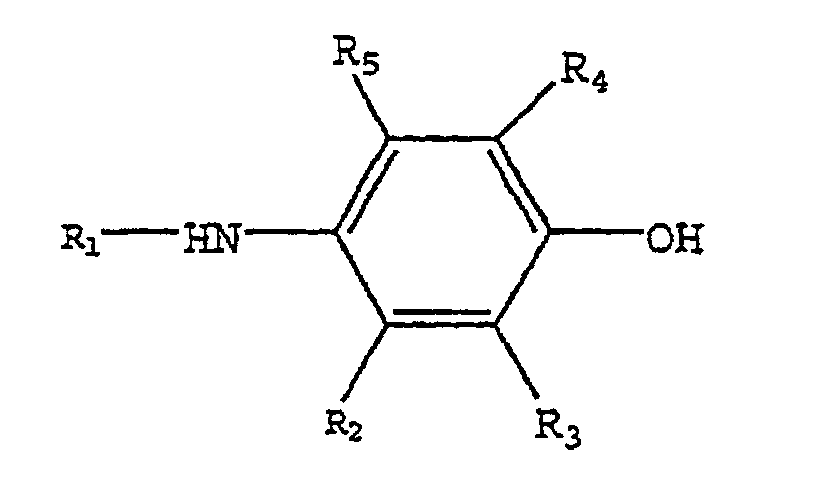
wherein R1 is hydrogen, hydroxyf, alkyl, alkoxy, aryloxy, alkenyl, cycloalkyl, aryl, aralkyl, alkaryl, alkylamino, arylamino, heterocycle, acyl, aroyl, cyano, halogen, thiol, thioalkyl, thioaryl, amino, nitro, sulfonate, sulfone, sulfonamide, carboxylic acid, alkyl ester, and aryl ester, wherein the alkyl moieties in the R1 groups may be linear or branched and each of the R1 groups may be further substituted; further wherein R2, R3, R4, and R5 are the same or different and are selected from hydrogen, hydroxyl, alkyl, alkoxy, aryloxy, alkenyl, cycloalkyl, aryl, aralkyl, alkaryl, alkylamino, arylamino, heterocycle, acyl, aroyl, cyano, halogen, thiol, thioalkyl, thioaryl, amino, nitro, sulfonate, sulfone, sulfonamide, carboxylic acid, alkyl ester, and aryl ester, wherein the alkyl moieties in the R2, R3, R4, and R5 groups may be linear or branched and each of the R2, R3, R4, and R5 groups may be further substituted, wherein adjacent R2, R3, R4, and R5 groups may join to form a polycyclic ring system, and wherein the resulting corresponding para-quinoneimine is of the following Formula II:
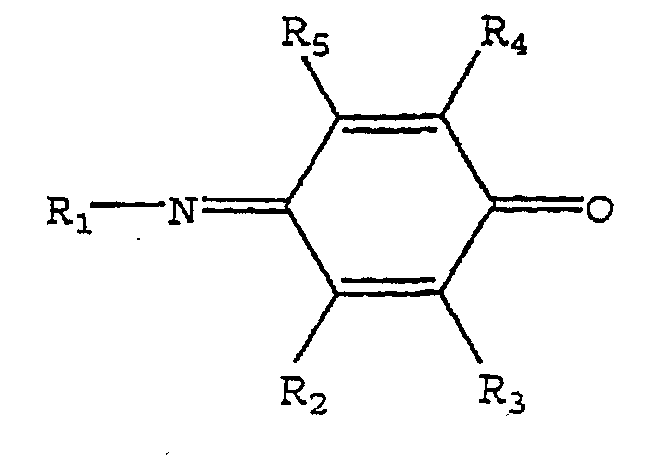
wherein R1, R2, R3, R4, and R5 are the same as in the compound of Formula I.
wherein R1 is hydrogen, hydroxyf, alkyl, alkoxy, aryloxy, alkenyl, cycloalkyl, aryl, aralkyl, alkaryl, alkylamino, arylamino, heterocycle, acyl, aroyl, cyano, halogen, thiol, thioalkyl, thioaryl, amino, nitro, sulfonate, sulfone, sulfonamide, carboxylic acid, alkyl ester, and aryl ester, wherein the alkyl moieties in the R1 groups may be linear or branched and each of the R1 groups may be further substituted; further wherein R2, R3, R4, and R5 are the same or different and are selected from hydrogen, hydroxyl, alkyl, alkoxy, aryloxy, alkenyl, cycloalkyl, aryl, aralkyl, alkaryl, alkylamino, arylamino, heterocycle, acyl, aroyl, cyano, halogen, thiol, thioalkyl, thioaryl, amino, nitro, sulfonate, sulfone, sulfonamide, carboxylic acid, alkyl ester, and aryl ester, wherein the alkyl moieties in the R2, R3, R4, and R5 groups may be linear or branched and each of the R2, R3, R4, and R5 groups may be further substituted, wherein adjacent R2, R3, R4, and R5 groups may join to form a polycyclic ring system, and wherein the resulting corresponding para-quinoneimine is of the following Formula II:
wherein R1, R2, R3, R4, and R5 are the same as in the compound of Formula I.
2. The process of claim 1 wherein the hypochlorite is of the formula M+OCl- wherein M is selected from a metal or an organic group.
3. The process of claim 2 wherein the hypochlorite is sodium hypochlorite (NaOCI).
4. The process of claim 1 wherein R1 = phenyl, naphthyl or anthracyl.
5. The process of claim 1 wherein R1 = phenyl, R2 = hydrogen, R3 = hydrogen, R4 = hydrogen and, R5 = hydrogen.
6. The process of claim 1 wherein R1, R2, R3, R4, and R5 are selected from isopropyl, sec-butyl, cyclohexyl, phenyl, tolyl, 1,4-dimethylpentyl,
naphthyl, 1-ethyl-3-methylpentyl, 1-methylheptyl, and hydrogen.
7. The process of claim 1 wherein the reaction takes place in the presence of a solvent.
8. The process of claim 7 wherein the solvent is selected from ketones, alcohols, nitriles,
aliphatic and/or aromatic alkanes, aliphatic and/or aromatic alkenes, hydrocarbon
solvents, water, and mixtures thereof.
9. The process of claim 7 wherein the solvent is selected from water, t-butyl alcohol,
hexanes, acetonitrile, xylenes, heptanes, toluene, methanol, acetone, methyl isobutyl
carbinol, chloroform, and methyl isobutyl ketone; each alone or in admixture.
10. The process of claim 7 wherein the solvent comprises a polar solvent and a non-polar
solvent, further wherein the polar solvent increases the rate of reaction of the process.
11. The process of claim 1 wherein the reaction takes place in a neat system.
12. The process of claim 1 further comprising addition of a polar solvent in an amount
which increases the rate of the reaction.
13. The process of claim 1 further comprising adding a phase transfer catalyst to the
reaction to increase the reaction rate.
14. The process of claim 13 wherein the phase transfer catalyst is selected from quaternary
ammonium salts, phosphonium salts, crown ethers, and polyethylene glycols.
15. The process of claim 13 wherein the phase transfer catalyst is tetra-N-butyl ammonium
bromide.
16. The process of claim 1 wherein the reactants are mixed or stirred together, further
wherein the reaction rate may be increased by increasing the mixing or stirring rate.
17. The process of claim 1 wherein the rate of reaction can be increased by increasing
the strength/concentration of the hypochlorite used.
18. A product prepared by the processs of claim 1 wherein the product comprises greater
than 90% quinoneimine.
19. The process of claim 1 wherein the hypochlorite is made in situ by mixing an alkali metal hydroxide with the para-hydroxyphenylamine to form an initial
reaction mixture and subsequestly passing chlorine through the initial reaction mixture.
20. The process of claim 1 wherein the reaction takes place by combining at least one
compound of Formula I with sodium hypochlorite in the presence of a solvent system
further wherein the reaction takes place at a temperature of from -200°C to 150°C.
21. The process according to claim 20 wherein water is further present in the solvent
system.
22. The process according to claim 20 wherein the solvent system comprises a polar solvent
and a non-polar solvent, further wherein the polar solvent increases the rate of reaction
of the process.
23. The processs of claim 20 wherein the sodium hypochlorite is present in an amount of
from 0.1 to 100 equivalents hypochlorite per equivalent of para-hydroxyphenylamine.
24. The process of claim 23 wherein the sodium hypochlorite is present in an amount of
from 0.3 to 5 equivalents hypochlorite per equivalent of para-hydroxyphenylamine.
25. The process of claim 20 wherein the solvent is selected from water, ketones, alcohols,
nitriles, aliphatic and/or aromatic alkanes, aliphatic and/or aromatic alkenes, hydrocarbon
solvents and mixtures thereof.
26. The process of claim 20 wherein R1 = phenyl, R2 = hydrogen, R3 = hydrogen, R4 = hydrogen and, R5 = hydrogen.
27. The process of claim, 20 wherein R1, R2, R3, R4, and R5 are selected from isopropyl, sec-butyl, cyclohexyl, phenyl, tolyl, 1,4-dimethylpentyl,
naphthyl, 1-ethyl-3-methylpentyl, 1-methylheptyl, and hydrogen.
28. The process of claim 20 wherein the hydroxyphenylamine component is comprised of a
mixture of two or more hydroxyphenylamines of formula I.
1. Hochselektives Verfahren zur Herstellung eines para-Chinonimins durch Umsetzen des
entsprechenden para-Hydroxyphenylamins mit einem Hypochlorit-Oxidationsmittel, wobei
das Hydroxyphenylamin die folgende Formel I hat:
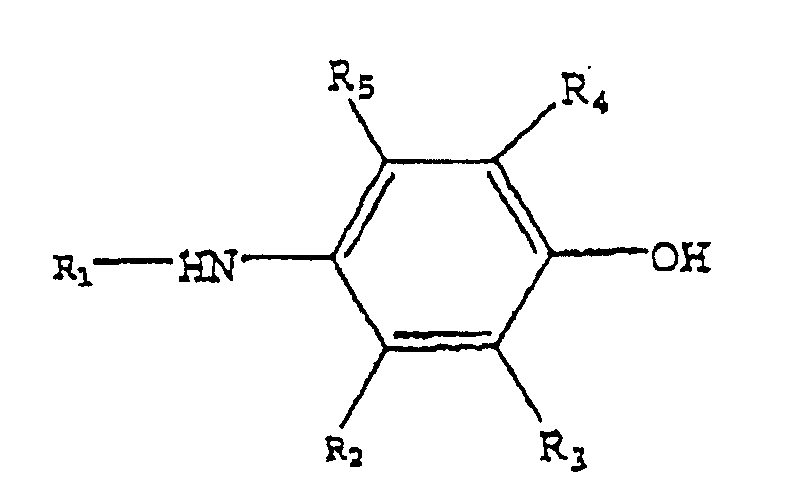
wobei R1 Wasserstoff, Hydroxy, Alkyl, Alkoxy, Aryloxy, Alkenyl, Cycloalkyl, Aryl, Aralkyl, Alkaryl, Alkylamino, Arylamino, Heterocyclyl, Acyl, Aroyl, Cyan, Halogen, Thiol, Thioalkyl, Thioaryl, Amino, Nitro, Sulfonat, Sulfon, Sulfonamid, Carbonsäure, Alkylester oder Arylester ist, wobei die Alkyl-Struktureinheiten in den R1-Gruppen linear oder verzweigt sein können und jede der R1-Gruppen weiterhin substituiert sein kann; wobei weiterhin R2, R3, R4 und R5 gleich oder verschieden sind und aus Wasserstoff, Hydroxy, Alkyl, Alkoxy, Aryloxy, Alkenyl, Cycloalkyl, Aryl, Aralkyl, Alkaryl, Alkylamino, Arylamino, Heterocyclyl, Acyl, Aroyl, Cyan, Halogen, Thiol, Thioalkyl, Thioaryl, Amino, Nitro, Sulfonat, Sulfon, Sulfonamid, Carbonsäure, Alkylester und Arylester ausgewählt sind, wobei die Alkyl-Struktureinheiten in den R2-, R3-, R4- und R5-Gruppen linear oder verzweigt sein können und jede der R2-, R3-, R4- und R5-Gruppen weiterhin substituiert sein kann, wobei benachbarte R2-, R3-, R4- und R5-Gruppen unter Bildung eines polycyclischen Ringsystems zusammentreten können, wobei das resultierende entsprechende para-Chinonimin die folgende Formel II hat:
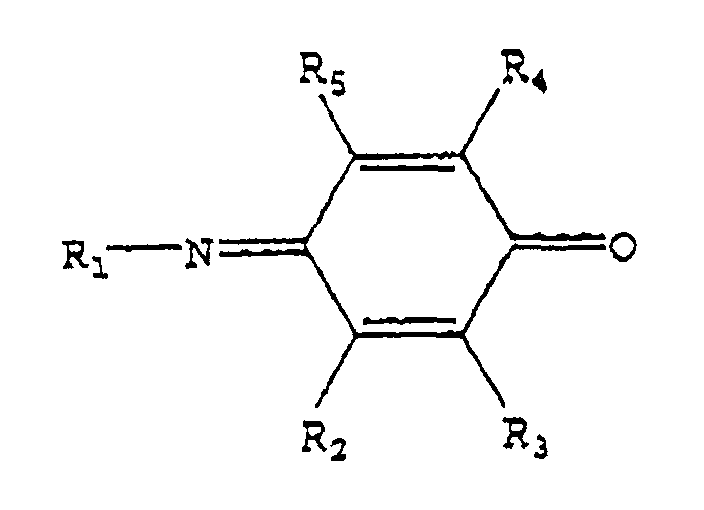
wobei R1, R2, R3, R4 und R5 dieselben sind wie in der Verbindung der Formel I.
wobei R1 Wasserstoff, Hydroxy, Alkyl, Alkoxy, Aryloxy, Alkenyl, Cycloalkyl, Aryl, Aralkyl, Alkaryl, Alkylamino, Arylamino, Heterocyclyl, Acyl, Aroyl, Cyan, Halogen, Thiol, Thioalkyl, Thioaryl, Amino, Nitro, Sulfonat, Sulfon, Sulfonamid, Carbonsäure, Alkylester oder Arylester ist, wobei die Alkyl-Struktureinheiten in den R1-Gruppen linear oder verzweigt sein können und jede der R1-Gruppen weiterhin substituiert sein kann; wobei weiterhin R2, R3, R4 und R5 gleich oder verschieden sind und aus Wasserstoff, Hydroxy, Alkyl, Alkoxy, Aryloxy, Alkenyl, Cycloalkyl, Aryl, Aralkyl, Alkaryl, Alkylamino, Arylamino, Heterocyclyl, Acyl, Aroyl, Cyan, Halogen, Thiol, Thioalkyl, Thioaryl, Amino, Nitro, Sulfonat, Sulfon, Sulfonamid, Carbonsäure, Alkylester und Arylester ausgewählt sind, wobei die Alkyl-Struktureinheiten in den R2-, R3-, R4- und R5-Gruppen linear oder verzweigt sein können und jede der R2-, R3-, R4- und R5-Gruppen weiterhin substituiert sein kann, wobei benachbarte R2-, R3-, R4- und R5-Gruppen unter Bildung eines polycyclischen Ringsystems zusammentreten können, wobei das resultierende entsprechende para-Chinonimin die folgende Formel II hat:
wobei R1, R2, R3, R4 und R5 dieselben sind wie in der Verbindung der Formel I.
2. Verfahren gemäß Anspruch 1, wobei das Hypochlorit die Formel M+OCl- hat, wobei M aus einem Metall oder einer organischen Gruppe ausgewählt ist.
3. Verfahren gemäß Anspruch 2, wobei es sich bei dem Hypochlorit um Natriumhypochlorit
(NaOCl) handelt.
4. Verfahren gemäß Anspruch 1, wobei R1 = Phenyl, Naphthyl oder Anthracyl.
5. Verfahren gemäß Anspruch 1, wobei R1 = Phenyl, R2 = Wasserstoff, R3 = Wasserstoff, R4 = Wasserstoff und R5 = Wasserstoff.
6. Verfahren gemäß Anspruch 1, wobei R1, R2, R3, R4 und R5 aus Isopropyl, sec-Butyl, Cyclohexyl, Phenyl, Tolyl, 1,4-Dimethylpentyl, Naphthyl,
1-Ethyl-3-methylpentyl, 1-Methylheptyl und Wasserstoff ausgewählt sind.
7. Verfahren gemäß Anspruch 1, wobei die Reaktion in Gegenwart eines Lösungsmittels stattfindet.
8. Verfahren gemäß Anspruch 7, wobei das Lösungsmittel aus Ketonen, Alkoholen, Nitrilen,
aliphatischen und/oder aromatischen Alkanen, aliphatischen und/oder aromatischen Alkenen,
Kohlenwasserstoff-Lösungsmitteln, Wasser und Gemischen davon ausgewählt ist.
9. Verfahren gemäß Anspruch 7, wobei das Lösungsmittel aus Wasser, t-Butylalkohol, Hexanen,
Acetonitril, Xylolen, Heptanen, Toluol, Methanol, Aceton, Methylisobutylcarbinol,
Chloroform und Methylisobutylketon jeweils allein oder im Gemisch ausgewählt ist.
10. Verfahren gemäß Anspruch 7, wobei das Lösungsmittel ein polares Lösungsmittel und
ein unpolares Lösungsmittel umfasst, wobei weiterhin das polare Lösungsmittel die
Reaktionsgeschwindigkeit des Verfahrens erhöht.
11. Verfahren gemäß Anspruch 1, wobei die Reaktion in einem lösungsmittelfreien System
stattfindet.
12. Verfahren gemäß Anspruch 1, das weiterhin die Zugabe eines polaren Lösungsmittels
in einer Menge, die die Reaktionsgeschwindigkeit erhöht, umfasst.
13. Verfahren gemäß Anspruch 1, das weiterhin die Zugabe eines Phasentransferkatalysators
zu der Reaktion umfasst, so dass die Reaktionsgeschwindigkeit erhöht wird.
14. Verfahren gemäß Anspruch 13, wobei der Phasentransferkatalysator aus quartären Ammoniumsalzen,
Phosphoniumsalzen, Kronenethern und Polyethylenglycolen ausgewählt ist.
15. Verfahren gemäß Anspruch 13, wobei es sich bei dem Phasentransferkatalysator um Tetra-N-butylammoniumbromid
handelt.
16. Verfahren gemäß Anspruch 1, wobei die Reaktanten miteinander gemischt oder gerührt
werden und wobei weiterhin die Reaktionsgeschwindigkeit durch Erhöhung der Misch-
oder Rührgeschwindigkeit erhöht werden kann.
17. Verfahren gemäß Anspruch 1, wobei die Reaktionsgeschwindigkeit durch Erhöhung der
Stärke/Konzentration des verwendeten Hypochlorits erhöht werden kann.
18. Produkt, das nach dem Verfahren von Anspruch 1 hergestellt ist, wobei das Produkt
mehr als 90% Chinonimin umfasst.
19. Verfahren gemäß Anspruch 1, wobei das Hypochlorit in situ hergestellt wird, indem
man ein Alkalimetallhydroxid unter Bildung eines Anfangsreaktionsgemischs mit dem
para-Hydroxyphenylamin mischt und anschließend Chlor durch das Anfangsreaktionsgemisch
leitet.
20. Verfahren gemäß Anspruch 1, wobei die Reaktion stattfindet, indem man wenigstens eine
Verbindung der Formel I in Gegenwart eines Lösungsmittelsystems mit Natriumhypochlorit
kombiniert, wobei die Reaktion weiterhin bei einer Temperatur von -200 °C bis 150
°C stattfindet.
21. Verfahren gemäß Anspruch 20, wobei weiterhin Wasser in dem Lösungsmittelsystem vorhanden
ist.
22. Verfahren gemäß Anspruch 20, wobei das Lösungsmittelsystem ein polares Lösungsmittel
und ein unpolares Lösungsmittel umfasst, wobei weiterhin das polare Lösungsmittel
die Reaktionsgeschwindigkeit des Verfahrens erhöht.
23. Verfahren gemäß Anspruch 20, wobei das Natriumhypochlorit in einer Menge von 0,1 bis
100 Äquivalenten Hypochlorit pro Äquivalent para-Hydroxyphenylamin vorhanden ist.
24. Verfahren gemäß Anspruch 23, wobei das Natriumhypochlorit in einer Menge von 0,3 bis
5 Äquivalenten Hypochlorit pro Äquivalent para-Hydroxyphenylamin vorhanden ist.
25. Verfahren gemäß Anspruch 20, wobei das Lösungsmittel aus Wasser, Ketonen, Alkoholen,
Nitrilen, aliphatischen und/oder aromatischen Alkanen, aliphatischen und/oder aromatischen
Alkenen, Kohlenwasserstoff-Lösungsmitteln und Gemischen davon ausgewählt ist.
26. Verfahren gemäß Anspruch 20, wobei R1 = Phenyl, R2 = Wasserstoff, R3 = Wasserstoff, R4 = Wasserstoff und R5 = Wasserstoff.
27. Verfahren gemäß Anspruch 20, wobei R1, R2, R3, R4 und R5 aus Isopropyl, sec-Butyl, Cyclohexyl, Phenyl, Tolyl, 1,4-Dimethylpentyl, Naphthyl,
1-Ethyl-3-methylpentyl, 1-Methylheptyl und Wasserstoff ausgewählt sind.
28. Verfahren gemäß Anspruch 20, wobei die para-Hydroxyphenylamin-Komponente aus einem
Gemisch von zwei oder mehr para-Hydroxyphenylaminen der Formel I besteht.
1. Procédé très sélectif de préparation d'un para-quinoneimine consistant à faire réagir
la para-hydroxyphénylamine correspondante avec un hypochlorite à titre d' agent d'oxydation,
dans lequel l'hydroxyphénylamine répond à la Formule I suivante :
dans laquelle R1 est hydrogène, hydroxyle, alkyle, alcoxy, aryloxy, alcényle, cycloalkyle, aryle, aralkyle, alkaryle, alkylamino, arylamino, hétérocycle, acyle, aroyle, cyano, halogène, thiol, thioalkyle, thioaryle, amino, nitro, sulfonate, sulfone, sulfonamide, acide carboxylique, ester d'alkyle, et ester d'aryle, les fragments alkyle dans les groupes R1 pouvant être linéaires ou ramifiés et chacun des groupes R1 pouvant, en outre, être substitué ; dans laquelle, en outre, R2, R3, R4 et R5 sont identiques ou différents et sont choisis parmi hydrogène, hydroxyle, alkyle, alcoxy, aryloxy, alcényle, cycloalkyle,- aryle, aralkyle, alkaryle, alkylamino, arylamino, hétérocycle, acyle, aroyle, cyano, halogène, thiol, thioalkyle, thioaryle, amino, nitro, sulfonate, sulfone, sulfonamide, acide carboxylique, ester d'alkyle, et ester d'aryle, les fragments alkyle dans les groupes R2, R3, R4 et R5 pouvant être linéaires ou ramifiés et chacun des groupes R2, R3, R4 et R5 pouvant, en outre, être substitué, dans laquelle les groupes R2, R3, R4 et R5 adjacents peuvent être joints pour former un système de cycle polycyclique, et dans laquelle le para-quinoneimine correspondant obtenu répond à la Formule II suivante :
dans laquelle R1, R2, R3, R4 et R5 sont les mêmes que dans le composé de Formule I.
dans laquelle R1 est hydrogène, hydroxyle, alkyle, alcoxy, aryloxy, alcényle, cycloalkyle, aryle, aralkyle, alkaryle, alkylamino, arylamino, hétérocycle, acyle, aroyle, cyano, halogène, thiol, thioalkyle, thioaryle, amino, nitro, sulfonate, sulfone, sulfonamide, acide carboxylique, ester d'alkyle, et ester d'aryle, les fragments alkyle dans les groupes R1 pouvant être linéaires ou ramifiés et chacun des groupes R1 pouvant, en outre, être substitué ; dans laquelle, en outre, R2, R3, R4 et R5 sont identiques ou différents et sont choisis parmi hydrogène, hydroxyle, alkyle, alcoxy, aryloxy, alcényle, cycloalkyle,- aryle, aralkyle, alkaryle, alkylamino, arylamino, hétérocycle, acyle, aroyle, cyano, halogène, thiol, thioalkyle, thioaryle, amino, nitro, sulfonate, sulfone, sulfonamide, acide carboxylique, ester d'alkyle, et ester d'aryle, les fragments alkyle dans les groupes R2, R3, R4 et R5 pouvant être linéaires ou ramifiés et chacun des groupes R2, R3, R4 et R5 pouvant, en outre, être substitué, dans laquelle les groupes R2, R3, R4 et R5 adjacents peuvent être joints pour former un système de cycle polycyclique, et dans laquelle le para-quinoneimine correspondant obtenu répond à la Formule II suivante :
dans laquelle R1, R2, R3, R4 et R5 sont les mêmes que dans le composé de Formule I.
2. Procédé selon la revendication 1, dans lequel l'hypochlorite répond à la formule M+OCl-, M étant choisi parmi un métal ou un groupe organique.
3. Procédé selon la revendication 2, dans lequel l'hypochlorite est l'hypochlorite de
sodium (NaOCl).
4. Procédé selon la revendication 1, dans lequel R1=phényle, naphtyle ou anthracyle.
5. Procédé selon la revendication 1, dans lequel R1=phényle, R2=hydrogène, R3=hydrogène, R4=hydrogène et R5=hydrogène.
6. Procédé selon la revendication 1, dans lequel R1, R2, R3, R4 et R5 sont choisis parmi isopropyle, sec-butyle, cyclohexyle, phényle, tolyle, 1,4-diméthylpentyle,
naphtyle, 1-éthyl-3-méthylpentyle, 1-méthylheptyle, et hydrogène.
7. Procédé selon la revendication 1, dans lequel la réaction est mise en oeuvre en présence
d'un solvant.
8. Procédé selon la revendication 7, dans lequel le solvant est choisi parmi les cétones,
les alcools, les nitriles, les alcanes aliphatiques et/ou aromatiques, les alcènes
aliphatiques et/ou aromatiques, les solvants de type hydrocarbures, l'eau, et leurs
mélanges.
9. Procédé selon la revendication 7, dans lequel le solvant est choisi parmi l'eau, l'alcool
t-butylique, les hexanes, l'acétonitrile, les xylènes, les heptanes, le toluène, le
méthanol, l'acétone, le méthylisobutylcarbinol, le chloroforme, et la méthylisobutylcétone
; chacun seul ou en mélange.
10. Procédé selon la revendication 7, dans lequel le solvant comprend un solvant polaire
et un solvant non polaire, dans lequel, en outre, le solvant polaire augmente la vitesse
de réaction du procédé.
11. Procédé selon la revendication 1, dans lequel la réaction est mise en oeuvre dans
un système chauffé.
12. Procédé selon la revendication 1 comprenant, en outre, l'étape consistant à ajouter
un solvant polaire en une quantité qui augmente la vitesse de réaction.
13. Procédé selon la revendication 1 comprenant, en outre, l'étape consistant à ajouter
un catalyseur de transfert de phase à la réaction pour augmenter la vitesse de réaction.
14. Procédé selon la revendication 13, dans lequel le catalyseur de transfert de phase
est choisi parmi les sels d'ammonium quaternaires, les sels de phosphonium, les éthers-couronnes,
et les polyéthylène glycols.
15. Procédé selon la revendication 13, dans lequel le catalyseur de transfert de phase
est le bromure de tétra-N-butyl-ammonium.
16. Procédé selon la revendication 1, dans lequel les réactifs sont mélangés ou agités
ensemble, dans lequel, en outre, la vitesse de réaction peut être augmentée en augmentant
la vitesse de mélange ou d'agitation.
17. Procédé selon la revendication 1, dans lequel la vitesse de réaction peut être augmentée
en augmentant la force/concentration de l'hypochlorite utilisé.
18. Produit préparé selon le procédé de la revendication 1, dans lequel le produit comprend
plus de 90% de quinoneimine.
19. Procédé selon la revendication 1, dans lequel l'hypochlorite est préparé in situ en mélangeant un hydroxyde de métal alcalin avec la para-hydroxyphénylamine de manière
à former un mélange réactionnel initial et en faisant passer ensuite du chlore dans
le mélange réactionnel initial.
20. Procédé selon la revendication 1, dans lequel la réaction est mise en oeuvre en combinant
au moins un composé de Formule I avec de l'hypochlorite de sodium en présence d'un
système de solvant, la réaction étant, en outre, mise en oeuvre à une température
de -200 à 150°C.
21. Procédé selon la revendication 20, dans lequel de l'eau est, en outre, présente dans
le système de solvant.
22. Procédé selon la revendication 20, dans lequel le système de solvant comprend un solvant
polaire et un solvant non polaire, dans lequel, en outre, le solvant polaire augmente
la vitesse de réaction du procédé.
23. Procédé selon la revendication 20, dans lequel l'hypochlorite de sodium est présent
en une quantité de 0,1 à 100 équivalents d'hypochlorite par équivalent de para-hydroxyphénylamine.
24. Procédé selon la revendication 23, dans lequel l'hypochlorite de sodium est présent
en une quantité de 0,3 à 5 équivalents d'hypochlorite par équivalent de para-hydroxyphénylamine.
25. Procédé selon la revendication 20, dans lequel le solvant est choisi parmi l'eau,
les cétones, les alcools, les nitriles, les alcanes aliphatiques et/ou aromatiques,
les alcènes aliphatiques et/ou aromatiques, les solvants de type hydrocarbures, et
leurs mélanges.
26. Procédé selon la revendication 20, dans lequel R1=phényle, R2=hydrogène, R3=hydrogène, R4=hydrogène et R5=hydrogène.
27. Procédé selon la revendication 20, dans lequel R1, R2, R3, R4 et R5 sont choisis parmi isopropyle, sec-butyle, cyclohexyle, phényle, tolyle, 1,4-diméthylpentyle,
naphtyle, 1-éthyl-3-méthylpentyle, 1-méthylheptyle, et hydrogène.
28. Procédé selon la revendication 20, dans lequel le composant hydroxyphénylamine comprend
un mélange de deux hydroxyphénylamines de Formule I ou plus.