|
(11) | EP 1 072 600 B1 |

| (12) | EUROPEAN PATENT SPECIFICATION |
|
|
| (54) |
Process for the preparation of Epoxides Verfahren zur Herstellung von Olefinoxiden Procédé pour la préparation d'oxydes d'oléfine |
|
|
|||||||||||||||||||||||||||||||
| Note: Within nine months from the publication of the mention of the grant of the European patent, any person may give notice to the European Patent Office of opposition to the European patent granted. Notice of opposition shall be filed in a written reasoned statement. It shall not be deemed to have been filed until the opposition fee has been paid. (Art. 99(1) European Patent Convention). |
[0002] More specifically, the present invention relates to a continuous process for the preparation of propylene oxide by direct epoxidation of propylene with hydrogen peroxide, or compounds capable of producing hydrogen peroxide under the reaction conditions, in a solvent medium, in the presence of a catalytic system consisting of a zeolite containing titanium and a buffer system with a pH controlled within values of 5.5 to 8.0, consisting of a nitrogenated base and a salt thereof with an organic or inorganic acid.
[0003] Epoxides, or olefin oxides, are intermediates useful for the preparation of a wide variety of compounds. For example epoxides can be used for the production of glycols, condensation polymers such as polyesters, or for the preparation of intermediates useful in the synthesis of polyurethane foams, elastomers, seals and similar products.
[0004] The use of zeolitic compounds with an MFI structure containing titanium atoms (TS-1) as catalysts in the direct epoxidation reactions of olefin compounds with hydrogen peroxide, is known in literature (EP-100,119).
[0005] However, the acidity which characterizes these catalysts contributes, together with the possible acidity present in the homogeneous phase, to catalyzing consecutive solvolitic reactions on the epoxide with the opening of the ring. This leads to an increase in production costs for both the decrease in yield to epoxide and for the separation of the by-products formed.
[0006] To overcome these disadvantages, processes have been proposed in the art for improving the catalytic performances of these zeolitic compounds by appropriate activation treatment.
[0007] For example, the patent EP-230,949 describes an epoxidation process which uses, as catalyst, a titanium silicalite treated, before or during the epoxidation reaction, with a neutralizing agent selected from organic derivatives of silicon of the type X-Si(R)3 or hydrosoluble substances deriving from cations of group I and II with a different base strength.
[0008] The patent EP-712,852 relates to an epoxidation process of olefins in the presence of titanium-silicalite which uses as neutralizing agent a non base salt selected from lithium chloride, sodium nitrate, potassium sulfate and ammonium phosphate. Under these conditions the maximum selectivity obtained is in the order of 93%.
[0009] The patent U.S. 5,675,026 describes an epoxidation process which uses as catalyst a titanium-silicalite treated, before or during the reaction, with a neutral or acid salt, selected from Na2SO4, (NH4)2SO4, NH4NO3 or NaH2PO4.
[0010] Operating according to these known processes, propylene oxide is obtained with a good yield and selectivity.
[0011] These processes, however, have disadvantages deriving from the fact that these catalytic systems have a short duration of the catalytic cycle and consequently require frequent regeneration.
[0012] This creates considerable problems from both a technical and economic point of view, above all when the epoxidation process is carried out in continuous.
[0013] In fact, a lowering in the production yield of the epoxide and a reduction in the catalytic activity during the subsequent regeneration phases, have been observed.
[0014] It has now been found that it is possible to overcome the disadvantages of the known art described above by means of the process of the present invention, which is based on the use of a buffer system with a pH controlled within the values of 5.5 and 8.0 and which is such that the pH of the reaction system ranges within the above values.
[0015] The use of this buffer system has substantial advantages, and in particular:
(i) it allows the catalytic activity to be kept stable over a period of time, reducing the frequency of the regeneration cycles of the catalyst to the minimum; and
(ii) it allows the preparation of epoxides with high yields and selectivities.
[0016] In accordance with this, the present invention relates to a continuous process for the preparation of epoxides by direct oxidation of an olefin with hydrogen peroxide, or compounds capable of producing hydrogen peroxide under the reaction conditions, in a solvent medium, in the presence of a catalytic system consisting of a synthetic zeolite containing titanium atoms and a buffer system with a pH controlled within the values of 5.5 and 8.0, consisting of a nitrogenated base and a salt thereof with an organic or inorganic acid.
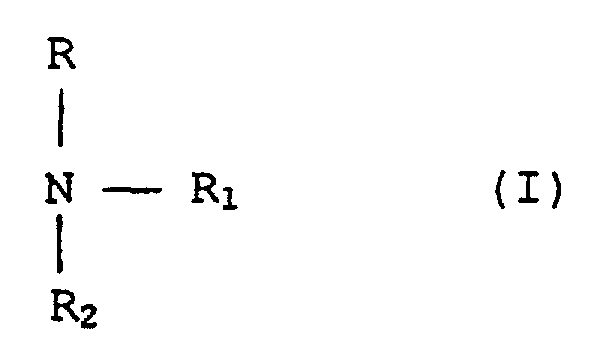
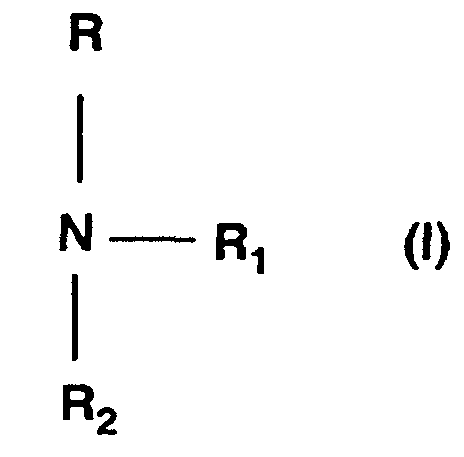
[0017] The nitrogenated base is selected from compounds having general formula (I)
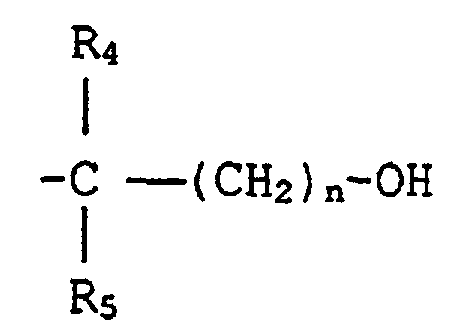
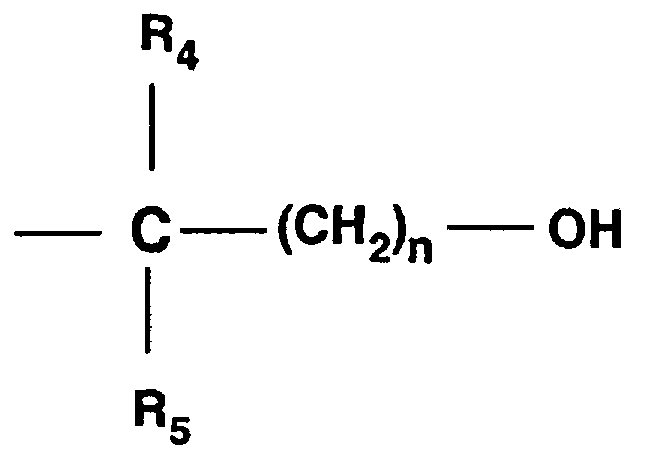
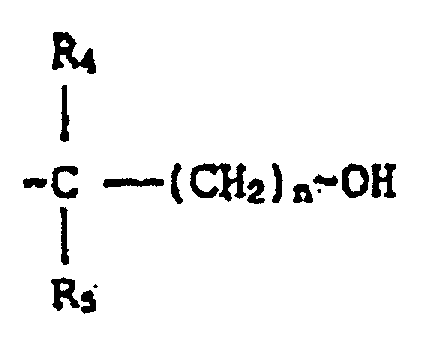
wherein: R, R1 and R2, the same or different, can be H, an alkyl group with C1-C10 carbon atoms, a -COR3 group wherein R3 is an alkyl group with C1-C10 carbon atoms or NH2, or a
group wherein n is a number from 1 to 10 and R4 and R5 are H or C1-C10 alkyl groups.
[0018] Preferred compounds having formula (I) are: ammonia, methylamine, ethylamine, diethylamine, trimethylamine, ethanolamine, diethanolamine, triethanolamine, n-propylamine.
[0019] Organic acids which can be used for the purposes of the present invention can be selected from carboxylic acids, such as acetic acid, formic acid, propionic or butyric acid and their derivatives, such as for example oxyacids such as glycol acid and α-lactic acid.
[0021] Sulfuric acid, acetic acid and formic acid are particularly preferred for the purposes of the present invention.
[0022] The olefin compounds which can be used in the process of the present invention can be selected from organic compounds having at least one double bond and can be linear or branched aliphatic, aromatic, alkylaromatic and cyclic. They are preferably olefin hydrocarbons having from 2 to 30 carbon atoms in the molecule and containing at least one double bond.
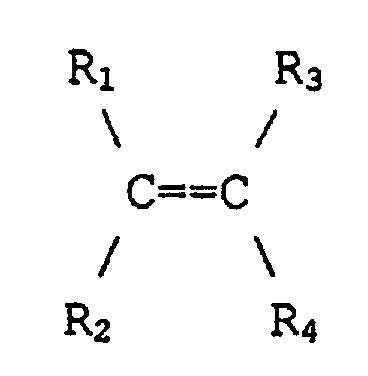
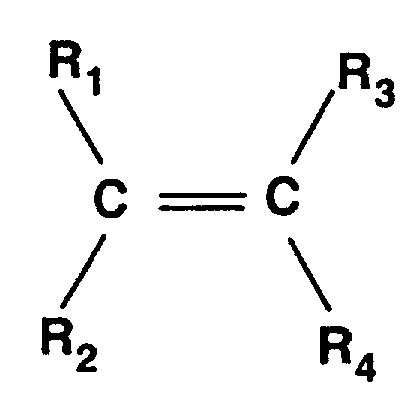
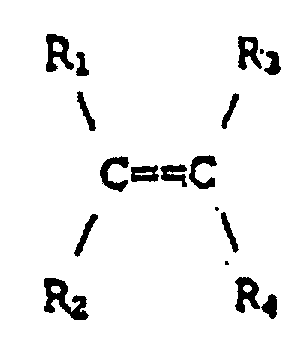
[0023] Examples of olefins suitable for the purposes of the present invention are selected from those having general formula (II)
wherein: R1, R2, R3 and R4, the same or different, can be H, an alkyl radical with from 1 to 20 carbon atoms, an aryl radical, an alkylaryl radical with from 7 to 20 carbon atoms, a cycloalkyl radical with from 6 to 10 carbon atoms, an alkylcycloalkyl radical with from 7 to 20 carbon atoms. The radicals R1, R2, R3 and R4, can form, in pairs, saturated or unsaturated rings. These radicals may additionally contain halogen atoms, nitro, nitrile, sulfonic groups and relative esters, carbonyl, hydroxyl, carboxyl, thiol, amine and ether groups.
[0024] Examples of olefins which can be epoxidated with the process of the present invention are: ethylene, propylene, allyl chloride, allyl alcohol, butenes, pentenes, hexenes, octeneheptenes-1, 1-tridecene, mesityl oxide, isoprene, cyclo-octene, cyclohexene or bicyclic compounds such as norbornenes, pinenes, etc. The olefins can carry the above substituents both on the unsaturated carbon atoms and on different positions.
[0025] The oxidizing agent used in the process of the present invention is hydrogen peroxide (H2O2) or a compound which is capable of generating H2O2 under the epoxidation conditions.
[0026] An aqueous solution of hydrogen peroxide is preferably used, at a minimum concentration of 1% by weight, preferably with a titer greater than or equal to 35% by weight.
[0027] The quantity of hydrogen peroxide with respect to the olefin is not critical, but a molar ratio olefin/H2O2 ranging from 10:1 to 1:10, preferably from 6:1 to 1:2, is preferably used.
[0028] The epoxidation reaction can be carried out in one or more solvents liquid at the epoxidation temperatures. Solvents of a polar nature are typically used, such as alcohols (methanol, ethanol, isopropyl alcohol, t-butyl alcohol, cyclohexanol), hydro-alcohol mixtures, ketones (for example acetone, methyl ethyl ketone, acetophenone), ethers (tetrahydrofuran, butyl ether), aliphatic and aromatic hydrocarbons, halogenated hydrocarbons, esters.
[0029] Methanol and, among the ketones, acetone, are preferably used. A mixture of methanol/water with a weight ratio ranging from 50/50 to 99/1, is particularly preferred.
[0030] The catalyst which can be used in the process of the present invention is selected from those generally known by the name of titanium-silicalites.
[0031] For example titanium-silicalites with an MFI structure can be used, described in the patent U.S. 4,410,501 which also specifies their structural characteristics.
[0032] Titanium-silicalites can also be used, in which part of the titanium is substituted by other metals, such as boron, aluminum, iron or gallium. These substituted titanium silicalites and the methods for their preparation are described in European patent applications 226,257, 226,258 and 266,825.
[0033] It is also possible to use titanium silicalites with a MEL or intermediate MFI/MEL structure described in Belgian patent 1,001,038. Other titanium-silicalites can be selected from beta zeolites containing titanium and having a BEA structure, described in Spanish patent 2,037,596, ZSM-12 containing titanium and optionally aluminum, described in "Journal of Chemical Communications, 1992, page 745).
[0034] The preferred catalyst according to the present invention is titanium-silicalite having the general formula:
xTiO2·(1-x)SiO2
wherein: x represents a number ranging from 0.0001 to 0.04, the value of x preferably ranging from 0.01 to 0.025, and described, for example, in U.S. patents 4,410,501, 4,824,976, 4,666,692, 4,656,016, 4,859,785, 4,937,216.
[0035] The quantity of catalyst used in the process of the present invention is not critical; it is selected however in such a way as to allow the epoxidation reaction to be completed in the shortest time possible.
[0036] The quantity of catalyst is generally selected in relation to various parameters, such as the'reaction temperature, the reactivity and concentration of the olefins, the concentration of hydrogen peroxide, the type and composition of the solvent, the catalytic activity and type of reactor or reaction system used.
[0037] The quantity of catalyst typically ranges from 1 to 15% by weight with respect to the reaction mixture, preferably from 4 to 10% by weight.
[0038] The catalyst can be used in the form of powder, pellets, microspheres, extruded product or other convenient physical forms.
[0039] The temperature used in the process of the present invention generally ranges from 20 to 150°C, preferably from 40 to 100°C. The operating pressure is that which allows the olefin to be maintained in liquid phase at the preset reaction temperature. The operating pressure is generally higher than atmospheric pressure when gaseous olefins are used.
[0040] The epoxidation process of the present invention can be carried out in batch, semi-continuous or, preferably, in continuous.
[0041] Various types of reactor can be used in the process of the present invention, for example a slurry reactor or a fixed-bed reactor.
[0042] The epoxidation process is preferably carried out in continuous, by feeding into a reaction zone containing the catalyst: hydrogen peroxide, the solvent, preferably methanol/water, propylene and an aqueous buffer solution having the composition and pH defined above, so that the pH is controlled in the reactor within values ranging from 5.5 to 8.0, preferably within values ranging from 6 and 7.0.
[0043] Conversion refers to the quantity of hydrogen peroxide which reacts during the epoxidation reaction with respect to the quantity charged into the reactor.
[0044] Selectivity refers to the number of moles of epoxide produced per moles of reacted hydrogen peroxide.
[0045] The epoxidation product obtained with the process of the present invention is separated and recovered from the reaction mixture using conventional techniques such as fractionated distillation.
[0046] The following examples have the sole purpose of describing the present invention in greater detail and should in no way be considered as limiting its scope.
Example 1 (comparative)
Oxidation of propylene
[0047] The epoxidation reaction is carried out in a stirred, 1.5 litre, AISI 316L steel reactor, equipped with a thermostat-regulation system, level control, pressure control and filter for continuously removing the solution, maintaining the catalyst in the reactor.
[0048] 760 g of a solution of methanol/water (93/7) and 40 g of titanium silicalite TS-1 (EniChem, with a titanium content equal to 2.05% by weight) are initially charged. After thermostat-regulating the system at 50°C and pressurizing with propylene to 12 bar, the following products are then fed in continuous by means of pumps:
1. 1970 g/hour of a solution of methanol/water 92.8/7.2 by weight
2. 230 g/hour of an aqueous solution of H2O2 at 35% by weight
3. propylene
4. 100 g/hour of water.
[0049] The overall reaction mixture in the feeding (without propylene) is equal to 2300 g/hour and its composition is the following:
H2O2 3.5%, H2O 17%, MeOH 79.5%.
The pressure in the reactor is maintained at 12 bar, feeding propylene.
[0050] The reaction trend is followed by taking samples every two hours and determining the residual H2O2 by titration with sodium thiosulfate and the reaction products by gaschromatography. The pH of the reaction mixture is determined on the liquid effluent leaving the reactor after partially degassing the propylene.
[0051] The results are shown in table 1.
Table 1
| Time (hrs) |
H2O2 conversion % |
PO selectivity % |
Reaction pH |
| 6 | 94 | 65 | 4.5 |
| 16 | 88 | 78 | 4.5 |
| 30 | 85 | 85 | 4.5 |
Example 2 (comparative)
[0052] The reaction is carried out under the same conditions as example 1, but using a reaction temperature equal to 60°C.
The results are indicated in table 2.
Table 2
| Time (hrs) |
H2O2 conversion % |
PO selectivity % |
Reaction pH |
| 6 | 90 | 67 | 4.5 |
| 16 | 82 | 75 | 4.5 |
| 30 | 75 | 80 | 4.5 |
Example 3
[0053] The reaction is carried out as described in example 2, but feeding in continuous (100 g/hour) an aqueous buffer solution containing 0.048% of NH3 and 0.12% of (NH4)2SO4 instead of water. The results are shown in table 3.
Table 3
| Reaction hours |
H2O2 conversion % |
PO selectivity % |
Reaction pH |
| 16 | 97 | 96.8 | 6.1 |
| 30 | 96 | 97.2 | 6.0 |
| 60 | 94 | 97.6 | 6.1 |
| 100 | 94 | 98.1 | 5.9 |
Example 4
[0054] The same procedure is adopted as in example 2, but feeding (100 g/hour) an aqueous buffer solution containing 0.048% of NH3 and 0.12% of ammonium acetate (CH3COONH4).
[0055] The results are shown in table 4.
Table 4
| Reaction Hours |
H2O2 conversion % |
PO selectivity % |
Reaction pH |
| 16 | 97 | 96.2 | 6.5 |
| 60 | 95.5 | 97.8 | 6.5 |
| 100 | 94.8 | 98.1 | 6.4 |
| 300 | 95.1 | 98.5 | 6.5 |
Example 5
[0056] The same procedure is adopted as in example 2, but feeding (100 g/hour) an aqueous buffer solution containing 0.048% of NH3 and 0.10% of ammonium formiate (HCOONH4).
[0057] The results are shown in table 5.
Table 5
| Time (hours) |
H2O2 conversion % |
PO selectivity % |
Reaction pH |
| 16 | 98.0 | 96.2 | 6.4 |
| 60 | 96.2 | 96.8 | 6.3 |
| 100 | 95.2 | 97.2 | 6.3 |
| 400 | 95.1 | 98.0 | 6.3 |
| 600 | 95.0 | 98.1 | 6.3 |
[0058] From the data indicated in tables 3, 4 and 5, high conversion and selectivity values are observed together with a stability in the catalyst activity.
Example 6 (comparative)
[0059] The same procedure is adopted as in example 2, but feeding (100 g/hour) an aqueous solution containing 0.10% of sodium acetate. The results are shown in table 6.
Table 6
| Time (hours) |
H2O2 conversion % |
PO selectivity % |
Reaction pH |
| 6 | 96 | 84 | 5.8 |
| 16 | 94 | 91 | 6.0 |
| 30 | 87 | 96 | 6.2 |
| 60 | 75 | 95 | 6.0 |
[0060] From the values indicated in the table, a deterioration in the catalyst over a period of time, is observed.
Example 7 (comparative)
[0061] The same procedure is adopted as in example 2, but feeding 100 g/hour of an aqueous solution containing 0.10% of NaNO3. The results are shown in table 7.
Table 7
| Time (hrs) |
H2O2 conversion % |
PO selectivity % |
Reaction pH |
| 6 | 92 | 71 | 4.5 |
| 16 | 87 | 82 | 4.4 |
| 30 | 84 | 86 | 4.5 |
Example 8 (comparative)
[0062] The same procedure is adopted as in example 2, but feeding 100 g/hour of an aqueous solution containing 0.04% of NaOH. The results are shown in table 8.
Table 8
| Time (hrs) |
H2O2 conversion % |
PO selectivity % |
Reaction pH |
| 6 | 85 | 93 | 6.6 |
| 16 | 65 | 98 | 7.3 |
Example 9 (comparative)
1. A continuous process for the preparation of olefin oxides by the direct epoxidation
of an olefin with hydrogen peroxide, or compounds capable of producing hydrogen peroxide
under the reaction conditions, in a solvent medium, in the presence of a catalytic
system consisting of a zeolite containing titanium atoms and a buffer system with
a pH controlled within values ranging from 5.5 to 8.0, consisting of a nitrogenated
base and a salt thereof with an organic or inorganic acid.
2. The process according to claim 1, wherein the nitrogenated base is selected from compounds
having general formula (I)
wherein: R, R1 and R2, the same or different, can be H, an alkyl group with C1-C10 carbon atoms, a -COR3 group wherein R3 is an alkyl group with C1-C10 carbon atoms or NH2, or a
group, wherein n is a number ranging from 1 to 10 and R4 and R5 are H or C1-C10 alkyl groups.
wherein: R, R1 and R2, the same or different, can be H, an alkyl group with C1-C10 carbon atoms, a -COR3 group wherein R3 is an alkyl group with C1-C10 carbon atoms or NH2, or a
group, wherein n is a number ranging from 1 to 10 and R4 and R5 are H or C1-C10 alkyl groups.
3. The process according to claim 2, wherein the nitrogenated base is selected from ammonia,
methylamine, ethylamine, dimethylamine, trimethylamine, ethanolamine, diethanolamine,
triethanolamine, n-propylamine.
4. The process according to claim 1, wherein the organic acids can be selected from carboxylic
acids, such as acetic acid, formic, propionic and butyric acid or their derivatives
such as glycolic acid and α-lactic acid.
5. The process according to claim 1, wherein the inorganic acids are selected from sulfuric
acid and phosphoric acid.
6. The process according to claim 1, wherein the olefin compounds can be selected from
organic compounds having at least one double bond and can be linear or branched aliphatic,
aromatic, alkylaromatic and cyclic.
7. The process according to claim 6, wherein the olefin compounds are selected from olefin
hydrocarbons having from 2 to 30 carbon atoms in the molecule and containing at least
one double bond.
8. The process according to claim 7, wherein the olefin compounds are selected from those
having general formula (II)
wherein: R1, R2, R3 and R4, the same or different, can be H, an alkyl radical with from 1 to 20 carbon atoms, an aryl radical, an alkylaryl radical with from 7 to 20 carbon atoms, a cycloalkyl radical with from 6 to 10 carbon atoms, an alkylcycloalkyl radical with from 7 to 20 carbon atoms.
wherein: R1, R2, R3 and R4, the same or different, can be H, an alkyl radical with from 1 to 20 carbon atoms, an aryl radical, an alkylaryl radical with from 7 to 20 carbon atoms, a cycloalkyl radical with from 6 to 10 carbon atoms, an alkylcycloalkyl radical with from 7 to 20 carbon atoms.
9. The process according to claim 8, wherein the radicals R1, R2, R3 and R4 can form, in pairs, saturated or unsaturated rings.
10. The process according to claim 8, wherein the radicals R1, R2, R3 and R4 can contain substituents selected from halogens, nitro, nitrile, sulfonic groups
and relative esters, carbonyl, hydroxyl, carboxyl, thiol amine and ether groups.
11. The process according to claim 1, wherein the olefin is propylene.
12. The process according to claim 1, wherein the hydrogen peroxide is used as an aqueous
solution with a minimum titer of 1% by weight.
13. The process according to claim 12, wherein the hydrogen peroxide is used as an aqueous
solution with a titer equal to or higher than 35% by weight.
14. The process according claim 1, wherein the molar ratio between olefin and hydrogen
peroxide ranges from 10/1 to 1/10.
15. The process according claim 14, wherein the molar ratio between olefin and hydrogen
peroxide ranges from 6/1 to 1/2.
16. The process according to claim 1, wherein the catalyst is selected from titanium silicalites
having general formula (III):
xTiO2·(1-x)SiO2
wherein: x ranges from 0.0001 to 0.04.
xTiO2·(1-x)SiO2
wherein: x ranges from 0.0001 to 0.04.
17. The process according to claim 16, wherein the value of x ranges from 0.01 to 0.025
18. The process according to claim 16, wherein in the titanium silicalite part of the
titanium is substituted by metals selected from boron, aluminum, iron or gallium.
19. The process according to claim 1, wherein the solvent medium is selected from alcohols,
hydro-alcohol mixtures, ketones, ethers, aliphatic and aromatic hydrocarbons, halogenated
hydrocarbons, esters or glycols.
20. The process according to claim 19, wherein the alcohols are selected from methanol,
ethanol, isopropyl alcohol, t-butyl alcohol, cyclohexanol.
21. The process according to claim 20, wherein the ketones are selected from acetone,
methyl ethyl ketone, acetophenone.
22. The process according to claim 19, wherein the ethers are selected from tetrahydrofuran
and butyl ether.
23. The process according to claim 19, wherein the solvent medium is a mixture of methanol/water
with a weight ratio ranging from 50/50 and 99/1.
24. The process according to claim 1, wherein the epoxidation reaction is carried out
at a temperature ranging from 20 to 150°C.
25. The process according to claim 24, wherein the temperature ranges from 40 to 100°C.
1. Kontinuierliches Verfahren (Durchlaufverfahren) zur Herstellung von Olefinoxiden durch
die direkte Epoxidation eines Olefins mit Wasserstoffperoxid oder mit Verbindungen,
welche zur Gewinnung von Wasserstoffperoxid unter den Reaktionsbedingungen befähigt
sind, und zwar in einem Lösungsmittelmilieu in Anwesenheit eines katalytischen Systems,
bestehend aus einem Zeolith mit einem Gehalt an Titanatomen, sowie eines Puffersystems
mit einem innerhalb des Bereichs von 5,5 bis 8,0 kontrollierten pH-Wert, wobei das
System aus einer stickstoffhaltigen Base und einem ihrer Salze mit einer organischen
oder anorganischen Säure besteht.
2. Verfahren nach Anspruch 1, wobei die stickstoffhaltige Base aus Verbindungen der allgemeinen
Formel (I)
ausgewählt ist, worin
R, R1, R2, die gleich oder verschieden sind, ein Wasserstoffatom, einen Alkylrest mit C1-C10 Kohlenstoffatomen, einen -COR3-Rest, worin R3 ein Alkylrest mit C1-C10 Kohlenstoffatomen oder NH2 oder ein Rest
ist, worin n eine Zahl im Bereich von 1 bis 10 und R4 sowie R5 ein Wasserstoffatom oder C1-C10 - Alkylreste darstellen.
ausgewählt ist, worin
R, R1, R2, die gleich oder verschieden sind, ein Wasserstoffatom, einen Alkylrest mit C1-C10 Kohlenstoffatomen, einen -COR3-Rest, worin R3 ein Alkylrest mit C1-C10 Kohlenstoffatomen oder NH2 oder ein Rest
ist, worin n eine Zahl im Bereich von 1 bis 10 und R4 sowie R5 ein Wasserstoffatom oder C1-C10 - Alkylreste darstellen.
3. Verfahren nach Anspruch 2, wobei die stickstoffhaltige Base aus Ammoniak, Methylamin,
Ethylamin, Dimethylamin, Trimethylamin, Ethanolamin, Diethanolamin, Triethanolamin
oder n-Propylamin ausgewählt ist.
4. Verfahren nach Anspruch 1, wobei die organischen Säuren aus Carbonsäuren, wie zum
Beispiel Essigsäure, Ameisensäure, Propionsäure und Buttersäure oder deren Derivaten,
wie zum Beispiel Glykolsäure und α-Milchsäure, ausgewählt sein können.
5. Verfahren nach Anspruch 1, wobei die anorganischen Säuren aus Schwefelsäure und Phosphorsäure
ausgewählt sind.
6. Verfahren nach Anspruch 1, wobei die Olefinverbindungen aus organischen Verbindungen
ausgewählt sein können, die mindestens 1 Doppelbindung aufweisen und in Form von gerad-
oder verzweigkettiger aliphatischer, aromatischer, alkylaromatischer und cyclischer
Natur vorliegen können.
7. Verfahren nach Anspruch 6, wobei die Olefinverbindungen aus Olefin-Kohlenwasserstoffen
mit 2 bis 30 Kohlenstoffatomen im Molekül und einem Gehalt an mindestens 1 Doppelbindung
ausgewählt sind.
8. Verfahren nach Anspruch 7, wobei die Olefinverbindungen aus solchen Verbindungen ausgewählt
sind, welche der allgemeinen Formel (II)
entsprechen, worin R1, R2, R3 und R4, die gleich oder verschieden sind, Wasserstoff, einen Alkylrest mit 1 bis 20 Kohlenstoffatomen, einen Arylrest, einen Alkylarylrest mit 7 bis 20 Kohlenstoffatomen, einen Cycloalkylrest mit 6 bis 10 Kohlenstoffatomen oder einen Alkylcycloalkylrest mit 7 bis 20 Kohlenstoffatomen bedeuten können.
entsprechen, worin R1, R2, R3 und R4, die gleich oder verschieden sind, Wasserstoff, einen Alkylrest mit 1 bis 20 Kohlenstoffatomen, einen Arylrest, einen Alkylarylrest mit 7 bis 20 Kohlenstoffatomen, einen Cycloalkylrest mit 6 bis 10 Kohlenstoffatomen oder einen Alkylcycloalkylrest mit 7 bis 20 Kohlenstoffatomen bedeuten können.
9. Verfahren nach Anspruch 8, wobei die Reste R1, R2, R3 und R4 jeweils paarweise gesättigte oder ungesättigte Ringe bilden können.
10. Verfahren nach Anspruch 8, wobei die Reste R1, R2, R3 und R4 Substituenten enthalten können, die aus Halogenen, Nitro, Nitril, Sulfongruppen und
damit verwandten Estern, aus Carbonyl, Hydroxyl, Carboxyl, Thiolamin und Ethergruppen
ausgewählt sind.
11. Verfahren nach Anspruch 1, wobei das Olefin als Propylen vorliegt.
12. Verfahren nach Anspruch 1, wobei das Wasserstoffperoxid in Form einer wässrigen Lösung
mit einem Minimumtiter von 1 Gew.-% eingesetzt wird.
13. Verfahren nach Anspruch 12, wobei das Wasserstoffperoxid in Form einer wässrigen Lösung
mit einem Titer von gleich oder höher als 35 Gew.-% eingesetzt wird.
14. Verfahren nach Anspruch 1, wobei das Molverhältnis zwischen dem Olefin und Wasserstoffperoxid
im Bereich von 10 : 1 bis 1 : 10 variiert.
15. Verfahren nach Anspruch 14, wobei das Molverhältnis zwischen dem Olefin und Wasserstoffperoxid
im Bereich von 6 : 1 bis 1 : 2 variiert.
16. Verfahren nach Anspruch 1, wobei der Katalysator aus Titan-Silicaliten der allgemeinen
Formel (III)
xTiO2•(1-x)SiO2
ausgewählt ist, worin x im Bereich von 0,0001 bis 0,04 liegt.
xTiO2•(1-x)SiO2
ausgewählt ist, worin x im Bereich von 0,0001 bis 0,04 liegt.
17. Verfahren nach Anspruch 16, wobei der Wert von x im Bereich von 0,01 bis 0,025 liegt.
18. Verfahren nach Anspruch 16, wobei der Anteil an Titansilicalit des Titan durch Metalle
substituiert ist, die aus Bor, Aluminium, Eisen oder Gallium ausgewählt sind.
19. Verfahren nach Anspruch 1, wobei das Lösungsmittelmilieu aus Alkoholen, wässrig-alkoholischen
Gemischen, Ketonen, Ethern, aliphatischen und aromatischen Kohlenwasserstoffen, halogenierten
Kohlenwasserstoffen, Estern oder Glykolen ausgewählt ist.
20. Verfahren nach Anspruch 19, wobei die Alkohole aus Methanol, Ethanol, Isopropanol,
t-Butylalkohol oder Cyclohexanol ausgewählt sind.
21. Verfahren nach Anspruch 20, wobei die Ketone aus Aceton, Methylethylketon oder Acetophenon
ausgewählt sind.
22. Verfahren nach Anspruch 19, wobei die Ether aus Tetrahydrofuran und Butylether ausgewählt
sind.
23. Verfahren nach Anspruch 19, wobei das Lösungsmittelmilieu ein Gemisch aus Methanol
zu Wasser in einem Gewichtsverhältnis im Bereich von 50 : 50 bis 99 : 1 darstellt.
24. Verfahren nach Anspruch 1, wobei die Reaktion der Epoxidation bei einer Temperatur
im Bereich von 20 bis 150 °C durchgeführt wird.
25. Verfahren nach Anspruch 24, wobei die Temperatur im Bereich von 40 bis 100 °C liegt.
1. Procédé continu pour la préparation d'oxydes d'oléfine par l'époxydation directe d'une
oléfine avec du peroxyde d'hydrogène, ou des composés capables de produire du peroxyde
d'hydrogène dans les conditions de réaction, dans un milieu de solvant, en présence
d'un système catalytique constitué d'un zéolite contenant des atomes de titane et
d'un système de tampon avec un pH contrôlé à l'intérieur des valeurs comprises entre
5,5 et 8,0, constitué d'une base azotée et d'un sel de celle-ci avec un acide organique
ou inorganique.
2. Procédé selon la revendication 1, dans lequel la base azotée est choisie parmi les
composés ayant la formule générale (I)

dans laquelle : R, R1 et R2, identiques ou différents, peuvent être H, un groupe alkyle avec des atomes de carbone en C1-C10, un groupe -COR3 dans lequel R3 est un groupe alkyle avec des atomes de carbone en C1-C10 ou NH2, ou un groupe
dans lequel n est un nombre compris entre 1 et 10 et R4 et R5 sont H ou des groupes alkyles en C1-C10.
dans laquelle : R, R1 et R2, identiques ou différents, peuvent être H, un groupe alkyle avec des atomes de carbone en C1-C10, un groupe -COR3 dans lequel R3 est un groupe alkyle avec des atomes de carbone en C1-C10 ou NH2, ou un groupe
dans lequel n est un nombre compris entre 1 et 10 et R4 et R5 sont H ou des groupes alkyles en C1-C10.
3. Procédé selon la revendication 2, dans lequel la base azotée est choisie parmi l'ammoniac,
la méthylamine, l'éthylamine, la diméthylamine, la triméthylamine, l'éthanolamine,
la diéthanolamine, la triéthanolamine, la n-propylamine.
4. Procédé selon la revendication 1, dans lequel les acides organiques peuvent être choisis
parmi les acides carboxyliques, tels que l'acide acétique, l'acide formique, propionique
et butyrique ou leurs dérivés tels que l'acide glycolique et l'acide α-lactique.
5. Procédé selon la revendication 1, dans lequel les acides organiques sont choisis parmi
l'acide sulfurique et l'acide phosphorique.
6. Procédé selon la revendication 1, dans lequel les composés d'oléfine peuvent être
choisis parmi les composés organiques ayant au moins une double liaison et peuvent
être des composés aliphatiques, aromatiques, alkylaromatiques et cycliques, linéaires
ou ramifiés.
7. Procédé selon la revendication 6, dans lequel les composés d'oléfine sont choisis
parmi les hydrocarbures d'oléfine ayant de 2 à 30 atomes de carbone dans la molécule
et contenant au moins une double liaison.
8. Procédé selon la revendication 7, dans lequel les composés d'oléfine sont choisis
parmi ceux ayant la formule générale (II)
dans laquelle : R1, R2, R3 et R4, identiques ou différents, peuvent être H, un radical alkyle avec de 1 à 20 atomes de carbone, un radical aryle, un radical alkylaryle avec de 7 à 20 atomes de carbone, un radical cycloalkyle avec de 6 à 10 atomes de carbone, un radical alkylcycloalkyle avec de 7 à 20 atomes de carbone.
dans laquelle : R1, R2, R3 et R4, identiques ou différents, peuvent être H, un radical alkyle avec de 1 à 20 atomes de carbone, un radical aryle, un radical alkylaryle avec de 7 à 20 atomes de carbone, un radical cycloalkyle avec de 6 à 10 atomes de carbone, un radical alkylcycloalkyle avec de 7 à 20 atomes de carbone.
9. Procédé selon la revendication 8, dans lequel les radicaux R1, R2, R3 et R4 peuvent former, en paires, des anneaux saturés ou insaturés.
10. Procédé selon la revendication 8, dans lequel les radicaux R1, R2, R3 et R4 peuvent contenir des substituants choisis parmi des halogènes, des groupes nitro,
nitrile, sulfoniques et les esters, des groupes carbonyle, hydroxyle, carboxyle, thiol,
amine et éther relatifs.
11. Procédé selon la revendication 1, dans lequel l'oléfine est du propylène.
12. Procédé selon la revendication 1, dans lequel le peroxyde d'hydrogène est utilisé
comme une solution aqueuse avec un titre minimum de 1 % en poids.
13. Procédé selon la revendication 12, dans lequel le peroxyde d'hydrogène est utilisé
comme une solution aqueuse avec un titre égal ou supérieur à 35 % en poids.
14. Procédé selon la revendication 1, dans lequel le rapport molaire entre l'oléfine et
le peroxyde d'hydrogène est compris entre 10/1 et 1/10.
15. Procédé selon la revendication 14, dans lequel le rapport molaire entre l'oléfine
et le peroxyde d'hydrogène est compris entre 6/1 et 1/2.
16. Procédé selon la revendication 1, dans lequel le catalyseur est choisi parmi des silicalites
de titane ayant la formule générale (III) :
xTiO2. (1-x)SiO2
dans laquelle : x est compris entre 0,0001 et 0,04.
xTiO2. (1-x)SiO2
dans laquelle : x est compris entre 0,0001 et 0,04.
17. Procédé selon la revendication 16, dans lequel la valeur de x est comprise entre 0,01
et 0,025.
18. Procédé selon la revendication 16, dans lequel dans la partie silicalite de titane,
le titane est substitué par des métaux choisis parmi le bore, l'aluminium, le fer
ou le gallium.
19. Procédé selon la revendication 1, dans lequel le milieu de solvant est choisi parmi
des alcools, des mélanges d'hydro-alcools, des cétones, des éthers, des hydrocarbures
aliphatiques et aromatiques, des hydrocarbures halogénés, des esters ou des glycols.
20. Procédé selon la revendication 19, dans lequel les alcools sont choisis parmi le méthanol,
l'éthanol, l'alcool isopropylique, l'alcool t-butylique et le cyclohexanol.
21. Procédé selon la revendication 20, dans lequel les cétones sont choisies parmi l'acétone,
la cétone de méthyléthyle, l'acétophénone.
22. Procédé selon la revendication 19, dans lequel les éthers sont choisis parmi le tétrahydrofurane
et le butyléther.
23. Procédé selon la revendication 19, dans lequel le milieu de solvant est un mélange
de méthanol/eau avec un rapport pondéral compris entre 50/50 et 99/1.
24. Procédé selon la revendication 1, dans lequel la réaction d'époxydation est réalisée
à une température comprise entre 20 et 150 °C.
25. Procédé selon la revendication 24, dans lequel la température est comprise entre 40
et 100 °C.