(57) The present invention uses wavelength conversion to increase the bandwidth of optical
communication systems. In an exemplary embodiment, a combination of wavelength conversion
and amplification with a discrete optical amplifier (OA) to allow communications systems
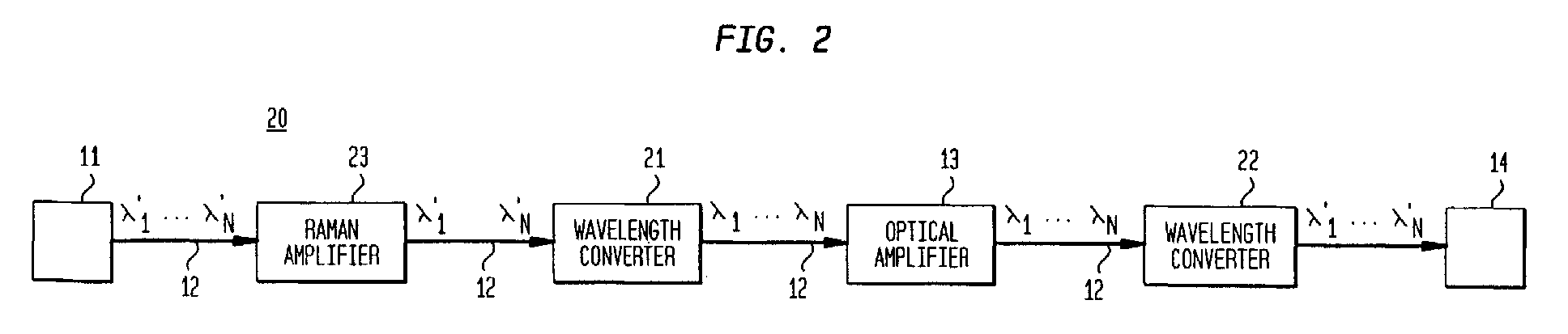
to operate in wavelength bands λ' outside the gain bandwidth of the OA. A transmitter
launches signal channels (λ1', λ2',...,λ'N) that are outside the gain bandwidth λ. A wavelength conversion device upstream of
the amplifier maps channels λ'1, λ'2,...λ'N to corresponding wavelengths λ1, λ2, ...λN within λ. The OA directly amplifies the converted signals and a second wavelength
conversion device downstream of the amplifier maps the amplified signals back to the
original channels λ'1, λ'2,...λ'N. This increases the capacity of the optical communication systems by facilitating
the use of both signals that lie within the OA gain bandwidth λ and signals that can
be converted to wavelengths within λ. Associated wavelength converters, transmitters
and receivers are also described.
This approach applies not only to the use of EDFAs, but also to gain-flattening elements,
dispersion-compensating fibers, variable attenuators, and any intermediate components
having bandwidths smaller than the transmission fiber.
|
|
