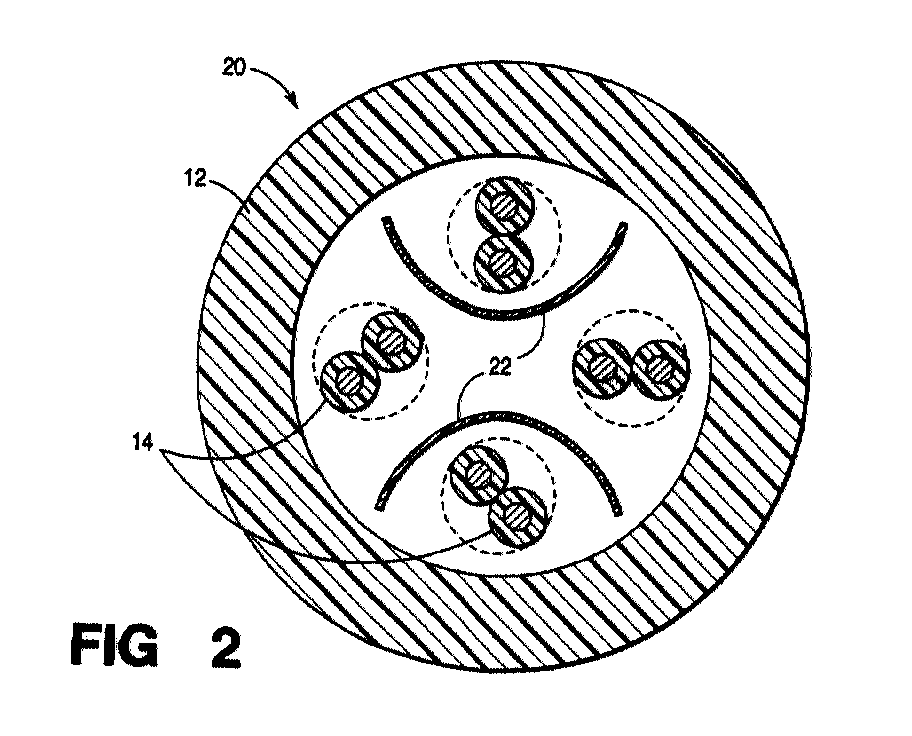
(57) Embodiments of the invention include an electrical cable apparatus (20). The electrical
cable apparatus (20) comprises a plurality of paired conductive elements (14), a dielectric
jacket (12) formed around the plurality of paired conductive elements, and at least
one dielectric film (22) separating the pairs of conductive elements within the dielectric
jacket. For example, for an arrangement having four twisted pair of copper wires within
an electrically insulating jacket, two dielectric films surround alternating pairs
of individually insulated conductor elements. The dielectric film is made of one or
more of the following materials: ethylchlorotrifluoroethylene (ECTFE or Halar®), poly(vinyl
chloride) (PVC), polyolefins, and fluoropolymers including fluorinated ethylene-propylene
(FEP or Teflon®), perfluoroalkoxy polymers of tetrafluoroethylene and either perfluoropropyl
ether (PFA) or perfluoromethylvinyl ether (MFA). Alternatively, the dielectric film
is made of woven glass yarn tape such as Kapton®. The dielectric film has a width,
for example, of approximately 0.125 to 0.250 inch and a thickness, for example, of
approximately 2 to 20 mils (0.002 to 0.020 inch). Alternatively, individual dielectric
films are positioned between individual conductive elements within the conductor pairs.
The method for making an electrical cable comprises providing a plurality of the paired
conductive elements, forming the dielectric film around one or more of the conductor
pairs and/or forming the dielectric film between the individual conductors within
one or more conductor pairs, and forming the dielectric jacket around the conductor
pairs. The thin dielectric film provides separation between conductor pairs and/or
between individual conductors within conductor pairs to reduce crosstalk therebetween.
|
|
