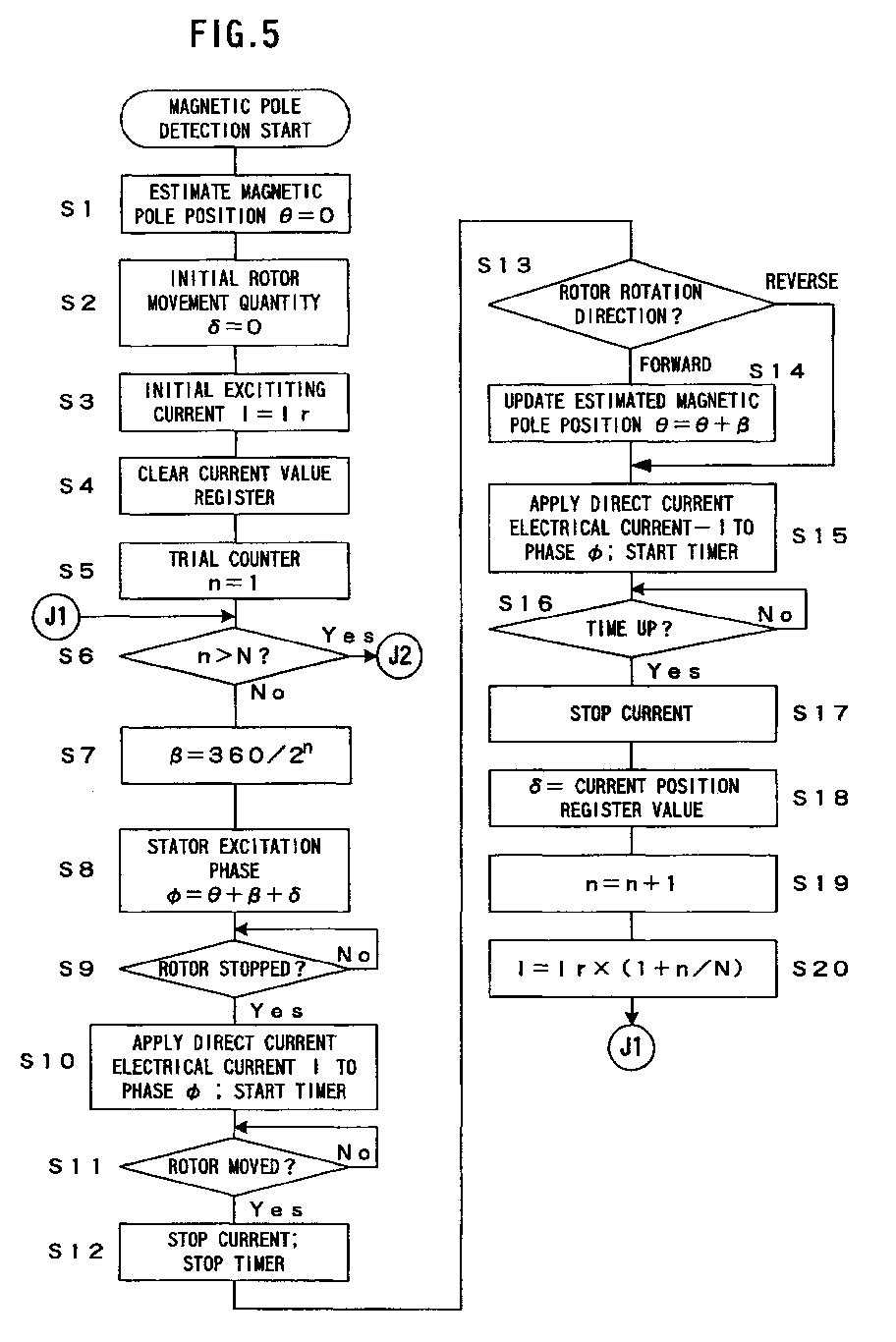
(57) First, a direct current is supplied to an excitation phase at 180 degrees (S10),
and stopped when the rotor rotates (S12). If it is forward rotation, the rotor magnetic
pole position is in the range from 180 to 360 degrees, and the starting point thereof,
180 degrees, is treated as the estimated magnetic pole position θ. A phase quantity
β of 1/2 of the width of a detected range (this time it will constitute 90 degrees)
is added to an estimated magnetic pole position (S14), and the result is treated as
an excitation phase. If rotation is in reverse, on the other hand, the magnetic pole
position lies in the range from 0 to 180 degrees, and the starting point thereof,
0 degrees, is treated as the estimated magnetic pole position θ. A reverse current
is supplied, and the rotor is returned to its original position (S15). The same processing
is repeated thereafter (S19), and the range in which the magnetic pole position is
estimated to exist is steadily narrowed. Repetition is performed, and the width of
the range in which the magnetic pole position exists is made smaller 90, 45, 22.5
..... (S20). The magnetic pole position can be detected without causing the rotor
to move noticeably.
|
|
