(57) A method, apparatus, article of manufacture for compensating for solar wing thermal
shock in a spacecraft (100) is disclosed. The method comprises the steps of determining
solar wing compensation to compensate for the thermal shock disturbance and rotating
the solar wing (114) about a second axis (110) according to the determined compensation,
wherein the second axis (110) is substantially perpendicular to a first axis (118)
and to a vector (204) from the spacecraft (100) to the sun. The solar wing compensation
can be based on predicted solar wing (114) deflections due to thermal shock perturbations,
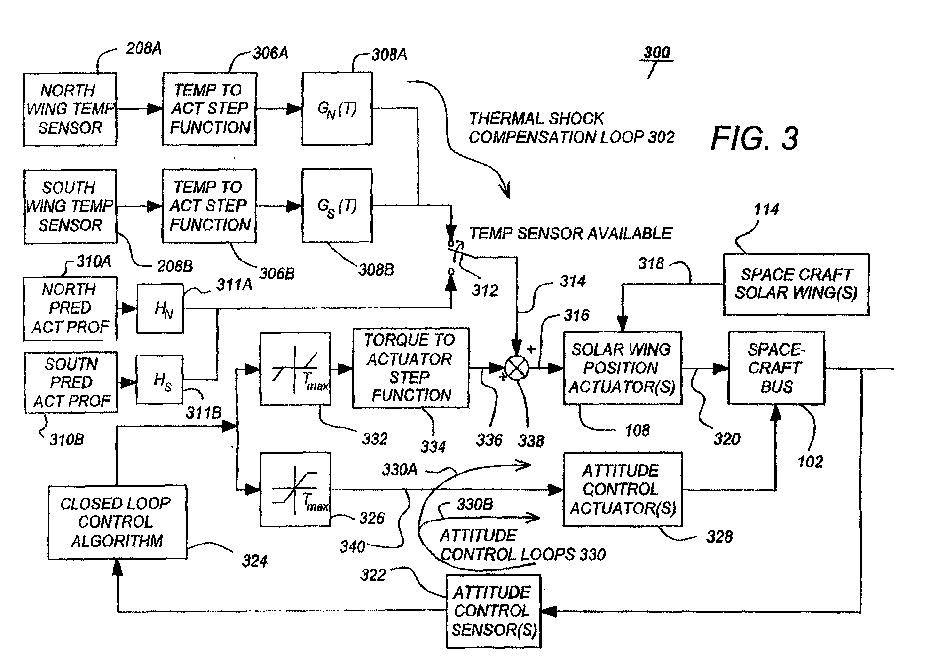
or if available, solar wing temperature measurements. In an embodiment of the present
invention applicable to satellites with multiple solar wings (114), asymmetric control
is applied by independent adjustment of the thermal shock compensation loop (302)
controlling each solar wing (114). In yet another embodiment of the present invention,
the solar wing position actuator (108) is further commanded by a feedback control
loop (330) using the measured spacecraft attitude. The apparatus comprises an attitude
control system having a device (310) for predicting or measuring solar wing perturbations,
at least one solar wing position actuator (108), cooperatively coupled to the solar
wing (114) for rotating the solar wing (114) about a second axis (110), wherein the
second axis (110) is substantially perpendicular to the first axis (108) and to a
vector (204) from the spacecraft (100) to the sun, and a thermal shock compensation
loop (302), for generating at least one solar wing position actuator command (316)
to rotate the solar wing (114) about the second axis (110) in accordance with the
predicted or measured solar wing perturbations.
|
|
