| (19) |
 |
|
(11) |
EP 1 097 014 B1 |
| (12) |
EUROPEAN PATENT SPECIFICATION |
| (45) |
Mention of the grant of the patent: |
|
05.01.2005 Bulletin 2005/01 |
| (22) |
Date of filing: 16.07.1999 |
|
| (51) |
International Patent Classification (IPC)7: B22D 41/20 |
| (86) |
International application number: |
|
PCT/GB1999/002149 |
| (87) |
International publication number: |
|
WO 2000/003822 (27.01.2000 Gazette 2000/04) |
|
| (54) |
APPARATUS AND METHOD FOR CONTROLLING THE FLOW OF MOLTEN METAL
VORRICHTUNG UND VERFAHREN ZUM KONTROLLIEREN DER AUSFLUSSMENGE GESCHMOLZENER METALLE
DISPOSITIF ET PROCEDE SERVANT A REGULER L'ECOULEMENT D'UN METAL EN FUSION
|
| (84) |
Designated Contracting States: |
|
AT CH DE FR GB IT LI |
| (30) |
Priority: |
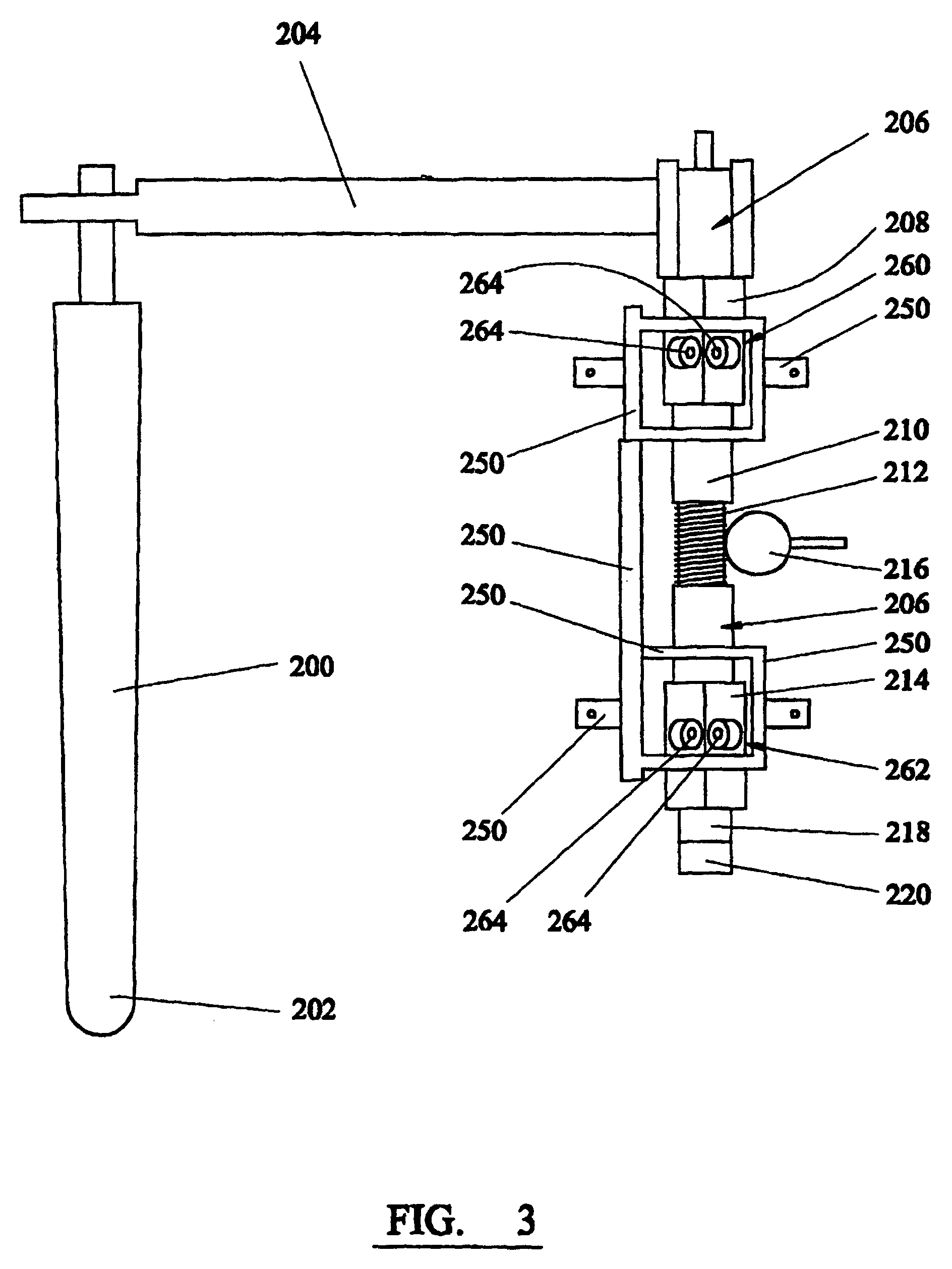
17.07.1998 GB 9815535
|
| (43) |
Date of publication of application: |
|
09.05.2001 Bulletin 2001/19 |
| (73) |
Proprietor: VAI Industries (UK) Limited |
|
Poole,
Dorset BH15 1AE (GB) |
|
| (72) |
Inventor: |
|
- HETHERINGTON, Adrian,
Kvaerner Met. Con. Cast. Ltd
Sheffield S9 4EX (GB)
|
| (74) |
Representative: Pawlyn, Anthony Neil |
|
Urquhart-Dykes & Lord LLP
Tower North Central
Merrion Way
Leeds LS2 8PA
Leeds LS2 8PA (GB) |
| (56) |
References cited: :
EP-B- 0 041 051
DE-B- 2 649 483
FR-A- 1 442 566
|
EP-B- 0 439 681
DE-C- 395 694
US-A- 2 223 062
|
|
| |
|
|
|
|
| |
|
| Note: Within nine months from the publication of the mention of the grant of the European
patent, any person may give notice to the European Patent Office of opposition to
the European patent
granted. Notice of opposition shall be filed in a written reasoned statement. It shall
not be deemed to
have been filed until the opposition fee has been paid. (Art. 99(1) European Patent
Convention).
|
[0001] This invention concerns improvements in and relating to handling molten materials,
particularly, but not exclusively, in relation to controlling the flow of molten metal
from a tundish.
[0002] Casting operations generally employ a tundish to act as a reservoir of molten metal
between the ladle and the mould. The ladle is used to convey molten metal from a melting
location to the casting location. The mould is used to control the profile of the
solidifying metal during casting.
[0003] To control the flow of metal from a tundish it is necessary to block and open an
outlet in the tundish, in a controlled manner. In general this is achieved using a
stopper element in the molten metal which cooperates with the outlet to seal it, the
stopper being supported by a stopper guide which is moved up and down using an actuator.
[0004] The stopper is frequently supported at a considerable distance away from the portion
of the stopper guide moved by the actuator. As a consequence of this problems in supporting
the stopper in the correct alignment and with reasonable levels of friction exist.
Prior art systems are prone to jamming and / or friction levels which give rise to
uneven movement of the stopper, or excessive clearance can lead to misalignment. These
problems all give rise to poor control of the flow from the tundish, as well as increasing
the mechanical loading on the actuator system.
[0005] EP-B-0439681 describes a device for the adjustable displacement of a stopper comprising
support rollers or balls independent of a carrier rod and an openable guide housing.
[0006] The present invention aims to provide an improved stopper gear mechanism in which
the stopper movement and positioning is controlled with great precision and the mechanical
loads on the stopper gear and actuator are reduced.
[0007] According to a first aspect of the present invention we provide apparatus for controlling
the flow of material, such as molten metal, from a container, the apparatus comprising
the features as recited in appended claim 1.
[0008] Preferably the bearing system facilitates reciprocating movement of this support
system relative to the fixed support framework. Reciprocating movement along a vertical
axis is preferred in this regard.
[0009] Preferably the contact surface(s) provided by one of the support framework or support
system is a flat surface(s). The flat surface(s) may be provided by the support framework,
preferably one provided by the support system, more preferably by the support shaft
of the support system and most preferably by a face of a square cross-section part
of the support shaft.
[0010] The contact surface capable of rotation may be provided by the support system, or
more preferably by the fixed support framework. Preferably the rotatable contacting
surface is provided by a unit mounted on the fixed support framework.
[0011] Preferably the unit comprises a mount, such as a shaft, providing rotation facilitating
retention of the rotatable contact surface and attached to the fixed support framework.
Preferably the rotation facilitating retention is provided by an axle engaging the
element defining the rotatable contacting surface. Preferably the element is a cam
or cam follower. The cam followers preferably have eccentric shafts.
[0012] At least two opposing contact surfaces between a component of the support framework
and a component of the support system are provided two sets of contact surfaces, in
opposition to one another, between a component of the support framework and a component
of support system are provided. Preferably the first set of opposing contact surfaces
is offset by an angle of 90° relative to the second set of contact surfaces. Preferably
the axis of rotation for the first and / or second set of contact surfaces are provided
in a common plane, most preferably a horizontal plane, and ideally a plane perpendicular
to the component of the support or support framework in question. Two or more such
groups of contact surfaces may be provided. Preferably one such set of contact surfaces
are provided on an upper portion of the support system and a second set is provided
on a lower portion of the support system.
[0013] Preferably the molten metal flows from the container to a casting or moulding operation.
Preferably the molten metal is supplied to the container by a ladle. The container
is preferably a tundish.
[0014] Preferably the first closing element comprises a stopper rod. Preferably the stopper
rod is provided on a substantial vertical axis within the container. Preferably the
end of the stopper rod is configured to cooperate in a sealing manner with the outlet
from the container.
[0015] Preferably the outlet from the container is provided in the base of the container.
Preferably the mouth of the outlet cooperates with the profile of the end of the stopper
rod to give closure. The outlet may have rounded edges, at its internal periphery.
[0016] Preferably the support system comprises a laterally extending, most preferably horizontally
extending, element. The element may be a bar.
[0017] Preferably the support system comprises, or further comprises, a substantially vertically
aligned support shaft. Preferably the support shaft is received in the bearing system.
Preferably the support shaft provides a mounting for the laterally extending element.
[0018] The support system may include one or more portions rotatably mounted relative to
one another. For instance a support shaft, received in the bearing system may be provided,
two or more portions of the support shaft being adapted to rotate relative to one
another. Rotation may be facilitated by bushes. Preferably rotation occurs about the
longitudinal axis of the shaft.
[0019] The support shaft may comprise one or more portions providing a contact surface of
the bearing system, longitudinally spaced from one another on the shaft, rotation
movement of the portions relative to one another being facilitating.
[0020] The support system may comprise, or preferably further comprise, an element linking
the support shaft to the actuator. A horizontally extending element connected to the
bottom of the support shaft is preferred in this regard.
[0021] The actuator system may comprise a reciprocating mover, for instance an hydraulic
piston. Preferably the actuator reciprocates along a substantially vertically aligned
axis.
[0022] Preferably the fixed support framework mounts the support system, via the bearing
system, on the container. Preferably the support system is provided with a mounting
on the side of the container.
[0023] According to a second aspect of the invention we provide means for providing a controlled
supply of molten metal, according to appended claim 16.
[0024] The second aspect of the invention may include any of the means, options, possibilities
and components set out in the first aspect of the invention and / or elsewhere in
this document.
[0025] According to a third aspect of the present invention we provide a method for controlling
the flow of molten metal from a container, according to appended claim 17.
[0026] Preferably movement of the actuator downward moves the closing, element downward.
Preferably movement of the actuator upward causes movement of the closing element
upward.
[0027] The components, options, features, possibilities and steps of this method may further
include details, features and possibilities set out elsewhere in this document.
[0028] Embodiments of the present invention will now be described, by way of example only,
and with reference to the accompanying drawings in which:-
Figure 1 illustrates a cross sectional view of a tundish and stopper gear mechanism;
Figure 2 illustrates a cross sectional view through a stopper gear mechanism; and
Figure 3 illustrates a cross sectional view through a stopper gear mechanism according
to a first embodiment of the present invention.
[0029] The tundish and stopper gear mechanism illustrated in Figure 1 is used to control
the flow of molten metal 2 to a moulding stage, not shown, via an outlet 4 in the
base of the tundish 6. The flow of metal 2 through the outlet 4 is controlled by the
engagement of, or spacing between, the end 8 of the stopper element 10 and the outlet
4.
[0030] The stopper bar 10 is formed of refractory material and forms a consumable component
of the stopper guide mechanism, as it is present in the molten material 2. The vertically
arranged stopper bar 10 is supported on the end 12 of a horizontal support arm 14.
The support arm 14 itself is mounted on the upper end 16 of a vertically provided
support shaft 20.
[0031] The support shaft 20 is provided so as to slide within a bore 22 provided in the
supporting framework 24 mounted on the tundish 6. The sliding engagement between the
support shaft and the supporting system is affected by a series of slide plates, discussed
in more detail below in relation to Figure 2.
[0032] The position of the stopper 10 is controlled via an actuator 26 which acts on the
end 28 of an element 30 connected to the support shaft 20. Extension of the actuator
lowers the stopper end 8 into engagement with the outlet 4. Retraction of the actuator
26 lifts the stopper end 8 out of engagement with the outlet 4, thereby allowing flow
of the molten material 2 out of the tundish 6.
[0033] The accurate positioning of the end 8 of the stopper 10 relative to the outlet 4
is critical in controlling the flow of molten metal 2. Inaccurate positioning gives
an inaccurate control of the flow of molten metal. Erratic movement of the stopper
10 gives erratic variations in the flow of molten metal 2.
[0034] When the sliding engagement between the support shaft 20 and the supporting framework
24 is provided using guide plates 100, see Figure 2, then problems can occur. In this
system, a square section 102 of the support shaft 20 is engaged on its four faces
by the guide plates 100. The sliding surface which results has a relatively high level
of friction and is also prone to jamming. Overcoming the high level of friction requires
a significant load from the actuator, a loading which once the support shaft 20 starts
moving can result in too great an effective outlet arising.
[0035] The use of plates 100, engaging on a square section 102 of shaft 20, also faces problems
from misalignment due to movement in the components of the system. The supporting
framework 24 is mounted on the tundish 6 and as a consequence is exposed to high temperatures.
These temperatures vary, however, depending upon the level of molten material within
the tundish 6, and as a consequence can give rise to deformation in the supporting
frame 24 and / or in the plates 100 themselves. Any such deformation can significantly
increase the level of friction encountered in the sliding system and / or lead to
misalignment to such an extent that the stopper mechanism jams. Either of these can
give rise to problems in controlling molten metal discharge and give rise to general
problems in the casting / moulding operation as a result.
[0036] The system of the present invention is illustrated in one embodiment in Figure 3.
Once again a stopper rod 200 is provided. The stopper rod 200 has an end portion 202
configured to cooperate with the mouth of an outlet in the tundish in question. The
stopper rod 200 is mounted on an horizontal arm 204 which in turn is mounted on a
support shaft 206. The support shaft 206 comprises an upper square cross sectioned
length 208, a circular cross sectioned length 210 which is provided with a circular
rack portion 212 and a lower square cross-sectional length 214 mounted coaxially.
The screw threaded portion 212 cooperates with a manual operating spur gear and lever
216 which is used to raise or lower the stopper manually, as required. The square
cross section 214 is mounted on to support shaft 206 via bushes to allow rotation
of 214 relative to shaft 206 about the longitudinal axis of shaft 206. This potential
for rotation of the lower square cross section being able to rotate avoids another
possible source of jamming. The bottom end 218 of the support shaft 208 is connected
to an horizontal arm 220 which in turn is connected to the end of an actuator, not
shown in Figure 3, but provided behind the support shaft 206 as viewed in Figure 3.
[0037] The cross sections 208 and 214 may be of some other geometric form having pairs of
surfaces to cooperate with the cam followers.
[0038] Control of the stopper rod 200 is effected using the actuator to move the arm 220,
support shaft 206, horizontal arm 204 and stopper rod 200, up and down, relative to
the outlet of the tundish.
[0039] The sliding engagement between the support shaft 206 and the supporting framework
250 is affected in a completely different way from the prior art, however. The supporting
frame 250 is provided with an upper set 260 and a lower set 262 of four cam followers
264. The cam followers 264 are configured so that one cam follower, in each of the
upper and lower sets, engages each face of the square cross-section lengths 208, 214
of the support shaft 206. The cam followers 264 are provided with mountings on the
support system 250 to allow their rotation during elevation or lowering of the support
shaft 206. The rolling engagement provided by the cam followers 264, rather than the
metal to metal sliding engagement provided in the prior art systems, is far smoother
and offers a considerable reduction in friction. A reduction in friction level of
approximately 5000% can be achieved using the present invention.
[0040] The use of eccentric cams 264 allows for the clearance between the cams 264 and the
support shaft 206 to be adjusted, for instance to accommodate support shafts of different
sizes or to accommodate variations due to changing operating conditions, such as temperature.
Due to the limited contact surface between the cam followers 264 and the support shaft
206, not only is the frictional level reduced, but the effects of any misalignment
or movement in the support shaft 206 and the support system 250 relative to one another
are greatly reduced.
[0041] Due to their nature, the cam followers 264 are also readily interchanged or placed,
when necessary, as they can be provided as a ready to mount item.
1. Apparatus for controlling the flow of material, such as molten metal, from a container,
the apparatus comprising a first closing element (200) for the outlet from the container,
a support system (204, 206) for the first element (200), an actuator system (216)
for moving the support system and first element, a fixed support frame (250) for mounting
the support system and first element, and a bearing system (260, 262) between the
fixed support frame (250) and the support system to facilitate movement of the support
system relative to the fixed support framework, wherein the bearing system comprises
a plurality of contact surfaces (208,264) between a component (264) of the fixed support
frame (250) and a component (208) of the support system (204,206), at least one of
the components (264,208) providing a contacting surface capable of rotation (264)
characterised in that the bearing system (260,262) is formed of at least:
a first set of opposing contact surfaces (208,264), each of the opposing contact surfaces
including a contact surface capable of rotation (264) contacting one of a pair of
surfaces (208) provided by a geometric form; and
a second set of opposing contact surfaces (208,264), each of the opposing contact
surfaces including a contact surface capable of rotation (264) contacting one of another
pair of surfaces (208) provided by the geometric form;
wherein the pair of surfaces and the another pair of surfaces are offset relative
to one another,
the contact surfaces capable of rotation (264) being provided by the fixed support
frame (250) or being provided by the support system (204,206), the geometric form
providing the pairs of contact surfaces (208) being provided by the other of the support
system or the fixed support frame (250).
2. Apparatus according to claim 1 in which the component (264) providing the contacting
surface capable of rotation is on a mount, the mount allowing rotation of the contact
surface capable of rotation whilst retaining the contact surface capable of rotation.
3. Apparatus according to claim 1 or claim 2 in which the contact surface capable of
rotation is provided by a component (242) mounted on the fixed support framework (250).
4. Apparatus according to any of claims 1 to 3 in which the cross-section of the geometric
form is other than a square cross-section.
5. Apparatus according to any of claims 1 to 3 in which the geometric form is of square
cross-section.
6. Apparatus according to any of claims 1 to 5 in which the bearing system (260, 262)
facilitates reciprocating movement of the support system (204, 206) relative to the
fixed support framework (250).
7. Apparatus according to any of claims 1 to 6 in which the contact surface(s) provided
by the geometric form of the support system are flat surfaces (208, 214).
8. Apparatus according to any preceding claim in which the first set of opposing contact
surfaces is offset by an angle of 90° relative to the second set of contact surfaces.
9. Apparatus according to any preceding claim 8 or claim 9 in which two or more such
groups of contact surfaces are provided, at least one such group of contact surfaces
(208, 264) are provided on an upper portion of the support system and at least one
such group of contact surfaces (214, 264) are provided on a lower portion of the support
system.
10. Apparatus according to any preceding claim in which the first closing element comprises
a stopper rod (200), and the stopper rod is provided on a substantial vertical axis
within the container.
11. Apparatus according to any preceding claim in which the support system comprises a
laterally extending element (204) and a substantially vertically aligned support shaft
(206), with the support shaft received in the bearing system, the support shaft providing
a mounting for the laterally extending element.
12. Apparatus according to any preceding claim in which the support system includes one
or more portions rotatably mounted relative to one another.
13. Apparatus according to any preceding claim in which a support shaft, received in the
bearing system is provided, two or more portions of the support shaft being adapted
to rotate relative to one another.
14. Apparatus according to any preceding claim in which the support system comprises an
element (212) linking the support shaft (206) to an actuator system, the actuator
system comprising a reciprocating mover (216), for instance an hydraulic piston.
15. Apparatus according to any preceding claim in which the fixed support framework (250)
mounts the support system, via the bearing system, on the container.
16. Means for providing a controlled supply of molten metal, the means comprising a container
(6), adapted to receive molten metal (2) in use, the container having an outlet (4),
the outlet cooperating with the closing element (200) of a control apparatus according
to any of claims 1 to 15.
17. A method for controlling the flow of molten metal from a container, the method comprising
the steps of providing a volume of molten metal in the container, moving an actuator
(216) from a first position to a second position, the change in position of the actuator
moving a support system (204, 206) relative to a fixed support framework (250) by
rotating a plurality of contact surfaces in the bearing system (264) between the support
system and the fixed support framework, the bearing system being formed of a first
set of opposing contact surfaces, each of the opposing contact surfaces including
a contact surface capable of rotation contacting one of a pair of surfaces provided
by geometric form and a second set of opposing contact surfaces, each of the opposing
contact surfaces including a contact surface capable of rotation contacting one of
another pair of surfaces provided by the geometric form, wherein the pair of contact
surfaces and the another pair of contact surfaces are offset relative to one another,
the contact surfaces of the bearing system being defined between a component (260,262)
of the support system and a component of the fixed support framework, the contact
surfaces capable of rotation being provided by the fixed support framework or being
provided by the support system, the geometric form providing the pairs of contact
surfaces being provided by the other of the support system or the fixed support framework,
the movement of the support system moving to a closing element (200) for the outlet
for the container, movement of the closing element away from the outlet facilitating
flow of molten metal out of the outlet, movement of the closing element into contact
with the outlet from the container preventing the flow of molten metal from the container.
1. Vorrichtung zum Steuern des Stromes eines Materiales, wie zum Beispiel eines geschmolzenen
Metalles, aus einem Behälter, mit einem ersten Element (200), welches ein Verschlussteil
für den Auslass des Behälters darstellt, mit einer Trageinrichtung (204, 206) für
das erste Element, mit einer Betätigungseinrichtung (216) zum Bewegen der Trageinrichtung
und des ersten Elementes, mit einem feststehenden Tragrahmen (250), welcher die Trageinrichtung
und das erste Element trägt, und mit einer Lageranordnung (260, 262), die zwischen
dem feststehenden Tragrahmen und der Trageinrichtung wirkt und das Bewegen der Trageinrichtung
bezüglich des feststehenden Tragrahmens erleichtert, wobei die Lageranordnung eine
Mehrzahl von Berührflächen zwischen einer Komponente (264) des Tragrahmens und einer
Komponente (208, 214) der Trageinrichtung aufweist und wobei zumindest eine der Komponenten
eine drehbare Berührfläche bereitstellt,
dadurch gekennzeichnet, dass die Lagereinrichtung folgende Bestandteile aufweist:
Einen ersten Satz einander gegenüber liegender Berührflächen, wobei jede der einander
gegenüber liegenden Berührflächen eine drehbare Berührfläche aufweist, die eine von
zwei Flächen berührt, welche durch eine geometrische Form bereitgestellt werden; und
einen zweiten Satz von einander gegenüber liegenden Berührflächen, wobei jede der
einander gegenüber liegenden Berührflächen eine drehbare Berührfläche umfasst, welche
eine eines anderen Paares von Berührflächen berührt, die von der geometrischen Form
bereitgestellt werden;
worin das paar der Berührflächen und das anderen paar der Berührflächen werden im
Verhältnis zu einer anderen versetzt,
wobei die drehbaren Berührflächen auf dem feststehenden Tragrahmen oder auf der Trageinrichtung
vorgesehen sind und wobei die geometrische Form, die die Paare von Berührflächen bereitstellt,
durch das jeweils andere der Gruppe von Teilen gebildet ist, welche die Trageinrichtung
und den feststehenden Tragrahmen umfasst.
2. Vorrichtung nach Anspruch 1, bei welcher diejenige Komponente (264), welche die drehbare
Berührfläche bereitstellt, auf einem Kopf angeordnet ist und bei welcher dieser Kopf
die Drehung der drehbaren Berührfläche ermöglicht, jedoch die drehbare Berührfläche
unverlierbar hält.
3. Vorrichtung nach Anspruch 1 oder 2, bei welcher die drehbare Berührfläche durch eine
Komponente (242) gebildet ist, die auf dem feststehenden Tragrahmen (250) vorgesehen
ist.
4. Vorrichtung nach einem der Ansprüche 1 bis 3, bei welcher der Querschnitt der geometrischen
Form sich von einer quadratischen Querschnittsform unterscheidet.
5. Vorrichtung nach einem der Ansprüche 1 bis 3, dadurch gekennzeichnet, dass die geometrische Form ein quadratischer Querschnitt ist.
6. Vorrichtung nach einem der Ansprüche 1 bis 5, bei welcher die Lageranordnung (260,
262) ein Hin- und Herbewegen der Trageinrichtung (204, 206) bezüglich des feststehenden
Tragrahmens (250) erleichtert.
7. Vorrichtung nach einem der Ansprüche 1 bis 6, bei welcher die Berührfläche(n), die
von der geometrischen Form der Trageinrichtung bereitgestellt wird/werden ebene Flächen
(208, 214) sind.
8. Vorrichtung nach einem der vorhergehenden Ansprüche, bei welcher der erste Satz einander
gegenüber liegender Berührflächen gegenüber dem zweiten Satz von Berührflächen um
einen Winkel von 90 Grad versetzt ist.
9. Vorrichtung nach Anspruch 8 oder 9, bei welcher zwei oder mehr Gruppen von Berührflächen
vorgesehen sind, wobei zumindest eine derartige Gruppe von Berührflächen auf einem
oberen Abschnitt der Trageinrichtung vorgesehen ist und zumindest eine derartige Gruppe
von Berührflächen auf einem unteren Abschnitt der Trageinrichtung vorgesehen ist.
10. Vorrichtung nach einem der vorhergehenden Ansprüche, bei welcher das erste ein Verschlussteil
darstellende Element einen Verschluss-Stab (200) aufweist und der Verschluss-Stab
in dem Behälter auf einer im Wesentlichen vertikalen Achse angeordnet ist.
11. Vorrichtung nach einem der vorhergehenden Ansprüche, bei welcher die Trageinrichtung
ein sich in seitlicher Richtung erstreckendes Element (204) und eine im Wesentlichen
vertikal ausgefluchtete Tragwelle (206) aufweist, wobei die Tragwelle in der Lageranordnung
Aufnahme findet und wobei die Tragwelle das sich in seitlicher Richtung verlaufende
Element trägt.
12. Vorrichtung nach einem der vorhergehenden Ansprüche, bei welcher die Trageinrichtung
einen oder mehrere Abschnitte aufweist, welche gegeneinander verdrehbar gelagert sind.
13. Vorrichtung nach einem der vorhergehenden Ansprüche, bei welcher eine in der Lageranordnung
Aufnahme findende Tragwelle vorgesehen ist, wobei zwei oder mehr Abschnitte der Tragwelle
so ausgebildet sind, dass sie gegen einander verdrehbar sind.
14. Vorrichtung nach einem der vorhergehenden Ansprüche, bei welcher die Trageinrichtung
ein Element (212) aufweist, durch welches die Tragwelle (206) mit einer Betätigungseinrichtung
verbunden wird, wobei die Betätigungseinrichtung einen hin- und herlaufenden Antrieb
(216) aufweist, z. B. einen hydraulischen Arbeitszylinder.
15. Vorrichtung nach einem der vorhergehenden Ansprüche, bei welcher der feststehende
Tragrahmen (250) die Trageinrichtung über die Lageranordnung auf dem Behälter trägt.
16. Einrichtung zum Erzeugen einer gesteuerten Abgabe von geschmolzenem Metall mit einem
Behälter (6) zur Aufnahme eines zu verarbeitenden geschmolzenen Metalles (2), wobei
der Behälter einen Auslass (4) aufweist, der mit dem Verschlussteil (200) einer Steuervorrichtung
nach einem der Ansprüche 1 bis 15 zusammenarbeitet.
17. Verfahren zum Steuern des Stromes geschmolzenen Metalles aus einem Behälter mit folgenden
Verfahrensschritten: Bereitstellen eines Volumen geschmolzenen Metalles in dem Behälter,
Bewegen eines Aktuators (216) aus einer ersten Stellung in eine zweite Stellung, wobei
die Stellungsänderung des Aktuators zu einer Bewegung der Trageinrichtung (204, 206)
bezüglich eines feststehenden Tragrahmens (250) führt, indem eine Mehrzahl von Berührflächen
in derLageranordnung (264), die zwischen der Trageinrichtung und dem feststehenden
Tragrahmen liegen, gedreht werden, wobei die Lageranordnung einen ersten Satz einander
gegenüber liegender Berührflächen aufweist, wobei jede der einander gegenüber liegenden
Berührflächen eine drehbare Berührfläche umfasst, die eine eines Paares von Flächen
berührt, die durch eine geometrische Form bereitgestellt werden, und einen zweiten
Satz einander gegenüber liegenden Berührflächen umfasst, wobei jede der einander gegenüber
liegenden Berührflächen eine drehbare Berührfläche umfasst, die eine eines anderen
Paares von Flächen berührt, die durch die geometrische Form bereitgestellt werden,
worin das paar der Berührflächen und das anderen paar der Berührflächen werden im
Verhältnis zu einer anderen versetzt,
wobei die Berührflächen der Lageranordnung zwischen einer Komponente (260, 262) der
Trageinrichtung und einer Komponente des feststehenden Tragrahmens vorgegeben sind,
wobei die drehbaren Berührflächen durch den feststehenden Tragrahmen oder die Trageinrichtung
bereitgestellt werden, wobei die geometrische Form, welche die Paare von Berührflächen
bereitstellt, auf den jeweils anderen Teil derjenigen Gruppe von Teilen ausgebildet
ist, welche durch die Trageinrichtung und den Tragrahmen gebildet sind, wobei die
Bewegung der Trageinrichtung dazu führt, dass ein Verschlussteil (200) für den Auslass
des Behälters bewegt wird, wobei die Bewegung des Verschlussteiles vom Auslass weg
das Fließen geschmolzenen Metalles aus dem Auslass begünstigt, während ein Bewegen
des Verschlussteiles in Berührung mit dem Auslass des Behälters ein Fließen geschmolzenen
Materiales aus dem Behälter unterbindet.
1. Appareil pour le contrôle de l'écoulement d'un matériau, tel que du métal liquide,
depuis un conteneur, ledit appareil comprenant un premier élément de fermeture (200)
pour l'orifice de sortie du conteneur, un système de support (204, 206) pour le premier
élément (200), un système d'actionneur (216) pour déplacer le système de support et
le premier élément, une armature de support fixe (250) pour monter le système de support
et le premier élément, et un système de palier (260, 262) entre l'armature de support
fixe et le système de support pour faciliter le mouvement du système de support par
rapport à l'armature de support fixe, dans lequel le système de palier comprend une
ou plusieurs surfaces de contact entre un composant (264) de l'armature de support
et un composant (208, 214) du système de support, au moins un des composants fournissant
une surface de contact capable de rotation
caractérisé en ce que le système de palier est formé de :
un premier jeu de surfaces de contact opposées, chacune des surfaces de contact opposées
comprenant une surface de contact capable de rotation entrant en contact avec une
surface de contact d'une paire de surfaces fournies par une forme géométrique ; et
un deuxième jeu de surfaces de contact opposées, chacune des surfaces de contact opposées
comprenant une surface de contact capable de rotation entrant en contact avec une
surface de contact d'une autre paire de surfaces fournies par la forme géométrique
;
où une paire de surfaces fournies et une paire different de surfaces fournies
sont excentrées relativement à une une autre,
les surfaces de contact capables de rotation étant fournies par l'armature de support
fixe ou étant fournies par le système de support, la forme géométrique fournissant
les paires de surfaces de contact étant fournie par l'autre forme géométrique du système
de support ou de l'armature de support fixe.
2. Appareil selon la revendication 1 dans lequel le composant (264) fournissant la surface
de contact capable de rotation se trouve sur un socle, le socle permettant une rotation
de la surface de contact capable de rotation tout en retenant la surface de contact
capable de rotation.
3. Appareil selon la revendication 1 ou la revendication 2 dans lequel la surface de
contact capable de rotation est fournie par un composant (242) monté sur l'armature
de support fixe (250).
4. Appareil selon l'une quelconque des revendications 1 à 3 dans lequel la section transversale
de la forme géométrique est autre qu'une section transversale carrée.
5. Appareil selon l'une quelconque des revendications 1 à 3 dans lequel la forme géométrique
est de section transversale carrée.
6. Appareil selon l'une quelconque des revendications 1 à 5 dans lequel le système de
palier (206, 262) facilite le mouvement alternatif du système de support (204, 206)
par rapport à l'armature de support fixe (250).
7. Appareil selon l'une quelconque des revendications 1 à 6 dans lequel la/les surface(s)
de contact fournie(s) par la forme géométrique du système de support est/sont une/des
surface(s) plane(s) (208, 214).
8. Appareil selon l'une quelconque des revendications précédentes dans lequel le premier
jeu de surfaces de contact opposées est décalé d'un angle de 90° par rapport au deuxième
jeu de surfaces de contact.
9. Appareil selon l'une quelconque des revendications précédentes 8 ou 9 dans lequel
deux ou plusieurs desdits groupes de surfaces de contact sont prévus, au moins un
desdits groupes de surfaces de contact est prévu sur une section supérieure du système
de support et au moins un desdits groupes de surfaces de contact est prévu sur une
section inférieure du système de support.
10. Appareil selon l'une quelconque des revendications précédentes dans lequel le premier
élément de fermeture comprend une tige d'arrêt (200), et dans lequel la tige d'arrêt
est prévue sur un axe sensiblement vertical dans le conteneur.
11. Appareil selon l'une quelconque des revendications précédentes dans lequel le système
de support comprend un élément s'étendant latéralement (204) et un arbre-support aligné
sensiblement verticalement (206), avec l'arbre-support reçu dans le système de palier,
l'arbre-support fournissant un socle pour l'élément s'étendant latéralement.
12. Appareil selon l'une quelconque des revendications précédentes dans lequel le système
de support comprend une ou plusieurs sections montées de manière rotative les unes
par rapport aux autres.
13. Appareil selon l'une quelconque des revendications précédentes dans lequel un arbre-support
reçu dans le système de palier est prévu, deux ou plusieurs sections de l'arbre-support
étant adaptées pour tourner l'une par rapport à l'autre.
14. Appareil selon l'une quelconque des revendications précédentes dans lequel le système
de support comprend un élément (212) reliant l'arbre-support (206) à un système d'actionneur,
le système d'actionneur comprenant un dispositif à mouvement alternatif (216), par
exemple un piston hydraulique.
15. Appareil selon l'une quelconque des revendications précédentes dans lequel l'armature
de support fixe (250) monte le système de support, par le biais du système de palier,
sur le conteneur.
16. Moyens pour prévoir un écoulement contrôlé du métal en fusion, lesdits moyens comprenant
un conteneur (6), adapté pour recevoir le métal en fusion (3) utilisé, le conteneur
possédant un orifice de sortie (4), l'orifice de sortie fonctionnant avec l'élément
de fermeture (200) d'un appareil de contrôle selon l'une quelconque des revendications
1 à 15.
17. Procédé de contrôle de l'écoulement du métal en fusion à partir d'un conteneur, ledit
procédé comprenant les étapes consistant à prévoir un volume de métal en fusion dans
le conteneur, à déplacer un actionneur (216) depuis une première position dans une
deuxième position, le changement de position de l'actionneur déplaçant un système
de support (204, 206) par rapport à une armature de support fixe (250) en faisant
tourner une pluralité de surfaces de contact dans le système de palier (264) entre
le système de support et l'armature de support fixe, le système de palier étant formé
d'un premier jeu de surfaces de contact opposées, chacune des surfaces de contact
opposées comprenant une surface de contact capable de rotation entrant en contact
avec une surface de contact d'une paire de surfaces fournies par la forme géométrique
et un deuxième jeu de surfaces de contact opposées, chacune des surfaces de contact
opposées comprenant une surface de contact capable de rotation entrant en contact
avec une surface de contact d'une autre paire de surfaces fournies par la forme géométrique,
où une paire de surfaces fournies et une paire different de surfaces fournies sont
excentrées relativement à une une autre, les surfaces de contact du surfaces fournies
par la forme géométrique, les surfaces de contact du système de palier étant définies
entre un composant (260, 262) du système de support et un composant de l'armature
de support fixe, les surfaces de contact capables de rotation étant fournies par l'armature
de support fixe ou étant fournies par le système de support, la forme géométrique
fournissant les paires de surfaces de contact étant fournie par l'autre forme géométrique
du système de support ou de l'armature de support fixe, le mouvement du système de
support se déplaçant vers un élément de fermeture (200) de l'orifice de sortie du
conteneur, le mouvement de l'élément de fermeture à l'écart de l'orifice de sortie
facilitant l'écoulement du métal en fusion en-dehors de l'orifice de sortie, le mouvement
de l'élément de fermeture en contact avec l'orifice de sortie du conteneur empêchant
l'écoulement du métal en fusion depuis le conteneur.