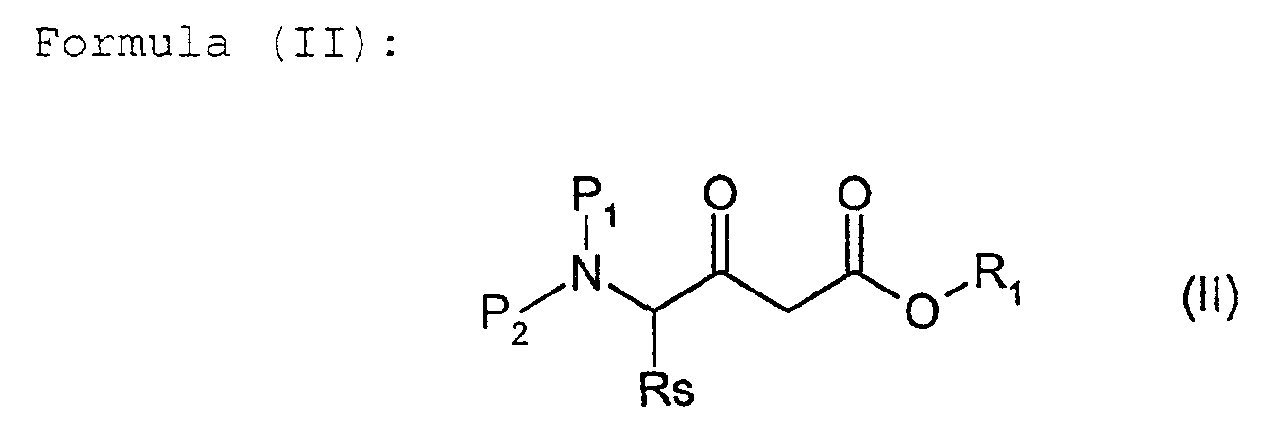
(57) A process for producing a 4-amino-3-oxo-butanoic acid ester of formula (II) is provided.
A compound of formula (I) is reacted with an alkali metal enolate of an acetate. The
compound of formula II can be used in production of 3-amino-2-oxo-1 halogenopropane
derivatives or salts which can be converted to 3-amino-1,2-epxoypropane derivates.
wherein
- Rs represents hydrogen, an optionally substituted alkyl group having from 1 to 10
carbon atoms, an optionally substituted aryl group having from 6 to 15 carbon atoms,
an optionally substituted aralkyl group having from 7 to 20 carbon atoms, or the above-mentioned
groups containing a hetero atom in the carbon skeleton,
- P1 and P2, independently from each other, represent hydrogen or an amino-protecting
group, or P1 and P2 together form a difunctional amino-protecting group, and
- R1 represents an optionally substituted alkyl group having from 1 to 10 carbon atoms,
an optionally substituted aryl group having from 6 to 15 carbon atoms, an optionally
substituted aralkyl group having from 7 to 20 carbon atoms, a trialkylsilyl group
having from 4 to 10 carbon atoms, a phenyldialkylsilyl group having 8 to 10 carbon
atoms or a diphenylalkylsilyl group having 13 to 15 carbon atoms, wherein
- Rs, P1 and P2 are as defined above, and
- E1 represents, as an active carboxy terminal, an ester residue of alkoxy having from
1 to 10 carbon atoms, a phenoxy or benzyloxy group which may have a substituent in
the ring.
|
|
