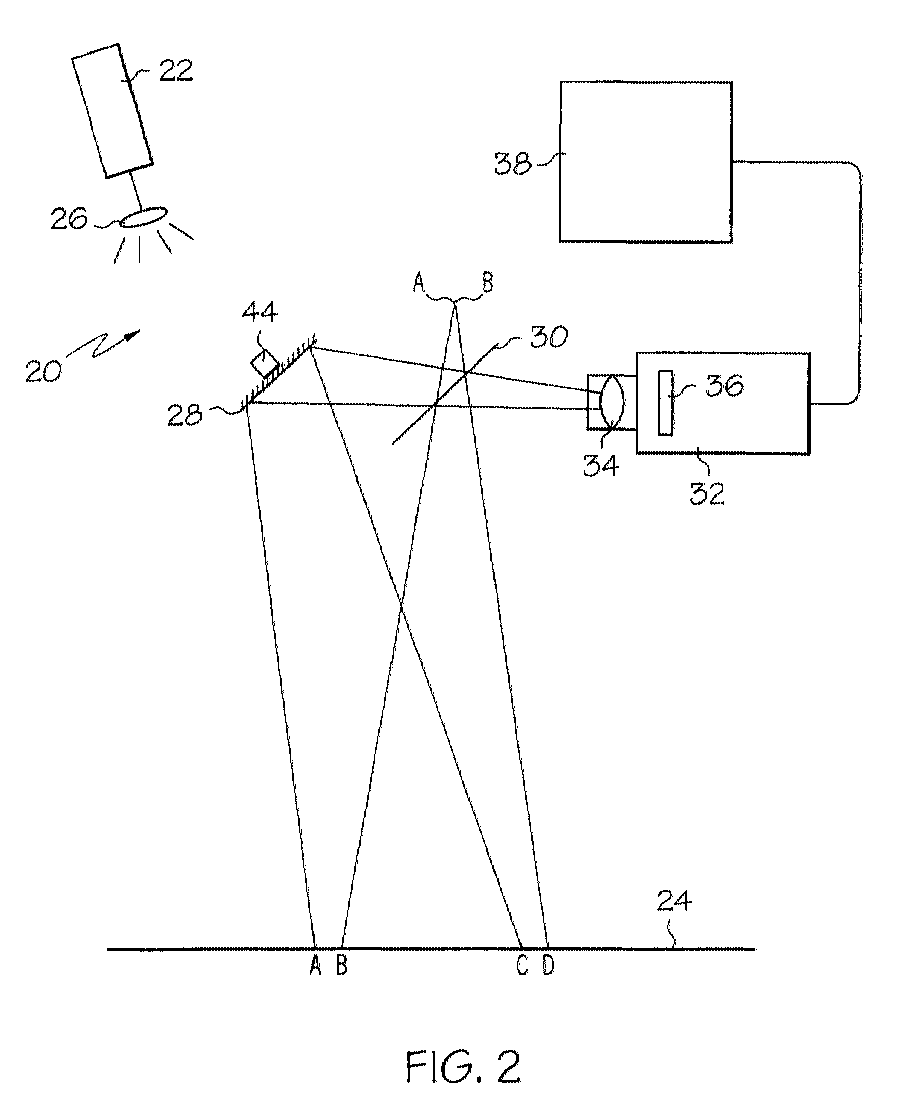
(57) Two laterally-displaced images of a test object interfere with each other to form
a shearogram. Two shearograms, taken while the object is unstressed and stressed,
respectively, are compared electronically to yield a composite interference pattern.
According to the invention, each shearogram is formed by the interference of pairs
of distinct rays of coherent light, reflected from different points on the object.
The first ray of each pair is reflected from the object, strikes a mirror spaced from
the object, and is reflected from the mirror. At the same time, the second ray of
each pair is reflected from the object and strikes a beam splitter that is constructed
as a partially silvered mirror. The beam splitter directs a portion of the second
ray in the same direction as the reflected first ray, and a portion of the first ray
passes through the beam splitter without being reflected. Since the two rays have
the same polarization angle, and are mutually parallel, the rays interfere. A detector
is positioned to receive light from the beam splitter. The detector observes the interference
between pairs of rays over the entire field of view, and the result is an interference
pattern, i.e. a shearogram, formed from the optical interference of the two laterally-displaced
images of the object. The amount of shearing can be controlled by varying the angle
of the mirror. Subsequent computer processing can be used to compare the shearograms
electronically. Such processing can include the averaging of several shearograms,
taken sequentially, with different phase shifts induced by linearly moving the mirror.
|
|
