(57) Based on changing reception conditions, a wireless receiver adapts its demodulation
method during active communications. Phase errors detected in the received signal
indicate current reception conditions, and, optionally, received signal strength serves
as an additional indicator. The receiver supports operation with fully coherent, fully
non-coherent, and partially coherent demodulation. The receiver determines a demodulation
quality indicator based on the phase error signal. The value of the demodulation quality
indicator increases with increasing phase error. When the demodulation quality indicator
is below a first defined threshold, the receiver operates with fully coherent demodulation.
When the demodulation quality indicator is above a second defined threshold, the receiver
operates with fully non-coherent demodulation. For demodulation quality indicator
values between the first and second defined thresholds, the receiver operates with
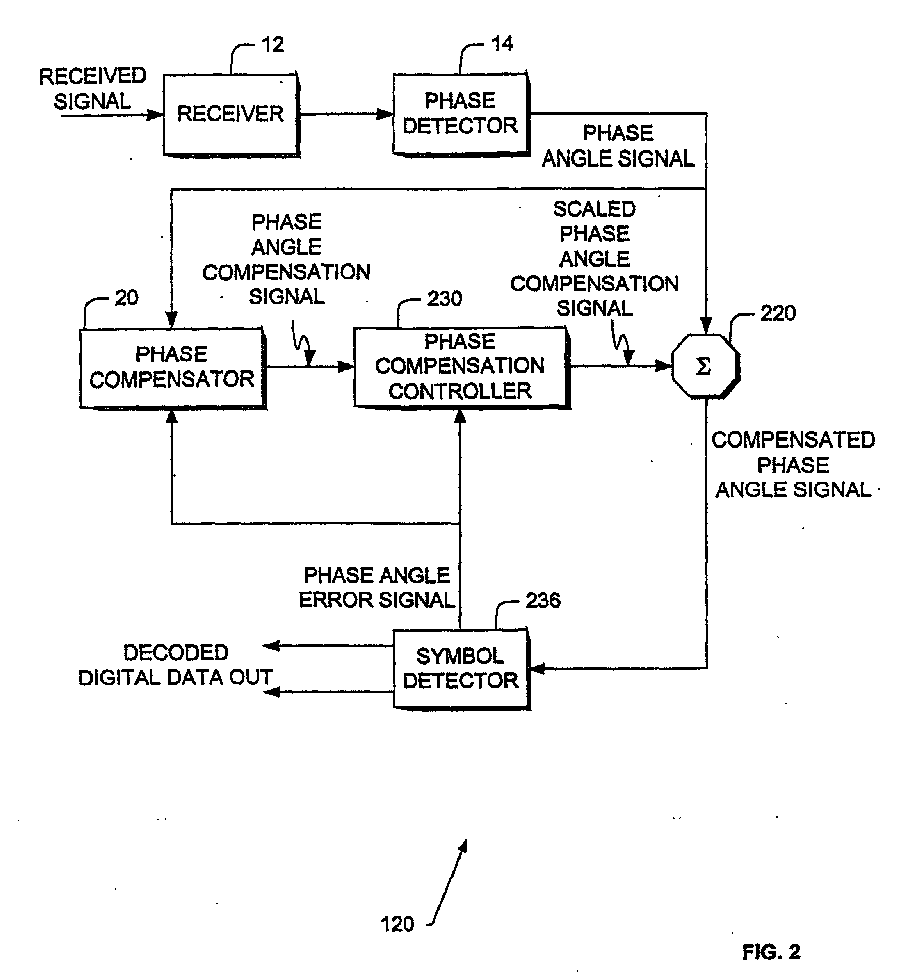
partially coherent demodulation. For partially coherent demodulation, a phase compensation
controller in the receiver applies a scaling factor to the phase compensation signal
used in fully coherent demodulation. The scaling factor fractionally ranges from a
value of one to zero, allowing the phase compensation controller to apply a fractional
amount, none, or all of the phase compensation signal to the received signal. The
phase compensation controller is optionally responsive to received signal strength
in addition to the demodulation quality indicator, and uses the received signal strength
to further refine its fractional scaling of the phase compensation signal.
|
|
