| (19) |
 |
|
(11) |
EP 1 106 025 B1 |
| (12) |
EUROPEAN PATENT SPECIFICATION |
| (45) |
Mention of the grant of the patent: |
|
27.02.2002 Bulletin 2002/09 |
| (22) |
Date of filing: 22.12.1998 |
|
| (86) |
International application number: |
|
PCT/EP9808/529 |
| (87) |
International publication number: |
|
WO 0010/352 (24.02.2000 Gazette 2000/08) |
|
| (54) |
METHOD FOR PROVIDING INTELLIGENT NETWORK SUPPORT TO A MOBILE SUBSCRIBER
VERFAHREN ZUR BEREITSTELLUNG VON INTELLIGENTER NETZWERKUNTERSTÜTZUNG FÜR EINEN MOBILEN
TEILNEHMER
PROCEDE PERMETTANT D'ASSURER UN SUPPORT RESEAU INTELLIGENT A UN ABONNE MOBILE
|
| (84) |
Designated Contracting States: |
|
AT CH DE DK ES FI FR GB GR IT LI NL PT SE |
| (30) |
Priority: |
11.08.1998 EP 98810773
|
| (43) |
Date of publication of application: |
|
13.06.2001 Bulletin 2001/24 |
| (73) |
Proprietor: Swisscom Mobile AG |
|
3050 Bern (CH) |
|
| (72) |
Inventor: |
|
- HUBER, Adriano
CH-6600 Locarno (CH)
|
| (74) |
Representative: BOVARD AG - Patentanwälte |
|
Optingenstrasse 16
3000 Bern 25
3000 Bern 25 (CH) |
| (56) |
References cited: :
EP-A- 0 693 859
WO-A-98/25426
|
WO-A-97/35450
WO-A-98/33343
|
|
| |
|
|
|
|
| |
|
| Note: Within nine months from the publication of the mention of the grant of the European
patent, any person may give notice to the European Patent Office of opposition to
the European patent
granted. Notice of opposition shall be filed in a written reasoned statement. It shall
not be deemed to
have been filed until the opposition fee has been paid. (Art. 99(1) European Patent
Convention).
|
[0001] The invention concerns a method for offering at least some intelligent network (IN)
support to subscribers of a telecommunication network roaming in a visited network,
as well as new means used for this method.
[0002] It is already known that various services such as VPN (Virtual Private Networks)
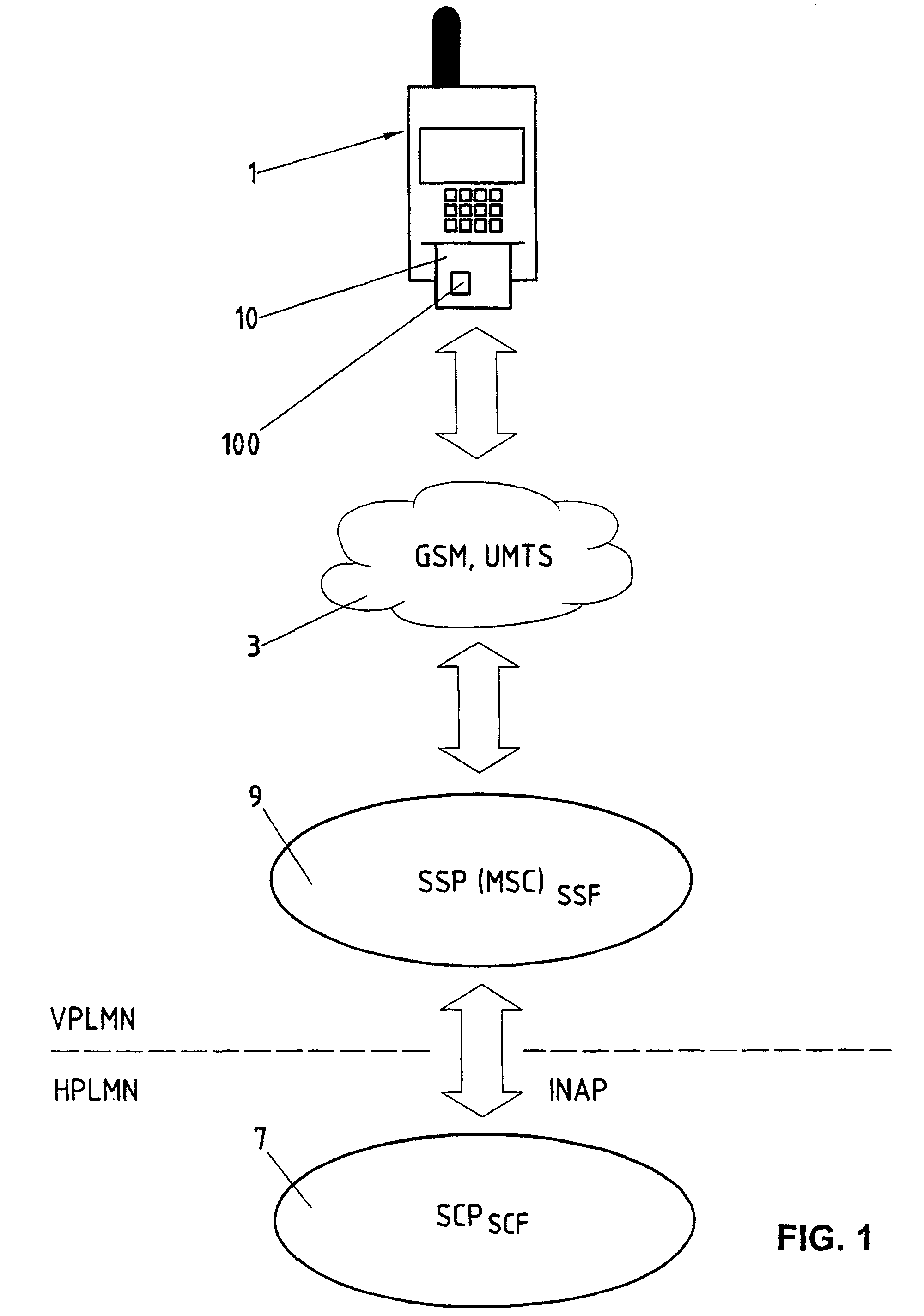
and PNP (Private Numbering Plan) can be provided by intelligent networks. Figure 1
shows a conventional intelligent network. Reference 1 denotes mobile equipment, e.g.
a mobile phone, of a mobile subscriber. An identification module 10, e.g. a SIM-Card,
is connected with the mobile equipment for identifying the subscriber in the network.
The identification module comprises processing and storage means 100.
[0003] The mobile subscriber is registered in his home public land mobile network (HPLMN)
and is shown in Figure 1 roaming in a visited network VPLMN, in this case a conventional
GSM or UMTS network 3. The network 3 comprises mobile switching center (MSC) 9, denoted
as Service Switching Points (SSPs) if they support Service Switching Functions (SSF).
A signalling relationship is established between the SSFs and a Service Control Function
(SCF) in a central platform 7, usually denoted as a Service Control Point (SCP) and
managed by the operator of the HPLMN of the mobile subscriber. The signalling between
the SSP and the SCP may use, for example, INAP messages (intelligent network application
part). The execution of the service (for example the parameters of a call setup) is
remotely controlled by service logic running in the central SCP 7.
[0004] In the prior art, intelligent network services are invoked and interacted with by
means of the service switching functions and trigger conditions in the service profiles
in the switches 9. In a GSM or UMTS mobile network this technology is denoted as Customised
Application Mobile service Execution Logic (CAMEL).
[0005] The patent application WO 98/25426 describes a method and system which allows a user
of a mobile telephone to use a certain intelligent network (IN) service regardless
of whether the network he is currently connected can support said certain services.
According to WO 98/25426 the MSC to which the user is currently logged in detects
when the user sets up a call for which an IN service is needed and sends an IN service
request to a SCP in the home network of the user. If additional information from the
customer is needed the SCP communicates directly with the mobile telephone of the
user via USSD messages. The SCP acts on the messages received and sends a service
response to the MSC the customer is currently logged in to and the MSC acts on the
service response by e.g. setting up a call. The system allows data to be transmitted
directly between the SCP and the user except for the initial and final stages where
IN support is needed by the MSC the customer is currently logged in to.
[0006] The patent application WO 98/33343 describes a subscriber identity module (SIM-card)
in a mobile station and a method for performing smart card functions with this SIM
card. Diversified service combinations may be implemented in the SIM card and may
be used via the mobile station. A feature characteristic of this service combinations
is that part of the series of actions is carried out in the SIM card. The SIM card
is therefore equipped with a processing device.
[0007] The patent application WO 98/35450 describes an intelligent mobile station for use
in a cellular telecommunications network that combines a mobile station component
with a service component in a single functional unit that stores and executes intelligent
network (IN) services. The system allows cellular subscribers to program their mobile
stations to define and implement customized subscriber services.
[0008] This prior art solution has the following disadvantages for subscribers of a HPLMN
roaming in a visited network VPLMN:
- The intelligent network services can only be invoked if the VPLMN-operator has provided
the SSF infrastructure with the associated large amount of processing power and memory
required in that infrastructure. Currently, many network operators do not provide
service switching functions in the switches 9. Consequently, even if there is a roaming
agreement between the HPLMN and the VPLMN, it is usually not possible to invoke IN-services
from a visited network.
- The direct access to the VPLMN infrastructure will require sophisticated commercial
agreements and solutions for the security between the HPLMN and the VPLMN.
[0009] It is one goal of the invention to provide for a new method for providing IN Support
to users of a telecommunication network, especially to subscribers of a telecommunication
network roaming in a foreign network, that overcomes at least some of the drawbacks
of the prior art methods.
[0010] According to the invention, these goals are achieved by a method comprising all the
features of claim 1, and by means comprising all the features of claim 12.
[0011] In a preferred embodiment, these goals are achieved by using standard signalling
messages in the visited network and using service logic running in the mobile equipment
or in the SIM card of the subscriber.
[0012] The mobile equipment can be a mobile phone, a palmtop, a PDA, etc.., or just a smart
card also used for identifying a subscriber in a telecommunication or computer network.
[0013] In a preferred embodiment, the telecommunication network is a GSM or UMTS network,
the signalling messages are standard USSD or SMS messages, and the service logic is
running in a mobile phone or in the SIM-Card of the user, according to the SIM Application
Toolkit (GSM 11.14).
[0014] The invention will be better understood with the help of the following description
of a preferred embodiment and of the annexed drawings that show:
[0015] Figure 1 a prior art intelligent network.
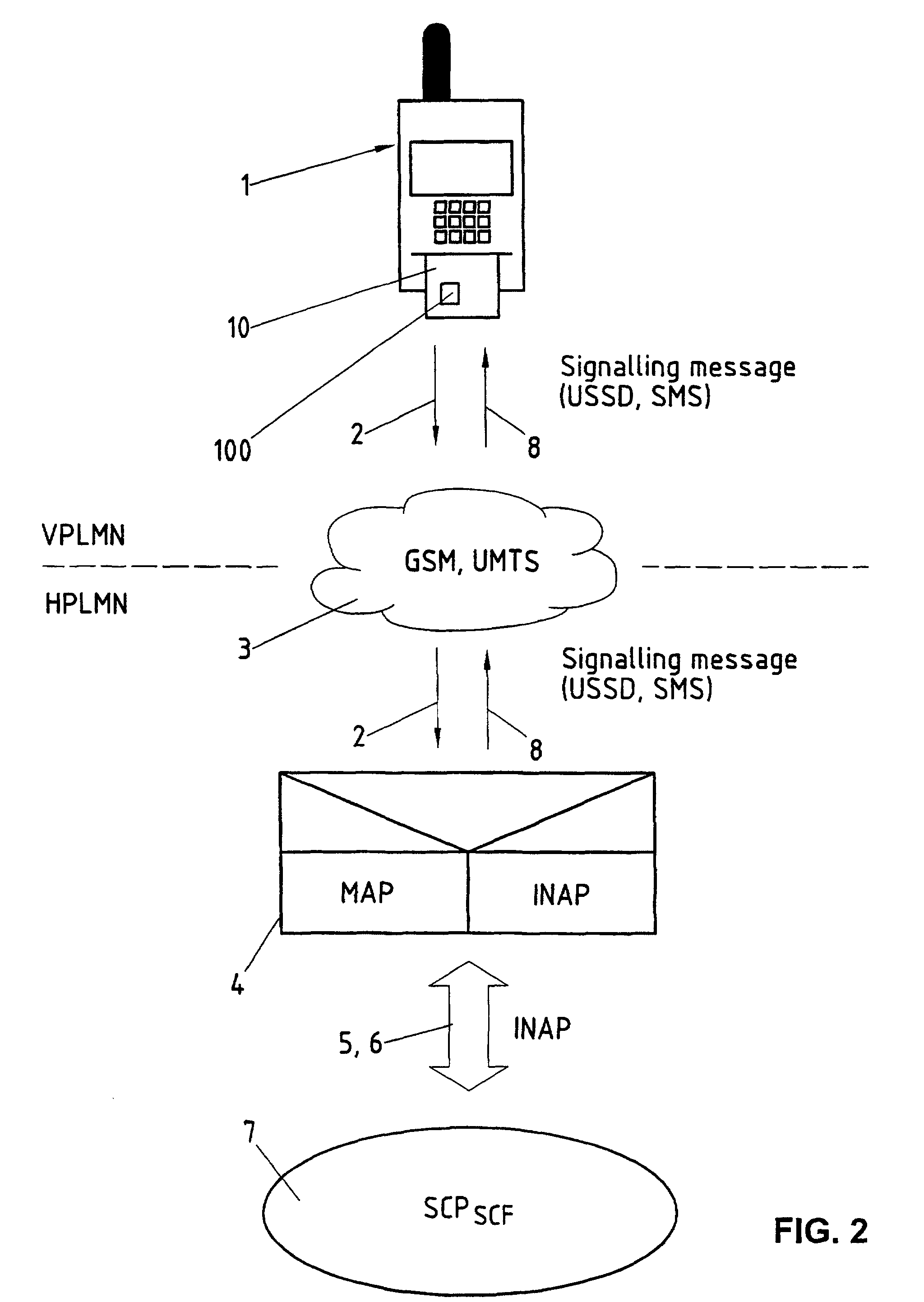
[0016] Figure 2 an intelligent network according to the invention.
[0017] The figure 2 shows the main components of an IN-network according to a preferred
embodiment of the invention; identical features are denoted with the same references
in Figures 1 and 2.
[0018] According to the invention, at least a subset of the service switch functions (SSF)
usually performed by the switches 9 is performed in the mobile equipment 1 and/or
in the SIM-card 10 of the mobile subscriber. The relevant information of the dialogue
(e.g. of the INAP dialogue) between the SSP 9 and the SCP 7 is mapped in short data
messages, e.g. in SMS (short message system), USSD (unstructured supplementary services
data), GPRS or IP messages, 2, 8 exchanged between the mobile equipment 1 or the chip-card
10 and an interworking unit 4 managed by the operator of the HPLMN. The interworking
unit 4 acts as a service switching point SSP, and interacts with a central platform
7, e.g. with a SCP or with any service control platform (e.g. Java-based servers,
Webservers, Corba platform, etc.). The interworking unit can be implemented physically
in the same server as the central platform 7 or in another server.
[0019] This invention can be used to provide any kind of services to the subscriber, but
more specifically for services of the Intelligent Network service type (eg. for Private
Numbering Plans).
[0020] A software module in the SIM-Card 10 (e.g. a GSM-Card with the SIM Application Toolkit,
or a JAVA or OpenCard Identification Card) and/or in the Mobile Equipment 1 (e.g.
in a Java terminal) recognises some events generated by the subscriber or in the network
3. The invention does not depend on the kind of events being intercepted; the software
module can, for example, intercept specific digits being dialled, specific patterns
in the digits, specific keyboard buttons selected on the user interface, digits dialled
during a call, selection of a menu point, busy or unanswered calls, etc. The software
module can by example detect from the pattern of the dialled digits (e.g. if only
4 or 5 digits are dialled) that the call is directed to a virtual private number VPN.
[0021] If the software module recognises that the intercepted event corresponds to a SSF
function not supported by the visited network (VPLMN) or by the responsible MSC in
the HPLMN, it sends a message, e.g. a SMS or USSD data message, or a GPRS or IP-packet,
to an interworking unit 4, requesting a specific service - e.g. a translation of the
dialled number. The interworking unit 4 acts as a SSP and sends an initial message
5 to a central platform, e.g. to the SCP 7, in the HPLMN of the mobile subscriber.
The SCP 7 replies - among others - with a message 6 containing the requested information
or service, e.g. the translated number. Messages between the interworking unit 4 and
the SCP 7 can be exchanged according to the INAP protocol, or to any adapted protocol,
e.g. RMI, CORBA, HTTP, XML, etc.
[0022] Before preparing and sending a signalling message 2 to the interworking unit 4, the
software module in the SIM-card 10 or in the mobile equipment 1 can check the temporary
location information stored in the SIM-card. A signalling message is sent only if
said temporary location information indicates that the mobile subscriber is not registered
with a network providing SSP 9 and a commercial agreement with the HPLMN of the mobile
subscriber. In a various embodiment, a signalling message is prepared in any case
when some events are detected, even if the mobile subscriber is registered in his
HPLMN. In still another embodiment, a signalling message is sent only if the location
information stored in the SIM-card 10 indicates that the mobile subscriber is registered
with his HPLMN or with a VPLMN registered in a list stored in said SIM-card, wherein
said list contains the mobile network codes of at least a subset of all networks providing
service switching functions to the user of the SIM-card.
[0023] The interworking unit 4 receives the message 6 from the SCP 7, extracts the relevant
information from that message (e.g. a translated number), and sends this information
to mobile equipment 1 and/or to the SIM Application in the SIM-card 10 via a short
message 8 (USSD, SMS, GPRS or IP). The mobile equipment 1 (possibly so instructed
by the SIM-Card 10) then performs the desired function, e.g. sets up a call to the
translated number.
[0024] In order to keep the protocol between the interworking unit 4 and the Service Control
Function correct, the interworking unit simulates the SSP 9, and signals to the SCP
7 a termination of the call.
[0025] Thus, the provider of the HPLMN can extend VPN and other IN-Services to VLPMNs that
do not yet support CAMEL or SSF.
1. Method for providing intelligent network support to a mobile subscriber roaming in
a VPLMN (visited public land mobile network) that does not provide SSF (Service Switching
Functions) to this mobile subscriber, comprising:
recognising by the SIM-card (10) or by a function in the mobile equipment (1) of said
mobile subscriber when intelligent network support is requested;
preparing a signalling message (2) by the SIM-card (10) or by a function in the mobile
equipment (1) of said mobile subscriber;
sending said signalling message (2) to an interworking unit (4) which interworking
unit (4) interacts with a SCP (service control point) (7) of the mobile subscriber's
HPLMN (home public land molile network);
preparing one or several messages (5) in said interworking unit (4), which messages
(5) depend on said signalling message (2) received;
sending said messages (5) to said SCP (7);
said SCP (7) replying with a message (6) containing the requested information or service;
said interworking unit (4) extracting the relevant information from said message (6)
received from the SCP (7); and
sending said information via a signalling message (8) to said mobile equipment (1)
and/or to said SIM-card (10).
2. Method according to claim 1, wherein said messages (5) prepared in said interworking
unit (4) and/or said messages (6) received from said SCP (7) are INAP (intelligent
network application part) messages and/or CORBA messages and/or RMI messages and/or
HTTP messages and/or XML messages.
3. Method according to one of the preceding claims, wherein said signalling messages
(2) prepared by said SIM-card (10) or by said function in said mobile equipment (1)
and/or said signalling messages (8) sent to said mobile equipment (1) and/or to said
SIM-card (10) are USSD (unstructured supplementary services data) messages and/or
SMS (short message service) messages and/or GPRS messages and/or IP (internet protocol)
packets.
4. Method according to one of the preceding claims, characterised in that said interworking unit (4) can signal to said SCP (7) some events other than said
mobile subscriber or network generated events.
5. Method according to the preceding claim, characterised in that said interworking (4) unit signals to said SCP (7) the termination of a call from
said mobile subscriber.
6. Method according to one of the preceding claims, wherein said SIM-card (10) or mobile
equipment (1) recognises when a request for call establishment should be directed
to a SCP (7).
7. Method according to the preceding claim, comprising :
intercepting events generated by the mobile subscriber;
recognising when the call is directed to a virtual private number;
preparing and sending a signalling message (2) containing said number to said interworking
unit (4).
8. Method according to the preceding claim, characterised by recognising that the call is to a virtual private number when only a predefined number
of digits are dialled and/or when a specific pattern of digits is dialled.
9. Method according to one of the preceding claims, characterised by checking the temporary location information stored in the SIM-card (10) before preparing
and sending a signalling message (2) to said interworking unit (4).
10. Method according to the preceding claim, characterised by checking if said temporary location information indicates that the mobile subscriber
is registered with a PLMN (public land mobile network) providing SSP (service switching
points) (9) and a commercial agreement with the HPLMN of the mobile subscriber.
11. Method according to one of the preceding claims, characterised in that said mobile equipment (1) performs the desired function upon reception of said signalling
message (8).
12. Means for providing intelligent network support to a mobile subscriber roaming in
a VPLMN (visited public land mobile network), said means comprising processing means
(4, 7), mobile equipment for use in said VPLMN and a SIM-card (10) which can be used
with said mobile equipment (1) for identifying said mobile subscriber,
characterised in that
the mobile equipment (1) and/or the SIM-card (10) comprise means for recognising when
intelligent network support is requested and in that case for preparing and sending a signalling message (2) to the processing means (4,
7);
said processing means (4, 7) comprise an interworking unit (4) for receiving said
signalling message (2) sent from said mobile equipment and/or said SIM-card (10),
for preparing one or several messages (5), which messages (5) depend on said signalling
message (2) received, for sending said messages (5) to a SCP (service control point)
(7) of the mobile subscriber's HPLMN (home public land mobile network) which SCP (7)
replies with a message (6) containing the requested information or service, for extracting
the relevant information from said message (6) received from said SCP (7), and for
sending said information via a signalling message (8) to said mobile equipment (1)
and/or to said SIM-card (10).
13. Means according to claim 12, wherein said signalling messages (2) sent from said mobile
equipment (1) and/or from said SIM-card (10) and/or said signalling messages (8) sent
to said mobile equipment and/or to said SIM-card (10) are USSD (unstructured supplementary
services data) messages and/or SMS (short message service) messages and/or GPRS messages
and/or IP (internet protocol) packets.
14. Means according to claim 12 or 13, wherein said messages (5) sent to said SCP (7)
and/or said messages (6) received from said SCP (7) are INAP (intelligent network
application part) messages and/or CORBA messages and/or RMI messages and/or HTTP messages
and/or XML messages.
15. Means according to one of the claims 12 to 14, wherein said SCP (7) and said interworking
unit (4) are on the same server.
16. Means according to one of the claims 12 to 15, wherein said interworking unit (4)
comprises means for signalling to said SCP (7) some events other than said mobile
subscriber or network generated events.
17. Means according to the preceding claim, characterised in that said interworking unit (4) comprises means for signalling to said SCP (7) the termination
of a call from said mobile subscriber.
18. Means according to one of the claims 12 to 17, wherein at least a subset of the service
switch functions (SSF) is performed in the mobile equipment (1) and/or in the SIM-card
(10) of the mobile subscriber.
19. Means according to the preceding claim, wherein said processor (100) and/or said mobile
equipment (1) can intercept the call digits selected by the mobile subscriber, recognise
when the call is directed to a VPN (virtual private number), and then prepare and
send a said signalling message (2) to said interworking unit (4).
20. Means according to the preceding claim, wherein said processor (100) and/or the mobile
equipment (1) can recognise that the call is directed to a VPN when only a limited
number of digits are dialled and/or when a specific pattern of digits is dialled.
21. Means according to one of the claims 12 to 20, wherein a said signalling message (2)
is prepared and sent by the SIM-card (10) and/or by the mobile equipment (1) only
if said VPLMN does not provide the service switching function requested.
22. Means according to the preceding claim, wherein a signalling message (2) is prepared
and sent by the SIM-card (10) and/or by the mobile equipment (1) to said interworking
unit (4) only if the temporary location information stored in the SIM-card (10) meets
certain criteria.
23. Means according to the preceding claim, wherein a signalling message (2) is not prepared
and not sent by the SIM-card (10) and/or by the mobile equipment (1) to said interworking
unit (4) if said temporary location information indicates that the mobile subscriber
is registered with his HPLMN or with a VPLMN registered in a list stored in said SIM-card
(10).
24. Means according to the preceding claim, wherein said list contains the mobile network
codes of at least a subset of all networks providing service switching functions to
the user of the SIM-card (10).
1. Verfahren zum Erzeugen einer intelligenten Netzwerkunterstützung für einen mobilen
Abonnenten, der sich in einem fremden Mobilfunknetz (VPLMN) umherbewegt, welches Mobilfunknetz
(VPLMN) keine Service Switching Funktionen (SSF) für diesen mobilen Abonnenten aufweist,
umfassend:
Erkennen mittels einer SIM-Karte (10) oder einer Funktion im Mobilfunkgerät (1) des
genannten mobilen Abonnenten, wenn intelligente Netzwerkunterstützung angefordert
wird;
Vorbereiten einer Signalmessage (2) durch die SIM-Karte (10) oder durch eine Funktion
im Mobilfunkgerät (1) des genannten mobilen Abonnenten;
Senden der genannten Signalmessage (2) zu einer Vermittlungseinheit (4), welche Vermittlungseinheit
(4) mit einem Service Control Point (7) des Heimmobilfunknetzes (HPLMN) des mobilen
Abonnenten wechselwirkt;
Vorbereiten eines oder mehrerer Messages (5) in der genannten Vermittlungseinheit
(4), welche Messages (5) auf der genannten, erhaltenen Signalmessage (2) basieren;
Senden der genannten Messages (5) zum genannten Service Control Point (7);
Antworten des genannten Service Control Points (7) mit einer Message (6), welche die
angeforderte Information umfasst;
Extrahieren der relevanten Information der genannten Message (6), die vom Service
Control Point (7) erhalten wurde, durch die genannte Vermittlungseinheit (4); und
Senden der genannten Information über eine Signalmessage (8) zum genannten Mobilfunkgerät
(1) und/oder zur genannten SIM-Karte (10).
2. Verfahren nach Anspruch 1, wobei die genannten Messages (5), die in der genannten
Vermittlungseinheit (4) vorbereitet wurden, und/oder die genannten Messages (6), die
vom genannten Service Control Point (7) erhalten wurde, INAP-Messages und/oder CORBA-Messages
und/oder RMI-Messages und/oder http-Messages und/oder XML-Messages sind.
3. Verfahren nach einem der vorhergehenden Ansprüche, wobei die genannten Signalmessages
(2), die durch die genannte SIM-Karte (10) oder durch eine genannte Funktion im Mobilfunkgerät
(1) vorbereitet wurden, und/oder die genannten Messages (8), die zum genannten Mobilfunkgerät
(1) und/oder zur genannten SIM-Karte (10) geschickt wurden, USSD-Messages und/oder
SMS-Messages und/oder GPRS-Messages und/oder IP-Datenpakete sind.
4. Verfahren nach einem der vorhergehenden Ansprüche, dadurch gekennzeichnet, dass die genannte Vermittlungseinheit (4) andere Signal als die durch den genannten mobilen
Abonnenten oder das Netzwerk erzeugten Signale zum genannten Service Control Point
(7) schickt.
5. Verfahren nach einem der vorhergehenden Ansprüche, dadurch gekennzeichnet, dass die genannte Vermittlungseinheit (4) die Beendigung eines Telefonanrufs des genannten
mobilen Abonnenten zum genannten Service Control Point (7) signalisiert.
6. Verfahren nach einem der vorhergehenden Ansprüche, wobei die genannte SIM-Karte (10)
oder das genannte Mobilfunkgerät (1) erkennt, wann eine Anforderung für einen Telefonanruf
zu einem Service Control Point (7) geschickt werden soll.
7. Verfahren nach dem vorhergehenden Anspruch, umfassend:
Abfangen von Events, welche durch den mobilen Abonnenten erzeugt werden;
Erkennen, wann der Anruf zu einer virtuellen privaten Nummer geleitet wird;
Vorbereiten und Schicken einer Signalmessage (2), welche die Nummer umfasst, zu der
genannten Vermittlungseinheit (4).
8. Verfahren nach dem vorhergehenden Anspruch, dadurch gekennzeichnet, dass es nur ein Anruf zu einer virtuellen Nummer ist, wenn eine vordefinierte Anzahl Ziffern
gewählt wird und/oder wenn ein bestimmtes Zahlenmuster gewählt wird.
9. Verfahren nach einem der vorhergehenden Ansprüche, dadurch gekennzeichnet, dass die temporäre Ortsinformation, die in der SIM-Karte (10) gespeichert wurde, vor dem
Vorbereiten und Senden einer Signalmessage (2) zu der genannten Vermittlungseinheit
(4) überprüft wird.
10. Verfahren nach dem vorhergehenden Anspruch, dadurch gekennzeichnet, dass die temporäre Ortsinformation überprüft wird, ob sie anzeigt, dass der mobile Abonnent
mit einem öffentlichen Mobilfunknetz (PLMN) registriert ist, welches Service Switching
Points (9) und eine kommerzielle Vereinbarung mit dem HPLMN des mobilen Abonnenten
unterstützt.
11. Verfahren nach dem vorhergehenden Anspruch, dadurch gekennzeichnet, dass dieses genannte Mobilfunkgerät (1) die gewünschte Funktion bei Erhalt der genannten
Signalmessage (8) durchführt.
12. Mittel zum Erzeugen einer intelligenten Netzwerkunterstützung für einen mobilen Abonnenten,
der sich in einem fremden Mobilfunknetz (VPLMN) herumbewegt, welche Mittel Verarbeitungsmittel
(4, 7), Mobilfunkmittel (1) für die Benutzung in dem genannten Mobilfunknetz (VPLMN)
und eine SIM-Karte (10) umfasst, welche SIM-Karte (10) zusammen mit den Mobilfunkmitteln
(1) zum Identifizieren des genannten mobilen Abonnenten benutzt werden kann,
dadurch gekennzeichnet,
dass die Mobilfunkmittel (1) und/oder die SIM-Karte (10) Mittel zum Erkennen, wenn intelligente
Netzwerkunterstützung angefordert wird, und in diesem Fall Mittel zum Vorbereiten
und Senden einer Signalmessage (2) zu den Verarbeitungsmitteln (4, 7) enthalten;
dass die Verarbeitungsmittel (4,7) eine Vermittlungseinheit (4) zum Empfangen der genannten
Signalmessage (2) enthalten, welche von den genannten Mobilfunkmitteln und/oder der
genannten SIM-Karte gesendet wurde, zum Vorbereiten einer oder mehrerer Messages (5),
welche Messages (5) auf der genannten, erhaltenen Signalmessage (2) basieren, zum
Senden der genannten Messages (5) zum genannten Service Control Point (7) des Heimmobilfunknetzes
(HPLMN) des mobilen Abonnenten, welche Service Control Point (7) mit einer Message
(6) antwortet, welche Message (6) die angeforderte Information oder Service umfasst,
zum Extrahieren der relevanten Information der genannten Message (6), die vom Service
Control Point (7) erhalten wurde, und zum Senden der genannten Information über eine
Signalmessage (8) zum genannten Mobilfunkgerät (1) und/oder zur genannten SIM-Karte
(10).
13. Mittel nach Anspruch 12, wobei die genannten Signalmessages (2), die von den genannten
Mobilfunkmitteln (1) und/oder durch die genannte SIM-Karte (10) gesendet wurden, und/oder
die Signalmessages (8), zu den genannten Mobilfunkmitteln (1) und/oder zur genannten
SIM-Karte (10) geschickt wurden, USSD-Messages und/oder SMS-Messages und/oder GPRS-Messages
und/oder IP-Datenpakete sind.
14. Mittel nach einem der Ansprüche 12 oder 13, wobei die genannten Messages (5), die
zu dem genannten Service Control Point (7) gesendet wurden, und/oder die genannten
Messages (6), die vom genannten Service Control Point (7) erhalten wurden, INAP-Messages
und/oder CORBA-Messages und/oder RMI-Messages und/oder http-Messages und/oder XML-Messages
sind.
15. Mittel nach einem der Ansprüche 12 bis 14, wobei der genannte Service Control Point
(7) und die genannte Vermittlungseinheit (4) auf dem gleichen Server sind.
16. Mittel nach einem der Ansprüche 12 bis 15, wobei die genannte Vermittlungseinheit
(4) Mittel umfasst zum Erzeugen von Signalen zum genannten Service Control Point (7),
welche anders sind als die durch den genannten mobilen Abonnenten oder das Netzwerk
erzeugten Signale.
17. Mittel nach dem vorhergehenden Anspruch, dadurch gekennzeichnet, dass die genannte Vermittlungseinheit (4) Mittel umfasst zum Signalisieren der Beendigung
eines Telefonanrufs des genannten mobilen Abonnenten zum genannten Service Control
Point (7).
18. Mittel nach einem der Ansprüche 12 bis 17, wobei mindestens ein Teil der Service Switching
Funktionen (SSF) in den Mobilfunkmitteln und/oder in der SIM-Karte (10) des mobilen
Abonnenten durchgeführt wird.
19. Mittel nach dem vorhergehenden Anspruch, wobei der genannte Prozessor (100) und/oder
die Mobilfunkmittel (1), die die Nummer abfangen, welche durch den mobilen Abonnenten
gewählt wurde, erkennen, wann der Anruf zu einer virtuellen privaten Nummer geleitet
wird, und dann eine Signalmessage (2) zu der genannten Vermittlungseinheit (4) schicken,
welche Signalmessage (2) die Nummer umfasst.
20. Mittel nach dem vorhergehenden Anspruch, wobei der genannte Prozessor (100) und/oder
die Mobilfunkmittel (1) erkennen, dass der Anruf zu einer virtuellen privaten Nummer
geleitet wird, wenn nur eine begrenzte Anzahl Ziffern gewählt werden und/oder wenn
ein bestimmtes Zahlenmuster gewählt wird.
21. Mittel nach einem der Ansprüche 12 bis 20, wobei eine genannte Signalmessage (2) mit
der SIM-Karte (10) und/oder den Mobilfunkmitteln (1) nur vorbereitet und gesendet
wird, falls das genannte fremde Mobilfunknetz (VPLMN) keine Service Switching Funktionen
unterstützt.
22. Mittel nach dem vorhergehenden Anspruch, wobei eine genannte Signalmessage (2) für
die genannte Vermittlungseinheit (4) mit der SIM-Karte (10) und/oder den Mobilfunkmitteln
(1) nur vorbereitet und gesendet wird, falls die in der SIM-Karte (10) temporär gespeicherte
Information bestimmten Kriterien genügt.
23. Mittel nach dem vorhergehenden Anspruch, wobei eine genannte Signalmessage (2) für
die genannte Vermittlungseinheit (4) mit der SIM-Karte (10) und/oder den Mobilfunkmitteln
(1) nicht vorbereitet und nicht gesendet wird, falls die temporäre Ortsinformation
anzeigt, dass der mobile Abonnent bei seinem HPLMN registriert ist oder ein fremdes
Mobilfunknetz (VPLMN) in einer Liste, welche in der genannten SIM-Karte (10) gespeichert
ist, registriert ist.
24. Mittel nach dem vorhergehenden Anspruch, wobei die genannte Liste die Mobilfunknetzcodes
von mindestens einem Teil aller Netzwerke, die Service Switching Funktionen (SSF)
für den Benutzer der SIM-Karte (10) unterstützen, umfasst.
1. Procédé de fourniture d'un appui de réseau intelligent à un abonné mobile qui se déplace
dans un VPLMN (visited public land (terrestre) mobile network (réseau) qui ne fournit
pas de SSF (Service Switching Functions, fonctions de commutation de services) à cet
abonné mobile, comprenant :
la reconnaissance, par la carte SIM (10) ou par une fonction située dans l'équipement
mobile (1), de l'abonné mobile quand un appui de réseau intelligent est demandé ;
la préparation d'un message de signalisation (2) par la carte SIM (10) ou par une
fonction située dans l'équipement mobile (1) de l'abonné mobile ;
l'envoi du message de signalisation (2) à une unité d'interfonctionnement (4) qui
agit de concert avec un SCP (service control point) (7) du HPLMN (home public land
mobile network, réseau mobile terrestre public (RMTP) de rattachement) de l'abonné
mobile ;
la préparation d'un ou plusieurs messages (5) dans l'unité d'interfonctionnement (4),
ces messages (5) dépendant du message de signalisation (2) reçu ;
l'envoi desdits messages (5) au SCP (7) mentionné,
ce SCP (7) répondant par un message (6) qui contient l'information ou le service demandés
;
l'unité d'interfonctionnement (4) extrayant l'information voulue du message (6) reçu
du SCP (7), et
l'envoi de de l'information mentionnée, au moyen d'un message de signalisation (8),
à l'équipement mobile (1) ou à la carte SIM (10), ou aux deux.
2. Procédé selon la première revendication, dans lequel les messages (5) préparés dans
l'unité d'interfonctionnement (4) ou les messages (6) reçus du SCP (7), ou les uns
et les autres, sont des messages INAP (intelligent network (réseau) application part)
ou des messages CORBA, ou des messages RMI, ou des messages HTTP, ou des messages
XML, ou une combinaison de ces catégories.
3. Procédé selon l'une des revendications précédentes, dans lequel les messages de signalisation
(2) préparés par la carte SIM (10) ou par la fonction de l'équipement mobile (1) ou
par les messages de signalisation (8) envoyés à l'équipement mobile (1) ou à la carte
SIM (10) sont des messages USSD (unstructured supplementary services data (données))
ou des messages SMS (short (courts) message service) ou des message GPRS ou des paquets
IP (Internet protocol), ou une combinaison quelconque de ces catégories.
4. Procédé selon l'une des revendications précédentes, caractérisé en ce que l'unité d'interfonctionnement (4) peut envoyer au SCP (7) des signaux l'informant
d'autres évènements que les évènements engendrés par l'abonné mobile ou par le réseau.
5. Procédé selon la revendication précédente, caractérisé en ce que l'unité d'interfonctionnement (4) envoie au SCP (7) un signal indiquant qu'il est
mis fin à une communication en provenance de l'abonné mobile.
6. Procédé selon l'une des revendications précédentes, avec lequel la carte SIM (10)
ou l'équipement mobile (1) reconnaît les demandes d'établissement de communications
qui doivent être dirigées vers un SCP (7).
7. Procédé selon la revendication précédente, comprenant :
l'interception d'évènements engendrés par l'abonné mobile ;
la reconnaissance des communications adressées à un numéro privé virtuel ;
la préparation et l'envoi d'un message de signalisation (2), contenant le numéro en
question, à l'unité d'interfonctionnement (4).
8. Procédé selon la revendication précédente, caractérisé par la reconnaissance du fait que la communication est destinée à un numéro privé virtuel
quand seulement un nombre déterminé de chiffres est composé ou quand un ensemble particulier
de chiffres est composé, ou les deux.
9. Procédé selon l'une des revendications précédentes, caractérisé par le contrôle des renseignements sur l'emplacement temporaire qui sont enregistrés
dans la carte SIM (10), avant la préparation et l'envoi d'un message de signalisation
(2) à l'unité d'interfonctionnement (4).
10. Procédé selon la revendication précédente, caractérisé par le contrôle des renseignements sur l'emplacement temporaire pour savoir s'ils indiquent
que l'abonné mobile est inscrit auprès d'un PLMN (public land mobile network, réseau
mobile terrestre public) fournissant des SSP (service switching points, points de
commutation du service) (9) et un accord commercial avec le HPLMN de l'abonné mobile.
11. Procédé selon l'une des revendications précédentes, caractérisé en ce que l'équipement mobile (1) exécute la fonction désirée quand il a reçu le message de
signalisation (8).
12. Moyens de fourniture d'un appui de réseau intelligent à un abonné mobile qui se déplace
dans un VPLMN (visited public land mobile network, réseau mobile terrestre public
visité), ces moyens comprenant des moyens de traitement (4, 7), un équipement mobile
destiné à l'utilisation dans ce VPLMN et une carte SIM (10) pouvant être utilisée
avec l'équipement mobile (1) pour identifier l'abonné mobile,
caractérisés en ce que
l'équipement mobile (1) ou la carte SIM (10), ou les deux, comportent des moyens permettant
de reconnaître quand un appui de réseau intelligent est demandé et, dans ce cas, de
préparer et d'envoyer un message de signalisation (2) aux moyens de traitement (4,
7) ;
les moyens de traitement (4, 7) comprennent une unité d'interfonctionne-ment (4) servant
à recevoir le message de signalisation (2) envoyé par l'équipement mobile ou par la
carte SIM (10), ou par les deux, pour préparer un ou plusieurs messages (5), messages
(5) qui dépendent du message de signalisation (2) reçu, pour envoyer ces messages
(5) à un SCP (service control point) (7) du HPLMN (home public land mobile network,
réseau mobile terrestre public de rattachement) de l'abonné mobile, ce SCP (7) répondant
par un message (6) contenant les renseignements ou le service demandés, pour extraire
les renseignements voulus du message (6) reçu du SCP (7) et pour envoyer ces renseignements,
au moyen d'un message de signalisation (8), à l'équipement mobile (1) ou à la carte
SIM (10), ou aux deux.
13. Moyens selon la revendication 12, dans lesquels les messages de signalisation (2)
envoyés par l'équipement mobile (1) ou par la carte SIM (10), ou par les deux, ou
les messages de signalisation (8) envoyés à l'équipement mobile ou à la carte SIM
(10), ou aux deux, ou les uns et les autres à la fois, sont des messages USSD (unstructured
supplementary services data (données)) ou des messages SMS (short message service)
ou des messages GPRS ou des paquets IP (Internet protocol), ou une combinaison quelconque
d'entre eux.
14. Moyens selon la revendication 12 ou 13, avec lesquels les messages (5) envoyés au
SCP (7) ou les messages (6) reçus du SCP (7), ou les uns et les autres, sont des messages
INAP (intelligent network application part, partie application d'un réseau intelligent)
ou des messages CORBA, ou des messages RMI, HTTP ou XML, ou les uns et les autres
en combinaison quelconque.
15. Moyens selon l'une des revendications 12 à 14, avec lesquels le SCP (7) et l'unité
d'interfonctionnement (4) sont sur le même serveur.
16. Moyens selon l'une des revendications 12 à 15, avec lesquels l'unité d'interfonctionnement
(4) comprend des moyens servant à signaler au SCP (7) des évènements autres que ceux
engendrés par l'abonné mobile ou le réseau.
17. Moyens selon la revendication précédente, caractérisés en ce que l'unité d'interfonctionnement (4) comprend des moyens servant à signaler au SCP (7)
la fin d'une communication partie de l'abonné mobile.
18. Moyens selon l'une des revendications 12 à 17, avec lesquels au moins un sous-ensemble
des fonctions de commutation de services (SSF, service switch functions) est exécuté
dans l'équipement mobile (1) ou dans la carte SIM (10) de l'abonné mobile, ou dans
les deux.
19. Moyens selon la revendication précédente, dans lesquels le processeur (100) ou l'équipement
mobile (1), ou les deux, peuvent intercepter les chiffres d'appel choisis par l'abonné
mobile, reconnaître les cas où l'appel est adressé à un VPN (virtual private number),
et ensuite préparer et envoyer un message de signalisation (2) à l'unité d'interfonctionnement
(4).
20. Moyens selon la revendication précédente, dans lesquels le processeur (100) ou l'équipement
mobile (1), ou les deux, peuvent reconnaître que l'appel est adressé à un VPN quand
seulement un nombre limité de chiffres a été composé ou quand des chiffres sont composés
suivant un modèle particulier, ou les deux.
21. Moyens selon l'une des revendications 12 à 20, dans lesquels un message de signalisation
(2) est préparé et envoyé par la carte SIM (10) ou par l'équipement mobile (1), ou
par les deux, seulement si le VPLMN ne fournit pas la fonction de commutation de services
qui est nécessaire.
22. Moyens selon la revendication précédente, dans lesquels un message de signalisation
(2) est préparé et envoyé par la carte SIM (10) ou par l'équipement mobile (1), ou
par les deux, à l'unité d'interfonctionnement (4), seulement si les informations sur
l'emplacement temporaire stockées dans la carte SIM (10) correspondent à certains
critères.
23. Moyens selon la revendication précédente, dans lesquels un message de signalisation
(2) n'est ni préparé ni envoyé par la carte SIM (10) ou par l'équipement mobile (1),
ou par les deux, à l'unité d'interfonctionnement (4), si les informations sur l'emplacement
temporaire indiquent que l'abonné mobile est inscrit avec son HPLMN ou avec un VPLMN
enregistré sur une liste mise en mémoire dans la carte SIM (10).
24. Moyens selon la revendication précédente, dans lesquels la liste contient les codes
de réseaux mobiles d'au moins un sous-ensemble de tous les réseaux fournissant des
fonctions de commutation de services à l'utilisateur de la carte SIM (10).