(57) The control of particle characteristics of flame made nanostructured powders is investigated
at high production rates addressing the required safety concerns. The influence of
increasing the fuel and production rate, burner configuration and total oxidant flow
on particle size morphology and composition is presented for synthesis of silica in
a commercial oxy-hydrogen burner.
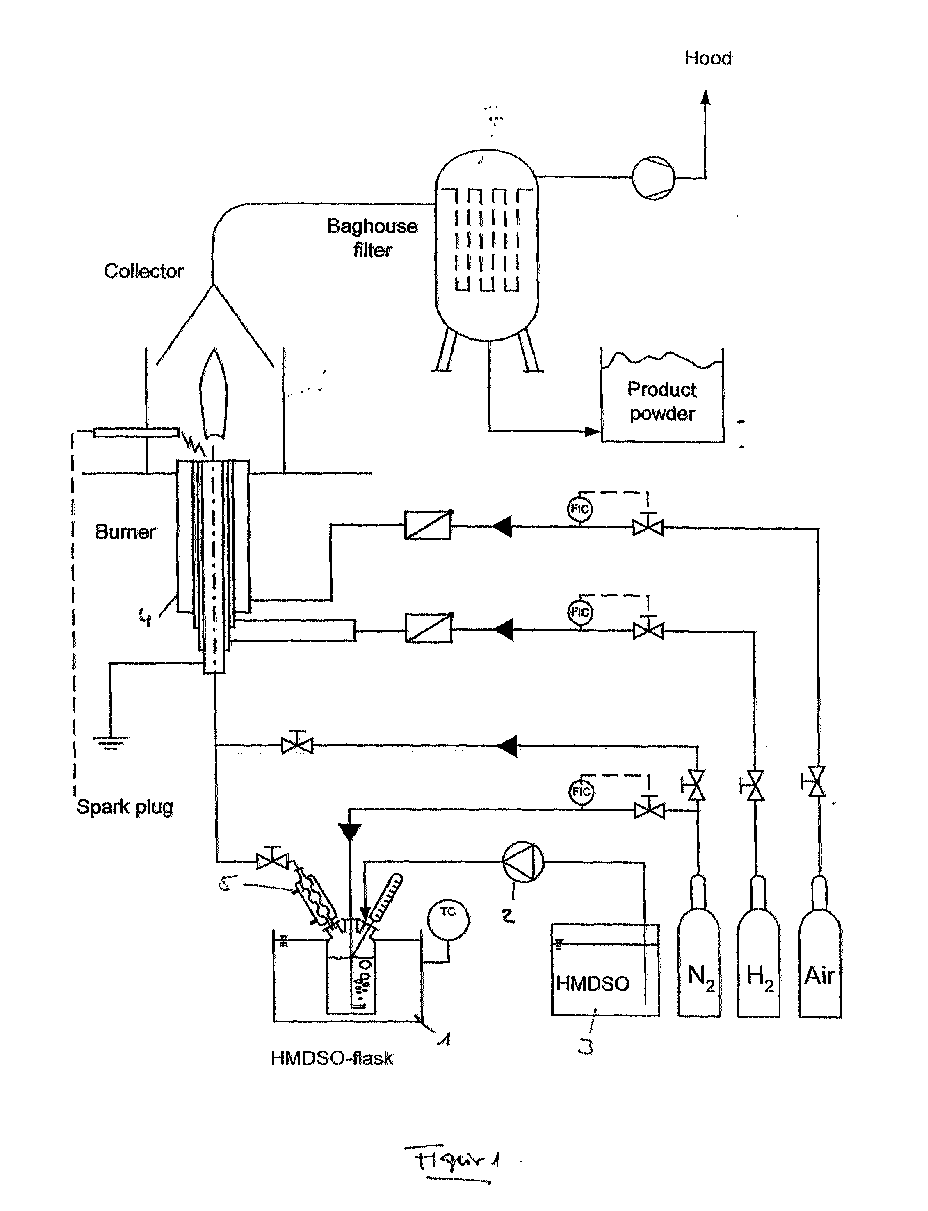
Hexamethyldisiloxane (HMDSO) is used as silica source as it has been shown that silica
particles with special characteristics can be made by controlling the adiabatic flame
temperature in premixed flame reactors (Briesen et al., 1998). The particle concentration
is controlled by the HMDSO-flask temperature and carrier gas flow rate. A hydrogen-air
burner is modified to a diffusion flame reactor to make pure silica and composite
silica-carbon particles. Silica production rates were increased from 125 g/h to 300
g/h, while higher production rates are achievable when increasing the HMDSO flask
temperature. The specific surface area of the product silica particles reached 250
m2/g at a silica production rate of 125 g/h and 150 m2/g at a rate of 300 g/h, respectively. The required high powder collection rates are
achieved using industrial baghouse filter units which are cleaned periodically by
air-pressure shocks. Also, the evaluation of the soot content of the product carbon-silica
particles with thermogravimetric analysis is presented.
|
|
