|
(11) | EP 1 133 356 B1 |

| (12) | EUROPEAN PATENT SPECIFICATION |
|
|
| (54) |
HYDROFORMYLATION PROCESS USING CHLOROPHOSPHITE-METAL CATALYST SYSTEM HYDROFORMYLIERUNGSVERFAHREN UNTER VERWENDUNG EINES CHLORPHOSPHIT-METALL KATALYSATORSYSTEMS PROCEDE D'HYDROFORMYLATION UTILISANT UN SYSTEME DE CATALYSEUR METALLIQUE A BASE DE CHLOROPHOSPHITE |
|
|
|||||||||||||||||||||||||||||||
| Note: Within nine months from the publication of the mention of the grant of the European patent, any person may give notice to the European Patent Office of opposition to the European patent granted. Notice of opposition shall be filed in a written reasoned statement. It shall not be deemed to have been filed until the opposition fee has been paid. (Art. 99(1) European Patent Convention). |
[0001] This invention pertains to certain novel catalyst systems comprising at least one chlorophosphite ligand compound in combination with a transition metal and the use of the catalyst system in the hydroformylation of various α-olefins to produce aldehydes.
[0002] The hydroformylation reaction, also known as the oxo reaction, is used extensively in commercial processes for the preparation of aldehydes by the reaction of one mole of an olefin with one mole each of hydrogen and carbon monoxide. The most extensive use of the reaction is in the preparation of normal- and iso-butyraldehyde from propylene. The ratio of the amount of the normal aldehyde product to the amount of the iso aldehyde product typically is referred to as the normal to iso (N:I) or the normal to branched (N:B) ratio. In the case of propylene, The normal- and iso-butyraldehydes obtained from propylene are in turn converted into many commercially-valuable chemical products such as, for example, n-butanol, 2-ethylhexanol, n-butyric acid, iso-butanol, neo-pentyl glycol, 2,2,4-trimethyl-1,3-pentanediol, the mono-isobutyrate and di-isobutyrate esters of 2,2,4-trimethyl-1,3-pentanediol. The hydroformylation of higher α-olefins such as 1-octene, 1-hexene and 1-decene yield aldehyde products which are useful feedstocks for the preparation of detergent alcohols and plasticizer alcohols. The hydroformylation of substituted olefins such as allyl alcohol is useful for the production of other commercially valuable products such as 1,4-butanediol.
[0003] U.S. Patent 3,239,566, issued March 8, 1966, to Slaugh and Mullineaux, discloses a low pressure hydroformylation process using trialkylphosphines in combination with rhodium catalysts for the preparation of aldehydes. Trialkylphosphines have seen much use in industrial hydroformylation processes but they typically produce a limited range of products and, furthermore, frequently are very oxygen sensitive. U.S. Patent 3,527,809, issued September 8, 1970 to Pruett and Smith, discloses a low pressure hydroformylation process which utilizes triarylphosphine or triarylphosphite ligands in combination with rhodium catalysts. The ligands disclosed by Pruett and Smith, although used in many commercial applications, have limitations due to oxidative and hydrolytic stability problems. Since these early disclosures, numerous improvements have been made to increase the catalyst stability, catalyst activity and the product ratio with a heavy emphasis on yielding linear aldehyde product. A wide variety of monodentate phosphite and phosphine ligands, bidentate ligands such as bisphosphites and bisphosphines as well as tridentate and polydentate ligands have been prepared and disclosed in the literature. Notwithstanding the substantial progress which has been made in the area of hydroformylation catalyst systems and chemistry, there still exists a need to develop, more stable, less expensive and more selective hydroformylation catalysts.
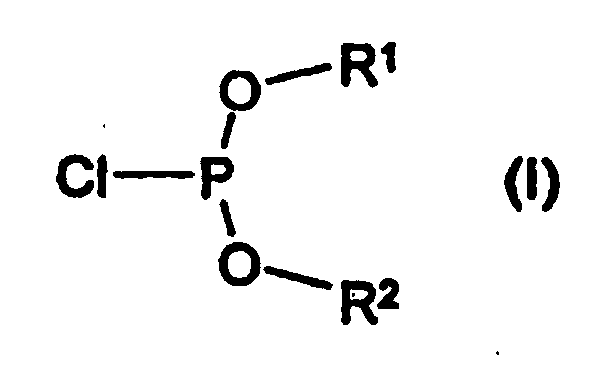
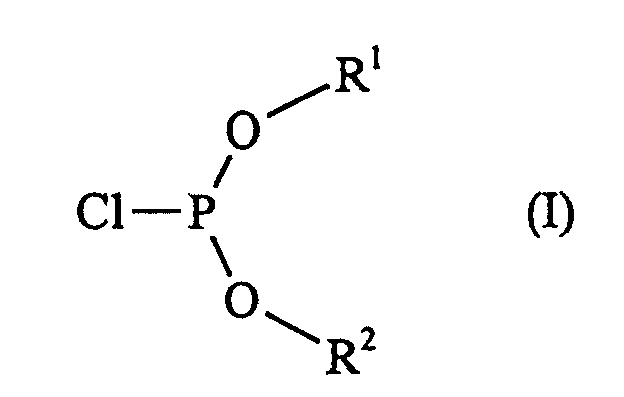
[0004] We have discovered that chlorophosphite diester compounds are useful as ligands in catalyst systems for the conversion of olefins to aldehydes. The chlorophosphite ligands of the present invention can be substituted for, or used in combination with, known phosphite and/or phosphine ligands in a wide variety of catalyst systems utilizing a transition metal as the primary catalyst component. Thus, one embodiment of the present invention is a novel catalyst system comprising a combination of one or more transition metals selected from the Group VIII metals and rhenium and one or more chlorophosphite compounds (also known as chlorophosphonites) having the general formula
wherein R1 and R2 are aromatic hydrocarbyl radicals which contain a total of up to about 40 carbon atoms and wherein the mole ratio of chlorophosphite ligand to rhodium is at least 1:1. The novel catalyst systems may be used in a wide variety of transition metal-catalyzed processes such as, for example, hydroformylation, hydrogenation, isomerization, hydrocyanation, hydrosilation, carbonylations, oxidations, acetoxylations, epoxidations, hydroamination, dihydroxylation, cyclopropanation, telomerizatons, carbon hydrogen bond activation, olefin metathesis, olefin dimerizations, oligomerizations, olefin polymerizations, olefin-carbon monoxide copolymerizations, butadiene dimerization and oligomerization, butadiene polymerization, and other carbon-carbon bond forming reactions such as the Heck reaction and arene coupling reactions. The catalyst systems comprising rhodium as the transition metal are especially useful for the hydroformylation of olefins to produce aldehydes and, therefore, are preferred.
[0005] A second embodiment of our invention concerns a novel catalyst solution comprising (1) one or more of the chlorophosphite ligands of formula (I), (2) rhodium and (3) a hydroformylation solvent. This embodiment comprises a solution of the active catalyst in which a carbonylation process such as the hydroformylation of an ethylenically-unsaturated compound may be carried out.
[0006] A third embodiment of the present invention pertains to a hydroformylation process utilizing the above-described catalyst systems and solutions. The process of the present invention therefore includes a process for preparing an aldehyde which comprises contacting an olefin, hydrogen and carbon monoxide with a solution of a catalyst system comprising rhodium and a chlorophosphite ligand of formula (I) wherein the mole ratio of phosphine ligand:rhodium is at least 1:1.
[0007] It is generally recognized in the art that the presence of halogens in hydroformylation catalysts normally reduces substantially the activity of the catalyst. The literature contains numerous references and citations in which halogens are identified at poisons in the rhodium catalyzed hydroformylation process. For example, Falbe ("New Syntheses with Carbon Monoxide" edited by J. Falbe, 1980, Springer-Verlag) on page 73 lists halogens as poisons for hydroformylation catalysts. U.S. Patents 5,059,710, 4,595,753, 4,605,781 and 4,642,395 teach that halogen atoms generally are detrimental to the activity of hydroformylation catalyst systems. U.S. Patent 4,871,878 discloses that halogens may be present in the organic structure of a ligand, but these halogen-containing substituents typically have the halogen located in a stable, non-hydrolyzable group, away from the phosphorus center and sufficiently far removed from the rhodium atom that no interactions can occur. For example, U.S. Patent 4,871,878 teaches the use of halogen substituted tribenzylphosphine ligands except those cases where the chlorine, bromine or iodine are in the positions adjacent to the benzylic group.
[0008] Reactions of halophosphorus compounds with hydroxylic materials or water are well known in the chemical literature. Cotton and Wilkinson ("Advanced Inorganic Chemistry", 3rd Edition, 1972, Wiley and Sons, pages 374-375) describe the phosphorus halides as materials which are hydrolyzed, sometimes violently, in the presence of water. Kosolapoff reported many years ago ("Organophosphorus Compounds", 1950, Wiley and Sons, pages 180 to 199) that the halophosphites are unstable to heat, and react with water, alcohols, and phenols. Chlorophosphites have been characterized as "Rapidly hydrolyzed" and "Reacts violently with water" ("Dictionary Of Organophosphorus Compounds", edited by Edmundson, 1988, Chapman and Hall, pages 144 and 149, entries C-00063 and C-00092). The reactions with the hydroxylic materials generate phosphoric acid esters as the initial product and hydrogen halides. Hydrogen halides have been described as poisons to many transition metal-catalyzed processes such as the hydroformylation reaction. Therefore, the presence of any phosphorus halide species in a hydroformylation reaction usually is deemed undesirable.
[0009] Contrary to the teachings of the prior art, we have found that the chlorophosphite ester compounds having the formula
function as effective ligands when used in combination with transition metals to form catalyst systems for the processes described hereinabove. The hydrocarbyl groups represented by R1 and R2 may be the same or different, separate or combined, and are selected from unsubstituted and substituted aryl groups containing a total of up to about 40 carbon atoms. The total carbon content of substituents R1 and R2 preferably is in the range of about 12 to 35 carbon atoms.
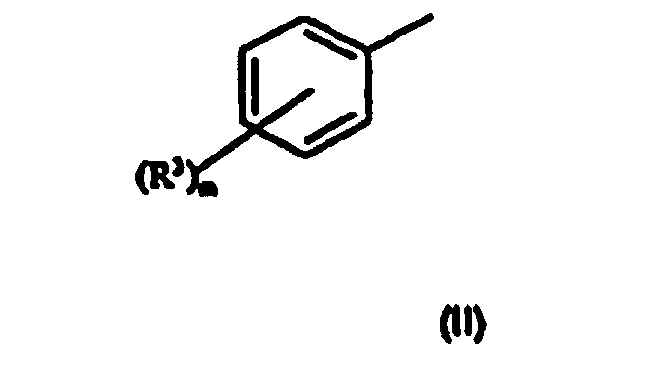
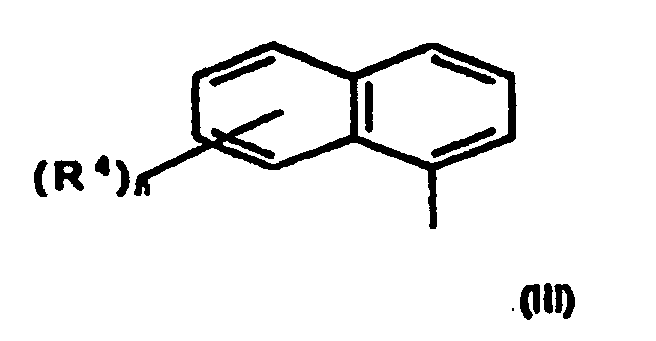
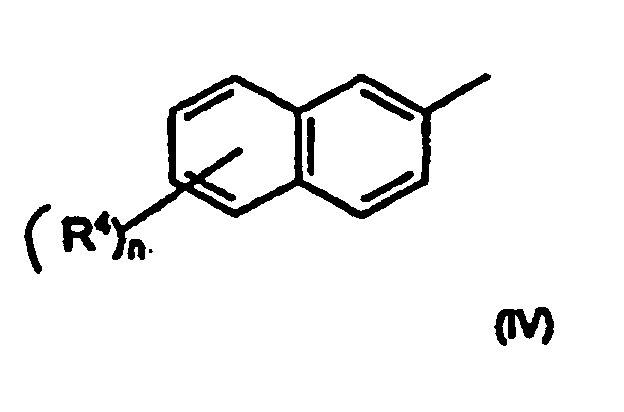
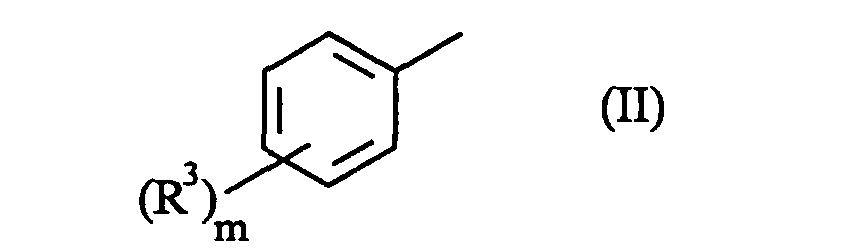
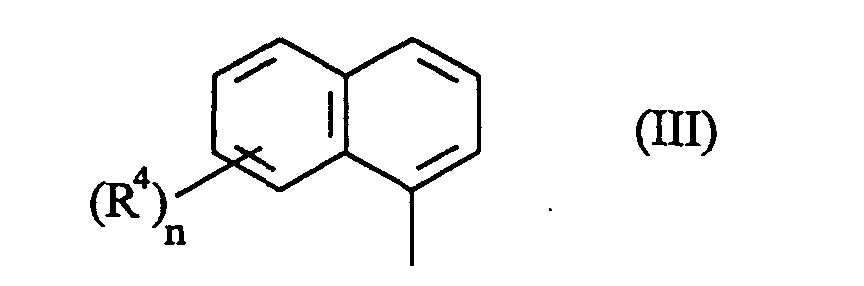
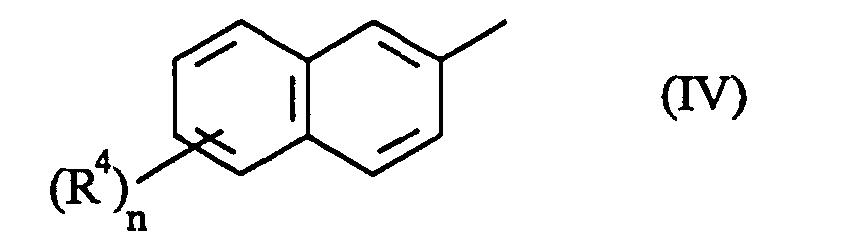
[0010] Examples of the aryl groups which R1 and/or R2 individually can represent include carbocyclic aryl such as phenyl, naphthyl, anthracenyl and substituted derivatives thereof. Examples of the carbocyclic aryl groups which R1 and/or R2 individually can represent are the radicals having the formulas
wherein R3 and R4 may represent one or more substituents independently selected from alkyl, alkoxy, halogen, cycloalkoxy, formyl, alkanoyl, cycloalkyl, aryl, aryloxy, aroyl, carboxyl, carboxylate salts, alkoxycarbonyl, alkanoyloxy, cyano, sulfonic acid, sulfonate salts and the like. The alkyl moiety of the aforesaid alkyl, alkoxy, alkanoyl, alkoxycarbonyl and alkanoyloxy groups typically contain up to about 8 carbon atoms. Although it is possible for m to represent 0 to 5 and for n to represent 0 to 7, the value of each of m and n usually will not exceed 2. R3 and R4 preferably represent halogens and/or lower alkyl groups, i.e., straight-chain and branched-chain alkyl of up to about 4 carbon atoms, and m and n each represent 0, 1 or 2.
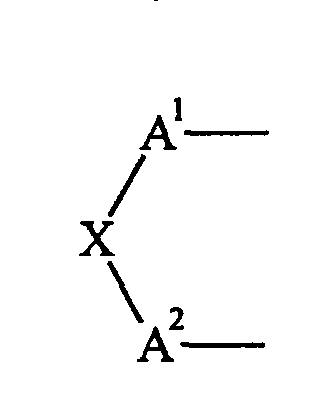
[0011] Alternatively, R1 and R2 in combination or collectively may represent a divalent arylene group. The divalent groups which R1 and R2 collectively may represent include radicals having the formula
wherein
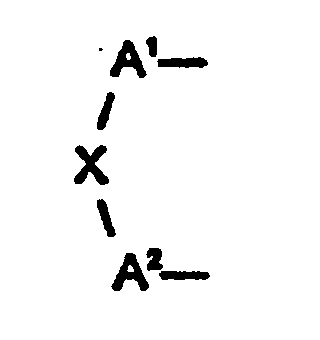
each of A1 and A2 is an arylene radical, e.g., a divalent, carbocyclic aromatic group containing 6 to 10 ring carbon atoms, wherein each ester oxygen atom of chlorophosphite (I) is bonded to a ring carbon atom of A1 and A2;
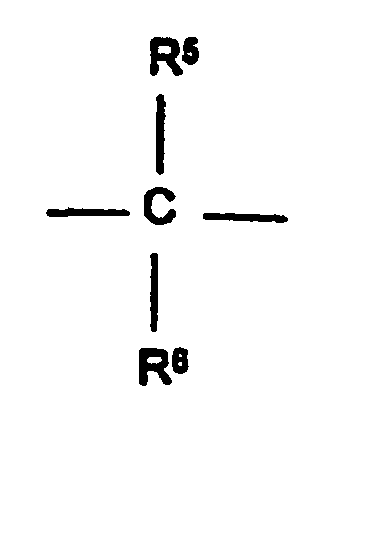
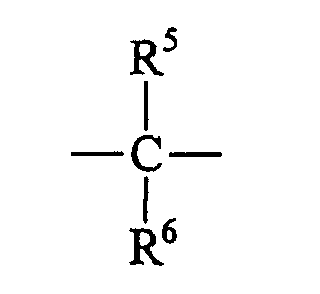
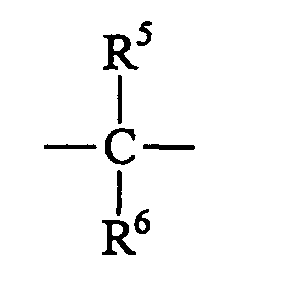
X is an oxygen atom, a group having the formula -(CH2)y- wherein y is 2 to 4 or a group having the formula
wherein R5 is hydrogen, alkyl or aryl, e.g., the aryl groups illustrated by formulas (II), (III) and (IV), and R6 is hydrogen or alkyl. The total carbon content of the group -C(R5)(R6)- normally will not exceed 20 and, preferably, is in the range of 1 to 8 carbon atoms. Normally, when R1 and R2 collectively represent a divalent hydrocarbylene group, the phosphite ester oxygen atoms, i.e. the oxygen atoms depicted in formula (I), are separated by a chain of atoms containing at least 3 carbon atoms.
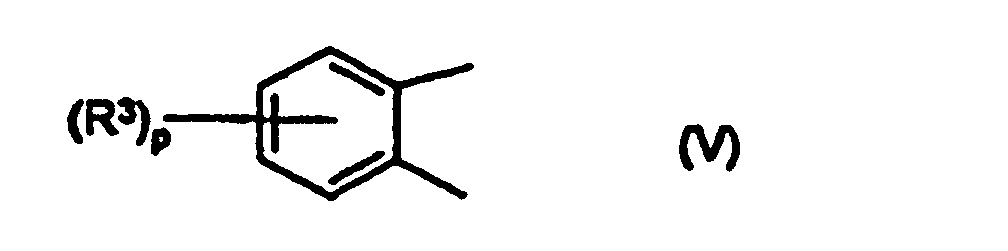
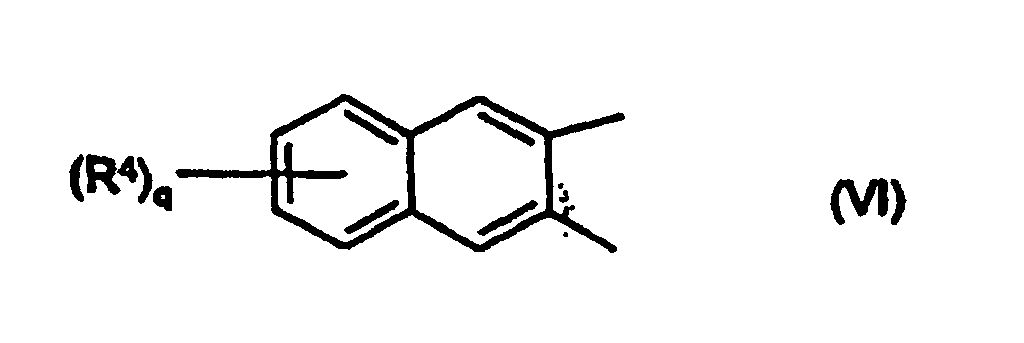
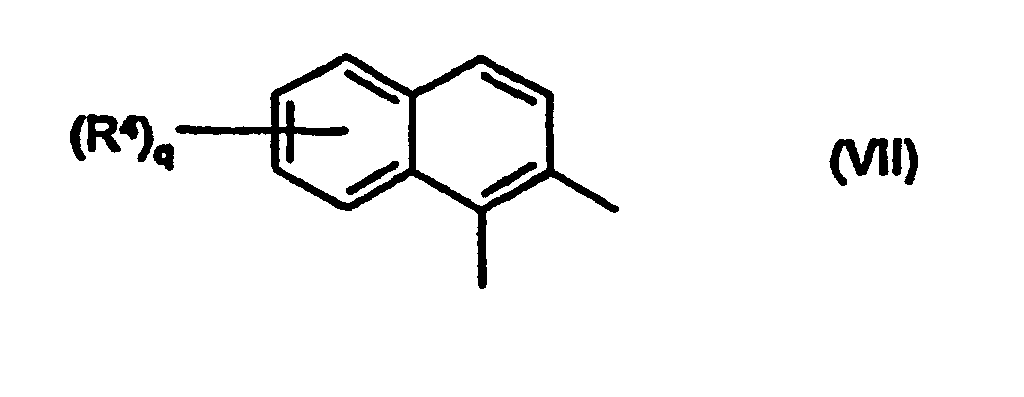
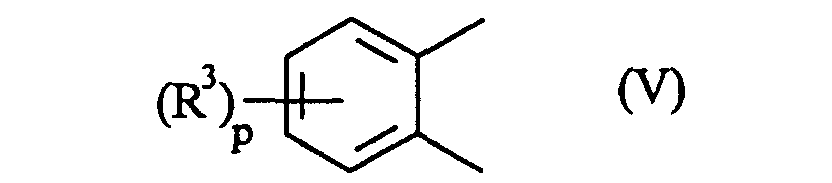
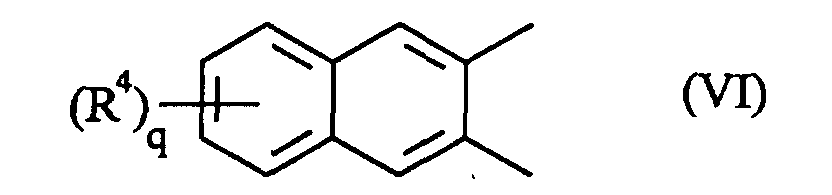
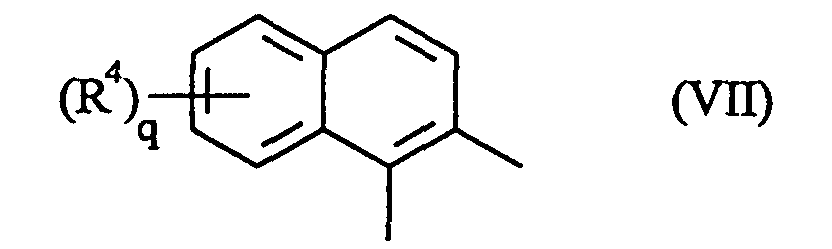
[0012] Examples of the arylene groups represented by each of A1 and A2 include the divalent radicals represented by the formulas (V), (VI) and (VII).
wherein R3 and R4 may represent one or more substituents independently selected from alkyl, alkoxy, halogen, cycloalkoxy, formyl, alkanoyl, cycloalkyl, aryl, aryloxy, aroyl, carboxyl, carboxylate salts, alkoxycarbonyl, alkanoyloxy, cyano, sulfonic acid, sulfonate salts and the like. The alkyl moiety of such alkyl, alkoxy, alkanoyl, alkoxycarbonyl and alkanoyloxy groups typically contains up to about 8 carbon atoms. Although it is possible for p to represent 0 to 4 and for q to represent 0 to 6, the value of each of p and q usually will not exceed 2. R3 and R4 preferably represent a halogen such as chlorine, a lower alkyl group, i.e., straight-chain and branched-chain alkyl of up to about 4 carbon atoms, or lower alkoxy; and p and q each represent 0, 1 or 2.
[0013] We have found that better results are obtained from those ligands which are unsubstituted or preferably, substituted with an electron withdrawing group in the position that is para to the oxygen on the aromatic ring. The presence of the electron withdrawing groups on the aromatic ring stabilizes the catalyst prepared from the chlorophosphite ligands.
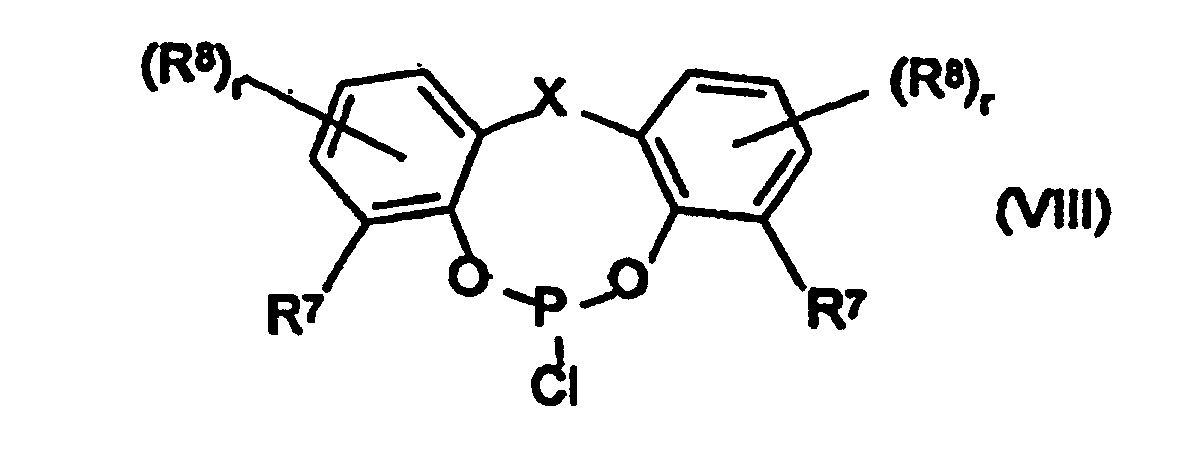
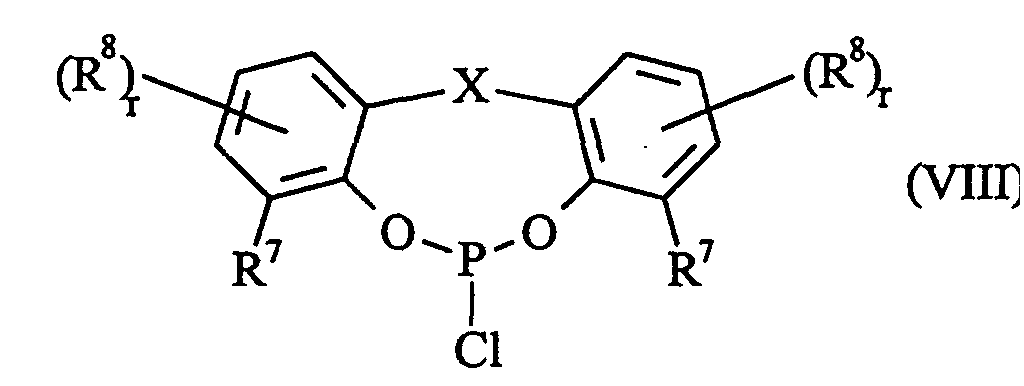
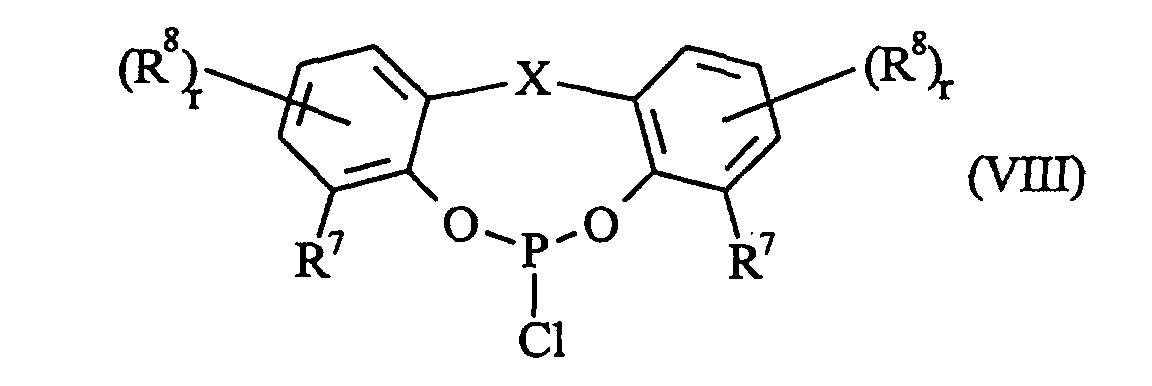
[0014] The chlorophosphite esters which are particularly preferred, e.g., those which exhibit the best stability, are those of formula (VIII)
wherein A1, A2 and X are defined above and wherein the ring carbon atoms of arylene radicals A1 and A2 which are in a position ortho to the ring carbon atoms bonded to the chlorophosphite ester oxygen atom are substituted with a halogen atom, preferably chloro, or an alkyl group such as a branched chain alkyl group such as isopropyl, tert-butyl, tert-octyl and the like.
[0015] The most preferred chlorophosphite esters have the general formula:
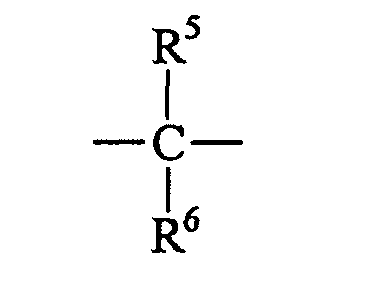
wherein R7 represents hydrogen, halogen such as chloro or C1 to C12, preferably C1 to C4, alkyl; R8 represent halogen such as chloro, C1 to C12, preferably C1 to C4, alkyl or C1 to C12, preferably C1 to C4, alkoxy; r is 0, 1 or 2; and X is a group having the formula
wherein R5 is hydrogen, alkyl or aryl, e.g., the aryl groups illustrated by formulas (II), (III) and (IV), and R6 is hydrogen or alkyl.
The chlorophosphite diester which is particularly preferred is 2,2'-methylenebis(3,4,6,trichlorophenyl)chlorophosphite which has the structure:
[0016] The chlorophosphite esters of formula (I) may be prepared by published procedures or by techniques analogous thereto. See, for example, the procedures described in the examples of U.S. Patent 5,059,710, U. S. Patent 4,912,155 and White et al., J. Am. Chem. Soc., 92, 7125 (1970). The organic moiety of the chlorophosphite compounds, i.e., the residue(s) represented by R1 and R2 in formula (I) can be derived from chiral or optically active compounds. Chlorophosphite ligands derived from chiral glycols or phenols will generate chiral ligands. Ligands consisting of the chiral chlorophosphites can be used in many transition metal-catalyzed processes including, but not limited to, hydroformylation, hydrogenation, hydrocyanation, hydrosilation, carbonylations, oxidations, acetoxylations, epoxidations, hydroamination, dihydroxylation, cyclopropanation, carbon hydrogen bond activation, olefin metathesis, olefin dimerizations, olefin oligomerizations, olefin polymerizations, olefin-carbon monoxide copolymerizations, butadiene dimerization and oligomerization, butadiene polymerization, and other carbon-carbon bond forming reactions such as the Heck reaction to yield enantioselective product mixtures.
[0017] The novel catalyst systems provided by the present invention comprise a combination of rhodium and one or more of the chlorophosphite compounds described in detail hereinabove. The rhodium metal may be provided in the form of various metal compounds such as carboxylate salts of the transition metal. Rhodium compounds that may be used as a source of rhodium for the active catalyst include rhodium II or rhodium III salts of carboxylic acids of which examples such as di-rhodium tetraacetate dihydrate, rhodium(II) acetate, rhodium(II) isobutyrate, rhodium(II) 2-ethylhexanoate, rhodium(II) benzoate and rhodium(II) octanoate exist. Also, rhodium carbonyl species such as Rh4(CO)12, Rh6(CO)16 and rhodium(I) acetylacetonate dicarbonyl may be suitable rhodium feeds. Additionally, rhodium organophosphine complexes such as tris(triphenylphosphine) rhodium carbonyl hydride may be used when the organophosphine moieties of the complex fed are easily displaced by the chlorophosphite ligands of the present invention. We have found rhodium 2-ethylhexanoate to be a particularly preferred source of rhodium from which to prepare the catalyst system of the invention because it is a convenient source of soluble rhodium and can be efficiently prepared from inorganic rhodium salts such as rhodium halides.
[0018] The relative amounts of chlorophosphite ligand and transition metal can vary over a wide range, e.g., amounts which give phosphorus:rhodium mole ratios of about 1:1 to 100:1. For the rhodium-containing catalyst system, the ratio of moles of phosphorus (provided by the chlorophosphite) to moles of rhodium preferably is in the range of about 10:1 up to 70:1 with ratios in the range of about 15:1 to 50:1 being particularly preferred.
[0019] A second embodiment of our invention concerns a novel catalyst solution comprising (1) one or more of the chlorophosphite ligands of formula (I), (2) rhodium and (3) a hydroformylation solvent. This embodiment comprises a solution of the active catalyst in which a carbonylation process such as the hydroformylation of an ethylenically-unsaturated compound may be carried out.
[0020] The hydroformylation reaction solvent may be selected from a wide variety of compounds, mixture of compounds, or materials which are liquid at the pressure at which the process is being operated. Such compounds and materials include various alkanes, cycloalkanes, alkenes, cycloalkenes, carbocyclic aromatic compounds, alcohols, esters, ketones, acetals, and ethers. Specific examples of such solvents include alkanes and cycloalkanes such as dodecane, decalin, octane, iso-octane mixtures, cyclohexane, cyclooctane, cyclododecane, methylcyclohexane; aromatic hydrocarbons such as benzene, toluene, xylene isomers, tetralin, cumene, alkyl-substituted aromatic compounds such as the isomers of diisopropylbenzene, triisopropylbenzene and tert-butylbenzene; alkenes and cycloalkenes such as 1,7-octadiene, dicyclopentadiene, 1,5-cyclooctadiene, octene-1, octene-2, 4-vinylcyclohexene, eyclohexene, 1,5,9-cyclododecatriene, 1-pentene; crude hydrocarbon mixtures such as naphtha, mineral oils and kerosene; high-boiling esters such as 2,2,4-trimethyl-1,3-pentane-diol monoisobutyrate. The aldehyde product of the hydroformylation process also may be used. In practice, the preferred solvent is the higher boiling by-products that are naturally formed during the process of the hydroformylation reaction and the subsequent steps, e.g., distillations, that are required for aldehyde product isolation. The main criteria for the solvent is that it dissolves the catalyst and olefin substrate and does not act as a poison to the catalyst. Preferred solvents for the production of volatile aldehydes, e.g., propionaldehyde and the butyraldehydes, are those which are sufficiently high boiling to remain, for the most part, in a gas sparged reactor. Solvents and solvent combinations which are preferred for use in the production of less volatile and non-volatile aldehyde products include 1-methyl-2-pyrrolidinone, dimethylformamide, perfluorinated solvents such as perfluorokerosene, sulfolane, dioctyl phthalate, dibutyl phthalate, butyl benzyl phthalate and high boiling hydrocarbon liquids such as Norpar 15® (a paraffinic hydrocarbon solvent marketed by Exxon Chemical) as well as combinations of these solvents. We have found that non-hydroxylic compounds, in general, and hydrocarbons, in particular, may be used advantageously as the hydroformylation solvent since their use can minimize decomposition of the chlorophosphite ester ligands.
[0021] The concentration of the rhodium and ligand in the hydroformylation solvent or reaction mixture is not critical for the successful operation of our invention. As mentioned hereinabove, a phosphorus:rhodium mole ratio of at least 1:1 normally is maintained in the reaction mixture. The absolute concentration of rhodium in the reaction mixture or solution may vary from 1 mg/liter up to 5000 mg/liter or more. When the process is operated within the practical conditions of this invention, the concentration of rhodium in the reaction solution normally is in the range of about 30 and 300 mg/liter. Concentrations of rhodium lower than this range generally do not yield acceptable reaction rates with most olefin reactants and/or require reactor operating temperatures that are so high as to be detrimental to catalyst stability. Higher rhodium concentrations are not preferred because of the high cost of rhodium.
[0022] No special or unusual techniques are required for the preparation of the catalyst systems and solutions of the present invention, although it is preferred, to obtain a catalyst of high activity, that all manipulations of the rhodium and chlorophosphite ligand components be carried out under an inert atmosphere, e.g., nitrogen, argon and the like. The desired quantities of a suitable rhodium compound and ligand are charged to the reactor in a suitable solvent. The sequence in which the various catalyst components or reactants are charged to the reactor is not critical.
[0023] The third embodiment of the present invention pertains to a hydroformylation process utilizing the above-described catalyst systems and solutions. The process of the present invention therefore is a process for preparing an aldehyde which comprises contacting an olefin, hydrogen and carbon monoxide with a solution of a catalyst system comprising rhodium and a chlorophosphite ligand of formula (I) wherein the ratio of gram moles ligand:gram atom rhodium is at least 1:1. The olefins which may be hydroformylated by means of our novel process comprise aliphatic, including ethylenically-unsaturated, low molecular weight polymers, alicyclic, aromatic and heterocyclic mono-, di- and tri-olefins containing up to about 40 carbon atoms. Examples of the aliphatic olefins which may be utilized in the process include straight- and branched-chain, unsubstituted and substituted, aliphatic mono-α-olefins containing up to about 20 carbon atoms. Examples of the groups which may be present on the substituted mono-α-olefins include hydroxy; alkoxy including ethers and acetals; alkanoyloxy such as acetoxy; amino including substituted amino; carboxy; alkoxycarbonyl; carboxamido; keto; cyano; and the like. Preferred aliphatic mono-α-olefins have the general formulas:
and
wherein
R9 is hydrogen or straight- or branched-chain alkyl of up to about 8 carbon atoms;
R10 is straight- or branched-chain alkylene of up to about 18 carbon atoms; and
R11 is hydroxy, alkoxy of up to about 4 carbon atoms, alkanoyloxy of up to about 4 carbon atoms, carboxyl or alkoxycarbonyl of 2 to about 10 carbon atoms.
[0024] Specific examples of the aliphatic mono-α-olefins include ethylene, propylene, 1-butene, 1-octene, allyl alcohol and 3-acetoxy-1-propene.
[0025] The aliphatic, di-olefins may contain up to about 40 carbon atoms. Preferred aliphatic, di-olefins have the general formula:
wherein R12 is straight- or branched-chain alkylene having 1 to about 18 carbon atoms.
[0026] The cyclic olefins which may be used in the hydroformylation process of the present invention may be cycloalkenes, e.g., cyclohexene, 1,5-cyclooctadiene, and cyclodecatriene, and from various vinyl-substituted cycloalkanes, cycloalkenes, heterocyclic and aromatic compounds. Examples of such cyclic olefins include 4-vinylcyclohexene, 1,3-cyclohexadiene, 4-cyclohexene-carboxylic acid, methyl 4-cyclohexene-carboxylic acid, 1,4-cyclooctadiene and 1,5,9-cyclododecatriene. The olefin reactants which are particularly preferred comprise mono-α-olefins of 2 to 10 carbon atoms, especially propylene.
[0027] Mixtures of olefins can also be used in the practice of this invention. The mixtures may be of the same carbon number such as mixtures of n-octenes or it may represent refinery distillation cuts which will contain a mixture of olefins over a range of several carbon numbers.
[0028] The reaction conditions used are not critical for the operation of the process and conventional hydroformylation conditions normally are used. The process requires that an olefin is contacted with hydrogen and carbon monoxide in the presence of the novel catalyst system described hereinabove. While the process may be carried out at temperatures in the range of about 20 to 200°C, the preferred hydroformylation reaction temperatures are from 50 to 135°C with the most favored reaction temperatures ranging from 75 to 125°C. Higher reactor temperatures are not favored because of increased rates of catalyst decomposition while lower reactor temperatures result in relatively slow reaction rates. The total reaction pressure may range from about ambient or atmospheric up to 70 bars absolute (bara - about 1000 psig), preferably from about 8 to 28 bara (about 100 to 400 psig).
[0029] The hydrogen:carbon monoxide mole ratio in the reactor likewise may vary considerably ranging from 10:1 to 1:10 and the sum of the absolute partial pressures of hydrogen and carbon monoxide may range from 0.3 to 36 bara. The partial pressures of the ratio of the hydrogen to carbon monoxide in the feed is selected according to the linear:branched isomer ratio desired. Generally, the partial pressure of hydrogen and carbon monoxide in the reactor is maintained within the range of about 1.4 to 13.8 bara (about 20 to 200 psia) for each gas. The partial pressure of carbon monoxide in the reactor is maintained within the range of about 1.4 to 13.8 bara (about 20 to 200 psia) and is varied independently of the hydrogen partial pressure. The molar ratio of hydrogen to carbon monoxide can be varied widely within these partial pressure ranges for the hydrogen and carbon monoxide. The ratios of the hydrogen to carbon monoxide and the partial pressure of each in the synthesis gas (syngas - carbon monoxide and hydrogen) can be readily changed by the addition of either hydrogen or carbon monoxide to the syngas stream. We have found that with the chlorophosphite ligands described herein, the ratio of linear to branched products can be varied widely by changing the reaction parameters such as the carbon monoxide partial pressure or the reactor temperature.
[0030] The amount of olefin present in the reaction mixture also is not critical. For example, relatively high-boiling olefins such as 1-octene may function both as the olefin reactant and the process solvent. In the hydroformylation of a gaseous olefin feedstock such as propylene, the partial pressures in the vapor space in the reactor typically are in the range of about 0.07 to 35 bara. In practice the rate of reaction is favored by high concentrations of olefin in the reactor. In the hydroformylation of propylene, the partial pressure of propylene preferably is greater than 1.4 bara, e.g., from about 1.4 to 10 bara. In the case of ethylene hydroformylation, the preferred partial pressure of ethylene in the reactor is greater than 0.14 bara.
[0031] Any of the known hydroformylation reactor designs or configurations may be used in carrying out the process provided by the present invention. Thus, a gas-sparged, vapor take-off reactor design as disclosed in the examples set forth herein may be used. In this mode of operation the catalyst which is dissolved in a high boiling organic solvent under pressure does not leave the reaction zone with the aldehyde product which is taken overhead by the unreacted gases. The overhead gases then are chilled in a vapor/liquid separator to liquify the aldehyde product and the gases can be recycled to the reactor. The liquid product is let down to atmospheric pressure for separation and purification by conventional technique. The process also may be practiced in a batchwise manner by contacting the olefin, hydrogen and carbon monoxide with the present catalyst in an autoclave.
[0032] A reactor design where catalyst and feedstock are pumped into a reactor and allowed to overflow with product aldehyde, i.e. liquid overflow reactor design, is also suitable. For example, high boiling aldehyde products such as nonyl aldehydes may be prepared in a continuous manner with the aldehyde product being removed from the reactor zone as a liquid in combination with the catalyst. The aldehyde product may be separated from the catalyst by conventional means such as by distillation or extraction and the catalyst then recycled back to the reactor. Water soluble aldehyde products, such as hydroxy butyraldehyde products obtained by the hydroformylation of allyl alcohol, can be separated from the catalyst by extraction techniques. A trickle-bed reactor design also is suitable for this process. It will be apparent to those skilled in the art that other reactor schemes may be used with this invention.
[0033] The various embodiments of the present invention are further illustrated by the following examples. The hydroformylation process in which propylene is hydroformylated to produce butyraldehydes is carried out in a vapor take-off reactor consisting of a vertically arranged stainless steel pipe having a 2.5 cm inside diameter and a length of 1.2 meters. The reactor has a filter element welded into the side down near the bottom of the reactor for the inlet of gaseous reactants. The reactor contains a thermowell which is arranged axially with the reactor in its center for accurate measurement of the temperature of the hydroformylation reaction mixture. The bottom of the reactor has a high pressure tubing connection that is connected to a cross. One of the connections to the cross permits the addition of non-gaseous reactants such as octene-1 or make-up solvent, another leads to the high-pressure connection of a differential pressure (D/P) cell that is used to measure catalyst level in the reactor and the bottom connection is used for draining the catalyst solution at the end of the run.
[0034] In the hydroformylation of propylene in a vapor take-off mode of operation, the hydroformylation reaction mixture or solution containing the catalyst is sparged under pressure with the incoming reactants of propylene, hydrogen and carbon monoxide as well as any inert feed such as nitrogen. As butyraldehyde is formed in the catalyst solution, it and unreacted reactant gases are removed as a vapor from the top of the reactor by a side-port. The vapor removed is chilled in a high-pressure separator where the butyraldehyde product is condensed along with some of the unreacted propylene. The uncondensed gases are let down to atmospheric pressure via the pressure control valve. These gases pass through a series of dry-ice traps where any other aldehyde product is collected. The product from the high-pressure separator is combined with that of the traps, and is subsequently weighed and analyzed by standard gas/liquid phase chromatography (GLC) techniques for the net weight and normal/iso ratio of the butyraldehyde product.
[0035] The gaseous feeds to the reactor are fed to the reactor via twin cylinder manifolds and high-pressure regulators. The hydrogen passes through a mass flow controller and then through a commercially available "Deoxo" (registered trademark of Engelhard Inc.) catalyst bed to remove any oxygen contamination. The carbon monoxide passes through an iron carbonyl removal bed (as disclosed in U.S. Patent 4,608,239), a similar "Deoxo" bed heated to 125°C, and then a mass flow contoller. Nitrogen can be added to the feed mixture as an inert gas. Nitrogen, when added, is metered in and then mixed with the hydrogen feed prior to the hydrogen Deoxo bed. Propylene is fed to the reactor from feed tanks that are pressurized with hydrogen and is controlled using a liquid mass flow meter. All gases and propylene are passed through a preheater to insure complete vaporization of the liquid propylene prior to entering the reactor.
[0036] Higher-boiling, liquid olefins such as 1-octene, are subjected to hydroformylation in a high pressure autoclave. The olefin, catalyst, and solvent are sealed in the autoclave under nitrogen. The reaction mixture then is pressurized with hydrogen and carbon monoxide and heated to the desired reaction temperature. The autoclave is maintained at reaction temperature and pressure selected for a predetermined amount of time or until gas uptake ceases. The autoclave then is cooled to ambient temperature and vented. The contents of the autoclave are recovered and analyzed for olefin and aldehyde content by conventional gas chromatography.
EXAMPLE 1
[0037] A catalyst solution was prepared under nitrogen using a charge of 15 mg of rhodium charged as a rhodium (II) dicarbonylacetonyl acetate (0.145 mmole, 0.0375 g), chlorobis(4-chloro-2-methylphenyl)phosphite (4.37 mmole, 1.53 g, [P]:[Rh]=30) and 190 mL of Norpar 15® solvent. This catalyst solution was charged to the reactor under an argon blanket and the reactor sealed. The reactor was pressured to 18.9 bara (260 psig) with hydrogen, carbon monoxide and nitrogen and heated to 115°C. Propylene feed then was started and the flows were adjusted to the following reported as liters/minute at standard temperature and pressure (STP): hydrogen = 3.70; carbon monoxide = 3.70; nitrogen = 1.12 and propylene = 2.08. This is equivalent to having the following partial pressures in the feed to the reactor reported as bara (psia): hydrogen = 6.6 (96); carbon monoxide = 6.6 (96); nitrogen = 2 (29); and propylene = 3.7 (54).
[0038] The reaction was carried out under the above flows for 5 hours. The butyraldehyde production rate for the last 3 hours of operation averaged 88.3 g/hour for a catalyst activity of 5.88 kilograms butyraldehyde/gram of rhodium-hour. The product N:Iso ratio was 2.1:1.
EXAMPLE 2
[0039] A catalyst solution was prepared under nitrogen using a charge of 15 mg of rhodium charged as a rhodium (II) dicarbonylacetonyl acetate (0.145 mmole, 0.0375 g), 2,2'-methylenebis(3,4,6,trichlorophenyl)chlorophosphite (4.35 mmole, 2.04 g, [P]:[Rh]=30) and 190 mL of dioctyl phthalate solvent. This catalyst solution was charged to the reactor under an argon blanket and the reactor sealed. The reactor was pressured to 18.9 bara (260 psig) with hydrogen, carbon monoxide and nitrogen and heated to 115°C. Propylene feed then was started and the flows were adjusted to the following reported as liters/minute at standard temperature and pressure (STP): hydrogen = 3.70; carbon monoxide = 3.70; nitrogen = 1.12 and propylene = 2.08. This is equivalent to having the following partial pressures in the feed to the reactor reported as bara (psia): hydrogen = 6.6 (96); carbon monoxide = 6.6 (96); nitrogen = 2 (29); and propylene = 3.7 (54).
[0040] The reaction was carried out under the above flows for 5 hours. The butyraldehyde production rate for the last 3 hours of operation averaged 31.9 g/hour for a catalyst activity of 2.13 kilograms butyraldehyde/gram of rhodium-hour. The product N:Iso ratio was 5.86:1.
EXAMPLE 3
[0041] This example illustrates the effect of using a lower carbon monoxide partial pressure in the hydroformylation of propylene. A catalyst solution was prepared under nitrogen using a charge of 15 mg of rhodium charged as a rhodium (II) dicarbonylacetonyl acetate (0.145 mmole, 0.0375 g), 2,2'-methylidenebis(3,4,6-trichlorophenyl) chlorophosphite (4.35 mmole, 2.06 g, [P]:[Rh]=30) and 190 mL of dioctyl phthalate solvent. The mixture was charged to the reactor under an argon blanket and the reactor sealed. The reactor was pressured to 18.9 bara (260 psig) with hydrogen, carbon monoxide and nitrogen and heated to 115°C. Propylene feed then was started and the flows were adjusted to the following values reported as liters/minute at standard temperature and pressure (STP): hydrogen = 3.80; carbon monoxide = 1.90; nitrogen = 1.93 and propylene = 1.87. This is equivalent to having the following partial pressures in the feed to the reactor reported as bara (psia): hydrogen = 7.6 (110); carbon monoxide = 3.8 (55); nitrogen = 3.9 (56); and propylene = 3.7 (54).
[0042] The process was operated for 5 hours using the above flows. The butyraldehyde production rate for the last 3 hours of operation averaged 24.5 g/hour for a catalyst activity of 1.63 kilograms butyraldehyde/gram of rhodium-hour. The product N:Iso ratio was 7.17:1.
EXAMPLE 4
[0043] This example illustrates the effect of using a higher carbon monoxide partial pressure in the hydroformylation of propylene. A catalyst solution was prepared under nitrogen using a charge of 15 mg of rhodium charged as a rhodium (II) dicarbonylacetonyl acetate (0.145 mmole, 0.0375 g), 2,2'-methylidenebis(3,4,6-trichlorophenyl)chlorophosphite (4.37 mmole, 2.06 g, [P]:[Rh]=30) and 190 mL of dioctyl phthalate solvent. The catalyst solution was charged to the reactor under an argon blanket and the reactor sealed. The reactor was pressured to 18.9 bara (260 psig) with hydrogen, carbon monoxide and nitrogen and heated to 115°C. Propylene feed then was started and the flows were adjusted to the following values reported as liters/minute at standard temperature and pressure (STP): hydrogen = 1.90; carbon monoxide = 3.80; nitrogen = 1.93 and propylene = 1.87. This is equivalent to having the following partial pressures in the feed to the reactor reported as bara (psia): hydrogen = 3.8 (55); carbon monoxide = 7.6 (110); nitrogen = 3.9 (56); and propylene = 3.7 (54).
[0044] The process was operated for 5 hours using the above flows. The butyraldehyde production rate for the last 3 hours of operation averaged 21.5 g/hour for a catalyst activity of 1.43 kilograms butyraldehyde/gram of rhodium-hour. The product N:Iso ratio was 4.52:1.
EXAMPLE 5
[0045] A catalyst solution was prepared under nitrogen using a charge of 15 mg of rhodium charged as a rhodium (II) dicarbonylacetonyl acetate (0.145 mmole, 0.0375 g), di(4-chloro-2-methylphenyl) chlorophosphite (4.35 mmole, 1.52 g) and 90 mL of Norpar 15® solvent. This catalyst solution and 10 mL of purified 1-octene were charged to a 300 mL, high pressure autoclave under an nitrogen blanket. The reactor was sealed and then pressurized to 27.6 bara (400 psig) with a 1:1 mixture of hydrogen and carbon monoxide. The reactor was heated to 110°C and maintained at 400 psig (28.6 bara) by the addition of a 1:1 mixture of hydrogen and carbon monoxide. When the uptake of gas ceased, the reactor was cooled, vented, and the contents analyzed. Gas chromatography of the recovered liquid revealed that 95% of the 1-octene reactant had been converted to a mixture of nonyl aldehydes. The nonyl aldehyde fraction had a normal to branched isomer ratio of 1.99:1.
EXAMPLE 6
[0046] A catalyst solution was prepared under nitrogen using a charge of 15 mg of rhodium charged as a rhodium (II) dicarbonylacetonyl acetate (0.145 mmole, 0.0375 g), di(4-chloro-2-methylphenyl) chlorophosphite (2.46 mmole, 0.86 g) and 90 mL of 2,2,4-trimethyl-1,3-pentanediol monoisobutyrate solvent. This catalyst solution and 10 mL of purified 1-octene were charged to a 300 mL, high pressure autoclave under an nitrogen blanket. The reactor was sealed and then pressurized to 28.6 bara (400 psig) with a 1:1 mixture of hydrogen and carbon monoxide. The reactor was heated to 110°C and maintained at 400 psig (28.6 bara) by the addition of a 1:1 mixture of hydrogen and carbon monoxide. When the uptake of gas ceased, the reactor was cooled, vented, and the contents analyzed. Gas chromatography of the recovered liquid revealed that 98% of the 1-octene reactant had been converted to a mixture of nonyl aldehydes. The nonyl aldehyde fraction had a normal to branched isomer ratio of 1.96:1.
EXAMPLE 7
[0047] A catalyst solution was prepared under nitrogen using a charge of 15 mg of rhodium charged as a rhodium (II) dicarbonylacetonyl acetate (0.145 mmole, 0.0375 g), di(4-acetyl-2-methylphenyl) chlorophosphite (2.46 mmole, 0.90 g) and a hydroformylation solvent consisting of 90 mL of Norpar 15® and 10 mL of dioctyl phthalate. This catalyst solution and 20 mL of purified 1-octene were charged to a 300 mL, high pressure autoclave under an nitrogen blanket. The reactor was sealed and then pressurized to 28.6 bara (400 psig) with a 1:1 mixture of hydrogen and carbon monoxide. The reactor was heated to 110°C and maintained at 400 psig (28.6 bara) by the addition of a 1:1 mixture of hydrogen and carbon monoxide. When the uptake of gas ceased, the reactor was cooled, vented, and the contents analyzed. Gas chromatography of the recovered liquid revealed that 97% of the 1-octene reactant had been converted to a mixture of nonyl aldehydes. The nonyl aldehyde fraction had a normal to branched isomer ratio of 1.94:1.
EXAMPLE 8
[0048] A catalyst solution was prepared under nitrogen using a charge of 15 mg of rhodium charged as a rhodium (II) dicarbonylacetonyl acetate (0.145 mmole, 0.0375 g), di(2-methylphenyl) chlorophosphite (2.46 mmole, 0.69 g) and 90 mL of Norpar 15® solvent. This catalyst solution and 20 mL of purified 1-octene were charged to a 300 mL, high pressure autoclave under an nitrogen blanket. The reactor was sealed and then pressurized to 28.6 bara (400 psig) with a 1:1 mixture of hydrogen and carbon monoxide. The reactor was heated to 110°C and maintained at 400 psig (28.6 bara) by the addition of a 1:1 mixture of hydrogen and carbon monoxide. When the uptake of gas ceased, the reactor was cooled, vented, and the contents analyzed. Gas chromatography of the recovered liquid revealed that 97% of the 1-octene reactant had been converted to a mixture of nonyl aldehydes. The nonyl aldehyde fraction had a normal to branched isomer ratio of 1.60:1.
EXAMPLE 9
[0049] A catalyst solution was prepared under nitrogen using a charge of 15 mg of rhodium charged as a rhodium (II) dicarbonylacetonyl acetate (0.145 mmole, 0.0375 g), di(2-methylphenyl) chlorophosphite (2.46 mmole, 0.69 g) and 90 mL of Norpar 15® solvent. This catalyst solution and 20 mL of 2-trans-octene were charged to a 300 mL, high pressure autoclave under an nitrogen blanket. The reactor was sealed and then pressurized to 28.6 bara (400 psig) with a 1:1 mixture of hydrogen and carbon monoxide. The reactor was heated to 110°C and maintained at 400 psig (28.6 bara) by the addition of a 1:1 mixture of hydrogen and carbon monoxide. When the uptake of gas ceased, the reactor was cooled, vented, and the contents analyzed. Gas chromatography of the recovered liquid revealed that 99.3% of the octene reactant had been converted to a mixture of nonyl aldehydes. The nonyl aldehyde fraction had a normal to branched isomer ratio of 0.15:1. GC-MS analysis revealed that the branched isomers consisted of 57% 2-methyl-1-octanal, 29% 2-ethyl-1-heptanal and 14% 2-propyl-1-hexanal.
EXAMPLE 10
[0050] A catalyst solution was prepared under nitrogen using a charge of 15 mg of rhodium charged as a rhodium (II) dicarbonylacetonyl acetate (0.145 mmole, 0.0375 g), di(2-methylphenyl) chlorophosphite (4.35 mmole, 1.22 g) and 90 mL of Norpar 15® solvent. This catalyst solution and 20 mL of 1,7-octadiene were charged to a 300 mL, high pressure autoclave under an nitrogen blanket. The reactor was sealed and then pressurized to 28.6 bara (400 psig) with a 1:1 mixture of hydrogen and carbon monoxide. The reactor was heated to 110°C and maintained at 400 psig (28.6 bara) by the addition of a 1:1 mixture of hydrogen and carbon monoxide. When the uptake of gas ceased, the reactor was cooled, vented, and the contents analyzed. Gas chromatography of the recovered liquid revealed that 99.3% of the 1,7-octadiene reactant had been converted to a mixture of aldehydes. The aldehyde fraction consisted of 4 dialdehyde isomers as determined by gas chromatography-mass spectroscopy utilizing chemical ionization techniques (MS and Cl). No monoaldehydes were visible by the Cl technique. The percentages of the dialdehydes in the order of their elution were 4.8%, 3.9%, 50.9% and 40.4%. The 40.4% fraction is 1,10-decanedialdehyde.
EXAMPLE 11
[0051] A catalyst solution was prepared under nitrogen using a charge of 15 mg of rhodium charged as a rhodium (II) dicarbonylacetonyl acetate (0.145 mmole, 0.0375 g), 2,2'-methylidenebis(3,4,6-trichlorophenyl) chlorophosphite (4.35 mmole, 2.05 g, [P]:[Rh]=30) and 90 mL of 2,2,4-trimethyl-1,3-pentanediol monoisobutyrate solvent. This catalyst solution and 20 mL of purified 1-octene were charged to a 300 mL, high pressure autoclave under an nitrogen blanket. The reactor was sealed and then pressurized to 28.6 bara (400 psig) with a 1:1 mixture of hydrogen and carbon monoxide. The reactor was heated to 110°C and maintained at 400 psig (28.6 bara) by the addition of a 1:1 mixture of hydrogen and carbon monoxide. When the uptake of gas ceased, the reactor was cooled, vented, and the contents analyzed. Gas chromatography of the recovered liquid revealed that 73.2% of the 1-octene reactant had been converted to a mixture of nonyl aldehydes. The nonyl aldehyde fraction had a normal to branched isomer ratio of 17.32:1.
EXAMPLE 12
[0052] A catalyst solution was prepared under nitrogen using a charge of 15 mg of rhodium charged as a rhodium (II) dicarbonylacetonyl acetate (0.145 mmole, 0.0375 g), bis(3-methoxyphenyl) chlorophosphite (4.35 mmole, 1.35 g, [P]:[Rh]=30) and 90 mL of Norpar 15® solvent. This catalyst solution and 20 mL of purified 1-octene were charged to a 300 mL, high pressure autoclave under an nitrogen blanket. The reactor was sealed and then pressurized to 28.6 bara (400 psig) with a 1:1 mixture of hydrogen and carbon monoxide. The reactor was heated to 115°C and maintained at 400 psig (28.6 bara) by the addition of a 1:1 mixture of hydrogen and carbon monoxide. When the uptake of gas ceased, the reactor was cooled, vented, and the contents analyzed. Gas chromatography of the recovered liquid revealed that 44% of the 1-octene reactant had been converted to a mixture of nonyl aldehydes. The nonyl aldehyde fraction had a normal to branched isomer ratio of 2.97:1.
EXAMPLE 13
[0053] A catalyst solution was prepared under nitrogen using a charge of 15 mg of rhodium charged as a rhodium (II) dicarbonylacetonyl acetate (0.145 mmole, 0.0375 g), bis(3-trifluoromethylphenyl) chlorophosphite (4.37 mmole, 1.59 g, [P]:[Rh]=30) and 90 mL of Norpar 15® solvent. This catalyst solution and 20 mL of purified 1-octene were charged to a 300 mL, high pressure autoclave under an nitrogen blanket. The reactor was sealed and then pressurized to 28.6 bara (400 psig) with a 1:1 mixture of hydrogen and carbon monoxide. The reactor was heated to 115°C and maintained at 400 psig (28.6 bara) by the addition of a 1:1 mixture of hydrogen and carbon monoxide. When the uptake of gas ceased, the reactor was cooled, vented, and the contents analyzed. Gas chromatography of the recovered liquid revealed that 20% of the 1-octene reactant had been converted to a mixture of nonyl aldehydes. The nonyl aldehyde fraction had a normal to branched isomer ratio of 1.33:1.
EXAMPLE 14
[0054] A catalyst solution was prepared under nitrogen using a charge of 15 mg of rhodium charged as a rhodium (II) dicarbonylacetonyl acetate (0.145 mmole, 0.0375 g), bis(4-methoxycarbonylphenyl) chlorophosphite (4.37 mmole, 1.61 g, [P]:[Rh]=30) and 90 mL of dioctyl phthalate solvent. This catalyst solution and 20 mL of purified 1-octene were charged to a 300 mL, high pressure autoclave under an nitrogen blanket. The reactor was sealed and then pressurized to 28.6 bara (400 psig) with a 1:1 mixture of hydrogen and carbon monoxide. The reactor was heated to 115°C and maintained at 400 psig (28.6 bara) by the addition of a 1:1 mixture of hydrogen and carbon monoxide. When the uptake of gas ceased, the reactor was cooled, vented, and the contents analyzed. Gas chromatography of the recovered liquid revealed that 81% of the 1-octene reactant had been converted to a mixture of nonyl aldehydes. The nonyl aldehyde fraction had a normal to branched isomer ratio of 4.82:1.
1. A catalyst system comprising rhodium and one or more chlorophosphite compounds having
the general formula
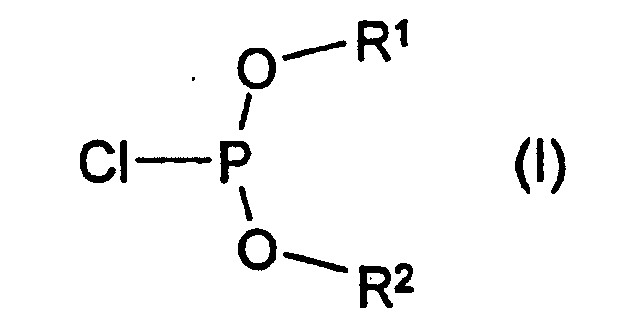
wherein R1 and R2 are aromatic hydrocarbyl radicals which contain a total of up to about 40 carbon atoms and wherein the mole ratio of chlorophosphite ligand to rhodium is at least 1:1.
wherein R1 and R2 are aromatic hydrocarbyl radicals which contain a total of up to about 40 carbon atoms and wherein the mole ratio of chlorophosphite ligand to rhodium is at least 1:1.
2. The catalyst system according to Claim 1 wherein the transition metal is rhodium and
the total carbon atom content of the aromatic hydrocarbyl radicals represented by
R1 and R2 is about 12 to 35.
3. The catalyst system according to claim 1 wherein R1 and R2 in said one or more chlorophosphite compounds individually are independently selected
from aryl groups having the formula:
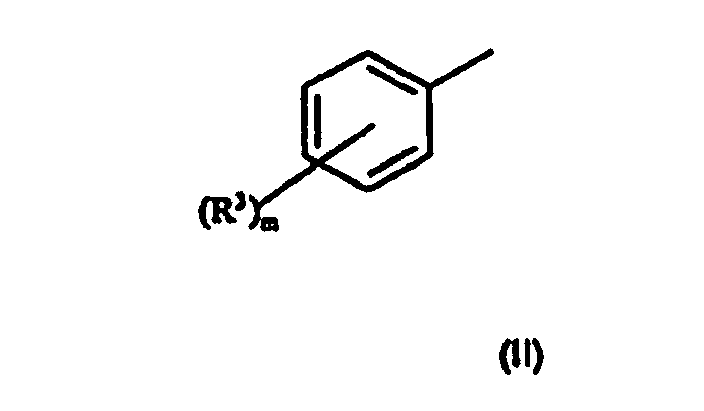
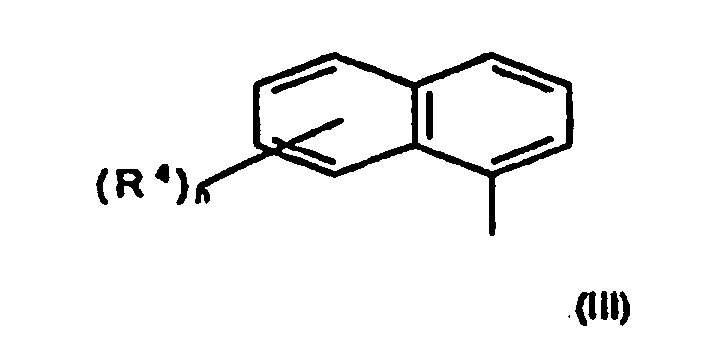
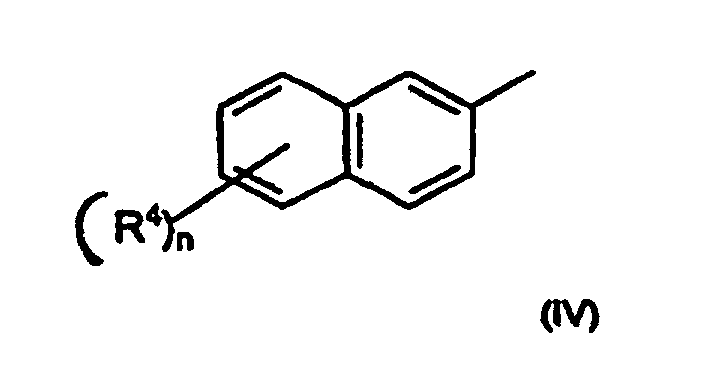
wherein R3 and R4 are independently selected from alkyl, alkoxy, halogen, cycloalkoxy, formyl, alkanoyl, cycloalkyl, aryl, aryloxy, aroyl, carboxyl, carboxylate salts, alkoxycarbonyl, alkanoyloxy, cyano, sulfonic acid and sulfonate salts in which the alkyl moiety of such alkyl, alkoxy, alkanoyl, alkoxycarbonyl and alkanoyloxy groups contains up to about 8 carbon atoms; m and n each is 0, 1 or 2; and the total carbon atom content of the hydrocarbyl radicals represented by R1 and R2 is about 12 to 35 and wherein the mole ratio of chlorophosphite ligand to rhodium is about 10:1 to 70:1.
wherein R3 and R4 are independently selected from alkyl, alkoxy, halogen, cycloalkoxy, formyl, alkanoyl, cycloalkyl, aryl, aryloxy, aroyl, carboxyl, carboxylate salts, alkoxycarbonyl, alkanoyloxy, cyano, sulfonic acid and sulfonate salts in which the alkyl moiety of such alkyl, alkoxy, alkanoyl, alkoxycarbonyl and alkanoyloxy groups contains up to about 8 carbon atoms; m and n each is 0, 1 or 2; and the total carbon atom content of the hydrocarbyl radicals represented by R1 and R2 is about 12 to 35 and wherein the mole ratio of chlorophosphite ligand to rhodium is about 10:1 to 70:1.
4. The catalyst system according to claim 1 wherein R1 and R2 in said one or more chlorophosphite compounds collectively represent an arylene group
having the formula
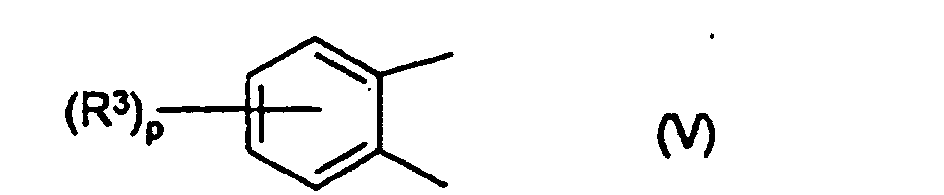
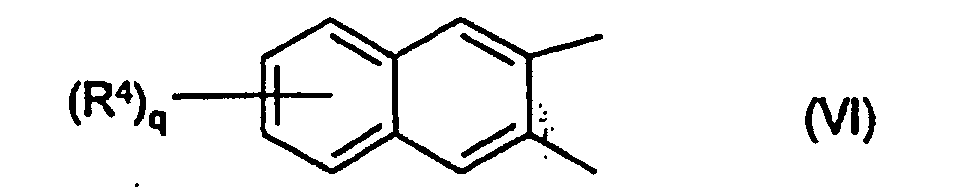
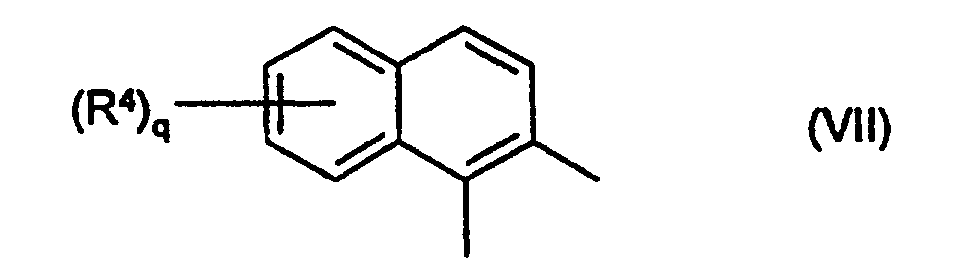
or a radical having the formula
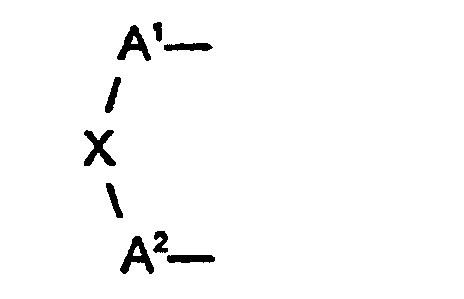
wherein
each of A1 and A2 is an arylene radical having formula (V), (VI) or (VII) above wherein each ester oxygen atom of chlorophosphite (I) is bonded to a ring carbon atom of A1 and A2;
X is an oxygen atom, a group having the formula -(CH2)y- wherein y is 2 to 4 or a group having the formula
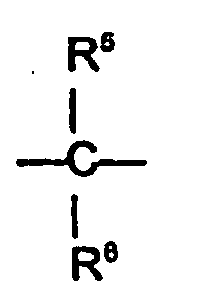
wherein R5 is hydrogen, alkyl or aryl; R6 is hydrogen or alkyl; and the group - C(R5)(R6)- contains up to about 8 carbon atoms; and
wherein R3 and R4 are independently selected from alkyl, alkoxy, halogen, cycloalkoxy, formyl, alkanoyl, cycloalkyl, aryl, aryloxy, aroyl, carboxyl, carboxylate salts, alkoxycarbonyl, alkanoyloxy, cyano, sulfonic acid and sulfonate salts in which the alkyl moiety of such alkyl, alkoxy, alkanoyl, alkoxycarbonyl and alkanoyloxy groups contains up to about 8 carbon atoms; p and q each is 0, 1 or 2.
or a radical having the formula
wherein
each of A1 and A2 is an arylene radical having formula (V), (VI) or (VII) above wherein each ester oxygen atom of chlorophosphite (I) is bonded to a ring carbon atom of A1 and A2;
X is an oxygen atom, a group having the formula -(CH2)y- wherein y is 2 to 4 or a group having the formula
wherein R5 is hydrogen, alkyl or aryl; R6 is hydrogen or alkyl; and the group - C(R5)(R6)- contains up to about 8 carbon atoms; and
wherein R3 and R4 are independently selected from alkyl, alkoxy, halogen, cycloalkoxy, formyl, alkanoyl, cycloalkyl, aryl, aryloxy, aroyl, carboxyl, carboxylate salts, alkoxycarbonyl, alkanoyloxy, cyano, sulfonic acid and sulfonate salts in which the alkyl moiety of such alkyl, alkoxy, alkanoyl, alkoxycarbonyl and alkanoyloxy groups contains up to about 8 carbon atoms; p and q each is 0, 1 or 2.
5. The catalyst system according to claim 4 wherein the chlorophosphite ligand has the
formula (VIII)
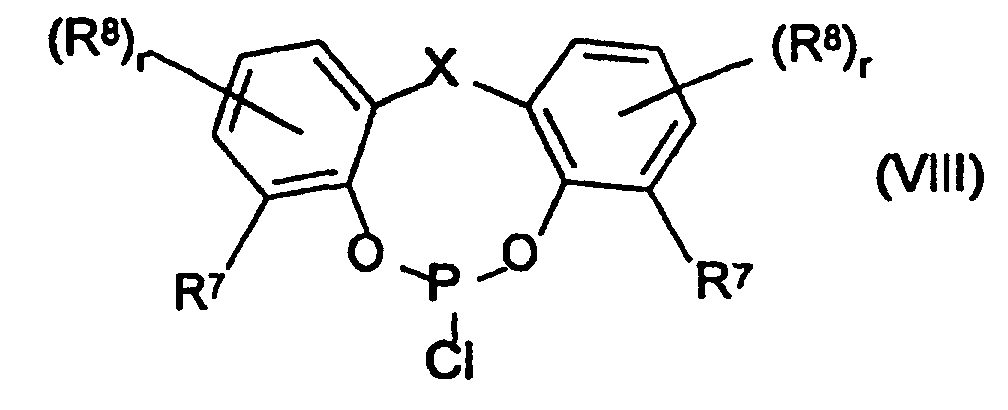
wherein R7 represents hydrogen, halogen or C1 to C12 alkyl; R8 represents halogen, C1 to C12 alkyl or C1 to C12 alkoxy; r is 0, 1 or 2; and X is a group having the formula
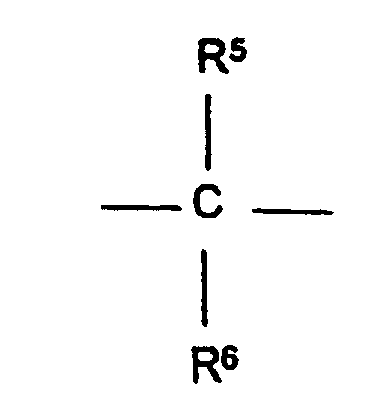
wherein R5 is hydrogen, alkyl or aryl; and R6 is hydrogen or alkyl and the mole ratio of chlorophosphite ligand to rhodium is about 15:1 to 50:1.
wherein R7 represents hydrogen, halogen or C1 to C12 alkyl; R8 represents halogen, C1 to C12 alkyl or C1 to C12 alkoxy; r is 0, 1 or 2; and X is a group having the formula
wherein R5 is hydrogen, alkyl or aryl; and R6 is hydrogen or alkyl and the mole ratio of chlorophosphite ligand to rhodium is about 15:1 to 50:1.
6. The catalyst system according to Claim 5 wherein the chlorophosphite ligand is 2,2'-methylidenebis(3,4,6-trichlorophenyl)
chlorophosphite.
7. A catalyst solution comprising a catalyst system according to any one of the preceding
claims and a hydroformylation solvent.
8. The catalyst solution according to Claim 7 wherein the mole ratio of chlorophosphite
ligand to rhodium is about 15:1 to 50:1 and the hydroformylation solvent is selected
from alkanes, cycloalkanes, alkenes, cycloalkenes, carbocyclic aromatic compounds,
esters, ketones, acetals and ethers which are liquid at the pressure at which the
process is being operated.
9. A process for preparing an aldehyde which comprises contacting an olefin, hydrogen
and carbon monoxide with a solution of a catalyst system as defined in any one of
claims 1-6 and a hydroformylation solvent.
10. Process according to Claim 9 wherein the concentration of rhodium in the solution
is in the range of about 30 to 300 mg per liter and the process is carried out at
a temperature of about 50 to 135°C at a pressure in the range of ambient to about
36 bars absolute (brara).
11. The process according to Claim 9 wherein the olefin is a mono-α-olefin of 2 to 10
carbon atoms.
12. The process according to Claim 9 wherein the solution of a catalyst system comprises
a chlorophosphite compound of the formula
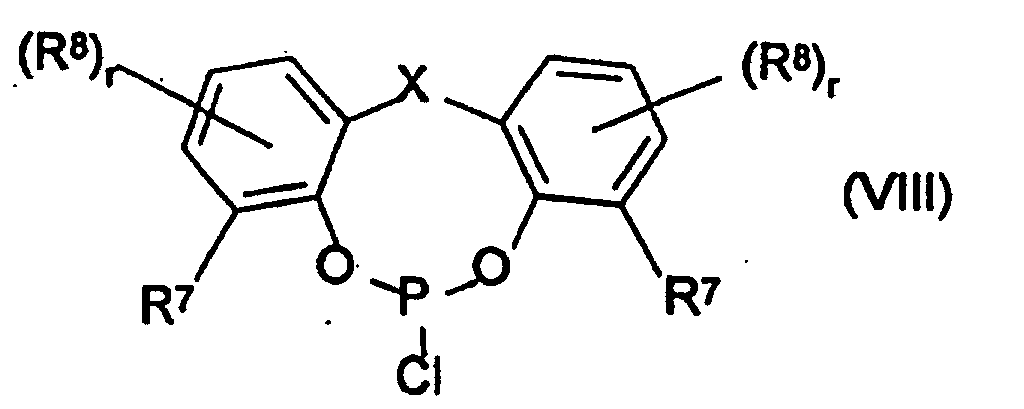
wherein R7 represents hydrogen, chloro or C1 to C4alkyl; R8 represents chloro, C1 to C4 alkyl or C1 to C4 alkoxy; r is 0, 1 or 2; and X is a group having the formula
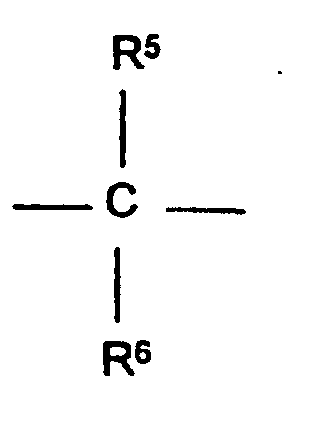
wherein R5 is hydrogen, alkyl or aryl; and R6 is hydrogen or alkyl; and the olefin is a mono-α-olefin of 3 to 8 carbon atoms; wherein the normal to iso ratio of the aldehyde product is controlled by varying the partial pressure of carbon monoxide in the reactor gas between 3 and 8 bara.
wherein R7 represents hydrogen, chloro or C1 to C4alkyl; R8 represents chloro, C1 to C4 alkyl or C1 to C4 alkoxy; r is 0, 1 or 2; and X is a group having the formula
wherein R5 is hydrogen, alkyl or aryl; and R6 is hydrogen or alkyl; and the olefin is a mono-α-olefin of 3 to 8 carbon atoms; wherein the normal to iso ratio of the aldehyde product is controlled by varying the partial pressure of carbon monoxide in the reactor gas between 3 and 8 bara.
13. The process according to claim 12 wherein the concentration of rhodium in the solution
is in the range of about 30 to 300 mg per liter; the chlorophosphite ligand is 2,2'-methylidenebis(3,4,6-trichlorophenyl)
chlorophosphite; the mole ratio of chlorophosphite ligand to rhodium is about 15:1
to 50:1; the olefin is a mono-α-olefin of 2 to 10 carbon atoms; and the process is
carried out at a temperature of about 50 to 135°C at a pressure in the range of ambient
to about 36 bars absolute.
1. Katalysatorsystem, umfassend Rhodium und eine oder mehrere Chlorophosphit-Verbindungen
mit der allgemeinen Formel
in der R1 und R2 aromatische Hydrocarbyl-Reste sind, die insgesamt bis zu etwa 40 Kohlenstoffatome enthalten, und wobei das Molverhältnis von Chlorophosphit-Ligand zu Rhodium mindestens 1 : 1 beträgt.
in der R1 und R2 aromatische Hydrocarbyl-Reste sind, die insgesamt bis zu etwa 40 Kohlenstoffatome enthalten, und wobei das Molverhältnis von Chlorophosphit-Ligand zu Rhodium mindestens 1 : 1 beträgt.
2. Katalysatorsystem nach Anspruch 1, in dem das Übergangsmetall Rhodium ist und der
Gesamt-Kohlenstoffatomgehalt der aromatischen Hydrocarbylreste, die durch R1 und R2 dargestellt werden, etwa 12 bis 35 ist.
3. Katalysatorsystem nach Anspruch 1, in dem R1 und R2 in der einen oder den mehreren Chlorophosphit-Verbindungen einzeln und unabhängig
aus Arylgruppen mit der Formel:
ausgewählt sind, in der R3 und R4 unabhängig aus Alkyl, Alkoxy, Halogen, Cycloalkoxy, Formyl, Alkanoyl, Cycloalkyl, Aryl, Aryloxy, Aroyl, Carboxyl, Carboxylat-Salzen, Alkoxycarbonyl, Alkanoyloxy, Cyano, Sulfonsäure und Sulfonat-Salzen ausgewählt sind, wobei die Alkyl-Einheit derartiger Alkyl-, Alkoxy-, Alkanoyl-, Alkoxycarbonyl- und Alkanoyloxy-Gruppen bis zu etwa 8 Kohlenstoffatome enthält; m und n jeweils 0, 1 oder 2 sind; und der Gesamt-Kohlenstoffatomgehalt der Hydrocarbyl-Reste, die durch R1 und R2 dargestellt werden, etwa 12 bis 35 beträgt, und wobei das Molverhältnis von Chlorophosphit-Ligand zu Rhodium etwa 10 : 1 bis 70 : 1 beträgt.
ausgewählt sind, in der R3 und R4 unabhängig aus Alkyl, Alkoxy, Halogen, Cycloalkoxy, Formyl, Alkanoyl, Cycloalkyl, Aryl, Aryloxy, Aroyl, Carboxyl, Carboxylat-Salzen, Alkoxycarbonyl, Alkanoyloxy, Cyano, Sulfonsäure und Sulfonat-Salzen ausgewählt sind, wobei die Alkyl-Einheit derartiger Alkyl-, Alkoxy-, Alkanoyl-, Alkoxycarbonyl- und Alkanoyloxy-Gruppen bis zu etwa 8 Kohlenstoffatome enthält; m und n jeweils 0, 1 oder 2 sind; und der Gesamt-Kohlenstoffatomgehalt der Hydrocarbyl-Reste, die durch R1 und R2 dargestellt werden, etwa 12 bis 35 beträgt, und wobei das Molverhältnis von Chlorophosphit-Ligand zu Rhodium etwa 10 : 1 bis 70 : 1 beträgt.
4. Katalysatorsystem nach Anspruch 1, in dem R1 und R2 in der einen oder den mehreren Chlorophosphit-Verbindungen zusammen eine Arylengruppe
mit der Formel
oder eine Rest mit der Formel
darstellen, worin
A1 und A2 jeweils ein Arylenrest mit der Formel (V), (VI) oder (VII) oben ist, wobei jedes Ester-Sauerstoffatom des Chlorophosphits (I) an ein RingKohlenstoffatom von A1 und A2 gebunden ist;
X ein Sauerstoffatom, eine Gruppe mit der Formel -(CH2)y-, worin y 2 bis 4 ist, oder eine Gruppe mit der Formel
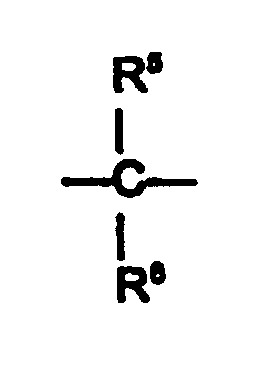
ist, in der R5 Wasserstoff, Alkyl oder Aryl ist; R6 Wasserstoff oder Alkyl ist; und die Gruppe -C(R5)(R6)- bis zu etwa 8 Kohlenstoffatome enthält; und worin R3 und R4 unabhängig aus Alkyl, Alkoxy, Halogen, Cycloalkoxy, Formyl, Alkanoyl, Cycloalkyl, Aryl, Aryloxy, Aroyl, Carboxyl, Carboxylat-Salzen, Alkoxycarbonyl, Alkanoyloxy, Cyano, Sulfonsäure und Sulfonat-Salzen ausgewählt sind, worin die Alkyl-Einheit derartiger Alkyl-, Alkoxy-, Alkanoyl-, Alkoxycarbonyl- und Alkanoyloxy-Gruppen bis zu etwa 8 Kohlenstoffatome enthält; p und q jeweils für 0, 1 oder 2 stehen.
oder eine Rest mit der Formel
darstellen, worin
A1 und A2 jeweils ein Arylenrest mit der Formel (V), (VI) oder (VII) oben ist, wobei jedes Ester-Sauerstoffatom des Chlorophosphits (I) an ein RingKohlenstoffatom von A1 und A2 gebunden ist;
X ein Sauerstoffatom, eine Gruppe mit der Formel -(CH2)y-, worin y 2 bis 4 ist, oder eine Gruppe mit der Formel
ist, in der R5 Wasserstoff, Alkyl oder Aryl ist; R6 Wasserstoff oder Alkyl ist; und die Gruppe -C(R5)(R6)- bis zu etwa 8 Kohlenstoffatome enthält; und worin R3 und R4 unabhängig aus Alkyl, Alkoxy, Halogen, Cycloalkoxy, Formyl, Alkanoyl, Cycloalkyl, Aryl, Aryloxy, Aroyl, Carboxyl, Carboxylat-Salzen, Alkoxycarbonyl, Alkanoyloxy, Cyano, Sulfonsäure und Sulfonat-Salzen ausgewählt sind, worin die Alkyl-Einheit derartiger Alkyl-, Alkoxy-, Alkanoyl-, Alkoxycarbonyl- und Alkanoyloxy-Gruppen bis zu etwa 8 Kohlenstoffatome enthält; p und q jeweils für 0, 1 oder 2 stehen.
5. Katalysatorsystem nach Anspruch 4, in dem der Chlorophosphit-Ligand die Formel (VIII)
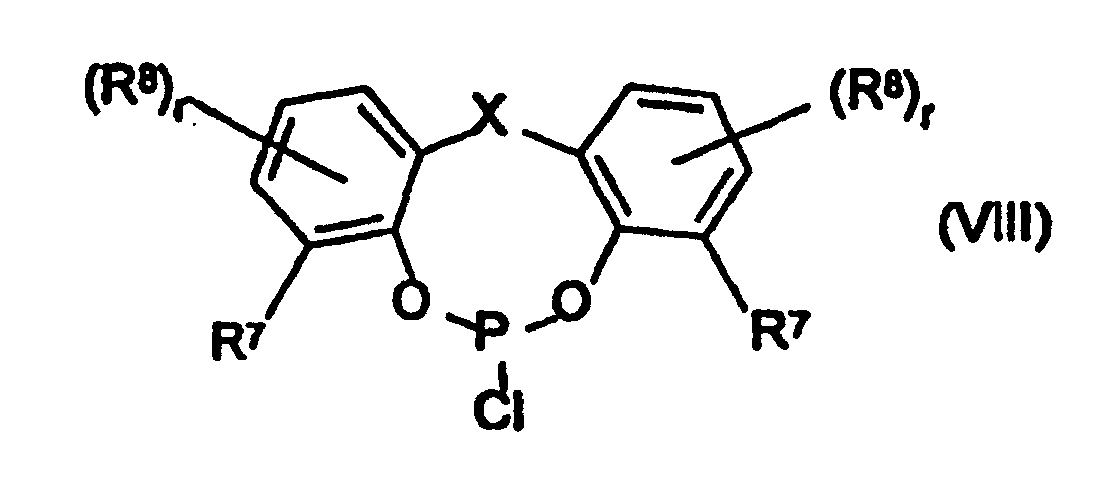
aufweist, in der R7 Wasserstoff, Halogen oder C1- bis C12-Alkyl darstellt; R8 Halogen, C1- bis C12-Alkyl oder C1- bis C12-Alkoxy darstellt; r für 0, 1 oder 2 steht und X eine Gruppe mit der Formel
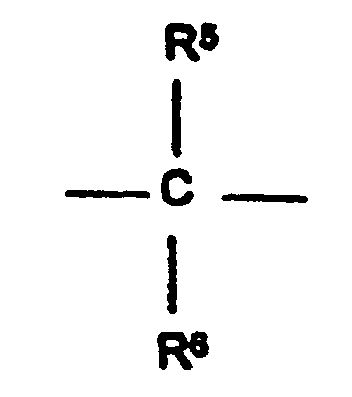
ist, in der R5 Wasserstoff, Alkyl oder Aryl ist; und R6 Wasserstoff oder Alkyl ist, und in dem das Molverhältnis von Chlorophosphit-Ligand zu Rhodium etwa 15 : 1 bis 50 : 1 beträgt.
aufweist, in der R7 Wasserstoff, Halogen oder C1- bis C12-Alkyl darstellt; R8 Halogen, C1- bis C12-Alkyl oder C1- bis C12-Alkoxy darstellt; r für 0, 1 oder 2 steht und X eine Gruppe mit der Formel
ist, in der R5 Wasserstoff, Alkyl oder Aryl ist; und R6 Wasserstoff oder Alkyl ist, und in dem das Molverhältnis von Chlorophosphit-Ligand zu Rhodium etwa 15 : 1 bis 50 : 1 beträgt.
6. Katalysatorsystem nach Anspruch 5, in dem der Chlorophosphit-Ligand 2,2'-Methylidenbis(3,4,6-trichlorphenyl)chlorophosphit
ist.
7. Katalysator-Lösung, umfassend ein Katalysatorsystem gemäß irgendeinem der vorangehenden
Ansprüche und ein Hydroformylierungs-Lösungsmittel.
8. Katalysator-Lösung nach Anspruch 7, in der das Molverhältnis von Chlorophosphit-Ligand
zu Rhodium etwa 15 : 1 bis 50 : 1 beträgt und das Hydroformylierungs-Lösungsmittel
aus Alkanen, Cycloalkanen, Alkenen, Cycloalkenen, carbocyclischen aromatischen Verbindungen,
Estern, Ketonen, Acetalen und Ethern ausgewählt ist, die bei dem Druck, bei dem das
Verfahren betrieben wird, flüssig sind.
9. Verfahren zur Herstellung eines Aldehyds, welches umfasst, dass man ein Olefin, Wasserstoff
und Kohlenmonoxid mit einer Lösung eines Katalysatorsystems nach irgendeinem der Ansprüche
1 - 6 und einem Hydroformylierungs-Lösungsmittel in Kontakt bringt.
10. Verfahren nach Anspruch 9, in dem die Konzentration an Rhodium in der Lösung im Bereich
von etwa 30 bis 300 mg pro Liter liegt und das Verfahren bei einer Temperatur von
etwa 50 bis 135 °C bei einem Druck im Bereich von Umgebung bis etwa 36 Bar absolut
(Bara) durchgeführt wird.
11. Verfahren nach Anspruch 9, in dem das Olefin ein Mono-α-olefin mit 2 bis 10 Kohlenstoffatomen
ist.
12. Verfahren nach Anspruch 9, in dem die Lösung eines Katalysatorsystems eine Chlorophosphit-Verbindung
der Formel
umfasst, in der R7 Wasserstoff, Chlor oder C1- bis C4-Alkyl darstellt; R8 Chlor, C1- bis C4-Alkyl oder C1- bis C4-Alkoxy darstellt; r für 0, 1 oder 2 steht; und X eine Gruppe mit der Formel
ist, in der R5 Wasserstoff, Alkyl oder Aryl ist; und R6 Wasserstoff oder Alkyl ist; und das Olefin ein Mono-α-olefin mit 3 bis 8 Kohlenstoffatomen ist; wobei das normal- zu iso-Verhältnis des Aldehydprodukts durch Variation des Partialdruckes von Kohlenmonoxid in dem Reaktorgas zwischen 3 und 8 Bara gesteuert wird.
umfasst, in der R7 Wasserstoff, Chlor oder C1- bis C4-Alkyl darstellt; R8 Chlor, C1- bis C4-Alkyl oder C1- bis C4-Alkoxy darstellt; r für 0, 1 oder 2 steht; und X eine Gruppe mit der Formel
ist, in der R5 Wasserstoff, Alkyl oder Aryl ist; und R6 Wasserstoff oder Alkyl ist; und das Olefin ein Mono-α-olefin mit 3 bis 8 Kohlenstoffatomen ist; wobei das normal- zu iso-Verhältnis des Aldehydprodukts durch Variation des Partialdruckes von Kohlenmonoxid in dem Reaktorgas zwischen 3 und 8 Bara gesteuert wird.
13. Verfahren nach Anspruch 12, in dem die Konzentration an Rhodium in der Lösung im Bereich
von etwa 30 bis 300 mg pro Liter liegt; der Chlorophosphit-Ligand 2,2'-Methylidenbis(3,4,6-trichlorphenyl)chlorophosphit
ist; das Molverhältnis von Chlorophosphit-Ligand zu Rhodium etwa 15 : 1 bis 50 : 1
beträgt; das Olefin ein Mono-α-olefin mit 2 bis 10 Kohlenstoffatomen ist und das Verfahren
bei einer Temperatur von etwa 50 bis 135 °C bei einem Druck im Bereich von Umgebung
bis etwa 36 Bar absolut durchgeführt wird.
1. Système catalytique comprenant du rhodium et un ou plusieurs composés chlorophosphite
ayant la formule générale
dans laquelle R1 et R2 sont des radicaux hydrocarbyle aromatiques qui contiennent un total d'atomes de carbone allant jusqu'à environ 40 et dans lequel le rapport molaire entre le ligand chlorophosphite et le rhodium est au moins égal à 1:1.
dans laquelle R1 et R2 sont des radicaux hydrocarbyle aromatiques qui contiennent un total d'atomes de carbone allant jusqu'à environ 40 et dans lequel le rapport molaire entre le ligand chlorophosphite et le rhodium est au moins égal à 1:1.
2. Système catalytique selon la revendication 1, dans lequel le métal de transition est
le rhodium et la teneur totale en atomes de carbone des radicaux hydrocarbyle aromatiques
représentés par R1 et R2 est comprise entre environ 12 et 35.
3. Système catalytique selon la revendication 1, dans lequel R1 et R2 dans ledit(lesdits) un ou plusieurs composés chlorophosphite sont individuellement
choisis indépendamment parmi les groupes aryle ayant les formules :
dans lesquelles R3 et R4 sont choisis indépendamment parmi les groupes alkyle, alcoxy, halogène, cycloalcoxy, formyle, alcanoyle, cycloalkyle, aryle, aryloxy, aroyle, carboxyle, les sels carboxylates, alcoxycarbonyle, alcanoyloxy, cyano, acide sulfonique et les sels sulfonates, où le reste alkyle de ces groupes alkyle, alcoxy, alcanoyle, alcoxycarbonyle et alcanoyloxy contient jusqu'à environ 8 atomes de carbone ; m et n sont chacun 0, 1 ou 2 ; et la teneur totale en atomes de carbone des radicaux hydrocarbyle représentés par R1 et R2 est comprise entre environ 12 et 35 et dans lequel le rapport molaire entre le ligand chlorophosphite et le rhodium est compris entre environ 10:1 et 70:1.
dans lesquelles R3 et R4 sont choisis indépendamment parmi les groupes alkyle, alcoxy, halogène, cycloalcoxy, formyle, alcanoyle, cycloalkyle, aryle, aryloxy, aroyle, carboxyle, les sels carboxylates, alcoxycarbonyle, alcanoyloxy, cyano, acide sulfonique et les sels sulfonates, où le reste alkyle de ces groupes alkyle, alcoxy, alcanoyle, alcoxycarbonyle et alcanoyloxy contient jusqu'à environ 8 atomes de carbone ; m et n sont chacun 0, 1 ou 2 ; et la teneur totale en atomes de carbone des radicaux hydrocarbyle représentés par R1 et R2 est comprise entre environ 12 et 35 et dans lequel le rapport molaire entre le ligand chlorophosphite et le rhodium est compris entre environ 10:1 et 70:1.
4. Système catalytique selon la revendication 1, dans lequel R1 et R2 dans ledit(lesdits) un ou plusieurs composés chlorophosphite représentent collectivement
un groupe arylène ayant les formules :
ou un radical de formule
dans laquelle
chacun des groupes A1 et A2 est un radical arylène ayant la formule (V), (VI) ou (VII) ci-dessus, où chaque atome d'oxygène estérifié du chlorophosphite (I) est lié à un atome de carbone cyclique de A1 et A2 ;
X est un atome d'oxygène, un groupe ayant la formule -(CH2)y-, dans laquelle y est compris entre 2 et 4 ou un groupe de formule
dans laquelle R5 est un atome d'hydrogène, un groupe alkyle ou aryle ; R6 est un atome d'hydrogène ou un groupe alkyle ; et le groupe -C(R5)(R6)- contient jusqu'à environ 8 atomes de carbone ; et
où R3 et R4 sont choisis indépendamment parmi les groupes alkyle, alcoxy, halogène, cycloalcoxy, formyle, alcanoyle, cycloalkyle, aryle, aryloxy, aroyle, carboxyle, les sels carboxylates, alcoxycarbonyle, alcanoyloxy, cyano, acide sulfonique et les sels sulfonates, où le reste alkyle de ces groupes alkyle, alcoxy alcanoyle, alcoxycarbonyle et alcanoyloxy contient jusqu'à environ 8 atomes de carbone ; p et q sont chacun 0, 1 ou 2.
ou un radical de formule
dans laquelle
chacun des groupes A1 et A2 est un radical arylène ayant la formule (V), (VI) ou (VII) ci-dessus, où chaque atome d'oxygène estérifié du chlorophosphite (I) est lié à un atome de carbone cyclique de A1 et A2 ;
X est un atome d'oxygène, un groupe ayant la formule -(CH2)y-, dans laquelle y est compris entre 2 et 4 ou un groupe de formule
dans laquelle R5 est un atome d'hydrogène, un groupe alkyle ou aryle ; R6 est un atome d'hydrogène ou un groupe alkyle ; et le groupe -C(R5)(R6)- contient jusqu'à environ 8 atomes de carbone ; et
où R3 et R4 sont choisis indépendamment parmi les groupes alkyle, alcoxy, halogène, cycloalcoxy, formyle, alcanoyle, cycloalkyle, aryle, aryloxy, aroyle, carboxyle, les sels carboxylates, alcoxycarbonyle, alcanoyloxy, cyano, acide sulfonique et les sels sulfonates, où le reste alkyle de ces groupes alkyle, alcoxy alcanoyle, alcoxycarbonyle et alcanoyloxy contient jusqu'à environ 8 atomes de carbone ; p et q sont chacun 0, 1 ou 2.
5. Système catalytique selon la revendication 4, dans lequel le ligand chlorophosphite
a la formule (VIII)
dans laquelle R7 représente un atome d'hydrogène, d'halogène ou un groupe alkyle en C1 à C12 ; R8 représente un atome d'halogène, un groupe alkyle en C1 à C12 ou alcoxy en C1 à C12 ; r est 0, 1 ou 2 ; et X est un groupe de formule
dans laquelle R5 est un atome d'hydrogène, un groupe alkyle ou aryle ; et R6 est un atome d'hydrogène ou un groupe alkyle et le rapport molaire entre le ligand chlorophosphite et le rhodium est compris entre environ 15:1 et 50:1.
dans laquelle R7 représente un atome d'hydrogène, d'halogène ou un groupe alkyle en C1 à C12 ; R8 représente un atome d'halogène, un groupe alkyle en C1 à C12 ou alcoxy en C1 à C12 ; r est 0, 1 ou 2 ; et X est un groupe de formule
dans laquelle R5 est un atome d'hydrogène, un groupe alkyle ou aryle ; et R6 est un atome d'hydrogène ou un groupe alkyle et le rapport molaire entre le ligand chlorophosphite et le rhodium est compris entre environ 15:1 et 50:1.
6. Système catalytique selon la revendication 5, dans lequel le ligand chlorophosphite
est le chlorophosphite de 2,2'-méthylidènebis(3,4,6-trichlorophényle).
7. Solution de catalyseur comprenant un système catalytique selon l'une quelconque des
revendications précédentes et un solvant d'hydroformylation.
8. Solution de catalyseur selon la revendication 7, dans laquelle le rapport molaire
entre le ligand chlorophosphite et le rhodium est compris entre environ 15:1 et 50:1
et le solvant d'hydroformylation est choisi parmi les alcanes, les cycloalcanes, les
alcènes, les cycloalcènes, les composés carbocycliques aromatiques, les esters, les
cétones, les acétals et les éthers, qui sont liquides à la pression à laquelle on
effectue le procédé.
9. Procédé pour préparer un aldéhyde, qui comprend la mise en contact d'une oléfine,
d'hydrogène et de monoxyde de carbone avec une solution d'un système catalytique tel
que défini dans l'une quelconque des revendications 1 à 6 et un solvant d'hydroformylation.
10. Procédé selon la revendication 9, dans lequel la concentration en rhodium dans la
solution est dans l'intervalle compris entre environ 30 et 300 mg par litre et le
procédé est effectué à une température comprise entre environ 50 et 135°C à une pression
dans l'intervalle compris entre la pression ambiante et environ 36 bars absolus (bara).
11. Procédé selon la revendication 9, dans lequel l'oléfine est une mono-α-oléfine ayant
2 à 10 atomes de carbone.
12. Procédé selon la revendication 9, dans lequel la solution d'un système catalytique
comprend un composé chlorophosphite de formule
dans laquelle R7 représente un atome d'hydrogène, de chlore ou un groupe alkyle en en C1 à C4 ; R8 représente un atome de chlore, un groupe alkyle en C1 à C4 ou alcoxy en C1 à C4 ; r est 0, 1 ou 2 ; et X est un groupe ayant la formule
dans laquelle R5 est un atome d'hydrogène, un groupe alkyle ou aryle ; et R6 est un atome d'hydrogène ou un groupe alkyle ; et l'oléfine est une mono-α-oléfine ayant 3 à 8 atomes de carbone ; dans lequel on contrôle le rapport entre le composé normal et le composé iso pour l'aldéhyde produit en faisant varier la pression partielle de monoxyde de carbone dans le gaz réactionnel entre 3 et 8 bara.
dans laquelle R7 représente un atome d'hydrogène, de chlore ou un groupe alkyle en en C1 à C4 ; R8 représente un atome de chlore, un groupe alkyle en C1 à C4 ou alcoxy en C1 à C4 ; r est 0, 1 ou 2 ; et X est un groupe ayant la formule
dans laquelle R5 est un atome d'hydrogène, un groupe alkyle ou aryle ; et R6 est un atome d'hydrogène ou un groupe alkyle ; et l'oléfine est une mono-α-oléfine ayant 3 à 8 atomes de carbone ; dans lequel on contrôle le rapport entre le composé normal et le composé iso pour l'aldéhyde produit en faisant varier la pression partielle de monoxyde de carbone dans le gaz réactionnel entre 3 et 8 bara.
13. Procédé selon la revendication 12, dans lequel la concentration en rhodium dans la
solution est dans l'intervalle compris entre environ 30 et 300 mg par litre ; le ligand
chlorophosphite est le chlorophosphite de 2,2'-méthylidènebis(3,4,6-trichlorophényle)
; le rapport molaire entre le ligand chlorophosphite et le rhodium est compris entre
environ 15:1 et 50:1 ; l'oléfine est une mono-α-oléfine ayant 2 à 10 atomes de carbone
; et le procédé est effectué à une température comprise entre environ 50 et 135°C
à une pression dans l'intervalle compris entre la pression ambiante et environ 36
bars absolus.