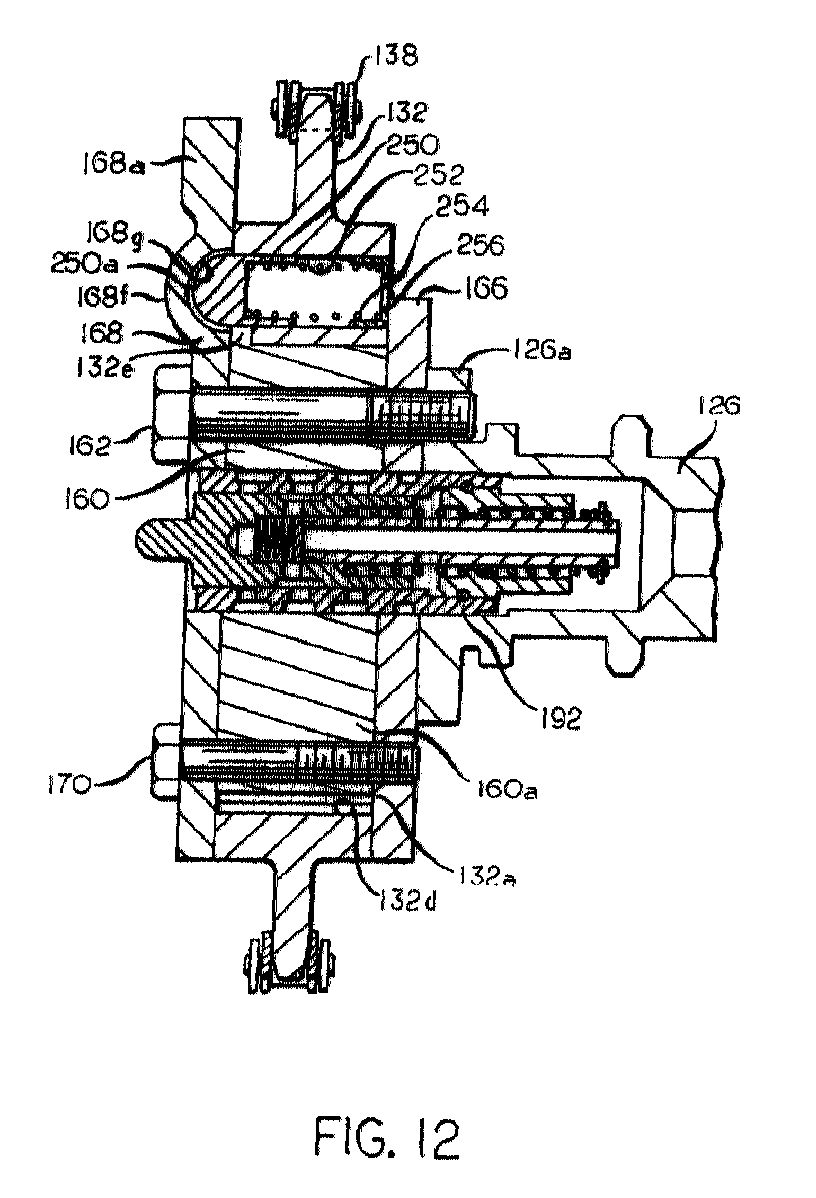
(57) A camshaft (126) has a vane (160) secured to an end thereof for non-oscillating rotation
therewith. The camshaft also carries a sprocket (132) that can rotate with the camshaft
but oscillatable with respect to the camshaft. The vane has opposed lobes (160a, 160b)
that are received in opposed recesses (132a, 132b), respectively, of the sprocket.
The recesses have greater circumferential extent than the lobes to permit the vane
and sprocket to oscillate with respect to one another, and thereby permit the camshaft
to change in phase relative to a crankshaft whose phase relative to the sprocket is
fixed by virtue of a chain drive extending therebetween. The camshaft phase tends
to change in reaction to pulses that it experiences during its normal operation, and
it is permitted to change only in a given direction, either to advance or retard,
by selectively blocking or permitting the flow of pressurized hydraulic fluid, preferably
engine oil, from the recesses by controlling the position of a spool within a valve
body (192) of a control valve in response to a signal indicative of an engine operating
condition from an engine control unit. The sprocket has a passage (252) extending
therethrough the passage extending parallel to and being spaced from a longitudinal
axis of rotation of the camshaft. A pin (250) is slidable within the passage and is
resiliently urged by a spring (254) to a position where a free end of the pin projects
beyond the passage. The vane carries a plate (168) with a pocket (168f), which is
aligned with the passage in a predetermined sprocket to camshaft orientation. The
pocket receives hydraulic fluid, and when the fluid pressure is at its normal operating
level, there will be sufficient pressure within the pocket to keep the free end of
the pin from entering the pocket. At low levels of hydraulic pressure, however, the
free end of the pin will enter the pocket and latch the camshaft and the sprocket
together in a predetermined orientation, until hydraulic pressure within the pocket
returns to a suitable level to permit the camshaft to properly oscillate relative
to the sprocket.
|
|
