|
(11) | EP 1 142 893 B1 |

| (12) | EUROPEAN PATENT SPECIFICATION |
|
|
| (54) |
Substituted 6(4)-benzyloxypyrimidines Substituierte 6(4)-Benzyloxypyrimidine 6(4)-benzyloxypyrimidines substituées |
|
|
|||||||||||||||||||||||||||||||||||
| Note: Within nine months from the publication of the mention of the grant of the European patent, any person may give notice to the European Patent Office of opposition to the European patent granted. Notice of opposition shall be filed in a written reasoned statement. It shall not be deemed to have been filed until the opposition fee has been paid. (Art. 99(1) European Patent Convention). |
TECHNICAL FIELD OF THE INVENTION
[0001] The present invention relates to substituted 6(4)-benzyloxypyrimidines, pharmaceutical compositions comprising such compounds, and methods of using such compounds. The subject compounds are particularly useful in inactivating the human DNA repair protein O6-alkylguanine-DNA alkyltransferase.
BACKGROUND OF THE INVENTION
[0002] The inactivation of the human DNA repair protein O6-alkylguanine-DNA alkyltransferase (AGT) by O6-benzylguanine leads to a dramatic enhancement in the cytotoxic response of human tumor cells and tumor xenografts to chemotherapeutic drugs whose mechanism of action involves modification of DNA guanine residues at the O6-position (Dolan et al., Proc. Natl. Acad. Sci. U.S.A., 87, 5368-5372 (1990); Dolan et al., Cancer Res., 51, 3367-3372 (1991); Dolan et al., Cancer Commun., 2, 371-377 (1990); Mitchell et al., Cancer Res., 52, 1171-1175 (1992); Friedman et al., J. Natl. Cancer Inst., 84, 1926-1931 (1992); Felker et al., Cancer Chem. Pharmacol., 32, 471-476 (1993); Dolan et al., Cancer Chem. Pharmacol., 32, 221-225 (1993); Dolan et al., Biochem. Pharmacol., 46, 285-290 (1993)). The AGT inactivating activity of a large number of O6-benzylguanine analogs have been compared with the aim of obtaining information about the types of substituent groups and the sites at which they could be attached to O6-benzylguanine without significantly lowering its AGT-inactivating activity (Moschel et al., J. Med. Chem., 35, 4486-4491 (1992); Chae et al., J. Med. Chem., 37, 342-347 (1994)). While these studies led to the production of a variety of analogs that were as potent or somewhat less potent than O6-benzylguanine, none of the analogs were better than O6-benzylguanine.
[0003] Thus, there remains a need for additional compounds which are capable of enhancing the chemotherapeutic treatment of tumor cells in a mammal with an antineoplastic alkylating agent which causes cytotoxic lesions at the O6-position of guanine. The present invention provides such compounds and associated pharmaceutical compositions and treatment methods. These and other objects and advantages of the present invention, as well as additional inventive features, will be apparent from the description of the invention provided herein.
BRIEF SUMMARY OF THE INVENTION
[0004] The present invention provides 4(6)-substituted 2-amino-5-nitro-6(4)-benzyloxypyrimidine and 2-amino-5-nitroso-6(4)-benzyloxypyrimidine derivatives which have been found to be effective AGT inactivators, as well as pharmaceutical compositions comprising- such derivatives along with a pharmaceutically acceptable carrier. The present invention further provides a method of enhancing the chemotherapeutic treatment of tumor cells in a mammal with an antineoplastic alkylating agent which causes cytotoxic lesions at the O6-position of guanine, by administering to a mammal an effective amount of one of the aforesaid derivatives, or of a 5-substituted 2,4-diamino-6-benzyloxypyrimidine and administering to the mammal an effective amount of an antineoplastic alkylating agent which causes cytotoxic lesions at the O6-position of guanine.
[0005] The present invention provides a compound of the formula II
wherein R1 is NO2 or NO, and R2 is a substituent selected from the group consisting of hydrogen, halo, C1-C4 alkyl, C1-C4 hydroxyalkyl, thiol, C1-C4 alkylthio, trifluoromethylthio, C1-C4 thioacyl, hydroxy, C1-C4 alkyloxy, trifluoromethoxy, methanesulfonyloxy, trifluoromethanesulfonyloxy, C1-C4 acyloxy, C1-C4 aminoalkyl, C1-C4 alkylamino, C1-C4 dialkylamino, trifluoromethylamino, ditrifluoromethylamino, aminomethanesulfonyl, amino C1-C4 alkylcarbonyl, aminotrifluoromethylcarbonyl, formylamino, nitro, nitroso, C1-C4 alkyldiazo, C5-C6 aryldiazo, trifluoromethyl, C1-C4 haloalkyl, cyanomethyl, C1-C4 cyanoalkyl, cyano, C1-C4 alkyloxycarbonyl, C1-C4 alkylcarbonyl, phenyl, phenylcarbonyl, formyl, C1-C4 alkoxymethyl, phenoxymethyl, C2-C4 vinyl, C2-C4 ethynyl, and SOnR' wherein n is 0, 1, 2, or 3 and R' is hydrogen, C1-C4 alkyl, amino, or phenyl. Suitable compounds include those compounds wherein R1 is NO2 and R2 is hydrogen or a C1-C4 alkyl. Examples of suitable compounds include 2-atnino-4-benzyloxy-5-nitropyrimidine and 2-amino-4-benzyloxy-6-methyl-5-nitropyrimidine.
[0006] The present invention additionally provides treatment methods, which are generally administered via pharmaceutical compositions comprising one or more of the O6-substituted compounds of the present invention. In particular, the present invention provides a method of enhancing the chemotherapeutic treatment of tumor cells in a mammal with an antineoplastic alkylating agent that causes cytotoxic lesions at the O6-position of guanine, which method comprises administering to a mammal an effective amount of one or more of the aforedescribed present inventive compounds of formulas I-V, and administering to the mammal an effective amount of an antineoplastic alkylating agent that causes cytotoxic lesions at the O6-position of guanine. The present invention also includes the method of enhancing the chemotherapeutic treatment of tumor cells in a mammal with an antineoplastic alkylating agent that causes cytotoxic, lesions at the O6-position of guanine, which method comprises (i) administering to a mammal an effective amount of
a compound of the formula VI
wherein R is a substituent selected from the group consisting of hydrogen, halo, C1-C4 alkyl, C1-C4 hydroxyalkyl, thiol, C1-C4 alkylthio, trifluoromethylthio, C1-C4 thioacyl, hydroxy, C1-C4 alkoxy, trifluoromethoxy, methanesulfonyloxy, trifluoromethanesulfonyloxy, C1-C4 acyloxy, amino, C1-C4 aminoalkyl, C1-C4 alkylamino, C1-C4 dialkylamino, trifluoromethylamino, ditrifluoromethylatnino, aminomethanesulfonyl, amino C1-C4 alkylcarbonyl, aminotrifluoromethylcarbonyl, formylamino, nitro, nitroso, C1-C4 alkyldiazo, C5-C6 aryldiazo, trifluoromethyl, C1-C4 haloalkyl, halomethyl, cyanomethyl, C1-C4 cyanoalkyl, cyano, C1-C4 alkyloxycarbonyl, C1-C4 alkylcarbonyl, phenyl, phenylcarbonyl, formyl, C1-C4 alkoxymethyl, phenoxymethyl, C2-C4 vinyl, C2-C4 ethynyl, and SOnR' wherein n is 0, 1, 2, or 3 and R' is hydrogen, C1-C4 alkyl, amino, or phenyl, or and (ii) administering to the mammal an effective amount of an antineoplastic alkylating agent which causes cytotoxic lesions at the O6-position of guanine.
[0007] Several O6-substituted compounds were tested for their ability to inactivate the human DNA repair protein, O6-alkylguanine DNA alkyltransferase (AGT, alkyltransferase). One class of compounds, which were identified as being significantly better than O6-benzylguanine (the prototype low-molecular-weight inactivator) in inactivating AGT in human HT29 colon tumor cell extracts were 5-substituted 2,4-diamino-6-benzyloxypyrimidines bearing electron-withdrawing groups at the 5-position. The latter derivatives were also more effective than O6-benzylguanine in inactivating AGT in intact HT29 colon tumor cells. This type of compound was as effective or more effective than O6-benzylguanine in enhancing cell killing by 1,3-bis(2-chloroethyl)-1-nitrosourea (BCNU) of colon, breast and prostate cancer cells grown in culture. Provided 5-substituted 2,4-diamino-6-benzyloxypyrimidines bearing electron-withdrawing substituents at the 5-position do not exhibit undesirable toxicity, they should be superior to O6-benzylguanine as chemotherapeutic adjuvants for enhancing the effectiveness of antitumor drugs whose mechanism of action involves modification of the O6-position of DNA guanine residues. The specific compounds surveyed for AGT inactivating activity are illustrated below.
[0008] With respect to the pyrimidine derivatives (3a-f), 4-amino-6-benzyloxy-5-nitropyrimidine (3a) was prepared by treating 4-amino-6-chloro-5-nitropyrimidine (Boon et al., J. Chem. Soc., 96-102 (1951)) with sodium benzyloxide in benzyl alcohol. Derivatives 3b-d were prepared by the method of Pfleiderer et al. (Chem. Ber., 94, 12-18 (1961)). 2,4-Diamino-6-benzyloxy-5-nitropyrimidine (3e) and 2,4-diamino-6-benzyloxy-5-bromopyrimidine (3f) were prepared previously by Kosary et al. (Acta Pharm. Hung., 49, 241-247 (1989)).
[0009] Compounds 5a (2-amino-4-benzyloxy-5-nitropyrimidine) and 5b (2-amino-4-benzyloxy-6-methyl-5-nitropyrimidine) were prepared by treating 2-amino-4-chloro-5-nitropyrimidine and 2-amino-4-chloro-6-methyl-5-nitropyrimidine (Boon et al., J. Chem. Soc., 96-102 (1951)), respectively, with sodium benzyloxide in benzyl alcohol.
[0010] The ability of these compounds to inactivate the AGT protein in HT29 human colon tumor cell extracts and in intact HT29 cells is summarized in Table 1. The data represent the dose of compound required to produce 50% inactivation in cell-free extracts upon incubation for 30 min or in cells upon incubation for 4 hr.
Table 1.
| AGT-Inactivating Activity of 6(4)-Benzyloxypyrimidine Derivatives | ||
| ED50 (µM)a | ||
| Compound | In HT29 cell-free extract | In HT29 cells |
| 2,4-diamino-6-benzyloxy-5-nitrosopyrimidine (3d) | 0.06 | 0.02 |
| 2,4-diamino-6-benzyloxy-5-nitropyrimidine (3e) | 0.06 | 0.02 |
| O6-benzylguanine | 0.2 | 0.05 |
| 2,4,5-triamino-6-benzyloxypyrimidine (3c) | 0.4 | 0.3 |
| 2-amino-4-benzyloxy-6-methyl-5-nitropyrimidine (5b) | 0.4 | 0.06 |
| 2-amino-4-benzyloxy-5-nitropyrimidine (5a) | 0.4 | 0.05 |
| 2,4-diamino-6-benzyloxy-5-bromopyrimidine (3f) | 2 | 0.8 |
| 2,4-diamino-6-benzyloxypyrimidine (3b) | 15 | 5 |
| 4-amino-6-benzyloxy-5-nitropyrimidine (3a) | 28 | 8 |
| a The effective dose required to produce 50% inactivation in cell-free extracts upon incubation for 30 min or in cells upon incubation for 4 hr. The values for O6-benzylguanine are from Moschel et al., J. Med. Chem., 35, 4486-4491 (1992). |
[0011] For comparison, the ED50 value exhibited by O6-benzylguanine was 0.2 µM (Table 1). The substituted pyrimidines 4-amino-6-benzyloxy-5-nitropyrimidine (3a) and 2,4-diamino-6-benzyloxypyrimidine (3b), were more active AGT inactivating agents exhibiting intermediate ED50 values of 28 and 15 µM respectively. 2,4-diamino-6-benzyloxy-5-bromopyrimidine (3f) was considerably more active than 3b indicating that electron-withdrawing groups at the 5-position of a 2,4-diamino-6-benzyloxypyrimidine derivative are positive contributors to efficient AGT inactivation. This is. further emphasized by the very high activity exhibited by 2,4-diamino-6-benzyloxy-5-nitrosopyrimidine (3d) and 2,4-diamino-6-benzyloxy-5-nitropyrimidine (3e), which contain strongly electron-withdrawing nitroso and nitro substituents, respectively. These two derivatives are the most active AGT inactivators tested to date. The observation that 2-amino-4-benzyloxy-5-nitropyrimidine (5a) is much more active than 3a indicates that a 2-amino group is critical for high activity for a 6(4)-benzyloxy-5-nitropyrimidine derivative. An additional alkyl group at the 4(6)-position (e.g., as in 5b) does not enhance activity significantly over that for 5a although an amino group at the 4(6)-position significantly enhances activity. Thus, AGT inactivating activity increases substantially over the series 5a=5b<3d=3e. With these considerations in mind the activity of 2,4,5-triamino-6-benzyloxypyrimidine (3c) seems exceptional and the reasons for its relatively high activity are unclear at present. It is also significant that pyrimidines 5a and 5b are quite active in cells, which is not totally predicted by their corresponding activity in HT29 cell extracts.
[0012] The ability of increasing concentrations of 3c-e to enhance the killing of human HT29 colon cancer cells, DU-145 prostate cancer cells, and MCF-71 breast cancer cells by BCNU (40 µM) is shown in Tables 2, 3, and 4, respectively. The data reflect the number of cell colonies that result following exposure to AGT inactivator alone or AGT inactivator 2 hr before exposure to BCNU as described in Dolan et al. (Proc. Natl. Acad. Sci., U.S.A., 87, 5368-5372 (1990)). Data for O6-benzylguanine are included for comparison.
[0013] For the pyrimidines tested, 2,4,5-triamino-6-benzyloxypyrimidine (3c) was as effective as O6-benzylguanine itself in enhancing BCNU toxicity although the nitroso- and nitropyrimidine derivatives (3d and 3e) were similarly effective at a 4-fold lower dose.
Table 2.
| Killing of HT-29 Colon Cancer Cells by BCNU Combined with AGT Inactivators | |||
| Inactivator | Inactivator Concentration (µM) | BCNU (µM) | Colony Formation per 1000 cells |
| None | None | 435±63 | |
| None | 40 | 442±34 | |
| O6-benzylguanine | 10 | None | 431±33 |
| 10 | 40 | 13±6 | |
| 2.5 | 40 | 38±15 | |
| 1 | 40 | 277±25 | |
| 2,4,5-triamino-6- benzyloxypyrimidine (3c) |
10 10 1 |
None 40 40 |
453±59 3±1 487±32 |
| 2,4-diamino-6- benzyloxy-5- nitrosopyrimidine (3d) |
2.5 2.5 1 |
None 40 40 |
528±64 <1 19±4 |
| 2,4-diamino-6- benzyloxy-5-n itropyrimidine (3e) |
2.5 2.5 1 |
None 40 40 |
438±25 <1 45±4 |
Table 3.
| Killing of DU-145 Prostate Cancer Cells by BCNU Combined with AGT Inactivators | |||
| Inactivator | Inactivator Concentration (µM) | BCNU (µM) | Colony Formation per 1000 cells |
| None | None | 453±81 | |
| None | 40 | 394±76 | |
| O6-benzylguanine | 10 | None | 462±68 |
| 10 | 40 | 28±5 | |
| 1 | 40 | 299±18 | |
| 2,4,5-triamino-6- benzyloxypyrimidine (3c) |
10 10 1 |
None 40 40 |
429±101 57±7 378±60 |
| 2,4-diamino-6- benzyloxy-5- nitrosopyrimidine (3d) |
2.5 2.5 1 0.25 |
None 40 40 40 |
403±35 7±3 25±4 192±17 |
| 2,4-diamino-6- benzyloxy-5- nitropyrimidine (3e) |
2.5 2.5 1 |
None 40 40 |
407±80 9±2 59±6 |
| 0.25 | 40 | 129±26 | |
Table 4.
| Killing of MCF-71 Breast Cancer Cells by BCNU Combined with AGT Inactivators | |||
| Inactivator | Inactivator Concentration (µM) | BCNU (µM) | Colony Formation per 1000 cells |
| None | None | 426±78 | |
| None | 40 | 364±60 | |
| O6-benzylgruanine | 10 | None | 455±63 |
| 10 | 40 | 4±2 | |
| 2.5 | 40 | 12±6 | |
| 2,4,5-triamino-6- benzyloxypyrimidine (3c) |
10 10 |
None 40 |
448±55 12±4 |
| 2,4-diamino-6-benzyloxy-5 -nitrosopyrimidine (3d) |
2.5 2.5 |
None 40 |
447±87 2±1 |
| 2,4-diamino-6-benzyloxy- 5-nitropyrimidine (3e) |
2.5 2.5 |
None 40 |
314±49 2±1 |
[0014] Although the human alkyltransferase is very sensitive to inactivation by O6-benzylguanine and the various compounds described above, a number of mutants have been generated that are resistant to O6-benzylguanine (Crone and Pegg, Cancer Res., 53, 4750-4753 (1993)). This resistance is probably caused by a reduction in the space surrounding the active site of the alkyltransferase, which limits the access to O6-benzylguanine. These mutants are produced by single base changes in the alkyltransferase DNA-coding sequence causing changes in one or two amino acids in the alkyltransferase (Crone and Pegg, Cancer Res., 53, 4750-4753 (1993)). Thus, as indicated in Table 5, changing the proline residue at position 140 to alanine (protein P140A) or the glycine residue at position 156 to an alanine (protein G156A) causes a 20-fold and a 240-fold increase in resistance to O6-benzylguanine, respectively. The alkyltransferase containing an arginine in place of a proline at residue 138 together with an arginine in place of a proline at residue 140 (protein P138A/P140A) is 88-fold more resistant to inactivation by O6-benzylguanine. It is possible that such resistant mutants will arise or be selected for in tumors under the selective pressure generated by treatment with O6-benzylguanine plus an alkylating agent. More potent inhibitors and/or those of a smaller size that are better able to fit into the space of the active site of the mutant alkyltransferase can be used to advantage to overcome this resistance.
Table 5.
| Inhibition of Mutant Alkyltransferase Proteins by O6-Benzylguanine or 2,4-Diamino-6-benzyloxy-5-nitrosopyrimidine | ||
| ED50 value (µM)a | ||
| Protein | O6-benzylguanine | 2,4-diamino-6-benzyloxy-5-nitroso-pyrimidine |
| Control | 0.25 | 0.05 |
| P140A | 5 | 0.1 |
| P138A/P140A | 22 | 0.3 |
| G156A | 60 | 1 |
| a The concentration needed to inactivate 50% of the activity in 30 minutes. |
[0015] As shown in Table 5, 2,4-diamino-6-benzyloxy-5-nitrosopyrimidine (3d) was 50 to 60 times better at inactivating the mutant alkyltransferases than O6-benzylguanine. Doses of 2,4-diamino-6-benzyloxy-5-nitrosopyrimidine leading to intracellular concentrations greater than 5 µM will therefore be effective at inactivating such resistant alkyltransferases. Concentrations greater than 200 µM of O6-benzylguanine would be needed to get such inactivation, and these are much more than can be achieved with this compound in current formulations. These data for mutant alkyltransferase inactivation and the data presented earlier indicate that pyrimidine derivatives bearing electron-withdrawing groups at the 5-position are superior to O6-benzylguanine for use as adjuvants in chemotherapy with agents whose mechanism of action, like that of BCNU, involves modification of the O6-position of DNA guanine residues.
[0016] Additional 2,4-diamino-6-benzyloxypyrimidine derivatives bearing electron-withdrawing groups other than halogen or nitro groups (e.g., formyl or cyano groups) could also be readily prepared. 2,4-Diamino-5-formyl-6-hydroxypyrimidine, a known compound (Delia and Ottoman, Heterocycles, 20, 1805-1809 (1983)), can be treated with phosphorus oxychloride to produce a 2,4-diamino-6-chloro-5-formylpyrimidine intermediate, which on treatment with sodium benzyloxide in benzyl alcohol produces 2,4-diamino-6-benzyloxy-5-formylpyrimidine. Treatment of the formyl pyrimidine with hydroxylamine affords 2,4-diamino-6-benzyloxy-5-cyanopyrimidine. The preparation of a large number of 5-substituted 6(4)-benzyloxypyrimidines is possible for those skilled in the art of synthesis of heterocyclic aromatic compounds (D.J. Brown, "The Pyrimidines," in The Chemistry of Heterocyclic Compounds, Vol. 16, A. Weissberger, Ed., Wiley Interscience, New York, 1962; D.J. Brown, "The Pyrimidines," Supplement I, in The Chemistry of Heterocyclic Compounds, Vol. 16, A. Weissberger and E.C. Taylor, Eds., Wiley Interscience, New York, 1970; J.H. Lister, "Fused Pyrimidines Part II Purines," in The Chemistry of Heterocyclic Compounds, Vol. 24 Part II, A. Weissberger and E.C. Taylor, Eds., Wiley Interscience, New York, 1971).
[0017] The O6-substituted compounds of the present invention can be administered in any suitable manner to a mammal for the purpose of enhancing the chemotherapeutic treatment of a particular cancer. Although more than one route can be used to administer a particular compound, a particular route can provide a more immediate and more effective reaction than another route. Accordingly, the described methods provided herein are merely exemplary and are in no way limiting.
[0018] Generally, the O6-substituted compounds of the present invention as described above will be administered in a pharmaceutical composition to an individual afflicted with a cancer. Those undergoing or about to undergo chemotherapy can be treated with the O6-substituted compounds separately or in conjunction with other treatments, as appropriate. In therapeutic applications, compositions are administered to a patient in an amount sufficient to elicit an effective depression of AGT activity thereby potentiating the cytotoxicity of the aforedescribed chemotherapeutic treatment. An amount adequate to accomplish this is defined as a "therapeutically effective dose," which is also an "AGT inactivating effective amount." Amounts effective for a therapeutic or prophylactic use will depend on, e.g., the. stage and severity of the disease being treated, the age, weight, and general state of health of the patient, and the judgment of the prescribing physician. The size of the dose will also be determined by the O6-substituted compound selected, method of administration, timing and frequency of administration as well as the existence, nature, and extent of any adverse side-effects that might accompany the administration of a particular O6-substituted compound and the desired physiological effect. It will be appreciated by one of skill in the art that various disease states may require prolonged treatment involving multiple administrations, perhaps using a series of different AGT inactivators and/or chemotherapeutic agents in each or various rounds of administration.
[0019] Suitable chemotherapeutic agents usefully administered in coordination with the O6-substituted compounds of the present invention include alkylating agents, such as chloroethylating and methylating agents. Such agents may be administered using conventional techniques such as those described in Wasserman et al., Cancer, 36, pp. 1258-1268 (1975), and Physicians' Desk Reference, 48th ed., Edward R. Barnhart publisher (1994). For example, 1,3-bis(2-chloroethyl)-1-nitrosourea (carmustine or BCNU, Bristol-Myers, Evansville, IN) may be administered intravenously at a dosage of from about 150 to 200 mg/m2 every six weeks. Another alkylating agent, 1- (2-chloroethyl)-3-cyclohexyl-1-nitrosourea (lomustine or CCNU, Bristol-Myers), may be administered orally at a dosage of about 130 mg/m2 every six weeks. Other alkylating agents may be administered in appropriate dosages via appropriate routes of administration known to skilled medical practitioners.
[0020] Suitable doses and dosage regimens can be determined by conventional range-finding techniques known to those of ordinary skill in the art. Generally, treatment is initiated with smaller dosages that are less than the optimum dose of the compound. Thereafter, the dosage is increased by small increments until the optimum effect under the circumstances is reached. The present inventive method typically will involve the administration of about 0.1 µg to about 50 mg of one or more of the compounds described above per kg body weight of the individual. For a 70 kg patient, dosages of from about 10 µg to about 200 mg of O6-substituted compound would be more commonly used, possibly followed by further lesser dosages from about 1 µg to about 1 mg of O6-substituted compound over weeks to months, depending on a patient's physiological response, as determined by measuring cancer-specific antigens or other measurable parameters related to the tumor load of a patient.
[0021] It must be kept in mind that the compounds and compositions of the present invention generally are employed in serious disease states, that is, life-threatening or potentially life-threatening situations. In such cases, in view of the minimization of extraneous substances and the relative nontoxic nature of the O6-substituted compounds, it is possible and may be felt desirable by the treating physician to administer substantial excesses of these O6-substituted compounds.
[0022] Single or multiple administrations of the compounds can be carried out with dose levels and pattern being selected by the treating physician. In any event, the pharmaceutical formulations should provide a quantity of AGT-inactivating compounds of the invention sufficient to effectively enhance the cytotoxic impact of the chemotherapy.
[0023] The pharmaceutical compositions for therapeutic treatment are intended for parenteral, topical, oral or local administration and generally comprise a pharmaceutically acceptable carrier and an amount of the active ingredient sufficient to reduce, and preferably prevent, the activity of the AGT protein. The carrier may be any of those conventionally used and is limited only by chemico-physical considerations, such as solubility and lack of reactivity with the compound, and by the route of administration.
[0024] Examples of pharmaceutically acceptable acid addition salts for use in the present inventive pharmaceutical composition include those derived from mineral acids, such as hydrochloric, hydrobromic, phosphoric, metaphosphoric, nitric and sulfuric acids, and organic acids, such as tartaric, acetic, citric, malic, lactic, fumaric, benzoic, glycolic, gluconic, succinic, p-toluenesulphonic acids, and arylsulphonic, for example.
[0025] The pharmaceutically acceptable excipients described herein, for example, vehicles, adjuvants, carriers or diluents, are well-known to those who are skilled in the art and are readily available to the public. It is preferred that the pharmaceutically acceptable carrier be one that is chemically inert to the active compounds and one that has no detrimental side effects or toxicity under the conditions of use. Such pharmaceutically acceptable excipients preferably include saline (e.g., 0.9% saline), Cremophor EL (which is a derivative of castor oil and ethylene oxide available from Sigma Chemical Co., St. Louis, MO) (e.g., 5% Cremophor EL/5% ethanol/90% saline, 10% Cremophor EL/90% saline, or 50% Cremophor EL/50% ethanol), propylene glycol (e.g., 40% propylene glycol/10% ethanol/50% water), polyethylene glycol (e.g., 40% PEG 400/60% saline), and alcohol (e.g., 40% t-butanol/60% water). The most preferred pharmaceutical excipient for use in conjunction with the present invention is polyethylene glycol, such as PEG 400, and particularly a composition comprising 40% PEG 400 and 60% water or saline.
[0026] The choice of excipient will be determined in part by the particular O6-substituted compound chosen, as well as by the particular method used to administer the composition. Accordingly, there is a wide variety of suitable formulations of the pharmaceutical composition of the present invention.
[0027] The following formulations for oral, aerosol, parenteral, subcutaneous, intravenous, intraarterial, intramuscular, interperitoneal, rectal, and vaginal administration are merely exemplary and are in no way limiting.
[0028] The pharmaceutical compositions can be administered parenterally, e.g., intravenously, intraarterially, subcutaneously, intradermally, or intramuscularly. Thus, the invention provides compositions for parenteral administration that comprise a solution of the O6-substituted compound dissolved or suspended in an acceptable carrier suitable for parenteral administration, including aqueous and non-aqueous, isotonic sterile injection solutions.
[0029] Overall, the requirements for effective pharmaceutical carriers for parenteral compositions are well known to those of ordinary skill in the art. See Pharmaceutics and Pharmacy Practice, J.B. Lippincott Company, Philadelphia, PA, Banker and Chalmers, eds., pages 238-250 (1982), and ASHP Handbook on Injectable Drugs, Toissel, 4th ed., pages 622-630 (1986). Such solutions can contain anti-oxidants, buffers, bacteriostats, and solutes that render the formulation isotonic with the blood of the intended recipient, and aqueous and non-aqueous sterile suspensions that can include suspending agents, solubilizers, thickening agents, stabilizers, and preservatives. The compound may be administered in a physiologically acceptable diluent in a pharmaceutical carrier, such as a sterile liquid or mixture of liquids, including water, saline, aqueous dextrose and related sugar solutions, an alcohol, such as ethanol, isopropanol, or hexadecyl alcohol, glycols, such as propylene glycol or polyethylene glycol, dimethylsulfoxide, glycerol ketals, such as 2,2-dimethyl-1,3-dioxolane-4-methanol, ethers, such as poly(ethyleneglycol) 400, an oil, a fatty acid, a fatty acid ester or glyceride, or an acetylated fatty acid glyceride with or without the addition of a pharmaceutically acceptable surfactant, such as a soap or a detergent, suspending agent, such as pectin, carbomers, methylcellulose, hydroxypropylmethylcellulose, or carboxymethylcellulose, or emulsifying agents and other pharmaceutical adjuvants.
[0030] Oils useful in parenteral formulations include petroleum, animal, vegetable, or synthetic oils. Specific examples of oils useful in such formulations include peanut, soybean, sesame, cottonseed, corn, olive, petrolatum, and mineral. Suitable fatty acids for use in parenteral formulations include oleic acid, stearic acid, and isostearic acid. Ethyl oleate and isopropyl myristate are examples of suitable fatty acid esters.
[0031] Suitable soaps for use in parenteral formulations include fatty alkali metal, ammonium, and triethanolamine salts, and suitable detergents include (a) cationic detergents such as, for example, dimethyl dialkyl ammonium halides, and alkyl pyridinium halides, (b) anionic detergents such as, for example, alkyl, aryl, and olefin sulfonates, alkyl, olefin, ether, and monoglyceride sulfates, and sulfosuccinates, (c) nonionic detergents such as, for example, fatty amine oxides, fatty acid alkanolamides, and polyoxyethylenepolypropylene copolymers, (d) amphoteric detergents such as, for example, alkyl-β-aminopropionates, and 2-alkyl-imidazoline quaternary ammonium salts, and (e) mixtures thereof.
[0032] The parenteral formulations typically will contain from about 0.5% to about 25% by weight of the active ingredient in solution. Preservatives and buffers may be used. In order to minimize or eliminate irritation at the site of injection, such compositions may contain one or more nonionic surfactants having a hydrophile-lipophile balance (HLB) of from about 12 to about 17. The quantity of surfactant in such formulations will typically range from about 5% to about 15% by weight. Suitable surfactants include polyethylene sorbitan fatty acid esters, such as sorbitan monooleate and the high molecular weight adducts of ethylene oxide with a hydrophobic base, formed by the condensation of propylene oxide with propylene glycol. The parenteral formulations can be presented in unit-dose or multi-dose sealed containers, such as ampules and vials, and can be stored in a freeze-dried (lyophilized) condition requiring only the addition of the sterile liquid excipient, for example, water, for injections, immediately prior to use. Extemporaneous injection solutions and suspensions can be prepared from sterile powders, granules, and tablets of the kind previously described.
[0033] Topical formulations, including those that are useful for transdermal drug release, are well-known to those of skill in the art and are suitable in the context of the present invention for application to skin.
[0034] Formulations suitable for oral administration require extra considerations considering the peptidyl and/or carbohydrate nature of some of the O6-substituted compounds of the present invention and the likely breakdown thereof if such compounds are administered orally without protecting them from the digestive secretions of the gastrointestinal tract. Such a formulation can consist of (a) liquid solutions, such as an effective amount of the compound dissolved in diluents, such as water, saline, or orange juice; (b) capsules, sachets, tablets, lozenges, and troches, each containing a predetermined amount of the active ingredient, as solids or granules; (c) powders; (d) suspensions in an appropriate liquid; and (e) suitable emulsions. Liquid formulations may include diluents, such as water and alcohols, for example, ethanol, benzyl alcohol, and the polyethylene alcohols, either with or without the addition of a pharmaceutically acceptable surfactant, suspending agent, or emulsifying agent. Capsule forms can be of the ordinary hard- or soft-shelled gelatin type containing, for example, surfactants, lubricants, and inert fillers, such as lactose, sucrose, calcium phosphate, and corn starch. Tablet forms can include one or more of lactose, sucrose, mannitol, corn starch, potato starch, alginic acid, microcrystalline cellulose, acacia, gelatin, guar gum, colloidal silicon dioxide, croscarmellose sodium, talc, magnesium stearate, calcium stearate, zinc stearate, stearic acid, and other excipients, colorants, diluents, buffering agents, disintegrating agents, moistening agents, preservatives, flavoring agents, and pharmacologically compatible excipients. Lozenge forms can comprise the active ingredient in a flavor, usually sucrose and acacia or tragacanth, as well as pastilles comprising the active ingredient in an inert base, such as gelatin and glycerin, or sucrose and acacia, emulsions, gels, and the like containing, in addition to the active ingredient, such excipients as are known in the art.
[0035] The O6-substituted compounds of the present invention, alone or in combination with other suitable components, can be made into aerosol formulations to be administered via inhalation. The compounds are preferably supplied in finely divided form along with a surfactant and propellant. Typical percentages of active compound are 0.01%-20% by weight, preferably 1%-10%. The surfactant must, of course, be nontoxic, and preferably soluble in the propellant. Representative of such surfactants are the esters or partial esters of fatty acids containing from 6 to 22 carbon atoms, such as caproic, octanoic, lauric, palmitic, stearic, linoleic, linolenic, olesteric and oleic acids with an aliphatic polyhydric alcohol or its cyclic anhydride. Mixed esters, such as mixed or natural glycerides may be employed. The surfactant may constitute 0.1%-20% by weight of the composition, preferably 0.25-5%. The balance of the composition is ordinarily propellant. A carrier can also be included as desired, e.g., lecithin for intranasal delivery. These aerosol formulations can be placed into acceptable pressurized propellants, such as dichlorodifluoromethane, propane, nitrogen, and the like. They also may be formulated as pharmaceuticals for non-pressured preparations, such as in a nebulizer or an atomizer- Such spray formulations may be used to spray mucosa.
[0036] Additionally, the compounds and polymers useful in the present inventive methods may be made into suppositories by mixing with a variety of bases, such as emulsifying bases or water-soluble bases. Formulations suitable for vaginal administration may be presented as pessaries, tampons, creams, gels, pastes, foams, or spray formulas containing, in addition to the active ingredient, such carriers as are known in the art to be appropriate.
[0037] The concentration of the O6-substituted compounds of the present invention in the pharmaceutical formulations can vary widely, i.e., from less than about 1%, usually at or at least about 10%, to as much as 20% to 50% or more by weight, and will be selected primarily by fluid volumes, viscosities, etc., in accordance with the particular mode of administration selected.
[0038] Thus, a typical pharmaceutical composition for intravenous infusion could be made up to contain 250 ml of sterile Ringer's solution, and 100 mg of the O6-substituted compound. Actual methods for preparing parenterally administrable compounds will be known or apparent to those skilled in the art and are described in more detail in, for example, Remington's Pharmaceutical Science (17th ed., Mack Publishing Company, Easton, PA, 1985).
[0039] It will be appreciated by one of ordinary skill in the art that, in addition to the aforedescribed pharmaceutical compositions, the O6-substituted compounds of the present inventive method may be formulated as inclusion complexes, such as cyclodextrin inclusion complexes, or liposomes. Liposomes serve to target the compounds to a particular tissue, such as lymphoid tissue or cancerous hepatic cells. Liposomes can also be used to increase the half-life of the O6-substituted compound. Liposomes useful in the present invention include emulsions, foams, micelles, insoluble monolayers, liquid crystals, phospholipid dispersions, lamellar layers and the like. In these preparations, the O6-substituted compound to be delivered is incorporated as part of a liposome, alone or in conjunction with a suitable chemotherapeutic agent. Thus, liposomes filled with a desired O6-substituted compound of the invention can be directed to the Bite of a specific tissue type, hepatic cells, for example, where the liposomes then deliver the selected chemotherapeutic-enhancement compositions. Liposomes for use in the invention are formed from standard vesicle-forming lipids, which generally include neutral and negatively charged phospholipids and a sterol such as cholesterol. The selection of lipids is generally guided by consideration of, for example, liposome size and stability of the liposomes in the blood stream. A variety of methods are available for preparing liposomes, as described in, for example, Szoka et al., Ann. Rev. Biophys. Bioeng., 9, 467 (1980), and U.S. Patents 4,235,871, 4,501,728, 4,837,028, and 5,019,369. For targeting to the cells of a particular tissue type, a ligand to be incorporated into the liposome can include, for example, antibodies or fragments thereof specific for cell surface determinants of the targeted tissue type. A liposome suspension containing an O6-substituted compound may be administered intravenously, locally, topically, etc. in a dose that varies according to the mode of administration, the O6-substituted compound being delivered, the stage of disease being treated, etc.
[0040] While the efficacy of the O6-substituted compounds of the present invention has been demonstrated with respect to particular types of cancerous cells, e.g., colon, prostate, and breast cancer cells, the present invention has applicability to the treatment of any type of cancer capable of being treated with an antineoplastic alkylating agent which causes cytotoxic lesions at the O6-position of guanine. Such cancers include, for example, colon tumors, prostrate tumors, brain tumors, lymphomas, leukemias, breast tumors, ovarian tumors, lung tumors, Wilms' tumor, rhabdomyosarcoma, multiplemyeloma, stomach tumors, soft-tissue sarcomas, Hodgkin's disease, and non-Hodgkin's lymphomas.
[0041] Similarly, in view of the mode of action of the O6-substituted compounds of the present invention, such compounds can be used in conjunction with any type of antineoplastic alkylating agent which causes cytotoxic lesions at the O6-position of guanine. Such antineoplastic alkylating agents include, for example, chloroethylating agents (e.g. chloroethylnitrosoureas and chloroethyltriazines) and monofunctional alkylating agents such as Streptozotocin, Procarbazine, Dacarbazine, and Temozolomide.
[0042] Among the chloroethylating agents, the most frequently used chemotherapeutic drugs are 1-(2-chloroethyl)-3-cyclohexyl-1-nitrosourea (CCNU, lomustine), 1,3-bis(2-chloroethyl)-1-nitrosourea (BCNU, carmustine), 1-(2-chloroethyl)-3-(4-methylcyclohexyl)-1-nitrosourea (MeCCNU, semustine), and 1-(2-chloroethyl)-3-(4-amino-2-methyl-5-pyrimidinyl)methyl-1-nitroeourea (ACNU). These agents have been used clinically against tumors of the central nervous system, multiple myeloma, melanoma, lymphoma, gastrointestinal tumors, and other solid tumors (Colvin and Chabner, Alkylating Agents. In: Cancer Chemotherapy: Principles and Practice, Chabner and Collins, eds., Lippincott, Philadelphia, pp. 276-313 (1990); McCormick and McElhinney, Eur. J. Cancer, 26, 207-221 (1990)). Chloroethylating agents currently under development with fewer side effects are 1-(2-chloroethyl)-3-(2-hydroxyethyl)-1-nitrosourea (HECNU), 2-chloroethyl-methylsulfonylmethanesulfonate (Clomesone), and 1-[N-(2-chloroethyl)-N-nitrosoureido]ethylphosphonic acid diethyl ester (Fotemustine) (Colvin and Chabner, Alkylating Agents. In: Cancer Chemotherapy: Principles and Practice, Chabner and Collins, eds., Lippincott, Philadelphia, pp. 276-313 (1990) ; McCormick and McElhinney, Eur. J. Cancer, 26, 207-'221 (1990)). Methylating chemotherapeutic agents include Streptozotocin (2-deoxy-2-(3-methyl-3-nitrosoureido)-D-glucopyranose), Procarbazine (N-(1-methylethyl)-4-[(2-methylhydrazino)methyl]benzamide), Dacarbazine or DTIC (5-(3,3-dimethyl-1-triazenyl)-1H-imidazole-4-carboxamide),and Temozolomide (8-carbamoyl-3-methylimidazo[5,1-d]-1,2,3,5-tetrazine-4-(3H)-one). Temozolomide is active against malignant melanomas, brain tumors, and mycosis fungoides. Streptozotocin is effective against pancreatic tumors. Procarbazine is used to treat Hodgkin's disease and brain tumors, and DTIC is used in treatment of melanoma and lymphomas (Colvin and Cabner, Alkylating Agents. In: Cancer Chemotherapy: Principles and Practice, Chabner and Collins, eds., Lippincott, Philadelphia, pp. 276-313 (1990); Longo, Semin. Concol., 17, 716-735 (1990)).
[0043] The examples set forth below describe the syntheses of the aforedescribed compounds. As regards the methods and materials set forth in these examples, 1H-NMR spectra were recorded on a Varian VXR 500S spectrometer equipped with Sun 2/110 data stations or a Varian XL 200 instrument interfaced to an Advanced data system. Samples were dissolved in DMSO-d6 with Me4Si as an internal standard. EI mass spectra were obtained on a reversed geometry VG Micromass ZAB-2F spectrometer interfaced to a VG 2035 data system. Elemental analyses were performed by Galbraith Laboratories, Inc., Knoxville, TN.
[0044] Most of the reagents and solvents were from Aldrich Chemical Co., Inc., Milwaukee, WI. 2,4-diamino-6-benzyloxypyrimidine (3b) (Pfleiderer and Lohrmann, Chem. Ber., 94, 12-18 (1961)), 2,4,5-triamino-6-benzyloxypyrimidine (3c) (Pfleiderer and Lohrmann, Chem. Ber., 94, 12-18 (1961)), 2,4-diamino-6-benzyloxy-5-nitrosopyrimidine (3d) (Pfleiderer and Lohrman, Chem. Ber., 94, 12-18 (1961)), 2,4-diamino-6-benzyloxy-5-nitropyrimidine (3e) (Kosary et al., Acta Pharm. Hung., 49, 241-247 (1989)), 2,4-diamino-6-benzyloxy-5-bromopyrimidine (3f) (Kosary et al., Acta Pharm. Hung., 49, 241-247 (1989)), 4-amino-6-benzyloxy-5-nitropyrimidine (3a) were prepared previously. Alternative synthetic methods are provided below for some of these compounds together with spectroscopic data not provided previously. AGT inactivation studies were carried out as described in Moschel et al., J. Med. Chem., 35, 4486-4491 (1992). Cell killing experiments involving various AGT inactivators in combination with BCNU were carried out as in Dolan, et al. (Proc. Natl. Acad. Sci. U.S.A., 87, 5368-5372 (1990)). Cells were treated for 2 h with AGT inactivator prior to exposure to BCNU.
Example 1: 4-Amino-6-benzyloxy-5-nitropyrimidine (3a)
[0045] 4-Amino-6-chloro-5-nitropyrimidine (Boon et al., J. Chem. Soc., 96-102 (1951)) (1.5 g, 8.6 mmol) was added to a solution of sodium (0.23 g, 9.9 mmol) in benzyl alcohol (14 mL). The solution was heated in a 130 °C oil bath for 3.5 h, and was poured into benzene (50 mL). A yellow solid was collected by filtration and washed with benzene. Crystallization from benzene/ether afforded an analytically pure sample of 3a: yield, 0.71 g (34%); mp 149 - 150 °C; UV (pH 1) λmax 284 nm (ε = 0.368 x 10⁴), 333 (0.488 x 10⁴); (pH 6.9) 284 (0.329 x 10⁴), 336 (0.470 x 10⁴); (pH 13) 290 (0.344 x 10⁴), 333 (0.494 × 10⁴); 1H NMR δ 5.50 (s, 2 H, ArCH2), 7.33 - 7.49 (m, 5 H, ArH), 8.12 - 8.24 (br d, 2 H, NHa and NHb, exchange with D2O), 8.24 (s, 1 H, H-2); MS (EI) calcd. m/z for C11H10N4O3 246.0752, found 246.0751; Anal. (C11H10N4O3) C, H, N.
Example 2: 2,4-Diamino-6-benzyloxy-5-nitropyrimidine (3e)
[0046] 2,4-Diamino-6-chloro-5-nitropyrimidine (O'Brien et. al., J. Med. Chem., 9, 573 - 575 (1966)) (1.0 g, 5.28 mmol) was added to a solution of sodium (0.14 g, 6.08 mmol) in benzyl alcohol (9 mL). The solution was heated in a 160 °C oil bath for 3.5 h and the solvent was evaporated under reduced pressure to provide a yellow solid. This solid was washed with water, and air dried. Crystallization from benzene/ether gave a pale yellow filamentous solid: yield, 0.69 g (50 %); mp 194 - 195 °C (171 °C; Kosary et. al., Acta. Pharm. Hung., 49, 241 - 247 (1989)): UV (pH 1) λmax 236 nm (sh) (ε = 1.452 x 10⁴) , 264 (0.522 x 10⁴), 321 (1.294 x 10⁴); (pH 6.9) 242 (sh) (0.965 x 10⁴), 337 (1.493 x 10⁴); (pH 13) 242 (sh) (0.952 x 10⁴), 338 (1.479 x 10⁴); 1H NMR δ 5.43 (s, 2 H, ArCH2), 7.26 (br s, 2 H, NH2, exchange with D2O), 7.33 - 7.51 (m, 5 H, ArH), 7.93 (br s, 2 H, NH2, exchange with D2O); MS (EI) calcd. m/z for C11H11N5O3 261.0861, found 261.0866; Anal. (C11H11N5O3).
Example 3. 2,4-Diamino-6-benzyloxy-5-bromopyrimidine (3f)
[0047] 2,4-Diamino-5-bromo-6-chloropyrimidine (Phillips et. al., J. Org. chem., 29, 1488 - 1490 (1963)) (2.3 g, 10 mmol) was added to a solution of sodium (0.29 g, 12.5 mmol) in benzyl alcohol (10 mL) under argon. The solution was heated in a 130 °C oil bath for 3 h and the benzyl alcohol was evaporated under reduced pressure to give a white solid. This solid was washed with water, and air dried. Crystallization from 50% aqueous ethanol gave white crystalline needles of 3f: yield, 2.32 g (76%); mp 165 - 166 °C Slit. 136 °C; Kosary et. al., Acta Pharm. Hung., 49, 241 - 247 (1989)); UV (pH 1) λmax 236 nm (ε = 0.873 x 10⁴), 291 (1.388 x 10⁴); (pH 6.9) 236 (0.850 x 10⁴), 277 (0.835 x 10⁴); (pH 13) 234 (0.869 x 10⁴), 277 (0.827 x 10⁴); 1H NMR δ 5.30 (s, 2 H, ArCH2), 6.15 (s, 2 H, NH2, exchange with D2O), 6.32 (s, 2 H, NH2, exchange with D2O), 7.31 - 7.45 (m, 5 H, ArH); MS (EI) calcd. m/z for C11H11N4O79Br 294.0115, found 294.0127; calcd. m/z for C11H11N4O81Br 296.0094, found 296.0083; Anal. (C11H11N4OBr) C, H, N.
Example 4: 2-Amino-4-chloro-5-nitropyrimidine
[0048] A suspension of 2-amino-4-hydroxy-5-nitropyrimidine (5.0 g, 32.1 mmol) in phosphorous oxychloride (100 mL) was refluxed overnight, and the excess phosphorous oxychloride was evaporated under reduced pressure. The residue was mixed with ice (100 g) in an ice-bath, and the mixture was neutralized with concentrated aqueous sodium carbonate solution. A yellow precipitate was collected by filtration and washed with water: yield, 1.39 g (25%); mp 191 - 194 °C dec.; 1H NMR δ 8.45 (br s, 2 H, NH2, exchange with D2O), 9.03 (s, 1 H, H-6); MS (EI) calcd. m/z for C4H3N4O235Cl 173.9944, found 173.9934; calcd. m/z for C4H3N4O237Cl 175.9915, found 175.9916.
Example 5: 2-Amino-4-benzyloxy-5-nitropyrimidine (5a)
[0049] 2-Amino-4-chloro-5-nitropyrimidine (0.70 g, 4.0 mmol) was added to a solution of sodium (0.12 g, 5.2 mmol) in benzyl alcohol (8 mL) under argon. The solution was heated in a 130 °C oil bath for 3 h, and approximately half of the benzyl alcohol was evaporated under reduced pressure. The residue was poured into water (50 mL) with constant stirring for 10 min. After neutralization with glacial acetic acid, a brown precipitate formed which was collected by filtration and washed with water. This solid was crystallized from benzene to give 5a as a golden crystalline solid: yield, 126 mg (13%); mp 164 - 167 °C; UV (pH 1) λmax 262 nm (ε = 0.879 x 10⁴), 295. (sh) (0.571 x 10⁴); (pH 6.9) 235 (sh) (0.448 x 10⁴), 273 (0.360 x 10⁴), 326 (1.085 x 10⁴); (pH 13) 273 (0.404 x 10⁴), 327 (1.055 x 10⁴); 1H NMR δ 5.51 (s, 2 H, ArCH2), 7.35 - 7.54 (m, 5 H, ArH), 8.05 (d, 2 H, NH2, exchange with D2O), 8.92 (s, 1 H, H-6); MS (EI) calcd. m/z for C11H10N4O3 246.0752, found 246.0758; Anal. (C11H10N4O3) C, H, N.
Example 6: 2-Amino-4-benzyloxy-6-methyl-5-nitropyrimidine (5b)
[0050] 2-Amino-4-chloro-6-methyl-5-nitropyrimidine (Boon et al., J. Chem. Soc., 96 - 102 (1951)) (1.24 g, 6.58 mmol) was added to a solution of sodium (0.21 g, 9.13 mmol) in benzyl alcohol (14 mL) under argon. The solution was heated in a 135 °C oil bath for 3.5 h, and was poured into water (70 mL) with constant stirring for 10 min. After neutralization with glacial acetic acid, a yellow precipitate formed which was collected by filtration and washed with water. This solid was crystallized from benzene to give 5b as a bright yellow crystalline solid: yield, 0.57 g (33%); mp 159 - 160 °C; UV (pH 1) λmax 268 nm (ε = 0.783 x 10⁴), 345 (sh) (0.104 x 10⁴); (pH 6.9) 282 (0.564 x 10⁴), 345 (sh) (0.338 x 10⁴); (pH 13) 282 (0.549 x 10⁴), 345 (sh) (0.332 x 10⁴); 1H NMR δ 2.35 (s, 3 H, CH3), 5.44 (s, 2 H, ArCH2), 7.34 - 7.46 (m, 5 H, ArH), 7.64 (b s, 2 H, NH2, exchange with D2O); MS (EI) calcd. m/z for C12H12N4O3 260.0908, found 260.0913; Anal. (C12H12N4O3) C, H, N.
1. A compound of the formula
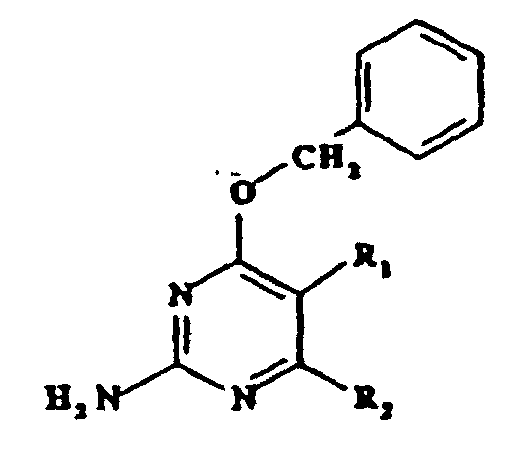
wherein R1 is NO2 or NO, and R2 is a substituent selected from the group consisting of hydrogen, halo, C1-C4 alkyl, C1-C4 hydroxyalkyl, thiol, C1-C4 alkylthio, trifluoromethylthio, C1-C4 thioacyl, hydroxy, C1-C4 alkoxy, trifluoromethoxy, methanesulfonyloxy , trifluoromethanesulfonyloxy, C1-C4 acyloxy, C1-C4: aminoalkyl, C1-C4 alkylamino, C1-C4 dialkylamino, trifluoromethylamino, ditrifluoromethylamino, aminomethanesulfonyl, amino C1-C4 alkylcarbonyl, aminotrifluoromethylcarbonyl, formylamino, nitro, nitroso, C1-C4 alkyldiazo, C5-C6 aryldiazo, trifluoromethyl, C1-C4 haloalkyl, C1-C4 cyanoalkyl, cyano, C1-C4 alkyloxycarbonyl, C1-C4 alkylcarbonyl, phenyl, phenylcarbonyl, formyl, C1-C4 alkoxymethyl, phenoxymethyl, C2-C4 vinyl, C2-C4 ethynyl, and SOnR' wherein n is 0, 1, 2, or 3 and R' is hydrogen, C1-C4 alkyl, amino, or phenyl.
wherein R1 is NO2 or NO, and R2 is a substituent selected from the group consisting of hydrogen, halo, C1-C4 alkyl, C1-C4 hydroxyalkyl, thiol, C1-C4 alkylthio, trifluoromethylthio, C1-C4 thioacyl, hydroxy, C1-C4 alkoxy, trifluoromethoxy, methanesulfonyloxy , trifluoromethanesulfonyloxy, C1-C4 acyloxy, C1-C4: aminoalkyl, C1-C4 alkylamino, C1-C4 dialkylamino, trifluoromethylamino, ditrifluoromethylamino, aminomethanesulfonyl, amino C1-C4 alkylcarbonyl, aminotrifluoromethylcarbonyl, formylamino, nitro, nitroso, C1-C4 alkyldiazo, C5-C6 aryldiazo, trifluoromethyl, C1-C4 haloalkyl, C1-C4 cyanoalkyl, cyano, C1-C4 alkyloxycarbonyl, C1-C4 alkylcarbonyl, phenyl, phenylcarbonyl, formyl, C1-C4 alkoxymethyl, phenoxymethyl, C2-C4 vinyl, C2-C4 ethynyl, and SOnR' wherein n is 0, 1, 2, or 3 and R' is hydrogen, C1-C4 alkyl, amino, or phenyl.
2. The compound of claim 1, wherein R1 is NO2, and R2 is selected from the group consisting of hydrogen and C1-C4 alkyl.
3. The compound of claim 2, wherein said compound is selected from the group consisting
of 2-amino-4-benzyloxy-5-nitropyrimidine and 2-amino-4-benzyloxy-6-methyl-5-nitropyrimidine.
4. A pharmaceutical composition comprising a pharmaceutically acceptable carrier and
at least one compound of any one of claims 1 to 3.
5. The pharmaceutical composition of claim 4, wherein said pharmaceutically acceptable
carrier comprises polyethylene glycol.
6. A pharmaceutical composition comprising a pharmaceutically acceptable carrier and
a compound of the formula
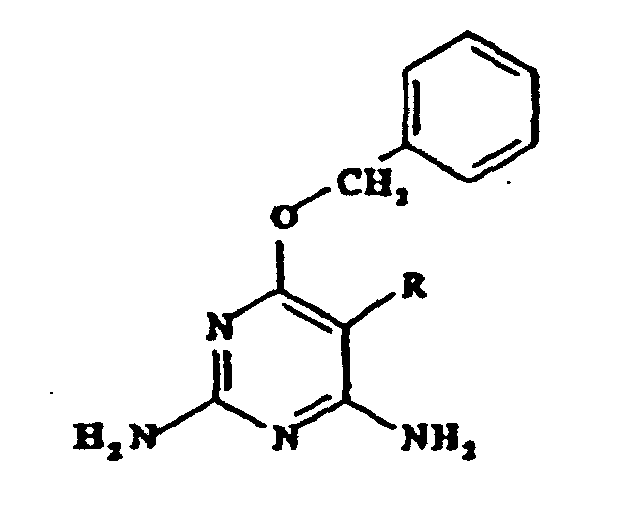
wherein R is a substituent selected from the group consisting of Ttydrbgen, halo, C1-C4 alkyl, C1-C4 hydroxyalkyl, thiol, C1-C4 alkylthio, trifluoromethylthio, C1-C4 thioacyl, hydroxy, C1-C4 alkoxy, trifluoromethoxy, methanesulfonyloxy, trifluoromethanesulfonyloxy, C1-C4 acyloxy, amino, C1-C4 aminoalkyl, C1-C4 alkylamino, C1-C4 dialkylamino, trifluoromethylamino, ditrifluoromethylamino, aminomethanesulfonyl, amino C1-C4 alkylcarbonyl, aminotrifluoromethylcarbonyl, formylamino, nitro, nitroso, C1-C4 alkyldiazo, C5-C6 aryldiazo, trifluoromethyl, C1-C4 haloalkyl, cyanomethyl, C1-C4 cyanoalkyl, cyano, C1-C4 alkyloxycarbonyl, C1-C4 alkylcarbonyl, phenyl, phenylcarbonyl, C1-C4 acyl, formyl, C1-C4 alkoxymethyl, phenoxymethyl, C2-C4 vinyl, C2-C4 ethynyl, and SOnR1 wherein n is 0, 1, 2, or 3 and R1 is hydrogen, C1-C4 alkyl, amino, or phenyl, and wherein said pharmaceutically acceptable carrier comprises polyethylene glycol.
wherein R is a substituent selected from the group consisting of Ttydrbgen, halo, C1-C4 alkyl, C1-C4 hydroxyalkyl, thiol, C1-C4 alkylthio, trifluoromethylthio, C1-C4 thioacyl, hydroxy, C1-C4 alkoxy, trifluoromethoxy, methanesulfonyloxy, trifluoromethanesulfonyloxy, C1-C4 acyloxy, amino, C1-C4 aminoalkyl, C1-C4 alkylamino, C1-C4 dialkylamino, trifluoromethylamino, ditrifluoromethylamino, aminomethanesulfonyl, amino C1-C4 alkylcarbonyl, aminotrifluoromethylcarbonyl, formylamino, nitro, nitroso, C1-C4 alkyldiazo, C5-C6 aryldiazo, trifluoromethyl, C1-C4 haloalkyl, cyanomethyl, C1-C4 cyanoalkyl, cyano, C1-C4 alkyloxycarbonyl, C1-C4 alkylcarbonyl, phenyl, phenylcarbonyl, C1-C4 acyl, formyl, C1-C4 alkoxymethyl, phenoxymethyl, C2-C4 vinyl, C2-C4 ethynyl, and SOnR1 wherein n is 0, 1, 2, or 3 and R1 is hydrogen, C1-C4 alkyl, amino, or phenyl, and wherein said pharmaceutically acceptable carrier comprises polyethylene glycol.
7. A product containing a compound of any one of claims 1 to 3 and an antineoplastic
alkylating agent that causes cytotoxic lesions at the O6-position of guanine as a combined preparation for simultaneous, separate or sequential
use in a method of enhancing the chemotherapeutic treatment of tumor cells in a mammal.
8. A product containing a compound of the formula
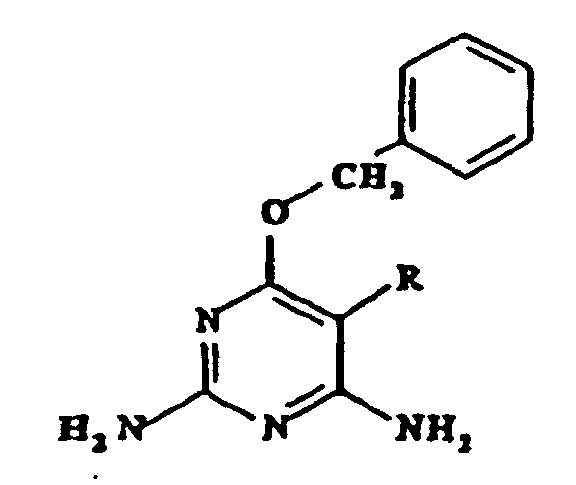
wherein R is a substituent selected from the group consisting of hydrogen, halo, C1-C4 alkyl, C1-C4 hydroxyalkyl, thiol, C1-C4 alkylthio, trifluoromethylthio, C1-C4 thioacyl, hydroxy, C1-C4 alkoxy, trifluoromethoxy, methanesulfonyloxy, trifluoromethanesulfonyloxy, C1-C4 acyloxy, amino, C1-C4 aminoalkyl, C1-C4 alkylamino, C1-C4 dialkylamino, trifluoromethylamino, ditrifluoromethylamino, aminomethanesulfonyl, amino C1-C4 alkylcarbonyl, aminotrifluoromethylcarbonyl, formylamino, nitro, nitroso, C1-C4 alkyldiazo, C5-C6 aryldiazo, trifluoromethyl, C1-C4 haloalkyl, cyanomethyl, C1-C4 cyanoalkyl, cyano, C1-C4 alkyloxycarbonyl, C1-C4 alkylcarbonyl, phenyl, phenylcarbonyl, C1-C4 acyl, formyl, C1-C4 alkoxymethyl, phenoxymethyl, C2-C4 vinyl, C2-C4 ethynyl, and SOnR1 wherein n is 0, 1, 2, or 3 and R1 is hydrogen, C1-C4 alkyl, amino, or phenyl, and
an antineoplastic alkylating agent which causes cytotoxic lesions at the O6-position of guanine as a combined preparation as a combined preparation for simultaneous, separate or sequential use in a method of enhancing the chemotherapeutic treatment of tumor cells in a mammal.
wherein R is a substituent selected from the group consisting of hydrogen, halo, C1-C4 alkyl, C1-C4 hydroxyalkyl, thiol, C1-C4 alkylthio, trifluoromethylthio, C1-C4 thioacyl, hydroxy, C1-C4 alkoxy, trifluoromethoxy, methanesulfonyloxy, trifluoromethanesulfonyloxy, C1-C4 acyloxy, amino, C1-C4 aminoalkyl, C1-C4 alkylamino, C1-C4 dialkylamino, trifluoromethylamino, ditrifluoromethylamino, aminomethanesulfonyl, amino C1-C4 alkylcarbonyl, aminotrifluoromethylcarbonyl, formylamino, nitro, nitroso, C1-C4 alkyldiazo, C5-C6 aryldiazo, trifluoromethyl, C1-C4 haloalkyl, cyanomethyl, C1-C4 cyanoalkyl, cyano, C1-C4 alkyloxycarbonyl, C1-C4 alkylcarbonyl, phenyl, phenylcarbonyl, C1-C4 acyl, formyl, C1-C4 alkoxymethyl, phenoxymethyl, C2-C4 vinyl, C2-C4 ethynyl, and SOnR1 wherein n is 0, 1, 2, or 3 and R1 is hydrogen, C1-C4 alkyl, amino, or phenyl, and
an antineoplastic alkylating agent which causes cytotoxic lesions at the O6-position of guanine as a combined preparation as a combined preparation for simultaneous, separate or sequential use in a method of enhancing the chemotherapeutic treatment of tumor cells in a mammal.
9. Use of a compound of any one of claims 1 to 3 in the manufacture of a medicament for
enhancing the chemotherapeutic treatment of tumor cells in a mammal with an antineoplastic
alkylating agent that causes cytotoxic lesions at the O6-position of guanine.
10. A method of inhibiting the reaction of O6-alkylguanine- DNA- alkyltransferase with an alkylated DNA comprising reacting in
vitro the O6-alkylguanine-DNA-alkyltransferase with a compound of any one of claims 1 to 3.
1. Verbindung der Formel
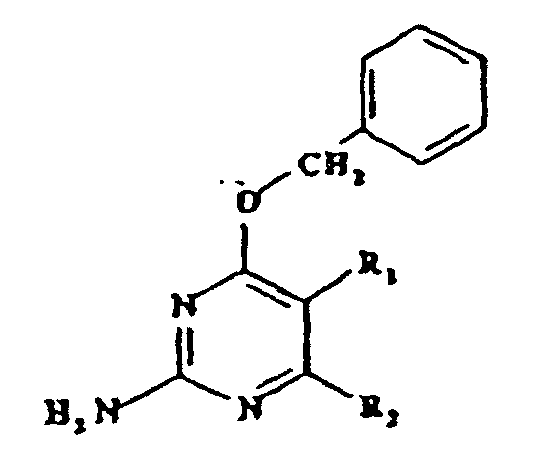
worin R1 NO2 oder NO ist und R2 ein Substituent ist, der aus der aus Wasserstoff, Halogen, C1-C4-Alkyl, C1-C4-Hydroxyalkyl, Thiol, C1-C4-Alkylthio, Trifluormethylthio, C1-C4-Thioacyl, Hydroxy, C1-C4-Alkoxy, Trifluormethoxy, Methansulfonyloxy, Trifluormethansulfonyloxy, C1-C4-Acyloxy, C1-C4-Aminoalkyl, C1-C4-Alkylamino, C1-C4-Dialkylamino, Trifluormethylamino, Ditrifluormethylamino, Aminomethansulfonyl, Amino-C1-C4-Alkylcarbonyl, Aminotrifluormethylcarbonyl, Formylamino, Nitro, Nitroso, C1-C4-Alkyldiazo, C5-C6-Aryldiazo, Trifluormethyl, C1-C4-Halogenalkyl, C1-C4-Cyanoalkyl, Cyano, C1-C4-Alkyloxycarbonyl, C1-C4-Alkylcarbonyl, Phenyl, Phenylcarbonyl, Formyl, C1-C4-Alkoxymethyl, Phenoxymethyl, C2-C4-Vinyl, C2-C4-Ethinyl und SOnR', worin n = 0, 1, 2 oder 3 ist und R' Wasserstoff, C1-C4-Alkyl, Amino oder Phenyl ist, bestehenden Gruppe ausgewählt ist.
worin R1 NO2 oder NO ist und R2 ein Substituent ist, der aus der aus Wasserstoff, Halogen, C1-C4-Alkyl, C1-C4-Hydroxyalkyl, Thiol, C1-C4-Alkylthio, Trifluormethylthio, C1-C4-Thioacyl, Hydroxy, C1-C4-Alkoxy, Trifluormethoxy, Methansulfonyloxy, Trifluormethansulfonyloxy, C1-C4-Acyloxy, C1-C4-Aminoalkyl, C1-C4-Alkylamino, C1-C4-Dialkylamino, Trifluormethylamino, Ditrifluormethylamino, Aminomethansulfonyl, Amino-C1-C4-Alkylcarbonyl, Aminotrifluormethylcarbonyl, Formylamino, Nitro, Nitroso, C1-C4-Alkyldiazo, C5-C6-Aryldiazo, Trifluormethyl, C1-C4-Halogenalkyl, C1-C4-Cyanoalkyl, Cyano, C1-C4-Alkyloxycarbonyl, C1-C4-Alkylcarbonyl, Phenyl, Phenylcarbonyl, Formyl, C1-C4-Alkoxymethyl, Phenoxymethyl, C2-C4-Vinyl, C2-C4-Ethinyl und SOnR', worin n = 0, 1, 2 oder 3 ist und R' Wasserstoff, C1-C4-Alkyl, Amino oder Phenyl ist, bestehenden Gruppe ausgewählt ist.
2. Verbindung nach Anspruch 1, worin R1 NO2 ist und R2 aus der aus Wasserstoff und C1-C4-Alkyl bestehenden Gruppe ausgewählt ist.
3. Verbindung nach Anspruch 2, worin die Verbindung aus der aus 2-Amino-4-benzyloxy-5-nitropyrimidin
und 2-Amino-4-benzyloxy-6-methyl-5-nitropyrimidin bestehenden Gruppe ausgewählt ist.
4. Pharmazeutische Zusammensetzung, umfassend einen pharmazeutisch annehmbaren Träger
und zumindest eine Verbindung nach einem der Ansprüche 1 bis 3.
5. Pharmazeutische Zusammensetzung nach Anspruch 4, worin der pharmazeutisch annehmbare
Träger Polyethylenglykol umfasst.
6. Pharmazeutische Zusammensetzung, umfassend einen pharmazeutisch annehmbaren Träger
und eine Verbindung der Formel
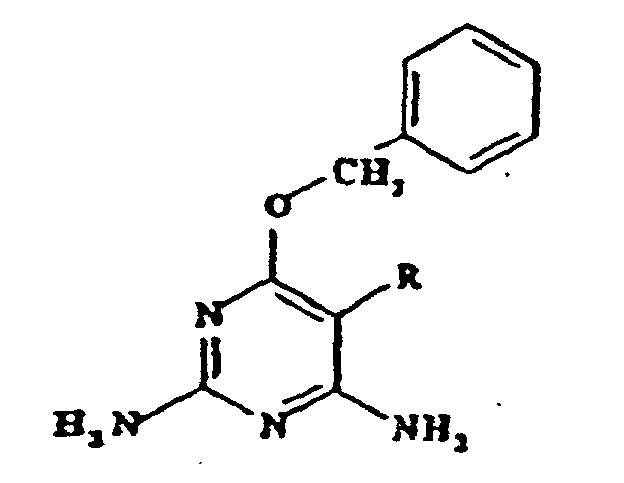
worin R ein Substituent ist, der aus der aus Wasserstoff, Halogen, C1-C4-Alkyl, C1-C4-Hydroxyalkyl, Thiol, C1-C4-Alkylthio, Trifluormethylthio, C1-C4-Thioacyl, Hydroxy, C1-C4-Alkoxy, Trifluormethoxy, Methansulfonyloxy, Trifluormethansulfonyloxy, C1-C4-Acyloxy, Amino, C1-C4-Aminoalkyl, C1-C4-Alkylamino, C1-C4-Dialkylamino, Trifluormethylamino, Ditrifluormethylamino, Aminomethansulfonyl, Amino-C1-C4-Alkylcarbonyl, Aminotrifluormethylcarbonyl, Formylamino, Nitro, Nitrose, C1-C4-Alkyldiazo, C5-C6-Aryldiazo, Trifluormethyl, C1-C4-Halogenalkyl, Cyanomethyl, C1-C4-Cyanoalkyl, Cyano, C1-C4-Alkyloxycarbonyl, C1-C4-Alkylcarbonyl, Phenyl, Phenylcarbonyl, C1-C4-Acyl, Formyl, C1-C4-Alkoxymethyl, Phenoxymethyl, C2-C4-Vinyl, C2-C4-Ethinyl und SOnR1, worin n = 0, 1, 2 oder 3 ist und R1 Wasserstoff, C1-C4-Alkyl, Amino oder Phenyl ist, bestehenden Gruppe ausgewählt ist, und worin der pharmazeutisch annehmbare Träger Polyethylenglykol umfasst.
worin R ein Substituent ist, der aus der aus Wasserstoff, Halogen, C1-C4-Alkyl, C1-C4-Hydroxyalkyl, Thiol, C1-C4-Alkylthio, Trifluormethylthio, C1-C4-Thioacyl, Hydroxy, C1-C4-Alkoxy, Trifluormethoxy, Methansulfonyloxy, Trifluormethansulfonyloxy, C1-C4-Acyloxy, Amino, C1-C4-Aminoalkyl, C1-C4-Alkylamino, C1-C4-Dialkylamino, Trifluormethylamino, Ditrifluormethylamino, Aminomethansulfonyl, Amino-C1-C4-Alkylcarbonyl, Aminotrifluormethylcarbonyl, Formylamino, Nitro, Nitrose, C1-C4-Alkyldiazo, C5-C6-Aryldiazo, Trifluormethyl, C1-C4-Halogenalkyl, Cyanomethyl, C1-C4-Cyanoalkyl, Cyano, C1-C4-Alkyloxycarbonyl, C1-C4-Alkylcarbonyl, Phenyl, Phenylcarbonyl, C1-C4-Acyl, Formyl, C1-C4-Alkoxymethyl, Phenoxymethyl, C2-C4-Vinyl, C2-C4-Ethinyl und SOnR1, worin n = 0, 1, 2 oder 3 ist und R1 Wasserstoff, C1-C4-Alkyl, Amino oder Phenyl ist, bestehenden Gruppe ausgewählt ist, und worin der pharmazeutisch annehmbare Träger Polyethylenglykol umfasst.
7. Produkt, umfassend eine Verbindung nach einem der Ansprüche 1 bis 3 und ein antineoplastisches
Alkylierungsmittel, das zytotoxische Läsionen an der O6-Position von Guanin verursacht, als ein kombiniertes Präparat zur gleichzeitigen,
separaten oder aufeinander folgenden Verwendung bei einem Verfahren zur Verbesserung
der chemotherapeutischen Behandlung von Tumorzellen in einem Säugetier.
8. Produkt, umfassend eine Verbindung der Formel
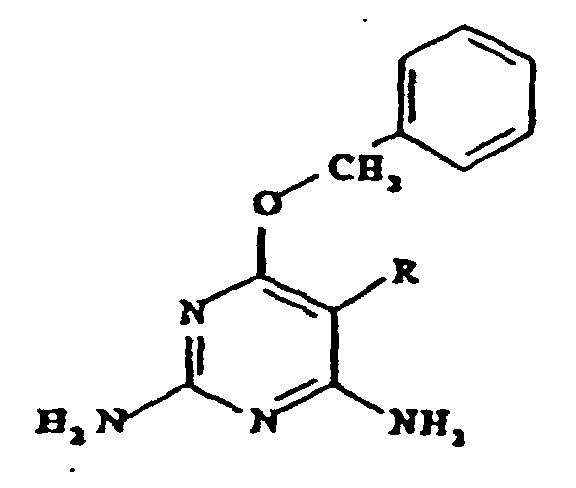
worin R ein Substituent ist, der aus der aus Wasserstoff, Halogen, C1-C4-Alkyl, C1-C4-Hydroxyalkyl, Thiol, C1-C4-Alkylthio, Trifluormethylthio, C1-C4-Thioacyl, Hydroxy, C1-C4-Alkoxy, Trifluormethoxy, Methansulfonyloxy, Trifluormethansulfonyloxy, C1-C4-Acyloxy, Amino, C1-C4-Aminoalkyl, C1-C4-Alkylamino, C1-C4-Dialkylamino, Trifluormethylamino, Ditrifluormethylamino, Aminomethansulfonyl, Amino-C1-C4-Alkylcarbonyl, Aminotrifluormethylcarbonyl, Formylamino, Nitro, Nitroso, C1-C4-Alkyldiazo, C5-C6-Aryldiazo, Trifluormethyl, C1-C4-Halogenalkyl, Cyanomethyl, C1-C4-Cyanoalkyl, Cyano, C1-C4-Alkyloxycarbonyl, C1-C4-Alkylcarbonyl, Phenyl, Phenylcarbonyl, C1-C4-Acyl, Formyl, C1-C4-Alkoxymethyl, Phenoxymethyl, C2-C4-Vinyl, C2-C4-Ethinyl und SOnR1, worin n = 0, 1, 2 oder 3 ist und R1 Wasserstoff, C1-C4-Alkyl, Amino oder Phenyl ist, bestehenden Gruppe ausgewählt ist, und
ein antineoplastisches Alkylierungsmittel, das zytotoxische Läsionen an der O6-Position von Guanin verursacht, als ein kombiniertes Präparat zur gleichzeitigen, separaten oder aufeinander folgenden Verwendung bei einem Verfahren zur Verbesserung der chemotherapeutischen Behandlung von Tumorzellen in einem Säugetier.
worin R ein Substituent ist, der aus der aus Wasserstoff, Halogen, C1-C4-Alkyl, C1-C4-Hydroxyalkyl, Thiol, C1-C4-Alkylthio, Trifluormethylthio, C1-C4-Thioacyl, Hydroxy, C1-C4-Alkoxy, Trifluormethoxy, Methansulfonyloxy, Trifluormethansulfonyloxy, C1-C4-Acyloxy, Amino, C1-C4-Aminoalkyl, C1-C4-Alkylamino, C1-C4-Dialkylamino, Trifluormethylamino, Ditrifluormethylamino, Aminomethansulfonyl, Amino-C1-C4-Alkylcarbonyl, Aminotrifluormethylcarbonyl, Formylamino, Nitro, Nitroso, C1-C4-Alkyldiazo, C5-C6-Aryldiazo, Trifluormethyl, C1-C4-Halogenalkyl, Cyanomethyl, C1-C4-Cyanoalkyl, Cyano, C1-C4-Alkyloxycarbonyl, C1-C4-Alkylcarbonyl, Phenyl, Phenylcarbonyl, C1-C4-Acyl, Formyl, C1-C4-Alkoxymethyl, Phenoxymethyl, C2-C4-Vinyl, C2-C4-Ethinyl und SOnR1, worin n = 0, 1, 2 oder 3 ist und R1 Wasserstoff, C1-C4-Alkyl, Amino oder Phenyl ist, bestehenden Gruppe ausgewählt ist, und
ein antineoplastisches Alkylierungsmittel, das zytotoxische Läsionen an der O6-Position von Guanin verursacht, als ein kombiniertes Präparat zur gleichzeitigen, separaten oder aufeinander folgenden Verwendung bei einem Verfahren zur Verbesserung der chemotherapeutischen Behandlung von Tumorzellen in einem Säugetier.
9. Verwendung einer Verbindung nach einem der Ansprüche 1 bis 3 bei der Herstellung eines
Medikaments zur Verbesserung der chemotherapeutischen Behandlung von Tumorzellen in
einem Säugetier mit einem antineoplastischen Alkylierungsmittel, das zytotoxische
Läsionen an der O6-Position von Guanin verursacht.
10. Verfahren zur Hemmung der Reaktion von O6-Alkylguanin-DNA-Alkyltransferase mit einer alkylierten DNA, umfassend das In-vitro-Umsetzen
der O6-Alkylguanin-DNA-Alkyltransferase mit einer Verbindung nach einem der Ansprüche 1
bis 3.
1. Composé de la formule
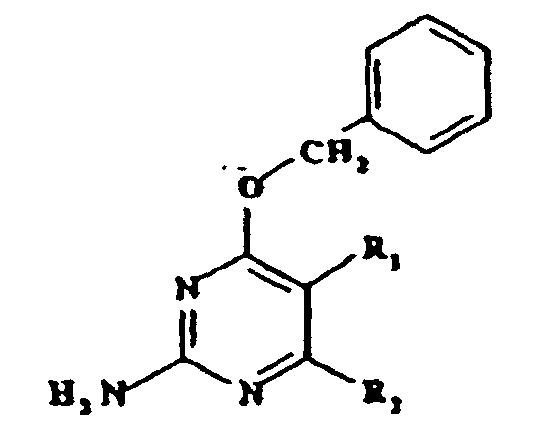
où R1 est NO2 ou NO, et R2 est un substituant sélectionné dans le groupe consistant en hydrogène, halo, alkyle C1-C4, hydroxyalkyle C1-C4, thiol, alkylthio C1-C-4, trifluorométhylthio, thioacyle C1-C4, hydroxy, alcoxy C1-C4, trifluorométhoxy, méthanesulfonyloxy, trifluoroéthansulfonyloxy, acyloxy C1-C4, aminoalkyle C1-C4, alkylamino C1-C4, dialkylamino C1-C4, trifluorométhylamino, ditrifluorométhylamino, amino-éthanesulfonyle, amino alkylC1-C4carbonyle, amino-fluorométhylcarbonyle, formylamino, nitro, nitroso, alkyldiazo C1-C4, aryldiazo C5-C6, trifluorométhyle, haloalkyle C1-C4, cyanoalkyle C1-C4, cyano, alkyloxy C1-C4 carbonyle, alkyl C1-C4 carbonyle, phényle, phénylcarbonyle, formyle, alcoxyméthyle C1-C4, phénoxyméthyle, vinyle C2-C4, éthynyle C2-C4, et SOnR' où n est 0, 1, 2 ou 3 et R' est hydrogène, alkyle C1-C4, amino ou phényle.
où R1 est NO2 ou NO, et R2 est un substituant sélectionné dans le groupe consistant en hydrogène, halo, alkyle C1-C4, hydroxyalkyle C1-C4, thiol, alkylthio C1-C-4, trifluorométhylthio, thioacyle C1-C4, hydroxy, alcoxy C1-C4, trifluorométhoxy, méthanesulfonyloxy, trifluoroéthansulfonyloxy, acyloxy C1-C4, aminoalkyle C1-C4, alkylamino C1-C4, dialkylamino C1-C4, trifluorométhylamino, ditrifluorométhylamino, amino-éthanesulfonyle, amino alkylC1-C4carbonyle, amino-fluorométhylcarbonyle, formylamino, nitro, nitroso, alkyldiazo C1-C4, aryldiazo C5-C6, trifluorométhyle, haloalkyle C1-C4, cyanoalkyle C1-C4, cyano, alkyloxy C1-C4 carbonyle, alkyl C1-C4 carbonyle, phényle, phénylcarbonyle, formyle, alcoxyméthyle C1-C4, phénoxyméthyle, vinyle C2-C4, éthynyle C2-C4, et SOnR' où n est 0, 1, 2 ou 3 et R' est hydrogène, alkyle C1-C4, amino ou phényle.
2. Composé de la revendication 1, où R1 est NO2 et R2 est sélectionné dans le groupe consistant en hydrogène et alkyle C1-C4.
3. Composé de la revendication 2, où ledit composé est sélectionné dans le groupe consistant
en 2-amino-4-benzyloxy-5-nitropyrimidine et 2-amino-4-benzyloxy-6-méthyl-5-nitropyrimidine.
4. Composition pharmaceutique comprenant un support pharmaceutiquement acceptable et
au moins un composé de l'une quelconque des revendications 1 à 3.
5. Composition pharmaceutique de la revendication 4, où ledit support pharmaceutiquement
acceptable comprend du polyéthylène glycol.
6. Composition pharmaceutique comprenant un support pharmaceutiquement acceptable et
un composé de la formule :
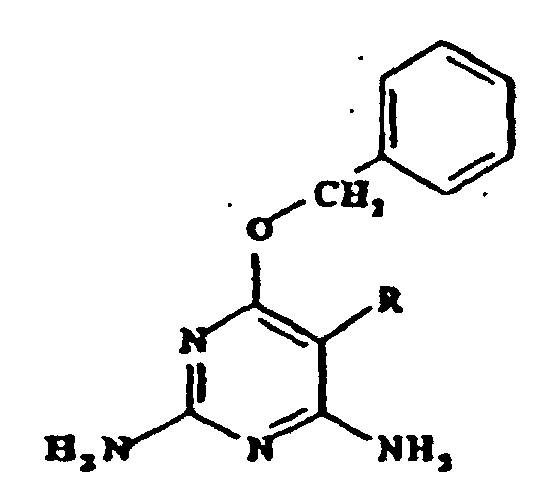
où R est un substituant sélectionné dans le groupe consistant en hydrogène, halo, alkyle C1-C4, hydroxyalkyle C1-C4, thiol, alkylthio C1-C-4, trifluorométhylthio, thioacyle C1-C4, hydroxy, alcoxy C1-C4, trifluorométhoxy, méthanesulfonyloxy, trifluorométhansulfonyloxy, acyloxy C1-C4, amino, aminoalkyle C1-C4, alkylamino C1-C4, dialkylamino C1-C4, trifluorométhylamino, ditrifluorométhylamino, aminométhanesulfonyle, aminolkylC1-C4carbonyle, aminotrifluorométhylcarbonyle, formylamino, nitro, nitroso, alkyldiazo C1-C4, aryldiazo C5-C6, trifluorométhyle, haloalkyle C1-C4, cyanométhyle, cyanoalkyle C1-C4, cyano, alkyloxy C1-C4 carbonyle, alkylC1-C4carbonyle, phényle, phénylcarbonyle, acyle C1-C4, formyle, alcoxyméthyle C1-C4, phénoxyméthyle, vinyle C2-C4, éthynyle C2-C4, et SOnR1 où n est 0, 1, 2 ou 3 et R1 est hydrogène, alkyle C1-C4, amino ou phényle et où ledit support pharmaceutiquement acceptable comprend du polyéthylène glycol.
où R est un substituant sélectionné dans le groupe consistant en hydrogène, halo, alkyle C1-C4, hydroxyalkyle C1-C4, thiol, alkylthio C1-C-4, trifluorométhylthio, thioacyle C1-C4, hydroxy, alcoxy C1-C4, trifluorométhoxy, méthanesulfonyloxy, trifluorométhansulfonyloxy, acyloxy C1-C4, amino, aminoalkyle C1-C4, alkylamino C1-C4, dialkylamino C1-C4, trifluorométhylamino, ditrifluorométhylamino, aminométhanesulfonyle, aminolkylC1-C4carbonyle, aminotrifluorométhylcarbonyle, formylamino, nitro, nitroso, alkyldiazo C1-C4, aryldiazo C5-C6, trifluorométhyle, haloalkyle C1-C4, cyanométhyle, cyanoalkyle C1-C4, cyano, alkyloxy C1-C4 carbonyle, alkylC1-C4carbonyle, phényle, phénylcarbonyle, acyle C1-C4, formyle, alcoxyméthyle C1-C4, phénoxyméthyle, vinyle C2-C4, éthynyle C2-C4, et SOnR1 où n est 0, 1, 2 ou 3 et R1 est hydrogène, alkyle C1-C4, amino ou phényle et où ledit support pharmaceutiquement acceptable comprend du polyéthylène glycol.
7. Produit contenant un produit de l'une quelconque des revendications 1 à 3, et un agent
alkylant antinéoplasique qui provoque des lésions cytotoxiques à la position O6 de la guanine en tant que préparation combinée pour un usage simultané, séparé ou
séquentiel dans une méthode d'amélioration du traitement chimiothérapeutique de cellules
de tumeur chez un mammifère.
8. Produit contenant un composé de la formule :
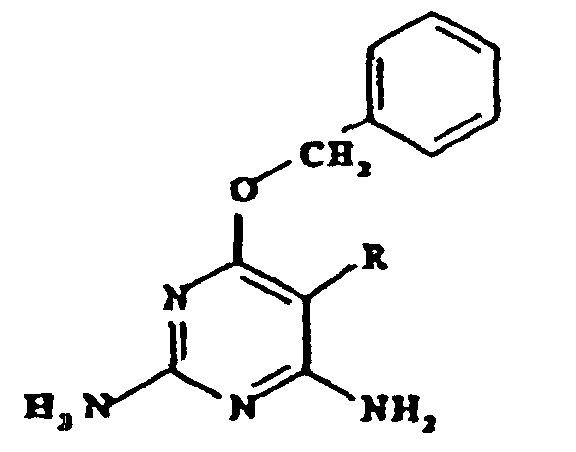
où R est un substituant sélectionné dans le groupe consistant en hydrogène, halo, alkyle C1-C4, hydroxyalkyle C1-C4, thiol, alkylthio C1-C4, trifluorométhylthio, thioacyle C1-C4, hydroxy, alcoxy C1-C4, trifluorométhoxy, méthanesulfonyloxy, trifluorométhansulfonyloxy, acyloxy C1-C4, amino, aminoalkyle C1-C4, alkylamino C1-C4, dialkylamino C1-C4, trifluorométhylamino, ditrifluorométhylamino, aminométhanesulfonyle, amino alkyl C1-C4 carbonyle, aminotrifluorométhylcarbonyle, formylamino, nitro, nitroso, alkyldiazo C1-C4, aryldiazo C5-C6, trifluorométhyle, haloalkyle C1-C4, cyanométhyle, cyanoalkyle C1-C4, cyano, alkyloxy C1-C4 carbonyle, alkyl C1-C4 carbonyle, phényle, phénylcarbonyle, acyle C1-C4, formyle, alcoxyméthyle C1-C4, phénoxyméthyle, vinyle C2-C4, éthynyle C2-C4, et SOnR1 où n est 0, 1, 2 ou 3 et R1 est hydrogène, alkyle C1-C4, amino ou phényle, et
un agent alkylant antinéoplasique qui provoque des lésions cytotoxiques à la position O6 de la guanine sous la forme d'une préparation combinée pour usage simultané, séparé ou séquentiel dans une méthode d'amélioration du traitement chimiothérapeutique des cellules de tumeur chez un mammifère.
où R est un substituant sélectionné dans le groupe consistant en hydrogène, halo, alkyle C1-C4, hydroxyalkyle C1-C4, thiol, alkylthio C1-C4, trifluorométhylthio, thioacyle C1-C4, hydroxy, alcoxy C1-C4, trifluorométhoxy, méthanesulfonyloxy, trifluorométhansulfonyloxy, acyloxy C1-C4, amino, aminoalkyle C1-C4, alkylamino C1-C4, dialkylamino C1-C4, trifluorométhylamino, ditrifluorométhylamino, aminométhanesulfonyle, amino alkyl C1-C4 carbonyle, aminotrifluorométhylcarbonyle, formylamino, nitro, nitroso, alkyldiazo C1-C4, aryldiazo C5-C6, trifluorométhyle, haloalkyle C1-C4, cyanométhyle, cyanoalkyle C1-C4, cyano, alkyloxy C1-C4 carbonyle, alkyl C1-C4 carbonyle, phényle, phénylcarbonyle, acyle C1-C4, formyle, alcoxyméthyle C1-C4, phénoxyméthyle, vinyle C2-C4, éthynyle C2-C4, et SOnR1 où n est 0, 1, 2 ou 3 et R1 est hydrogène, alkyle C1-C4, amino ou phényle, et
un agent alkylant antinéoplasique qui provoque des lésions cytotoxiques à la position O6 de la guanine sous la forme d'une préparation combinée pour usage simultané, séparé ou séquentiel dans une méthode d'amélioration du traitement chimiothérapeutique des cellules de tumeur chez un mammifère.
9. Utilisation d'un composé de l'une quelconque des revendications 1 à 3 dans la fabrication
d'un médicament pour améliorer le traitement chimiothérapeutique des cellules de tumeur
chez un mammifère avec un agent alkylant antinéoplasique qui provoque des lésions
cytotoxiques à la position O6 de la guanine.
10. Méthode d'inhibition de la réaction de la O6-alkylguanine-ADN-alkyltransférase avec un ADN alkylé comprenant la réaction in vitro
de la O6-alkylguanine-ADN-alkyltransférase avec un composé de l'une quelconque des revendications
1 à 3.