|
(11) | EP 1 144 389 B1 |

| (12) | EUROPEAN PATENT SPECIFICATION |
|
|
| (54) |
CRYSTALLINE BIS[(E)-7-[4-(4-FLUOROPHENYL)-6-ISOPROPYL-2-[METHYL(METHYLSULFONYL)AMINO]PYRIMIDIN-5-YL](3R,5S)-3,5-DIHYDROXYHEPT-6-ENOICACID]CALCIUM SALT KRISTALLINES BIS[(E)-7-[4-(4-FLUOROPHENYL)-6-ISOPROPYL-2-[METHYL(METHYLSULFONYL)AMINO]PYRIMIDIN-5-YL](3R,5S)-3,5-DIHYDROXYHEPT-6-ENOICACID]CALCIUM SALZ SEL CRISTALLIN DE CALCIUM BIS (E)-7- 4-(4- FLUOROPHENYL)- 6-ISOPROPYL-2- METHYL (METHYLSULFONYL) AMINO] PYRIMIDINE-5-YL] (3R,5S)-3, 5-DIHYDROXYHEPT -6-ACIDE ENOIQUE] |
|
|
|||||||||||||||||||||||||||||||||||
|
||||||||||||||||||||||||||||||||||||
| Note: Within nine months from the publication of the mention of the grant of the European patent, any person may give notice to the European Patent Office of opposition to the European patent granted. Notice of opposition shall be filed in a written reasoned statement. It shall not be deemed to have been filed until the opposition fee has been paid. (Art. 99(1) European Patent Convention). |
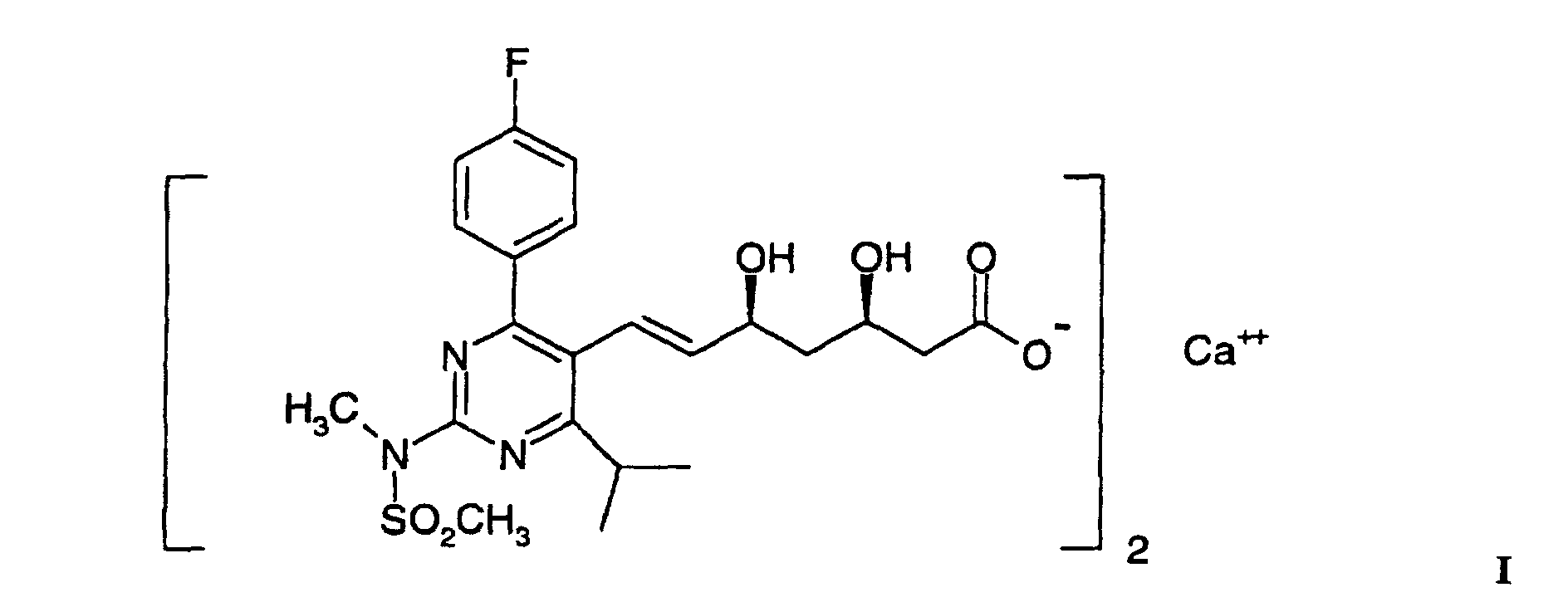
[0001] The present invention relates to a novel crystalline chemical compound and more particularly to a novel crystalline form of bis[(E)-7-[4-(4-fluorophenyl)-6-isopropyl-2-[methyl(methylsulfonyl)amino]pyrimidin-5-yl](3R,5S)-3,5-dihydroxyhept-6-enoic acid] calcium salt, hereinafter referred to as "the Agent", and illustrated in Formula I hereinafter, which compound is an inhibitor of the enzyme 3-hydroxy-3-methylglutaryl-coenzyme A reductase (HMG CoA reductase) and is useful as a pharmaceutical agent, for example in the treatment of hyperlipidemia, hypercholesterolemia and atherosclerosis, as well as other diseases or conditions in which HMG CoA reductase is implicated. The invention also relates to processes for the manufacture of the crystalline form, pharmaceutical compositions comprising the crystalline form and the use of the crystalline form in medical treatment.
[0002] European Patent Application, Publication No. 521471 (hereinafter EPA 521471), which is herein incorporated by reference, discloses an amorphous (powder) form of the Agent, prepared by dissolving the corresponding sodium salt in water, adding calcium chloride and collecting the resultant precipitate by filtration.
[0003] An amorphous form of a compound intended for pharmaceutical use may give rise to manufacturing problems and there is a need to identify crystalline forms of such compounds which have different physical characteristics compared to the amorphous form which may assist in the manufacture of the compound, or formulation of the compound, to the purity levels and uniformity required for regulatory approval. Crystalline forms of such compounds may also possess improved pharmacological characteristics, for example, improved bioavailability.
[0004] We have now surprisingly and unexpectedly discovered that the Agent can be prepared in a crystalline form.
[0005] According to the present invention there is provided a crystalline form of the Agent and hydrates thereof having an X-ray powder diffraction pattern with specific peaks at 2-theta = 4.92, 11.50, 6.93, 9.35, 23.12 and 18.76° (hereinafter referred to as Form A).
[0006] The X-ray powder diffraction spectra was determined by mounting a sample of the crystalline form on Siemans single silicon crystal (SSC) wafer mounts and spreading out the sample into a thin layer with the aid of a microscope slide. The sample was spun at 30 revolutions per minute (to improve counting statistics) and irradiated with X-rays generated by a copper long-fine focus tube operated at 40kV and 40mA with a wavelength of 1.5406 angstroms. The collimated x-ray source was passed through an automatic variable divergence slit set at V20 (20mm path length) and the reflected radiation directed through a 2mm antiscatter slit and a 0.2mm detector slit. The sample was exposed for 4 seconds per 0.02 degree 2-theta increment (continuous scan mode) over the range 2 degrees to 40 degrees 2-theta in theta-theta mode. The running time was 2 hours 6 minutes and 40 seconds. The instrument was equipped with a scintillation counter as detector. Control and data capture was by means of a DECpc LPv 433sx personal computer running with Diffrac AT (Socabim) software.
[0007] The X-ray powder diffraction spectra of a typical sample of Form A is shown in Figure 1 hereinafter. It will be understood that the 2-theta values of the X-ray powder diffraction pattern may vary slightly from one machine to another or from one sample of Form A to another, and so the values quoted are not to be construed as absolute.
[0008] Typically Form A is obtained in a hydrated form with, for example, a water content of about 7% w/w.
[0009] A further aspect of the present invention comprises a process for the preparation of Form A wherein Form A is caused to crystallise from a mixture of the Agent and (i) water and acetonitrile in the ratio of 1:1 by volume; (ii) water and acetone in the ratio of 1:1 by volume; or (iii) water, methanol and methyl tert-butyl ether in the ratio of 1:1:1 by volume. For example, Form A may be obtained by suspending the amorphous form of the Agent in water containing acetonitrile, acetone or a mixture of methanol and methyl tert-butyl ether (MTBE) in the ratios given above, warming the mixture to obtain complete solution and then allowing the solution to cool, followed by isolation of Form A, such as by filtration. The amorphous form of the Agent to be used as starting material for the manufacture of Form A may be obtained, for example, as described in EPA 521471.
[0010] The utility of the compound of the invention may be demonstrated by standard tests and clinical studies, including those described in EPA 521471.
[0011] According to a further feature of the invention is a method of treating a disease condition wherein inhibition of HMG CoA reductase is beneficial which comprises administering to a warm-blooded mammal an effective amount of the Agent. The invention also relates to the use of Form A in the manufacture of a medicament for use in a disease condition.
[0012] The compound of the invention may be administered to a warm-blooded animal, particularly a human, in need thereof for treatment of a disease in which HMG CoA reductase is implicated, in the form of a conventional pharmaceutical composition. Therefore in another aspect of the invention, there is provided a pharmaceutical composition comprising Form A in admixture with a pharmaceutically acceptable carrier.
[0013] Such compositions may be administered in standard manner for the disease condition that it is desired to treat, for example by oral, topical, parenteral, buccal, nasal, vaginal or rectal administration or by inhalation. For these purposes the Agent may be formulated by means known in the art into the form of, for example, tablets, capsules, aqueous or oily solutions, suspensions, emulsions, creams, ointments, gels, nasal sprays, suppositories, finely divided powders or aerosols for inhalation, and for parenteral use (including intravenous, intramuscular or infusion) sterile aqueous or oily solution or suspensions or sterile emulsions. A preferred route of administration is oral. The Agent will be administered to humans at a daily dose in, for example, the ranges set out in EPA 521471. The daily doses may be given in divided doses as necessary, the precise amount of the Agent received and the route of administration depending on the weight, age and sex of the patient being treated and on the particular disease condition being treated according to principles known in the art.
[0014] According to a further feature of the invention, there is provided a process for the manufacture of a pharmaceutical composition containing Form A as active ingredient, which comprises admixing Form A together with a pharmaceutically acceptable carrier.
Example 1
[0016] Amorphous form of the Agent (465 mg) was added to a mixture of water (5 ml) and acetonitrile (5 ml) at 15°C. The mixture was warmed to 40°C to obtain complete solution. The mixture was then cooled slowly to ambient temperature and stirred for 16 hours. The crystalline product was separated by filtration at ambient temperature and dried at 50° under vacuum to give Form A (337 mg) as white crystals.
[0017] X-ray powder diffraction (XRD):
| Peak Number | 2θ | d-Spacing | Counts/sec | Relative Intensity (>20%) |
| 1 | 4.92 | 17.945 | 820.25 | 100 |
| 2 | 11.50 | 7.686 | 258.75 | 31.55 |
| 3 | 6.93 | 12.750 | 230.25 | 28.07 |
| 4 | 9.35 | 9.455 | 213.75 | 26.06 |
| 5 | 23.12 | 3.843 | 212.75 | 25.94 |
| 6 | 18.76 | 4.726 | 177.5 | 21.64 |
1H NMR (d6-DMSO) δ : 7.7 (2H, t), 7.3 (2H, t), 6.5 (1H, d), 5.5 (1H,dd), 4.2 (1H, m), 3.8 (1H, m), 3.5 (3H, s), 1.9 - 2.1 (2H, dd), 1.3 - 1.5 (2H, m), 1.2 (6H, d)
Mass Spectrum: MH+ 482.3
1. A crystalline form of the compound bis[(E)-7-[4-(4-fluorophenyl)-6-isopropyl-2-[methyl(methylsulfonyl)amino]pyrimidin-5-yl]
(3R,5S)-3,5-dihydroxyhept-6-enoic acid] calcium salt of the formula I
or a hydrate thereof having an X-ray powder diffraction pattern with specific peaks at 2-theta (2θ) = 4.92, 11.50, 6.93, 9.35, 23.12 and 18.76°.
or a hydrate thereof having an X-ray powder diffraction pattern with specific peaks at 2-theta (2θ) = 4.92, 11.50, 6.93, 9.35, 23.12 and 18.76°.
2. A crystalline form as claimed in claim 1 which is a crystalline hydrated form.
3. A pharmaceutical composition comprising a crystalline form as claimed in claim 1 or
2, together with a pharmaceutically acceptable carrier.
4. A process for the manufacture of a crystalline form or hydrated form as claimed in
claim 1 which comprises forming crystals from a mixture of the compound of formula
I and (i) water and acetonitrile in the ratio of 1:1 by volume; (ii) water and acetone
in the ratio of 1:1 by volume; or (iii) water, methanol and methyl tert-butyl ether in the ratio of 1:1:1 by volume.
5. A process for the manufacture of a pharmaceutical composition as claimed in claim
3 which comprises admixing a crystalline form as claimed in claim 1 together with
a pharmaceutically acceptable carrier.
6. A crystalline form as claimed in claim 1 for use as a medicament.
7. The use of a crystalline form as claimed in claim 1 in the manufacture of a medicament.
8. The use of a crystalline form as claimed in claim 7 in the manufacture of a medicament
for use in the treatment of hypercholesterolemia, hyperlipidemia or atherosclerosis.
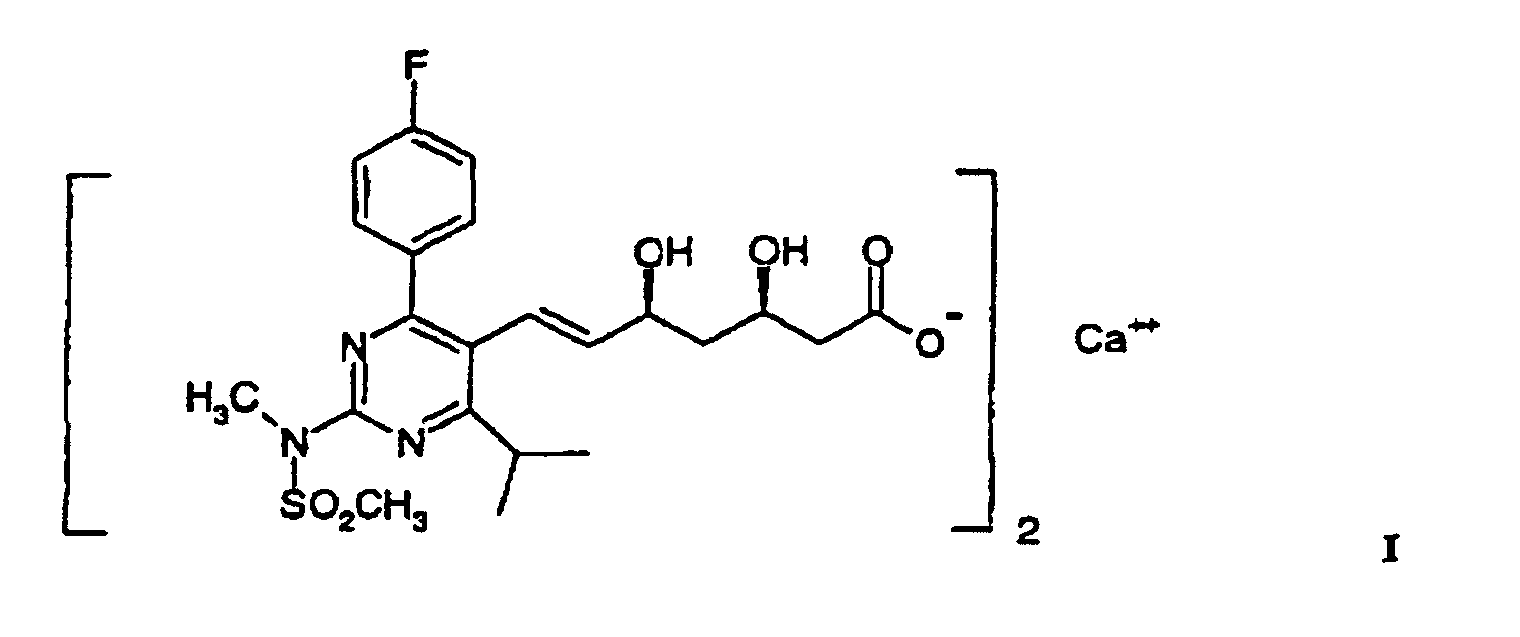
1. Kristalline Form der Verbindung Bis-[(E)-7-[4-(4-fluorphenyl)-6-isopropyl-2-[methyl(methylsulfonyl)-amino]pyrimidin-5-yl]-(3R,5S)-3,5-dihydroxyhept-6-ensäure]-Calciumsalz
der Formel I
oder ein Hydrat davon mit einem Röntgen-Pulverbeugungsdiagramm mit spezifischen Maxima bei 2-Theta (2θ) = 4,92, 11,50, 6,93, 9,35, 23,12 und 18,76°.
oder ein Hydrat davon mit einem Röntgen-Pulverbeugungsdiagramm mit spezifischen Maxima bei 2-Theta (2θ) = 4,92, 11,50, 6,93, 9,35, 23,12 und 18,76°.
2. Kristalline Form nach Anspruch 1, die eine kristalline hydratisierte Form ist.
3. Pharmazeutische Zusammensetzung, die eine kristalline Form nach Anspruch 1 oder 2
zusammen mit einem pharmazeutisch annehmbaren Träger umfasst.
4. Verfahren zur Herstellung einer kristallinen Form oder hydratisierten Form nach Anspruch
1, umfassend das Herstellen von Kristallen aus einem Gemisch der Verbindung der Formel
I und (i) Wasser und Acetonitril im Verhältnis 1:1, bezogen auf das Volumen; (ii)
Wasser und Aceton im Verhältnis 1:1, bezogen auf das Volumen; oder (iii) Wasser, Methanol
und Methyl-tert.-butylether im Verhältnis 1:1:1, bezogen auf das Volumen.
5. Verfahren zur Herstellung einer pharmazeutischen Zusammensetzung nach Anspruch 3,
umfassend das Beimischen einer kristallinen Form nach Anspruch 1 zusammen mit einem
pharmazeutisch annehmbaren Träger.
6. Kristalline Form nach Anspruch 1 zur Verwendung als Medikament.
7. Verwendung einer kristallinen Form nach Anspruch 1 zur Herstellung eines Medikamentes.
8. Verwendung einer kristallinen Form nach Anspruch 7 zur Herstellung eines Medikamentes
für die Verwendung zur Behandlung von Hypercholesterinämie, Hyperlipidämie oder Atherosklerose.
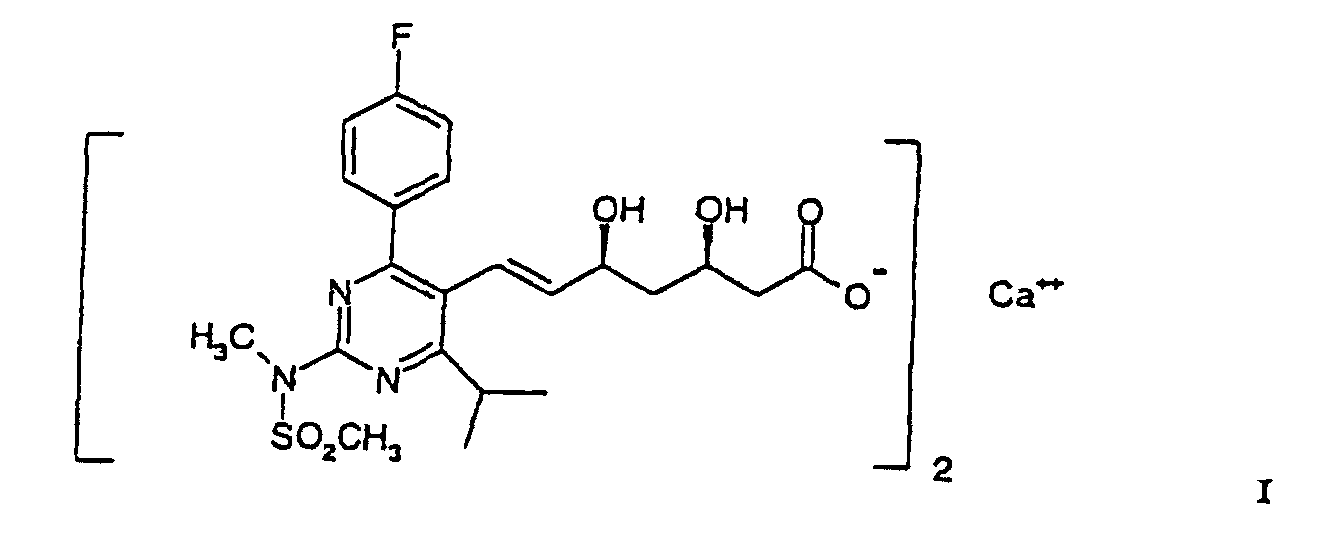
1. Forme cristalline du composé qui est un sel calcique de l'acide bis[(E)-7-[4-(4-fluorophényl)-6-isopropyl-2-[méthyl(méthylsulfonyl)amino]-pyrimidin-5-yl](3R,5S)-3,5-dihydroxyhept-6-énoïque]
ayant la formule I
ou un hydrate de celui-ci ayant un diagramme de diffraction de poudre aux rayons X comportant des pics spécifiques à 2-thêta (2θ) = 4,92, 11,50, 6,93, 9,35, 23,12 et 18,76 º.
ou un hydrate de celui-ci ayant un diagramme de diffraction de poudre aux rayons X comportant des pics spécifiques à 2-thêta (2θ) = 4,92, 11,50, 6,93, 9,35, 23,12 et 18,76 º.
2. Forme cristalline selon la revendication 1, qui est une forme hydratée cristalline.
3. Composition pharmaceutique comprenant une forme cristalline selon la revendication
1 ou 2, associée à un support pharmaceutiquement acceptable.
4. Procédé de fabrication d'une forme cristalline ou d'une forme hydratée selon la revendication
1, qui comprend la formation de cristaux à partir d'un mélange du composé ayant la
formule I et (i) d'eau et d'acétonitrile dans des proportions de 1:1 en volume ; (ii)
d'eau et d'acétone dans des proportions de 1:1 en volume ; ou (iii) d'eau, de méthanol
et d'éther méthyltert-butylique dans des proportions de 1:1:1 en volume.
5. Procédé de fabrication d'une composition pharmaceutique selon la revendication 3,
qui comprend le mélange additionnel d'une forme cristalline selon la revendication
1 avec un support pharmaceutiquement acceptable.
6. Forme cristalline selon la revendication 1, destinée à une utilisation comme médicament.
7. Utilisation de la forme cristalline selon la revendication 1 dans la fabrication d'un
médicament.
8. Utilisation de la forme cristalline selon la revendication 7 dans la fabrication d'un
médicament destiné au traitement de l'hypercholestérolémie, de l'hyperlipidémie ou
de l'athérosclérose.