(57) A technology, in which when an article, ordered by a person through a network being
not meeting each other, is delivered to the person, the article can be surely delivered
to the person who made the order by not allowing that another person pretends to be
the person who made the order, and it can be verified that the article was delivered
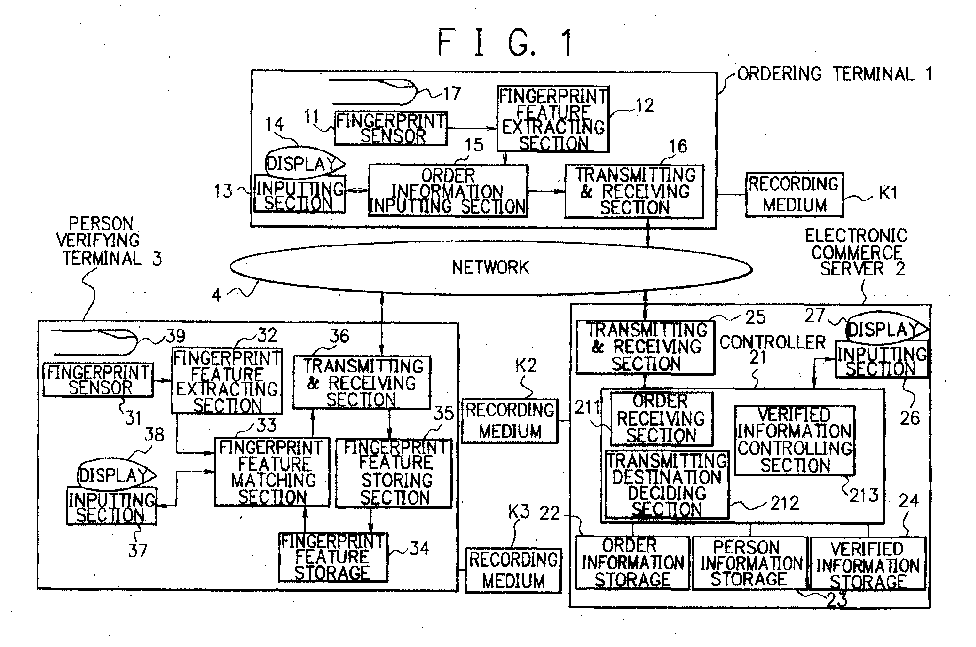
to the person who made the order, is provided. When a person orders an article, the
person inputs his/her own fingerprint to an ordering terminal in addition to inputting
order information including the article number of the article, its destination (the
delivering address of the article), the payment method, the price, and so on. And
a fingerprint feature of the inputted fingerprint and the order information are transmitted
to an electronic commerce (EC) server through a network. The EC server transmits the
fingerprint feature of the person who made the order and an order number attached
to the order to a person verifying terminal installed in a shop designated by the
person who made the order. And when a person who is to receive the article requires
that the article is delivered, a sales clerk in the shop takes a fingerprint of the
person who is to receive the article by using a person verifying terminal, and the
person verifying terminal matches the fingerprint feature of the person who is to
receive the article with the fingerprint feature of the person who made the order
transmitted from the EC server. And only when the matched result is equal, the article
is delivered to the person who is to receive the article. Further, verified information
composed of the fingerprint feature of the person who received the article and the
order number of the article are transmitted to the EC server, and the verified information
is stored in verified information storage in the EC server.
|
|
