(57) The filtering of optical signals, and in particular the interleaving/de-interleaving
of optical signals is becoming a necessary step in Dense-Wavelength Division Multiplexing
(D-WDM), because of a requirement for smaller channel spacing due to higher levels
of traffic. Finite Impulse Response (FIR) filters, including lattice and birefringent
waveplate versions, are a particular type of optical filter used for interleavering/de-interleavering
optical channels, which can be defined by their transfer function H(f). To ensure
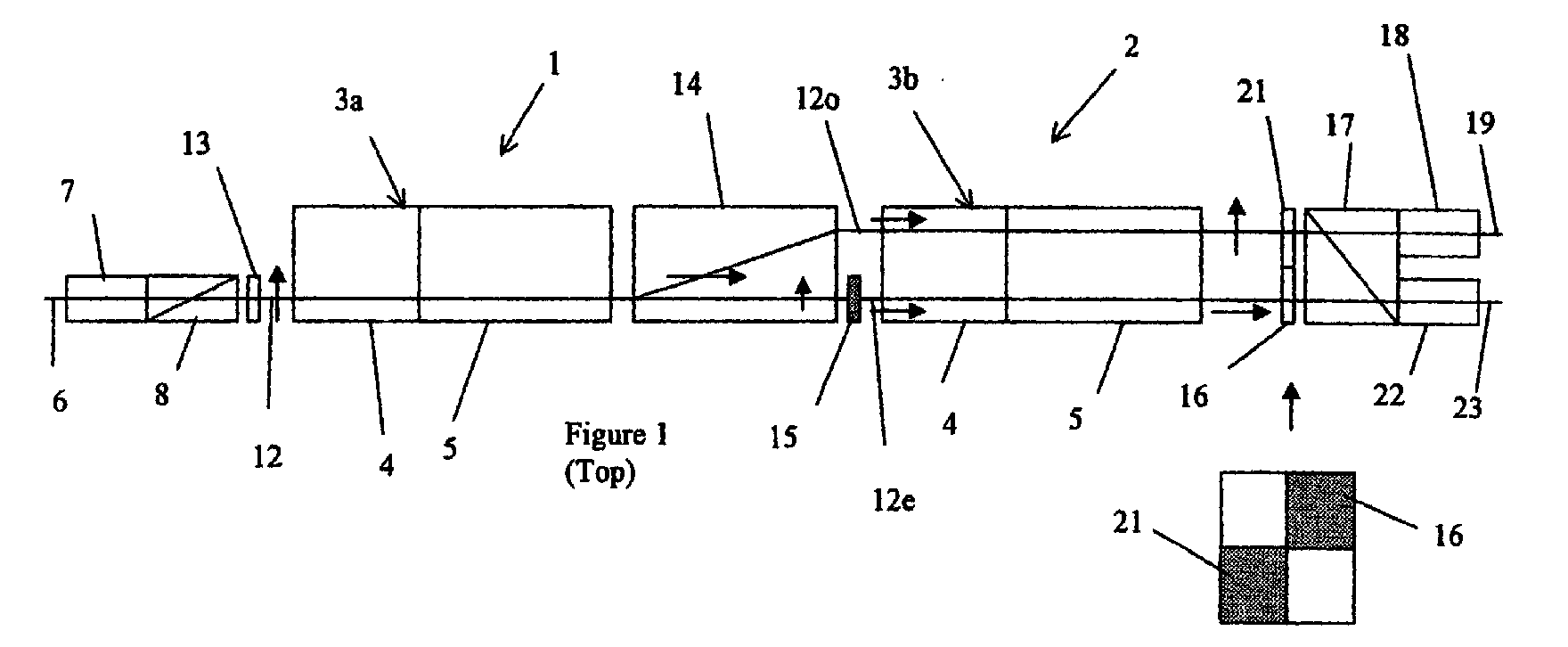
dispersion free filtering, the present invention provides a cascaded optical filter,
comprising two optical filters, wherein the transfer function of the second filter
is the complex conjugate of the first filter, i.e. H2(f)=H1(f), or the complex conjugate of the first filter H1(f) multiplied by the transfer function of a dispersion free optical filter G(f).
In the waveplate version, the relationship between the crystal angle of the waveplates
and the polarization of the input light is manipulated to ensure that the second filtering
step eliminates the dispersion caused by the first. Since the polarization of the
light can be altered between the first and second filters, birefringent filters can
be conceived using a single stack of waveplates that are passed through twice. In
lattice filters, a symmetric pulse response is an indication that the cascaded filter
is dispersion free. In this case, the second filter is the inverse of the first filter,
which individually would give the opposite pulse responses, but together provide a
symmetric pulse response.
|
|
