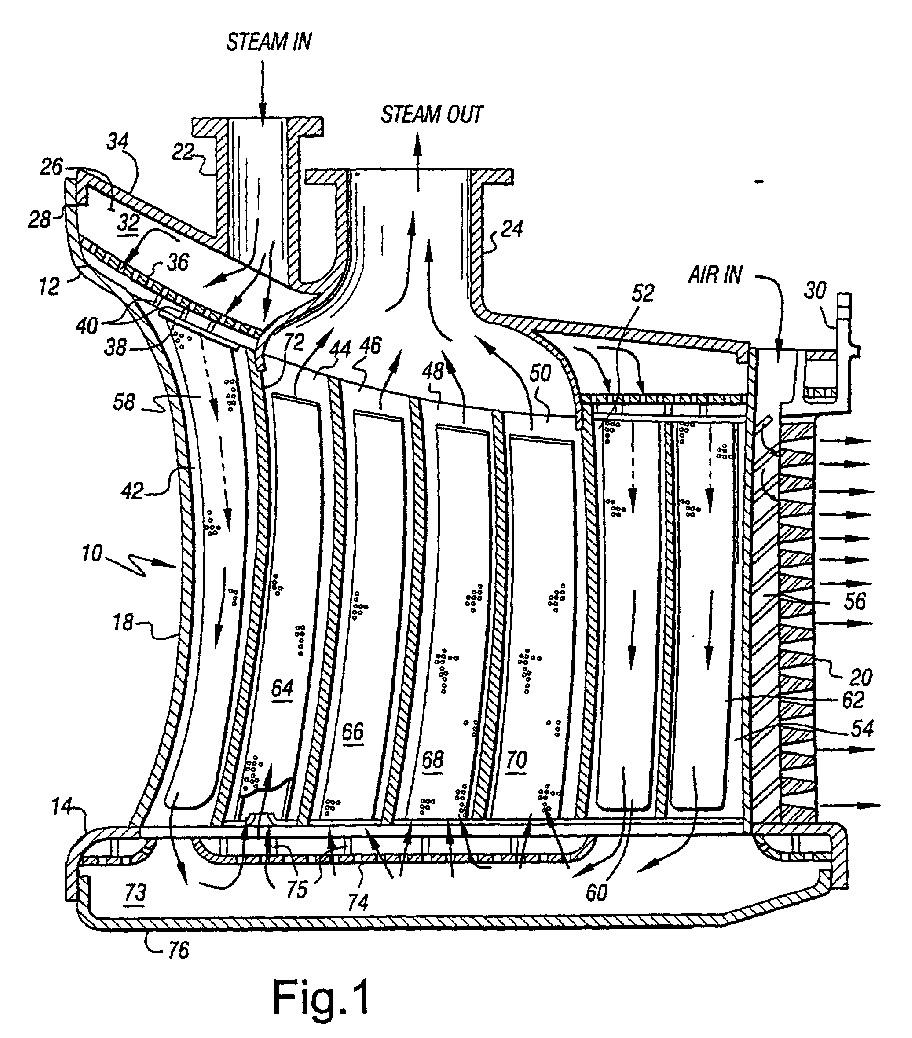
(57) A turbine vane segment is provided that has inner and outer walls (14, 12) spaced
from one another, a vane (10) extending between the inner and outer walls (14, 12)
and having leading and trailing edges (18, 20) and pressure and suction sides, the
vane (10) including discrete leading edge, intermediate, aft and trailing edge cavities
(42, 44, 46, 48, 50, 52) between the leading and trailing edges and extending lengthwise
of the vane (10) for flowing a cooling medium; and an insert sleeve (58, 60, 62, 64,
66, 68, 70) within at least one of the cavities (42, 44, 46, 48, 50, 52) and spaced
from interior wall surfaces thereof. The insert sleeve (58, 60, 62, 64, 66, 68, 70)
has an inlet for flowing the cooling medium into the insert sleeve and has impingement
holes (86, 88) defined in first and second walls (82, 84) thereof that respectively
face the pressure and suction sides of the vane. The impingement holes (86, 88) of
at least one of those first and second walls (82, 84) are defined along substantially
only a first, upstream portion (87, 89) thereof, whereby the cooling flow is predominantly
impingement cooling along a first region of the insert wall corresponding to the first,
upstream portion (87, 89)) and the cooling flow is predominantly convective cooling
along a second region corresponding to a second, downstream portion (90, 92) of the
at least one wall 82, 84) of the insert sleeve (64).
|
|
