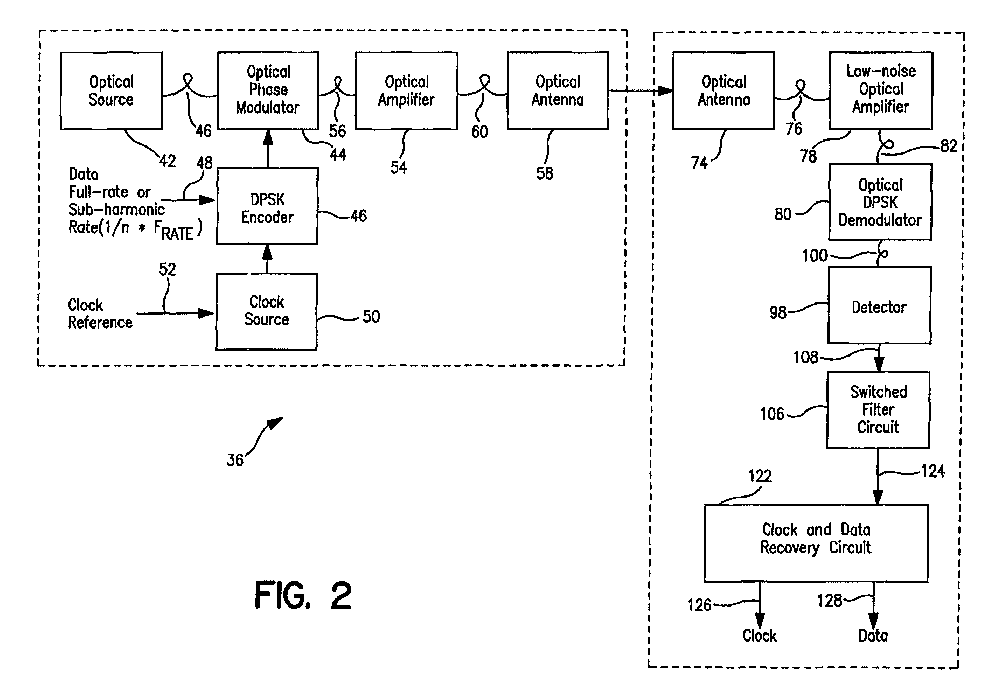
(57) The DPSK modulation system in accordance with the present invention includes a transmitter,
which includes a carrier signal source, a phase modulator and a DPSK encoder for modulating
a carrier signal. The modulated carrier signals may be amplified, for example, in
optical communication systems, by a rare-earth-element-doped fibre amplifier. The
multi-rate receiver includes a single demodulator, for example, a single optical interferometer,
used for multiple sub-harmonic data rates, which demodulates the modulated signal.
The demodulated signals are detected, for example, in optical communication systems,
by an arrangement of photodiodes, and the detected signals are applied to, for example,
a clock and data recovery circuit that is tuned as a function of data rate, for example,
by way of a switched filter circuit. The switched filter circuit may include a plurality
of low-pass filters, that are selected as a function of the data rate. Since the carrier
signal is continuously transmitted, a phase reference is available to demodulate all
received power and the peak transmitted power is approximately equal to the average
transmitted power even at data rates corresponding to bit times that are large compared
to the differential time delay of the demodulator.
|
|
