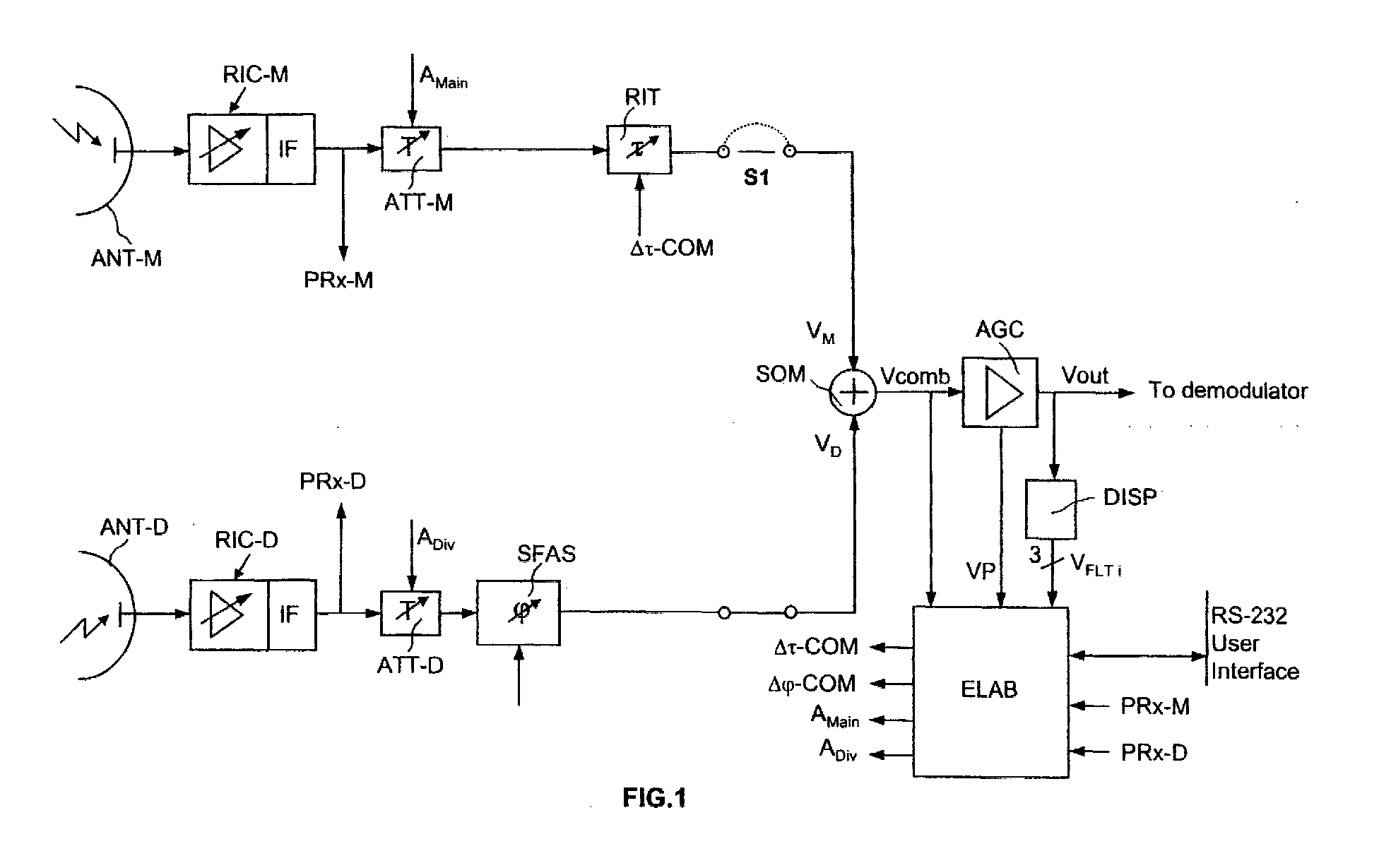
(57) In the following a method to automate the preliminary equalization of combined signals
in space diversity receivers is described. The method includes a start cycle in order
to check the absence of irregular propagation of radio signals caused by atmospheric
events, or to wait for the end of these events, followed by an equalization step of
the centre-band amplitudes of the Main and Diversity signals, and by a cycle aiming
at maximizing a target function ΔP that decreases with the absolute value of the delay
τ between the signals at the combination point. The second cycle includes a first
step to check the absence of flat fading and of selective fading within the band of
the modulated signal, followed by a cycle of phase shifting the Diversity signal with
small phase variations, at each step the logarithmic value of the maximum and minimum
amplitudes of the combined Vcomb signal is stored. After each 360° rotation, the ΔP
function is calculated, that is given by the difference between the stored maximum
and the minimum Vcomb values. The current ΔP is compared with the ΔP measured at the
previous 360° rotation, to check if it has increased or decreased. The ▵τ on the Main
signal path is then changed, which absolute value and sign, in the increasing direction
of ΔP, depend on the starting delay and on the sign, or on the absolute value and
sign, of the difference between the two ΔP. The procedure ends when the current ΔP
exceeds a threshold set as target for the accuracy of the preliminary equalization
(Figure 1).
|
|
