| (19) |
 |
|
(11) |
EP 1 181 606 B1 |
| (12) |
EUROPEAN PATENT SPECIFICATION |
| (45) |
Mention of the grant of the patent: |
|
21.11.2007 Bulletin 2007/47 |
| (22) |
Date of filing: 18.02.2000 |
|
| (51) |
International Patent Classification (IPC):
|
| (86) |
International application number: |
|
PCT/SE2000/000332 |
| (87) |
International publication number: |
|
WO 2000/050947 (31.08.2000 Gazette 2000/35) |
|
| (54) |
A FIBRE FEEDING DEVICE
FASERZUFUHRVORRICHTUNG
PASSE-FIBRE
|
| (84) |
Designated Contracting States: |
|
DE FR GB |
| (30) |
Priority: |
22.02.1999 SE 9900623
|
| (43) |
Date of publication of application: |
|
27.02.2002 Bulletin 2002/09 |
| (73) |
Proprietor: TELEFONAKTIEBOLAGET LM ERICSSON (publ) |
|
164 83 Stockholm (SE) |
|
| (72) |
Inventors: |
|
- BERGQVIST, Erik
S-820 70 Bergsjö (SE)
- OLSSON, Bertil
S-820 64 Näsviken (SE)
|
| (74) |
Representative: Sjöberg, Mats Hakan |
|
Ericsson AB
Patent Unit Core Networks, Älvsjö
Box 1505
125 25 Älvsjö
125 25 Älvsjö (SE) |
| (56) |
References cited: :
EP-A1- 0 508 016
|
GB-A- 2 207 562
|
|
| |
|
|
|
|
| |
|
| Note: Within nine months from the publication of the mention of the grant of the European
patent, any person may give notice to the European Patent Office of opposition to
the European patent
granted. Notice of opposition shall be filed in a written reasoned statement. It shall
not be deemed to
have been filed until the opposition fee has been paid. (Art. 99(1) European Patent
Convention).
|
FIELD OF INVENTION
[0001] The present invention relates to a fibre feeding device for feeding optical fibres
into a tubular element or into some corresponding element, either singly, loosely
or closely connected together, the latter being preferred.
DESCRIPTION OF THE BACKGROUND ART
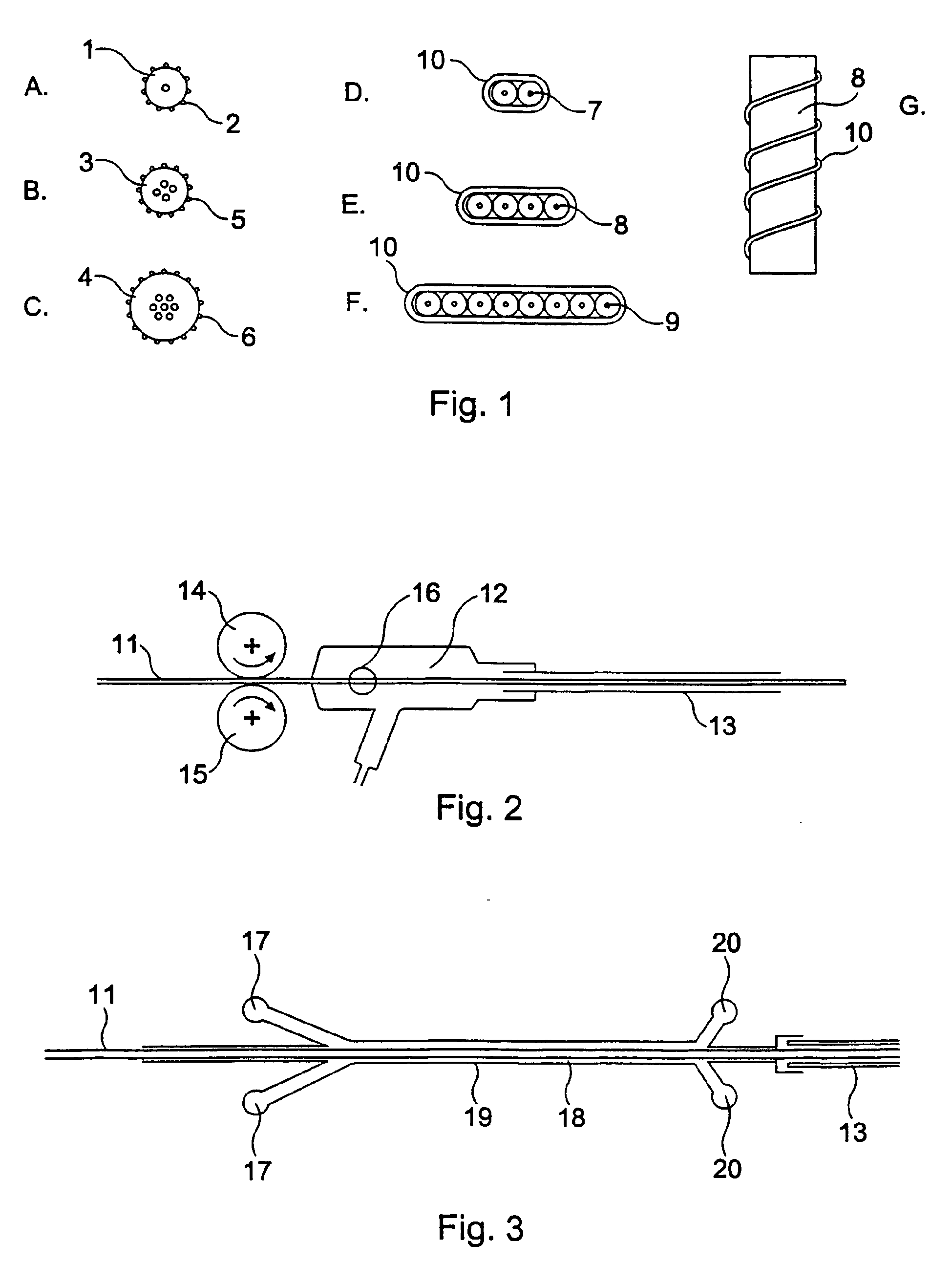
[0002] It is known to install optical fibres by means of a blowing technique. In order to
allow an optical fibre or several optical fibres contained in an optical fibre ribbon
to be blown into a tubular element, duct, or the like, it is essential that the friction
between the optical fibre or fibre ribbon and the inner surface of the tubular element
is very low, that the presence of static electricity is negligible, and that the air
resistance is sufficiently large to enable the optical fibre(s) or fibre ribbon to
be advanced even at moderate air propulsion speeds. Hitherto, the solution to this
problem has been achieved by applying to the optical fibre(s) 1 or to the optical
fibre ribbon a diameter-increasing layer 2 that includes friction reducing material.
In the case of mutually combined or closely connected optical fibres 3, 4, several
of these fibre combinations have been orientated in a rotationally symmetric bundle
so as to have the same flexural resistance in all planes, and have been provided with
a diameter-increasing layer 5, 6 of glass beads, for instance. In order to be able
to use optical fibre ribbon techniques 7-9 and utilise the advantages that this would
afford in respect of welding and the establishment of electrical contacts without
requiring additional material for rounding the cross-section of the ribbon, and for
reducing friction and increasing air resistance, a thin Kevlar® wire or filament 10
may be wound around the optical fibre ribbon.
[0003] This wire can be readily removed at the ends of the optical fibres at a later time,
when the ends are to be welded or when electrical connections shall be established.
See Figures 1A-G.
[0004] When an optical fibre 11 or an optical fibre ribbon shall be fed into a tubular element,
e.g. ducting, with the aid of compressed air, the optical fibre or ribbon is fed by
an optical fibre feeding device into a pressurised space 12 that is connected to the
tubular element into which the optical fibre shall be blown. In so doing, it is necessary
to apply some form of force that will overcome the backward ejection force acting
on the optical fibre in a direction opposite to the feed direction. This has been
achieved in the case of several systems, by allowing the optical fibre 11 to pass
between two feed rollers 14, 15 that have a soft surface coating. These rollers or
wheels may be electrically operated, although they may also conceivably be operated
by the compressed air used to propel the optical fibre, so as not to damage the fibre
should it be prevented from moving along the duct for some reason or other. A pressure
sensor 16 may be provided in the space 12 so as to detect any pressure changes that
would result from forward movement of the fibre through the duct being prevented.
An optical fibre feeding device designed to operate in accordance with this fibre
feeding technique would be relatively complicated and would also require the supply
of electrical energy in addition to the compressed air supply for propelling the optical
fibre. See Figure 2.
[0005] The aforesaid backward ejection force in the duct can be partially overcome with
the aid of an ejector effect generated by the compressed air 17 supplied, by allowing
a leakage flow 18 to pass through an optical fibre blow pipe 19 that is designed to
function as a Venturi tube, where the air velocity is high and the pressure is low.
The blow pipe may be provided with adjustable outler valves 20 on the downstream side,
for controlling the leakage flow. In this way, the optical fibre or fibre ribbon is
subjected to an additional propulsion force when introduced into the blow pipe. The
leakage flow results in a lower pressure in the blow pipe, a factor wihch may allow
the blow length to be reduced. See Figure 3.
[0006] The patent application
GB-A-2 207 562 discloses a device for blowing an optical fibre into a duct. The device has a housing
for connection to the duct and a sleeve joined to the housing. The sleeve has a throughbore
for a core, and a passage for the optical fibre is formed between the core and the
throughbore inside. The housing has an inlet for injected air and the sleeve has a
flexible membrane forming a non-return valve for the injected air, preventing it from
flowing backwards in the device along the fibre. The sleeve and the housing can be
divided into two parts along the directions of their lengths. The device can thereby
easily be removed from the optical fibre.
SUMMARY OF THE INVENTION
[0007] With the intention of simplifying handling of an optical fibre feeding device that
includes a blowing passage for feeding one or more optical fibres into a tubular element,
duct or the like, the blow passage can be opened to allow different types of optical
fibres to be fed thereinto. The present invention provides an optical fibre feeding
device according to claims 1 and 2. Holes for delivering and removing compressed air
used to propel the optical fibre(s) are provided in the bottom surface of the channel
in close proximity to its respective rear and front edges. With an optical fibre placed
in the groove and with the bar placed in the channel in the body of said device, the
optical fibre will be propelled forwards when compressed air is delivered through
the holes at the rear edge of the channel, by virtue of the blow passage functioning
in the manner of a Venturi tube, wherewith a small leakage flow in the blow passage
will cause transportation of the optical fibre through the fibre feeding device and
into a blow pipe through the medium of an ejector effect. Because the bar is removable
and is provided with grooves of mutually different sizes, or there are different bars
with grooves of different cross-sections, the fibre feeding device can be used for
different types of optical fibres and also enables optical fibres that have already
been connected electrically to be fed into the tubular element or duct. The blow passages
may be given a rectangular cross-section, so as to enable a non-rounded optical fibre
ribbon to be blown into the tubular element or duct by means of the fibre feeding
device.
[0008] The invention will now be described in more detail with reference to a preferred
embodiment thereof and also with reference to the accompanying drawings.
BRIEF DESCRIPTION OF THE DRAWINGS
[0009]
Figures 1A-G illustrate conventional optical fibres whose surfaces include friction
reducing means and/or air resistance increasing means, and an encased optical fibre
ribbon.
Figure 2 illustrates an optical fibre feeding device.
Figure 3 illustrates the principle of advancing optical fibres with the aid of a Venturi
technique.
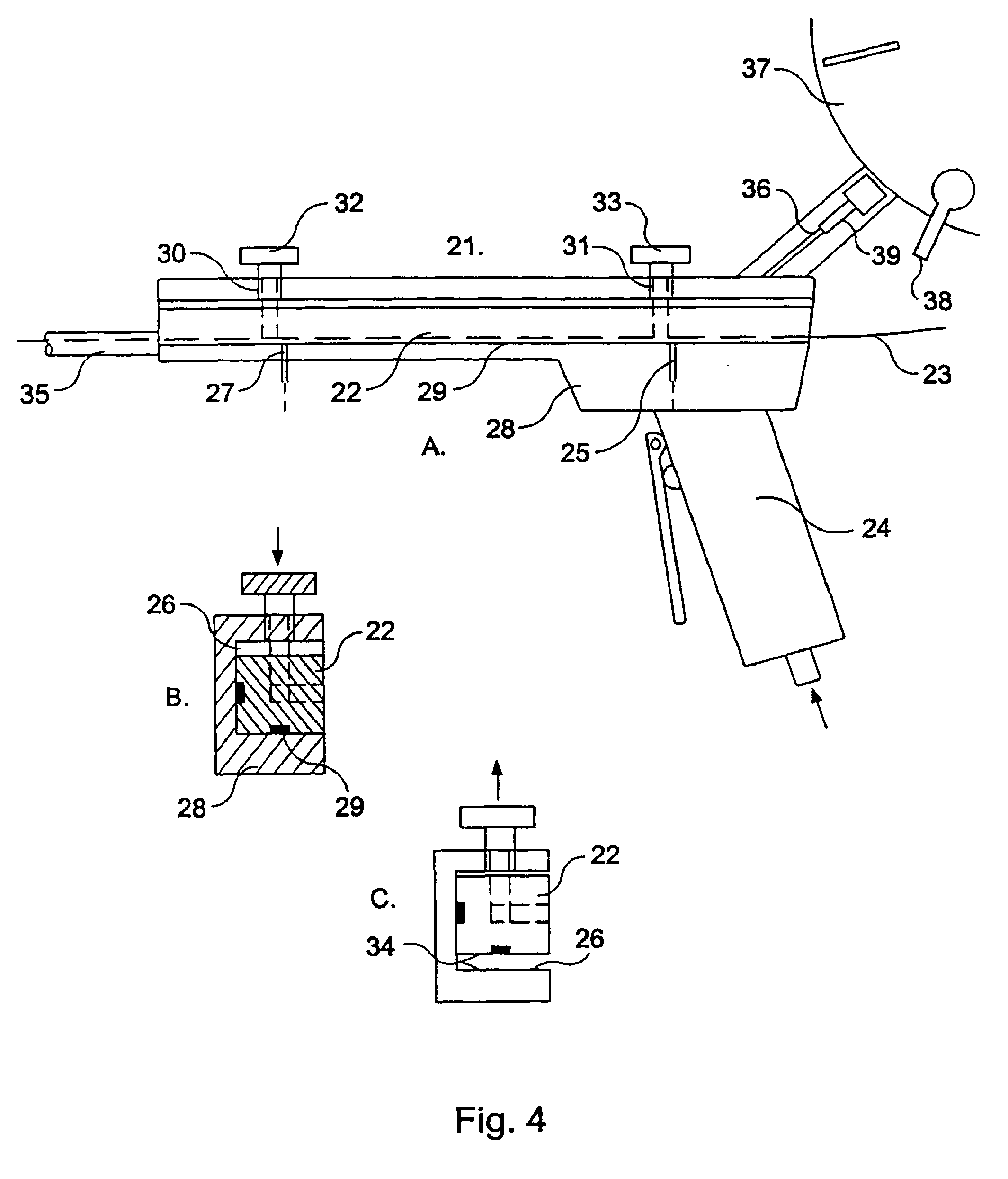
Figures 4A-C illustrate an inventive optical fibre feeding device, including two cross-sectional
views.
DESCRIPTION OF PREFERRED EMBODIMENTS
[0010] Figures 4A-C illustrate schematically an inventive optical fibre feeding device 21
that includes a removable bar 22 for in-feeding different types of optical fibre ribbons
23, The device includes an adjustable compressed-air connection 24 in the form of
a pistol grip which is connected to one end of the fibre feeding device. This compressed
air connection enables compressed air to be delivered to one or more holes 25 at one
end of the bottom surface of a channel 26 in the feed device. One or more holes 27,
which may optionally be adjustable, are provided at the other end of said channel
and connected with a region outside said device for evacuating air therefrom. The
bar 22 has an essentially square cross-sectional shape and can be inserted into the
channel 26 in the body 28 of said device and includes on at least one long side a
groove 29 which is intended to function as a blow passage for an inserted optical
fibre when the bar is placed in the body of said device. In this regard, the cross-section
of the blow passage 29 is adapted to fit a specific optical fibre or optical fibre
ribbon for advancement of the fibre or ribbon with the bar placed in said body. The
upper side of the body 28 includes threaded holes 30, 31 which coact with at least
two tightening screws 32, 33 for securing the bar 22 in the channel 26. The screws
enable the position of the bar in the body to be adjusted, i.e. the blow passage can
be opened for insertion of an optical fibre ribbon or closed for forward feeding of
said ribbon. In the illustrated case, the device includes a spring 34 positioned between
bar and body for simplifying handling of the optical fibre, by enabling the bar to
be lifted away from its abutment surface with a spring force and an optical fibre
to be easily removed from or placed into the blow passage. An optical fibre blow pipe
35 can then be readily connected to the fibre feeding device, by clamping the pipe
firmly between the body 28 and the bar 22. Bars that include grooves for blow passages
of mutually different cross-sections can be used with one and the same body, thereby
enabling ribbons/cables of mutually different cross-sections to be fed into the tubular
element/duct by means of the inventive device.
[0011] The installation of optical fibres can be further simplified by providing the fibre
feeding device with a simple holding means in the form of a collapsible arm 36 for
supporting a drum 37 or the like on which optical fibres have been wound. When an
inventive optical fibre feeding device is connected to a drum that carries optical
fibres, optical fibres can easily be installed by one single person. The inventive
fibre feeding device also enables optical fibre cables that have already been connected
electrically to be fed into a tubular element/duct in predetermined lengths, whereby
the bar is raised to expose the blow passage when the electrical connection is located
on the front end of the cable. When the electrical connection is located on the rear
end of the cable, this end of the cable can be supported by the drum together with
an optical fibre cable/ribbon of given length. When the optical fibre cable has been
fed into the blow pipe, there is immediately obtained an established optical fibre
connection that can be connected directly to an existing outlet, such as a wall outlet
in a living space.
[0012] The arm 36 holding the drum 37 may be provided with a recording device 38 which records
the length of optical fibre that has been blown into the duct. The device 38 may,
for instance, function to optically register a mark on one side of the drum so as
to determine the number of revolutions of the drum when taking optical fibre therefrom
and thereby the length of optical fibre unwound from the drum. The arm may also carry
a compressed air-driven brake means 39 which functions to stop the drum should feeding
of the optical fibre be stopped for some reason or other. The brake means may be activated
in response to a pressure change occurring in the blow passage when the optical fibre
is unable to move forwards.
[0013] It will be understood that the invention is not restricted to the aforedescribed
and illustrated exemplifying embodiments thereof and that modifications can be made
within the scope of the accompanying Claims.
1. A device for feeding optical fibres into a tubular element, duct, or the like, comprising
a compressed air-operated feeder (21) in which an optical fibre (23) is advanced with
the aid of the compressed air delivered to a blow passage in the feeder in which the
optical fibre is located, the device including a bar (22) which can be inserted into
and fixed in a channel (26) in a body (28) of said device, characterised in that the bar (22) has a groove on each of two of its long sides (29), said groove functioning
as the blow passage in combination with a wall of the channel (26) when the bar is
placed in the body of the device, and in that said channel includes holes (25, 27) for respectively, the delivery and removal of
the compressed air, and in that the blow passage has a cross-sectional shape that is adapted to a given type of optical
fibre or fibre ribbon, such that optical fibres of mutually different cross-sections
can be fed into said tubular element with the aid of one and the same optical fibre
feeding device, depending on the setting of the bar (22).
2. A device for feeding optical fibres into a tubular element, duct, or the like, comprising
a compressed air-operated feeder (21) in which an optical fibre (23) is advanced with
the aid of the compressed air delivered to a blow passage in the feeder in which the
optical fibre is located, the device further comprising at least two bars (22) which
can each be selectively separately inserted into and fixed in a channel (26) in a
body (28) of said device, each of the bars (22) having on at least one long side a
groove (29), said groove functioning as the blow passage in combination with a wall
of the channel (26) when a selected bar is placed in the body of the device, and in
that said channel includes holes (25, 27) for, respectively, the delivery and removal
of the compressed air, and in that the blow passage of said selected bar has a cross-sectional
shape that is adapted to a given type of optical fibre or fibre ribbon, such that
optical fibres of mutually different cross-sections can be fed into said tubular element
with the aid of one and the same optical fibre feeding device, depending on the selection
of the bar (22).
3. A device according to Claim 1 or 2, characterised in that said bar or bars (22) has or have a generally square cross-section.
4. A device according to Claim 1 or 2, characterised in that the body (28) of said device includes means (30-33) for releasing and fixing said
bar or bars.
5. A device according to Claim 1 or 2, characterised by a spring mechanism (34) disposed between said body (28) and said bar or bars (22)
for releasing said bar or bars from its fixed position.
6. A device according to Claim 1 or 2, characterised by an optical fibre carrying drum (37) which is connected to the feed device by means
of an arm (36), wherewith optical fibre coiled on the drum can be delivered directly
to the fibre feeding device.
7. A device according to Claim 6, characterised by means (38) for recording rotational movement of the drum (37), so as to enable the
number of optical fibre turns unwound from the drum to be recorded.
8. A device according to Claim 6, characterised by brake means (39) for stopping rotation of the drum (37).
9. A device according to Claim 8, characterised in that said brake means (39) is driven by compressed air and controllable, so that rotation
of the drum (37) can be stopped in response to pressure changes in the blow passage
(29).
1. Vorrichtung zur Zuführung von Glasfasern in ein röhrenförmiges Element, einen Kabelkanal
oder ähnliches, umfassend einen pressluftbetriebenen Zuführer (21), in welchem eine
Glasfaser (23) mit Hilfe der komprimierten Luft befördert wird, die einem Strömungsdurchgang
in dem Zuführer zugeführt wird, in welchem die Glasfaser angeordnet ist, wobei die
Vorrichtung eine Schiene (22) enthält, die in einen Kanal (26) in einem Körper (28)
der Vorrichtung eingeführt und befestigt werden kann, dadurch gekennzeichnet, dass die Schiene (22) eine Nut (29) auf jeder von zwei ihrer langen Seiten aufweist, wobei
die Nut als Strömungsdurchgang in Verbindung mit einer Wand des Kanals (26) fungiert,
wenn die Schiene in dem Körper der Vorrichtung angebracht ist, dass der Kanal Löcher
(25, 27) für die jeweilige Zuführung und Entfernung der komprimierten Luft enthält,
und dass der Strömungsdurchgang eine Querschnittsgestalt aufweist, die an eine gegebene
Art einer Glasfaser oder eines Faserbands derart angepasst ist, dass Glasfasern von
gegenseitig unterschiedlichen Querschnitten in das röhrenförmige Element mit Hilfe
ein und derselben Glasfaserzuführungsvorrichtung in Abhängigkeit der Einstellung der
Schiene (22) eingeführt werden können.
2. Vorrichtung zur Zuführung einer Glasfaser in ein röhrenförmiges Element, einen Kanal
oder ähnliches, umfassend einen pressluftbetriebenen Zuführer (21), in welchem eine
Glasfaser (23) mit der Hilfe der komprimierten Luft befördert wird, die einem Strömungsdurchgang
in dem Zuführer zugeführt wird, in welchem die Glasfaser angeordnet ist, wobei die
Vorrichtung weiter umfasst: wenigstens zwei Schienen (22), die wahlweise einzeln in
einen Kanal (26) in einem Körper (28) der Vorrichtung eingeführt und befestigt werden
können, wobei jede der Schienen (22) an wenigstens einer langen Seite eine Nut (29)
aufweist, wobei die Nut als ein Strömungsdurchgang in Kombination mit einer Wand des
Kanals (26) fungiert, wenn eine ausgewählte Schiene in dem Körper der Vorrichtung
angebracht ist, wobei der Kanal Löcher (25, 27) zur jeweiligen Zuführung und Entfernung
der komprimierten Luft enthält, wobei der Strömungsdurchgang der ausgewählten Schiene
eine Querschnittsgestalt aufweist, die an eine gegebene Art von Glasfasern oder Glasfaserbändern
derart angepasst ist, dass Glasfasern mit gegenseitig verschiedenen Querschnitten
in das röhrenförmige Element mit Hilfe ein und derselben Glasfaserzuführungsvorrichtung,
in Abhängigkeit der Wahl der Schiene (22), eingeführt werden können.
3. Vorrichtung nach Anspruch 1 oder 2, dadurch gekennzeichnet, dass die Schiene oder die Schienen (22) einen allgemein rechteckigen Querschnitt aufweist/aufweisen.
4. Vorrichtung nach Anspruch 1 oder 2, dadurch gekennzeichnet, dass der Körper (28) der Vorrichtung Mittel (30-33) zum Lösen und Befestigen der Schiene
oder der Schienen enthält.
5. Vorrichtung nach Anspruch 1 oder 2, dadurch gekennzeichnet, dass ein Federmechanismus (34) zwischen dem Körper (28) und der Schiene oder den Schienen
(22) angeordnet ist, um die Schiene oder die Schienen von ihrer befestigten Position
zu lösen.
6. Vorrichtung nach Anspruch 1 oder 2, dadurch gekennzeichnet, dass eine Glasfaser tragende Trommel (37) mit der Zuführungsvorrichtung mittels eines
Arms (36) verbunden ist, womit Glasfasern, die auf die Trommel gewickelt sind, direkt
der Faserzuführungsvorrichtung zugeführt werden können.
7. Vorrichtung nach Anspruch 6, gekennzeichnet durch Mittel (38), zur Aufzeichnung einer Rotationsbewegung der Trommel (37), um zu ermöglichen,
dass die Anzahl der Glasfaserumdrehungen, die von der Trommel abgewickelt sind, aufgezeichnet
werden.
8. Vorrichtung nach Anspruch 6, gekennzeichnet durch Bremsmittel (39), um die Rotation der Trommel (37) zu stoppen.
9. Vorrichtung nach Anspruch 8, dadurch gekennzeichnet, dass die Bremsmittel (39) durch komprimierte Luft angetrieben werden und steuerbar sind,
so dass eine Rotation der Trommel (37) als Antwort auf eine Druckänderung in dem Strömungsdurchgang
(29) gestoppt werden kann.
1. Dispositif d'avance de fibres optiques dans un élément tubulaire, conduit, ou autre,
comprenant un élément d'avance actionné par air comprimé (21) dans lequel une fibre
optique (23) est avancée à l'aide de l'air comprimé délivré à un passage de soufflage
dans l'élément d'avance dans lequel la fibre optique est située, le dispositif comprenant
une barre (22) qui peut être insérée dans un canal (26) et fixée dans celui-ci dans
un corps (28) dudit dispositif, caractérisé en ce que la barre (22) comporte une gorge (29) sur chacun de deux de ses côtés en longueur,
ladite gorge fonctionnant en tant que passage de soufflage en combinaison avec une
paroi du canal (26) lorsque la barre est placée dans le corps du dispositif, en ce que ledit canal comprend des trous (25, 27) pour respectivement la délivrance et l'élimination
de l'air comprimé, et en ce que le passage de soufflage présente une forme en section transversale qui est adaptée
à un type donné de fibre optique ou de ruban de fibres, de sorte que des fibres optiques
de sections transversales mutuellement différentes puissent être avancées dans ledit
élément tubulaire à l'aide d'un seul et même dispositif d'avance de fibres optiques,
en fonction du réglage de la barre (22).
2. Dispositif d'avance de fibres optiques dans un élément tubulaire, un conduit, ou autre,
comprenant un élément d'avance actionné par air comprimé (21) dans lequel une fibre
optique (23) est avancée à l'aide de l'air comprimé délivré à un passage de soufflage
dans l'élément d'avance dans lequel la fibre optique est située, le dispositif comprenant
en outre au moins deux barres (22) qui peuvent chacune être insérées de manière sélective
et séparée dans un canal (26) et fixées dans celui-ci dans un corps (28) dudit dispositif,
chacune des barres (22) comportant sur au moins un côté en longueur une gorge (29),
ladite gorge fonctionnant en tant que passage de soufflage en combinaison avec une
paroi du canal (26) lorsque la barre sélectionnée est placée dans le corps du dispositif,
en ce que ledit canal comprend des trous (25, 27) pour, respectivement la délivrance
et l'élimination de l'air comprimé, et en ce que le passage de soufflage de ladite
barre sélectionnée présente une forme en section transversale qui est conçue pour
un type donné de fibre optique ou de ruban de fibres, de sorte que des fibres optiques
de sections transversales mutuellement différentes puissent être avancées dans ledit
élément tubulaire à l'aide d'un seul et même dispositif d'avance de fibres optiques,
en fonction de la sélection de la barre (22).
3. Dispositif selon la revendication 1 ou 2, caractérisé en ce que ladite barre ou lesdites barres (22) présente ou présentent une section transversale
généralement carrée.
4. Dispositif selon la revendication 1 ou 2, caractérisé en ce que le corps (28) dudit dispositif comprend un moyen (30 à 33) destiné à libérer et à
fixer ladite barre ou lesdites barres.
5. Dispositif selon la revendication 1 ou 2, caractérisé par un mécanisme de ressort (34) disposé entre ledit corps (28) et ladite barre ou lesdites
barres (22) pour libérer ladite barre ou lesdites barres de sa position fixe.
6. Dispositif selon la revendication 1 ou 2, caractérisé par un tambour de support de fibres optiques (37) qui est connecté au dispositif d'avance
au moyen d'un bras (36), avec lequel la fibre optique enroulée sur le tambour peut
être délivrée directement au dispositif d'avance de fibres.
7. Dispositif selon la revendication 6, caractérisé par un moyen (38) destiné à enregistrer un mouvement de rotation du tambour (37), de
manière à permettre au nombre de tours de fibres optiques déroulés à partir du tambour
d'être enregistré.
8. Dispositif selon la revendication 6, caractérisé par un moyen de freinage (39) destiné à arrêter la rotation du tambour (37).
9. Dispositif selon la revendication 8, caractérisé en ce que ledit moyen de freinage (39) est commandé par de l'air comprimé et peut être commandé,
de sorte que la rotation du tambour (37) puisse être arrêtée en réponse à des changements
de pression dans le passage de soufflage (29).
REFERENCES CITED IN THE DESCRIPTION
This list of references cited by the applicant is for the reader's convenience only.
It does not form part of the European patent document. Even though great care has
been taken in compiling the references, errors or omissions cannot be excluded and
the EPO disclaims all liability in this regard.
Patent documents cited in the description