| (19) |
 |
|
(11) |
EP 1 186 833 B1 |
| (12) |
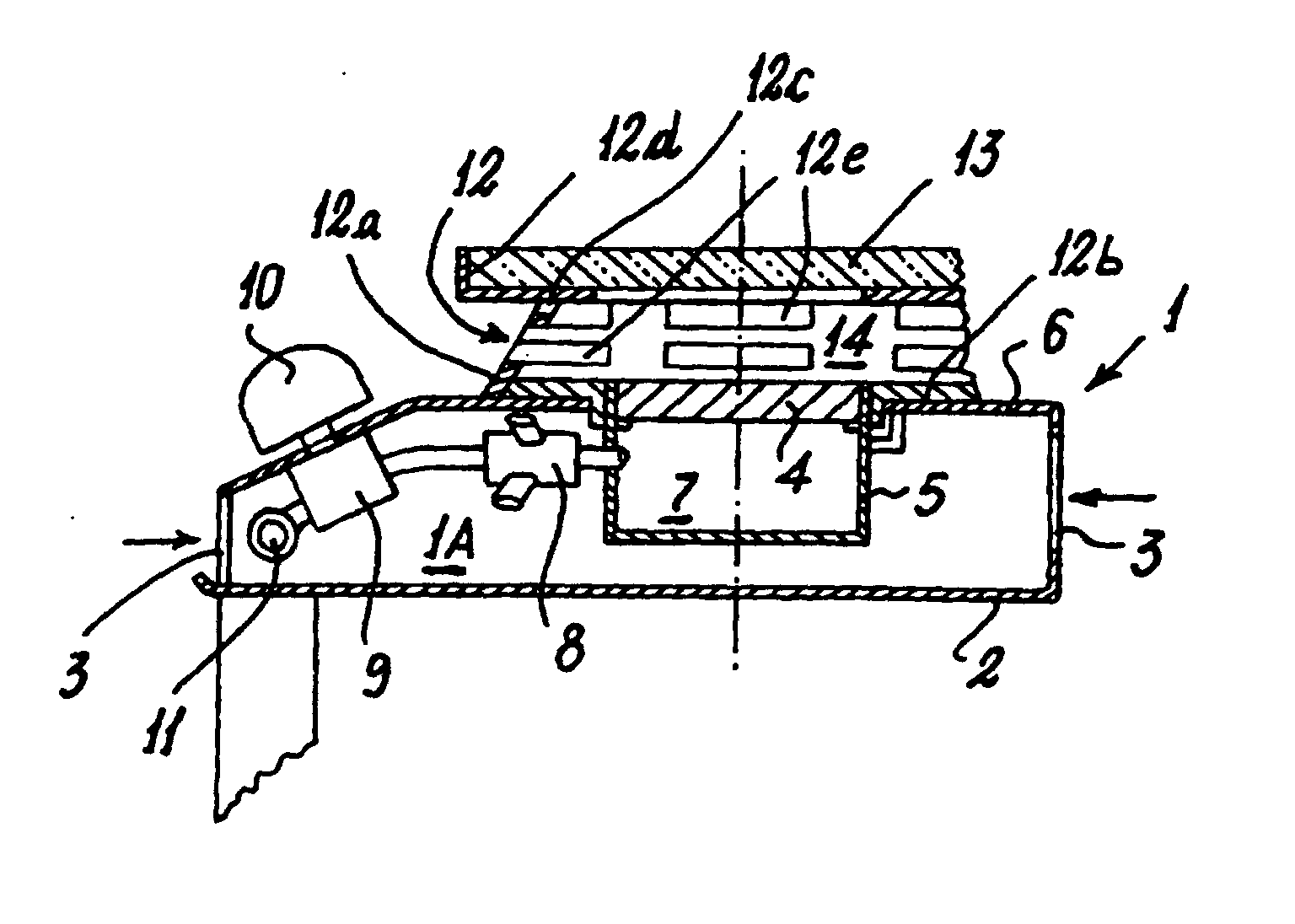
EUROPEAN PATENT SPECIFICATION |
| (45) |
Mention of the grant of the patent: |
|
17.11.2004 Bulletin 2004/47 |
| (22) |
Date of filing: 09.08.2001 |
|
| (51) |
International Patent Classification (IPC)7: F24C 3/06 |
|
| (54) |
Cooking appliance with atmospheric burner
Kochgerät mit atmosphärischem Brenner
Appareil de cuisson avec brûleur athmosphérique
|
| (84) |
Designated Contracting States: |
|
DE ES FR GB IT SE |
| (30) |
Priority: |
05.09.2000 IT MI000496 U
|
| (43) |
Date of publication of application: |
|
13.03.2002 Bulletin 2002/11 |
| (73) |
Proprietor: WHIRLPOOL CORPORATION |
|
Benton Harbor
Michigan 49022 (US) |
|
| (72) |
Inventors: |
|
- Distaso, Alessandro,
c/o Whirlpool Europe s.r.l.
21025 Comerio (IT)
- Franchi, Daniele,
c/o Whirlpool Europe s.r.l.
21025 Comerio (IT)
- Barrero, Davide,
c/o Whirlpool Europe s.r.l.
21025 Comerio (IT)
|
| (74) |
Representative: Guerci, Alessandro |
|
Whirlpool Europe S.r.l.
Patent Department
Viale G. Borghi 27
21025 Comerio (VA)
21025 Comerio (VA) (IT) |
| (56) |
References cited: :
FR-A- 2 082 312
GB-A- 1 569 810
|
GB-A- 1 324 376
|
|
| |
|
|
|
|
| |
|
| Note: Within nine months from the publication of the mention of the grant of the European
patent, any person may give notice to the European Patent Office of opposition to
the European patent
granted. Notice of opposition shall be filed in a written reasoned statement. It shall
not be deemed to
have been filed until the opposition fee has been paid. (Art. 99(1) European Patent
Convention).
|
[0001] This invention relates to a cooking appliance provided with an atmospheric burner,
a thermal receiver, a chamber for distributing the gas/air mixture to the burner,
and passages for the combustion products to enable their heat to be utilized for cooking,
the combustion products passing through a space between the burner and the thermal
receiver.
[0002] Cooking appliances structured in the aforesaid manner are known, for example from
US-A-4,569,328. In this patent the passages for the combustion products are holes
passing through the said thermal receiver, with the negative consequence that any
pan spillage, or spillage of the liquids used for cleaning the thermal receiver or
dirt in general reach the burner, to harm its operation. A heating (cooking) appliance
is known from EP-B1-0520913 in which the air/gas mixture is fed centrally into a distribution
chamber bounded upperly by the thermal receiver, lowerly by the burner and laterally
by a metal ring surrounding the receiver and burner. In this appliance the combustion
products do not pass through a space between the atmospheric burner and thermal receiver.
[0003] FR 2 082 312 A discloses an atmospheric burner to be placed in a tight chamber that
is in communication with a chimney.
[0004] The specific object of the invention is to improve the heating (cooking) appliances
of said US patent by eliminating the danger of deactivation of the burner and the
fragility of the thermal receiver (due to the holes).
[0005] This and further objects which will be more apparent from the ensuing detailed description
are attained by a cooking appliance in accordance with the teachings of the accompanying
claims.
[0006] The invention will be better understood from the detailed description thereof, given
hereinafter by way of non-limiting example with reference to the single figure of
the accompanying drawing which schematically reproduces, not to scale, a cooking appliance
conforming to the teachings of the invention, the appliance being limited to a single
atmospheric burner, it being however apparent that the scope of protection also includes
appliances provided with a plurality of burners.
[0007] In the figure, the reference numeral 1 indicates the appliance box casing, for example
of sheet metal, provided preferably with a removable base 2. This casing defines a
compartment 1A and presents, in suitable positions not susceptible to occasional blockage
(for example on the front and on the rear), wide apertures 3 communicating with the
outside such as to enable operationally adequate quantities of combustion air to enter
a conventional atmospheric burner 4, for example of channelized ceramic refractory
either lined or not lined with a catalyst.
[0008] The atmospheric burner is preferably and advantageously of discoidal shape and is
supported in, and closes, the upper aperture of a sheet metal cup member 5. The atmospheric
burner 4 is substantially and advantageously supported at the height of the upper
surface 6 of the casing 1 (i.e. of the "cooking hob"). With the cup member 5, the
burner 4 defines a chamber 7 for distributing the air/gas mixture which is fed to
it via a conventional injector 8 fed with the gas, to draw air from the compartment
1A and hence produce the relative mixing.
[0009] The injector is connected at one end to the cup member 5 and at its other end to
a conventional cock 9 for adjusting the gas flow rate (controlled by the knob 10)
and connected to a gas feed conduit 11.
[0010] On the cooking hob 6, coaxial with the atmospheric burner 4, there is mounted a preferably
metal spacer means, indicated overall by 12, of circular symmetry and provided with
a preferably frusto-conical annular wall 12a. This spacer means presents a base 12b
for its resting on the cooking hob 6 and, on the opposite side, a ring 12c with a
side wall 12d forming a support for the thermal receiver represented by a conventional
discoidal glass-ceramic body. The discoidal body 13 is supported spaced from the atmospheric
burner 4 coaxially to it, and preferably and advantageously has a diameter greater
than the base 12b of the spacer means 12. The wall 12a comprises wide apertures 12e
for the exit of combustion products from the space 14 lying between the glass-ceramic
disc and the atmospheric burner 4.
[0011] In operation, a considerable fraction of the infrared energy emitted by the atmospheric
burner passes through the glass-ceramic disc 13, the rest being absorbed by the latter
with the result that it becomes hot. This heating is substantially aided by the combustion
products which also graze the saucepan, frying pan or the like placed on the disc
13, to cook its contents.
[0012] The scope of protection of the present invention also includes the use of a cylindrical
instead of frusto-conical shape for the wall 12a of the spacer 12, possibly inclining
the axis of the apertures present in this wall.
1. A cooking appliance comprising: an atmospheric burner (4), a thermal receiver (13),
a chamber (7) for distributing the gas/air mixture to the burner (4), and passages
for the combustion products to enable their heat to be utilized for cooking, the combustion
products passing through a space (14) between the burner (4) and the thermal receiver
(13), wherein said space is bounded laterally by a spacer (12) which at one end supports
said thermal receiver (13) and which along its extension is provided with passages
(12e) for the exit of combustion products such that they leave these passages with
a component of their movement substantially perpendicular to the burner (4) and to
the thermal receiver (13).
2. An appliance as claimed in claim 1, characterised by a box casing (1) provided with apertures (3) for communication with the atmosphere
which are positioned in faces of said casing which cannot be randomly intercepted.
3. An appliance as claimed in claims 1 and 2, wherein the spacer (12) is of metal and
rests on said box casing (1).
4. An appliance as claimed in one or more of the preceding claims, wherein the burner
(4) and the thermal receiver (13) are of discoidal shape, the former having a smaller
diameter than the latter.
5. An appliance as claimed in one or more of the preceding claims, wherein the burner
(4) is disposed substantially at the level of the upper surface (6) of the box casing
(1).
6. An appliance as claimed in one or more of the preceding claims, wherein the metal
spacer (12) comprises an annular base (12b), a frusto-conical wall (12e) comprising
the passages (12e), and at its top a ring with side wall (12c+12d)) for supporting
the thermal receiver.
1. Kochgerät, umfassend:
einen atmosphärischen Brenner (4), einen thermischen Empfänger (13), eine Kammer (7)
zum Verteilen der Gas/Luft-Mischung zu dem Brenner (4) und Durchgänge für die Verbrennungsprodukte,
um zu ermöglichen, dass deren Wärme zum Kochen verwendet wird, wobei die Verbrennungsprodukte
durch einen Raum (14) zwischen dem Brenner (4) und dem thermischen Empfänger (13)
hindurchtreten, wobei dieser Raum seitlich von einem Distanzstück (12) begrenzt ist,
welches an einem Ende den thermischen Empfänger (13) abstützt und welches entlang
seiner Erstreckung mit Durchtritten (12e) für den Austritt von Verbrennungsprodukten
versehen ist, so dass diese die Durchtritte mit einer BewegungsKomponente verlassen,
welche im wesentlichen senkrecht zu dem Brenner (4) und zu dem thermischen Empfänger
(13) steht.
2. Kochgerät, wie in Anspruch 1 beansprucht, dadurch gekennzeichnet, dass ein Gehäuse (1) mit Öffnungen (3) zur Kommunikation mit der Atmosphäre versehen ist,
welche in Flächen dieses Gehäuses positioniert sind, die nicht zufällig abgeschnitten
werden können.
3. Kochgerät, wie in Anspruch 1 und 2 beansprucht, wobei das Distanzstück (12) aus Metall
besteht und auf dem Gehäuse (1) ruht.
4. Kochgerät, wie in einem oder mehreren der voranstehenden Ansprüche beansprucht, wobei
der Brenner (4) und der thermische Empfänger (13) eine scheibenförmige Form aufweisen,
wobei der erstere einen kleineren Durchmesser als der letztere besitzt.
5. Kochgerät, wie in einem oder mehreren der voranstehenden Ansprüche beansprucht, wobei
der Brenner (4) im wesentlichen auf dem Niveau der oberen Oberfläche (6) des Gehäuses
(1) angeordnet ist.
6. Kochgerät, wie in einem oder mehreren der voranstehenden Ansprüche beansprucht, wobei
das metallene Distanzstück (12) eine kreisförmige Basis (12b), eine frustrokonische
Wand (12e), welche die Durchtritte (12e) umfasst, sowie an dessen Spitze einen Ring
mit einer Seitenwand (12c und 12d) zum Abstützen des thermischen Empfängers umfasst.
1. Appareil de cuisson, comprenant un brûleur atmosphérique (4), un récepteur thermique
(13), une chambre (7) de distribution du mélange air-gaz au brûleur (4), et des passages
pour les produits de combustion afin que leur chaleur puisse être utilisée pour la
cuisson, les produits de combustion passant dans un espace (14) disposé entre le brûleur
(4) et le récepteur thermique (13), dans lequel l'espace est délimité latéralement
par une entretoise (12) qui, à une première extrémité, supporte le récepteur thermique
(13) et qui, sur sa longueur, a des passages (12e) pour la sortie des produits de
combustion de manière qu'ils quittent ces passages avec une composante de déplacement
pratiquement perpendiculaire au brûleur (4) et au récepteur thermique (13).
2. Appareil selon la revendication 1, caractérisé par un carter (1) en forme de boite ayant des ouvertures (3) destinées à communiquer
avec l'atmosphère et qui sont disposées dans des faces du carter qui ne peuvent pas
être interceptées au hasard.
3. Appareil selon les revendications 1 et 2, dans lequel l'entretoise (12) est formée
de métal et est en appui sur le carter (1) en forme de boîte.
4. Appareil selon une ou plusieurs des revendications précédentes, dans lequel le brûleur
(4) et le récepteur thermique (13) ont une forme de disque, le premier ayant un diamètre
inférieur à celui du second.
5. Appareil selon une ou plusieurs des revendications précédentes, dans lequel le brûleur
(4) est disposé pratiquement au niveau de la surface supérieure (6) du carter (1)
en forme de boîte.
6. Appareil selon une ou plusieurs des revendications précédentes, dans lequel l'entretoise
métallique (12) comporte une base annulaire (12b), une paroi tronconique (12e) comprenant
les passages (12e) et, à sa partie supérieure, un anneau ayant une paroi latérale
(12c + 12d) de support du récepteur thermique.