|
(11) | EP 1 197 490 B1 |

| (12) | EUROPEAN PATENT SPECIFICATION |
|
|
| (54) |
Process for preparing N-[1-(S)-ethoxycarbonyl-3-phenylpropyl]-L-alanine N-carboxyanhydride Verfahren zur Herstellung von N-[1-(S)-Ethoxycarbonyl-3-phenylpropyl]-L-alanin-N-carboxyanhydrid Procédé pour la préparation du N-carboxyanhydride de la N-[1-(S)-ethoxycarbonyl-3-phénylpropyl]-L-alanine |
|
|
|||||||||||||||||||||||||||||||
|
||||||||||||||||||||||||||||||||
| Note: Within nine months from the publication of the mention of the grant of the European patent, any person may give notice to the European Patent Office of opposition to the European patent granted. Notice of opposition shall be filed in a written reasoned statement. It shall not be deemed to have been filed until the opposition fee has been paid. (Art. 99(1) European Patent Convention). |
BACKGROUND OF THE INVENTION
1. Field of the Invention
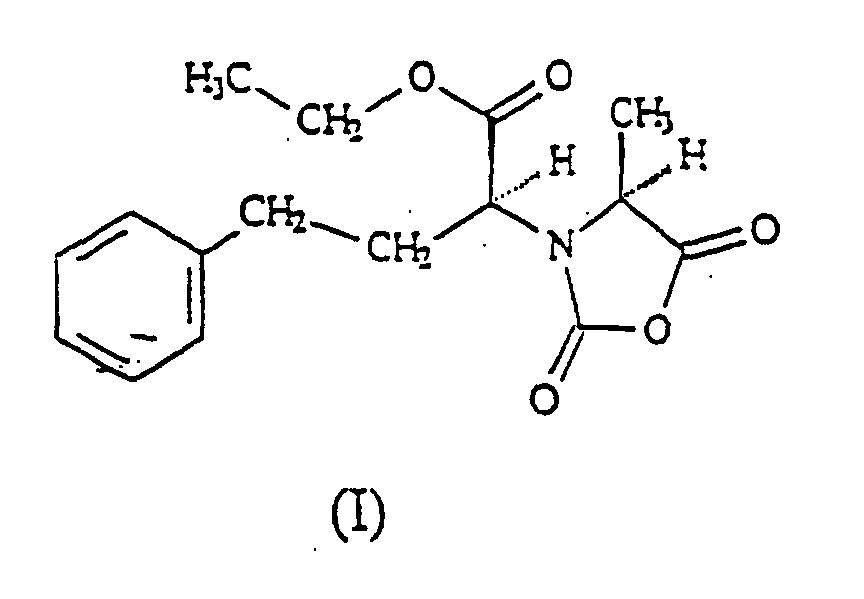
[0001] The present invention relates to a process for preparing the precursor of angiotensin converting enzyme (hereinafter referred to as "ACE") inhibitors. More particularly, it relates to a process for preparing N-[1-(S)-ethoxycarbonyl-3-phenylpropyl]-L-alanine N-carboxyanhydride (hereinafter referred to as "NEPA-NCA").
2. Description of the Prior Art
[0002] Enalapril Maleate of the following formula (II)
is a well-known antihypertensive agent due to an excellent ACE inhibitory activity. EP215335 discloses a process for preparing the formula (II) by using the NEPA-NCA of the formula (I) as starting material which undergo condensation reaction with L-proline under the basic condition to obtain the N-[1-(S)-ethoxycarbonyl-3-phenylpropyl]-L-alanyl-L-proline (hereinafter referred to as "Enalapril") :
After adding maleic acid, an amino acid salt as the formula (II) can thus be obtained.
[0003] Using NEPA-NCA to react with the different amino acids in similar condensation reactions can obtain the different ACE inhibitors, for example, Ramipril, Trandolapril, Delapril, Imidapril and Quinapril·HCl.
[0004] The processes for preparing NEPA-NCA of the formula (I) are to react N-[ 1-(S)-ethoxy carbonyl-3-phenylpropyl]-L-alanine (hereinafter referred as to "NEPA") of the following formula (III)
with phosgene, diphosgene or triphosgene. Those methods are well known and are disclosed in JP57175152A, US4496541 and EP215335. Although the yield of the above phosgene method is relatively high, it is needed to use toxic phosgene in process. As for the purpose of industrial production, there should be a special design for avoiding from the leakage of phosgene, as critical control point for safety control of hazards. Although diphosgene or triphosgene is liquid or solid form at room temperature, however it produces toxic vapor when be heated. Furthermore, the effluents produced by those processes are also pollutive.
[0005] U.S. Pat. No. 5,359,086 discloses a non-phosgene method which using N,N'-carbonyldiimidazole instead of phosgene. However N,N'-carbonyldiimidazole is relatively expensive and needs to use phosgene for recovery.
[0006] In the monography "α-Aminoacid-N-Carboxy-Anhydrides and Related Heterocycles", Springer-Verlag, Berlin, 1987, H. R. KRICHELDORF reviews the preparation of N-carboxyanhydrides starting from N-alkoxycarbonyl amino acid chlorides (the Leuchs method).
DE-A-35 08 251 discloses N-tert-butoxycarbonyl-N-[1-(S)-carbethoxy-3-phenylpropyl]-L-alanine.
SUMMARY OF THE INVENTION
[0007] An object of the present invention is to provide a method to prepare NEPA-NCA without using noxious phosgene, diphosgene or triphosgene.
[0008] It is another object of the present invention to provide an economical, safe, simple process of the industrial production of NEPA-NCA.
[0009] In accordance with the invention, then, a process is provided for synthesizing NEPA-NCA of the following formula (I),
which comprises reacting NEPA of the following formula (III)
with XCOOR of the following formula (V),
XCOOR (V)
wherein X is halogen atom, R is ethyl, to form a N-ethoxycarbonyl compound, then react with an acyl group activation reagent, and finally react with water.
DETAILED DESCRIPTION OF THE PREFERRED EMBODIMENTS
[0010] The process of the present invention is shown by the following reaction scheme,
wherein X is halogen atom, R is ethyl.
[0011] As shown by the above reaction scheme, NEPA of the formula (III) is reacted with the compound of formula (V) in the presence of organic solvent to form an N-ethoxycarbonyl compound of formula (IV). Then the compound of formula (IV) is reacted with an acyl group activation reagent, and finally contacted with water to obtain the compound of formula (I).
[0012] The organic solvents for the reaction can be aprotic solvents, for examples: dichloromethane, dichloroethane, toluene, ethylacetate, hexane, cyclohexane or heptane. It is preferred that said aprotic solvents are dichloromethane, dichloroethane, or toluene, and more preferably is dichloroethane.
[0013] It is preferred that the halogen atoms of formula (V) compound are chlorine atom, bromine atom or iodine atom, and more preferably is chlorine atom.
[0014] The acyl group activation reagent can be acyl chlorination reagent (for example: thionyl chloride or phosphorus pentachloride), acid anhydride or acyl halogen (for example: acetyl chloride), and more preferably is thionyl chloride, acetic anhydride or acetyl chloride.
[0015] When NEPA is reacted with formula (V) compound, the reaction temperature is not strictly limited. The range of the reaction temperature can be from 25°C to 120°C, it depends on what kind of organic solvents used in the reaction. The reaction time is also not strictly limited, and more preferably is 0.45 to 3.0 hours. When N-alkoxycarbonyl compound of formula (IV) is reacted with the acyl group activation reagent, the reaction temperature and the reaction time are depended on what kind of reagents chosen in the reaction. Generally speaking, the reaction temperature is ranged from -10°C to 120°C and the reaction time is 2 to 14 hours.
[0016] The method of the present invention provides advantages of non-toxic, safety and easy to handle process.
[0017] More detailed examples are used to illustrate the present invention, and these examples are used to explain the present invention. The examples below, which are given simply by way of illustration, must not be taken to limit the scope of the invention. In these examples, parts is counted as weight, temperature is Celsius °C.
Example 1 :
[0018] NEPA (27.9g), dichloroethane (90ml), ethyl chloroformate (13.1g) and triethylamine (10g) were added to a reactor equipped with a mechanical stirrer. The mixture was stirred at room temperature until the reaction was completed. The organic layer was washed with water (2x50ml) and was adjusted to pH 3-4 by adding HCl. The above organic layer was dried with magnesium sulphate, then filtrated.
[0019] Thionyl chloride (13.1g) was added to a reactor, and the above filtrate was slowly dropped into the reactor at 5∼10°C. The mixture was stirred at room temperature until the reaction was completed. The organic layer was washed with water (2x50ml), dried with magnesium sulphate, then concentrated to obtain the crude product. The crude product was recrystallized to get a white crystalline of N-[1- (S)-ethoxycarbonyl-3-phenylpropyl]-L-alanine N-carboxyanhydride, yield=70%, mp=68°C.
1H-NMR(CDCl3) : δ 1.26(t, 3H), δ 1.53(d, 3H), δ 2.22∼2.48(m, 2H), δ 2.66∼2.84(m, 2H), δ 3.39(q, 1H), δ 4.20(d, 2H), δ 4.33(d, 1H), and δ 7.15∼7.34(m, 5H).
Example 2 :
[0020] NEPA (27.9g), dichloroethane (60ml), ethyl chloroformate (13.1 g) and polyvinylpyridine (9.6g) were added to a reactor equipped with a mechanical stirrer. The mixture was stirred at room temperature until the reaction was completed. The organic layer was washed with water (2x50ml) and was adjusted to pH 3-4 by adding HCl. The above organic layer was dried with magnesium sulphate, then filtrated.
[0021] Acetyl chloride (10.2g) was added to a reactor, and the above filtrate was slowly dropped into the reactor at 5∼10°C. The mixture was stirred at room temperature until the reaction was completed. The organic layer was washed with water (2x50ml), dried with magnesium sulphate, then concentrated to obtain the crude product. The crude product was recrystallized to get a white crystalline of N-[1-(S)-ethoxycarbonyl-3-phenylpropyl]-L-alanine N-carboxyanhydride, yield=91%, mp=68°C.
Example 3 :
[0022] NEPA (560g), dichloroethane (1200ml) and ethyl chloroformate (237.6g) were added to a reactor equipped with a mechanical stirrer. After stirred for 0.5 hour, 10M NaOH (230ml) was added to the reactor. The mixture was stirred for 1 hour.
[0023] After the reaction was completed, acetyl chloride (188.4g) was added to the reactor. The mixture was stirred for 2 hours at 85∼95°C. Water (800ml) was added to the reactor and the mixture was stirred at 70∼80°C until the reaction was completed. The organic layer was separated and concentrated to obtain the crude product. The crude product was recrystallized to get a white crystalline of N-[1-(S)-ethoxycarbonyl-3-phenylpropyl]-L-alanine N-carboxyanhydride, yield=82%, mp=68°C.
Example 4 :
[0024] NEPA (27.9g), toluene (60ml), and ethyl chloroformate (13.1g) were added to a reactor equipped with a mechanical stirrer. After stirred for 1.0 hour, thionyl chloride (12.6g) was added to the reactor at room temperature. The mixture was stirred until the reaction was completed. The organic layer was washed with water (2x50ml), dried with magnesium sulphate, then concentrated to obtain the crude product. The crude product was recrystallized to get a white crystalline of N-[1-(S)-ethoxycarbonyl-3-phenylpropyl]-L-alanine N-carboxyanhydride, yield=53%, mp=68°C.
Example 5 :
[0025] NEPA (27.9g), dichloroethane (90ml), and ethyl chloroformate (13.1 g) were added to a reactor equipped with a mechanical stirrer. After stirred for 1.0 hour, 10M NaOH (10 ml) was added to the reactor. The mixture was stirred for 0.5 hour.
[0026] Upon completion of the reaction, acetic anhydride (5.1 g) was added to the mixture. After the salt was removed, thionyl chloride (13.1g) was added to the reactor. The mixture was stirred at room temperature until the reaction was completed. The organic layer was washed with water (20ml), dried with magnesium sulphate, then concentrated to obtain the crude product. The crude product was recrystallized to get a white crystalline of N-[1-(S)-ethoxycarbonyl-3-phenylpropyl]-L-alanine N-carboxyanhydride, yield=63%, mp=68°C.
1. A process for preparing N-[1-(S)-ethoxycarbonyl-3-phenylpropyl]-L-alanine N-carboxyanhydride
of the following formula I
which comprises reacting a compound of general formula IV
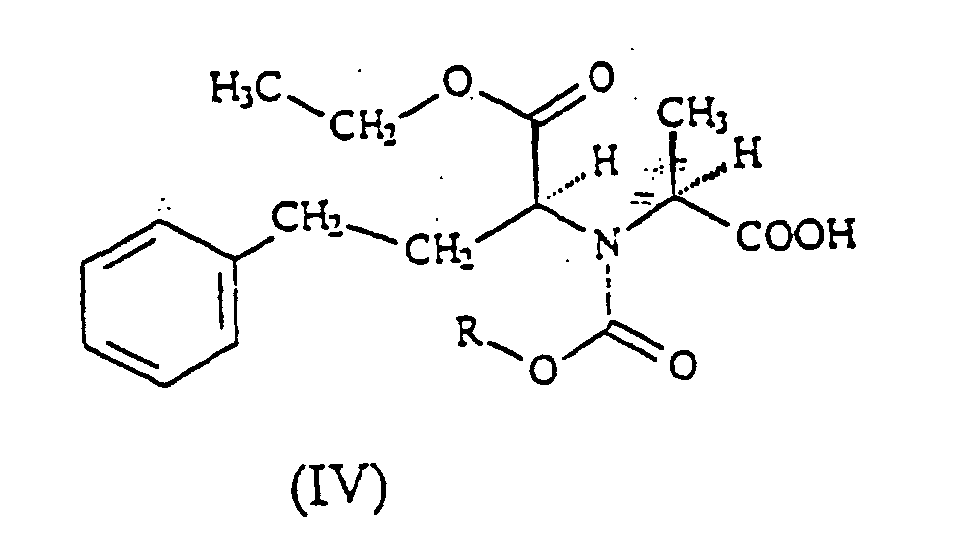
wherein R is ethyl, with an acyl group activation reagent, and then contacting with water.
which comprises reacting a compound of general formula IV
wherein R is ethyl, with an acyl group activation reagent, and then contacting with water.
2. The process of claim 1, wherein said acyl group activation reagent is thionyl chloride,
acetyl chloride or acetic anhydride.
3. The process of claim 1 or 2, wherein said compound of formula IV is obtained by reacting
N-[1-(S)-ethoxycarbonyl-3-phenylpropyl]-L-alanine of the following formula III
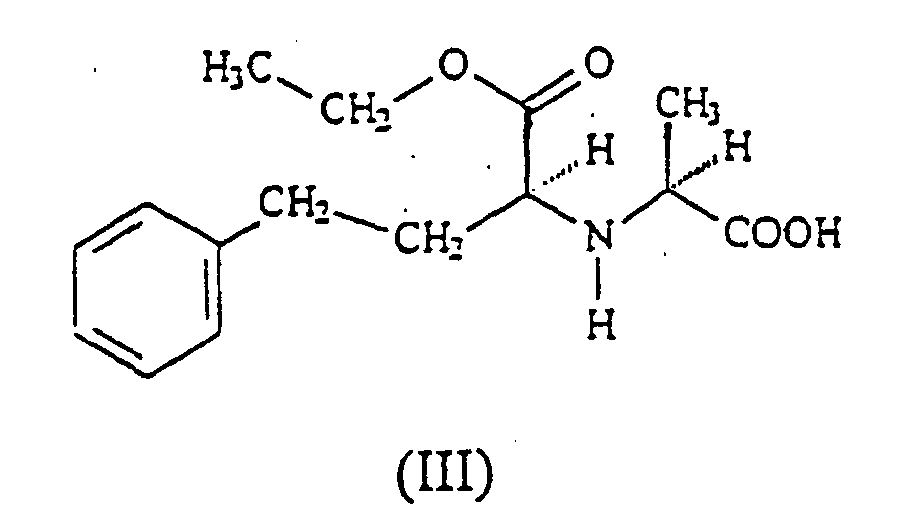
with a compound of the following formula V,
XCOOR (V)
wherein X is a halogen atom and R is as defined before.
with a compound of the following formula V,
XCOOR (V)
wherein X is a halogen atom and R is as defined before.
4. The process of claim 3, wherein said compound of formula V is ethyl chloroformate.
5. The process of claim 1 or 3, wherein said reaction is proceeded in the presence of
at least an aprotic organic solvent.
6. The process of claim 5, wherein said aprotic organic solvent is selected from the
group consisting of dichloromethane, dichloroethane, toluene, ethyl acetate, hexane,
cyclohexane and heptane.
7. The process of claim 5, wherein said aprotic organic solvent is dichloroethane.
8. A compound of general formula IV as defined in claim 1, wherein R is ethyl.
1. Verfahren zur Herstellung von N-[1-(S)-Ethoxycarbonyl-3-phenylpropyl]-Lalanin-N-carboxyanhydrid
der folgenden Formel I
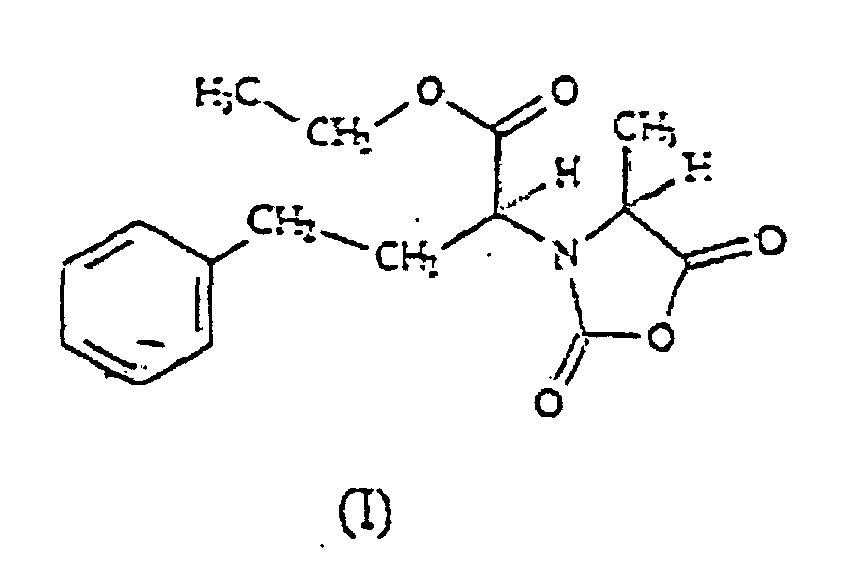
welches das Umsetzen einer Verbindung der allgemeinen Formel IV
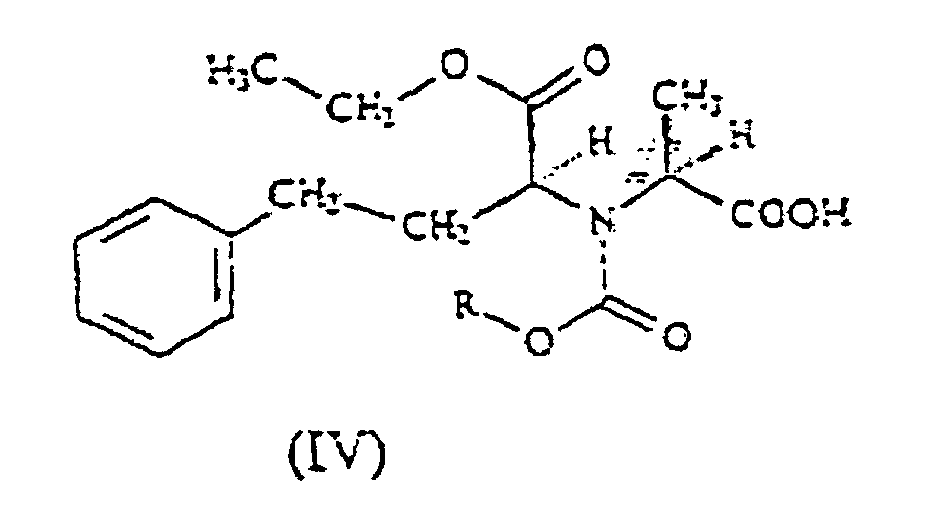
worin R Ethyl ist, mit einem Acylgruppen-Aktivierungsmittel und anschließendes In-Kontakt-Bringen mit Wasser umfasst.
welches das Umsetzen einer Verbindung der allgemeinen Formel IV
worin R Ethyl ist, mit einem Acylgruppen-Aktivierungsmittel und anschließendes In-Kontakt-Bringen mit Wasser umfasst.
2. Verfahren nach Anspruch 1, wobei das Acylgruppen-Aktivierungsmittel Thionylchlorid,
Acetylchlorid oder Essigsäureanhydrid ist.
3. Verfahren nach Anspruch 1 oder 2, wobei die Verbindung der Formel IV durch Umsetzen
von N-[1-(S)-Ethoxycarbonyl-3-phenylpropyl]-L-alanin der folgenden Formel III
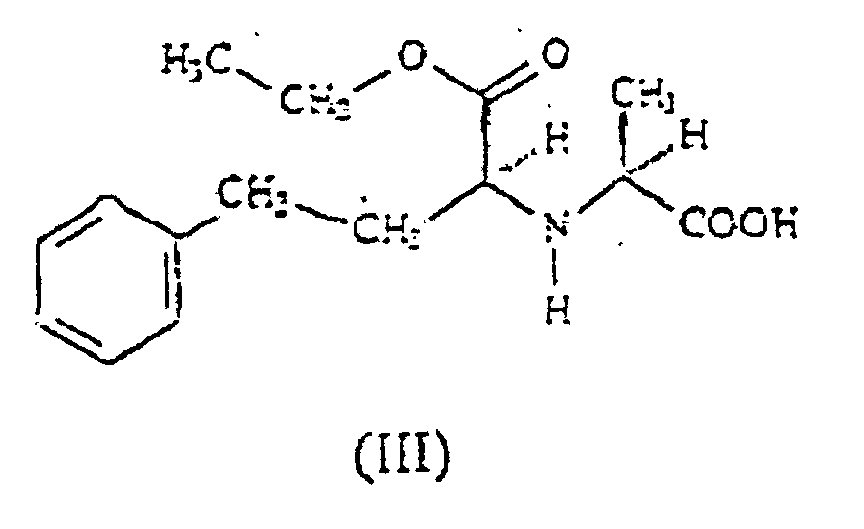
mit einer Verbindung der folgenden Formel V
XCOOR (V)
worin X ein Halogenatom ist und R wie oben definiert ist, erhalten wird.
mit einer Verbindung der folgenden Formel V
XCOOR (V)
worin X ein Halogenatom ist und R wie oben definiert ist, erhalten wird.
4. Verfahren nach Anspruch 3, wobei die Verbindung der Formel V Ethylchlorformiat ist.
5. Verfahren nach Anspruch 1 oder 3, wobei die Umsetzung in Gegenwart wenigstens eines
aprotischen organischen Lösungsmittels durchgeführt wird.
6. Verfahren nach Anspruch 5, wobei das aprotische organische Lösungsmittel aus der Gruppe
bestehend aus Dichlormethan, Dichlorethan, Toluol, Ethylacetat, Hexan, Cyclohexan
und Heptan ausgewählt wird.
7. Verfahren nach Anspruch 5, wobei das aprotische organische Lösungsmittel Dichlorethan
ist.
8. Verbindung der allgemeinen Formel IV wie in Anspruch 1 definiert, worin R Ethyl ist.
1. Procédé de préparation du N-carboxyanhydride de la N-[1-(S)-éthoxycarbonyl-3-phénylpropyl]-L-alanine
ayant la formule I ci-après
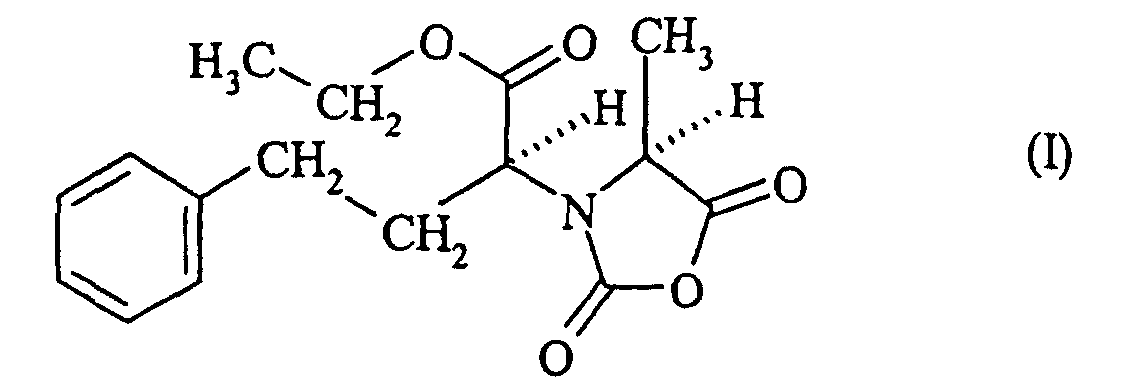
qui comprend la réaction d'un composé de formule générale IV
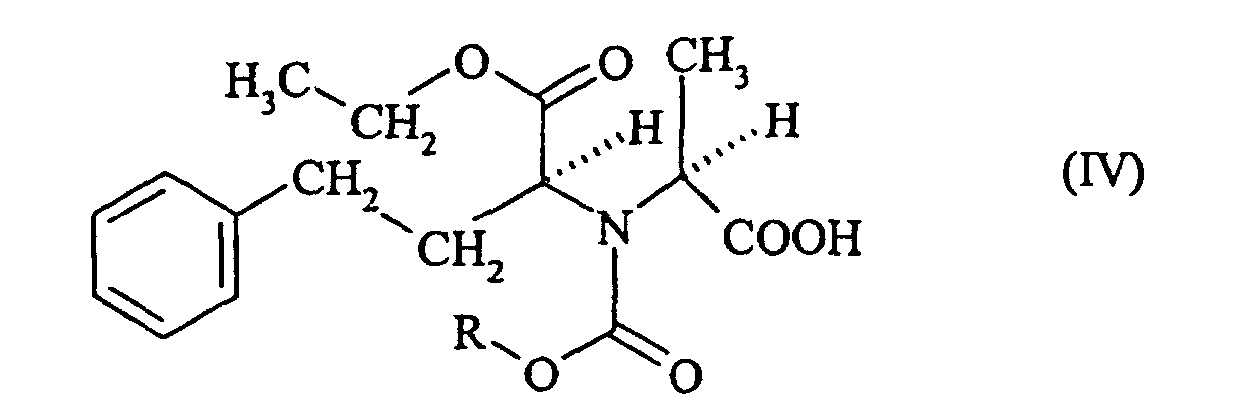
dans laquelle R est le groupe éthyle, avec un réactif d'activation du groupe acyle, puis sa mise en contact avec l'eau.
qui comprend la réaction d'un composé de formule générale IV
dans laquelle R est le groupe éthyle, avec un réactif d'activation du groupe acyle, puis sa mise en contact avec l'eau.
2. Procédé selon la revendication 1, dans lequel le réactif d'activation du groupe acyle
est le chlorure de thionyle, le chlorure d'acétyle ou l'anhydride acétique.
3. Procédé selon la revendication 1 ou 2, dans lequel ledit composé de formule IV est
obtenu par réaction de N-[1-(S)-éthoxycarbonyl-3-phénylpropyl]-L-alanine ayant la
formule III ci-après
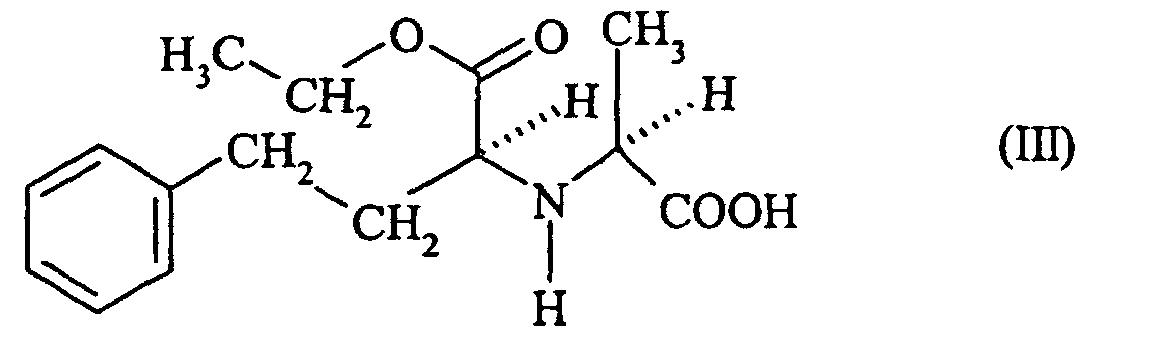
avec un composé ayant la formule V ci-après
XCOOR (V)
dans laquelle X est un atome d'halogène et R est tel que défini ci-dessus
avec un composé ayant la formule V ci-après
XCOOR (V)
dans laquelle X est un atome d'halogène et R est tel que défini ci-dessus
4. Procédé selon la revendication 3, dans lequel ledit composé de formule V est le chloroformiate
d'éthyle.
5. Procédé selon la revendication 1 ou 3, dans lequel ladite réaction est mise en oeuvre
en présence d'au moins un solvant organique aprotique.
6. Procédé selon la revendication 5, dans lequel ledit solvant organique aprotique est
choisi dans l'ensemble comprenant le dichlorométhane, le dichloréthane, le toluène,
l'acétate d'éthyle, l'hexane, le cyclohexane et l'heptane.
7. Procédé selon la revendication 5, dans lequel ledit solvant organique aprotique est
le dichloréthane.
8. Composé de formule générale IV selon la revendication 1, dans lequel R est le groupe
éthyle.