| (19) |
 |
|
(11) |
EP 1 217 596 B1 |
| (12) |
EUROPEAN PATENT SPECIFICATION |
| (45) |
Mention of the grant of the patent: |
|
23.08.2006 Bulletin 2006/34 |
| (22) |
Date of filing: 21.12.2000 |
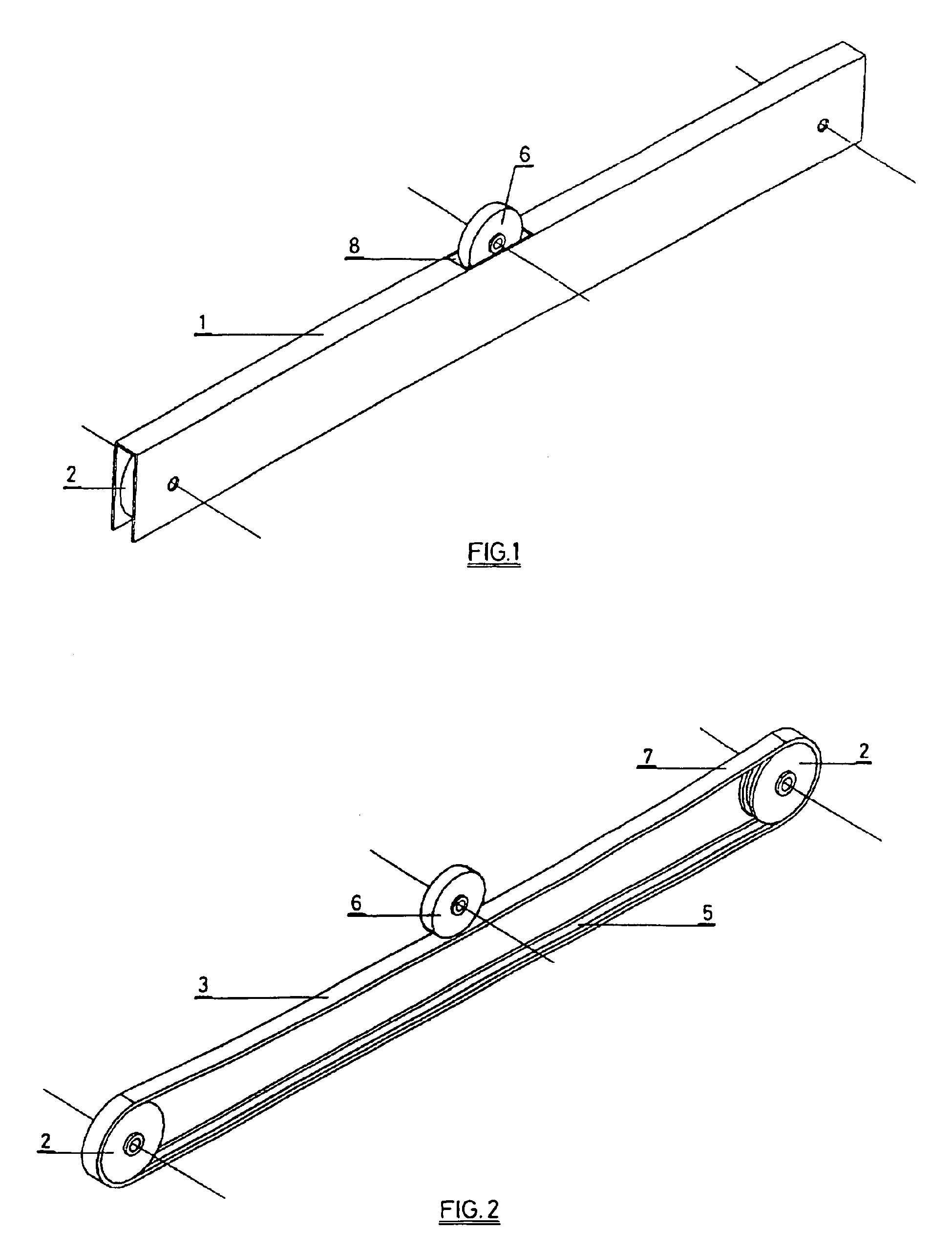
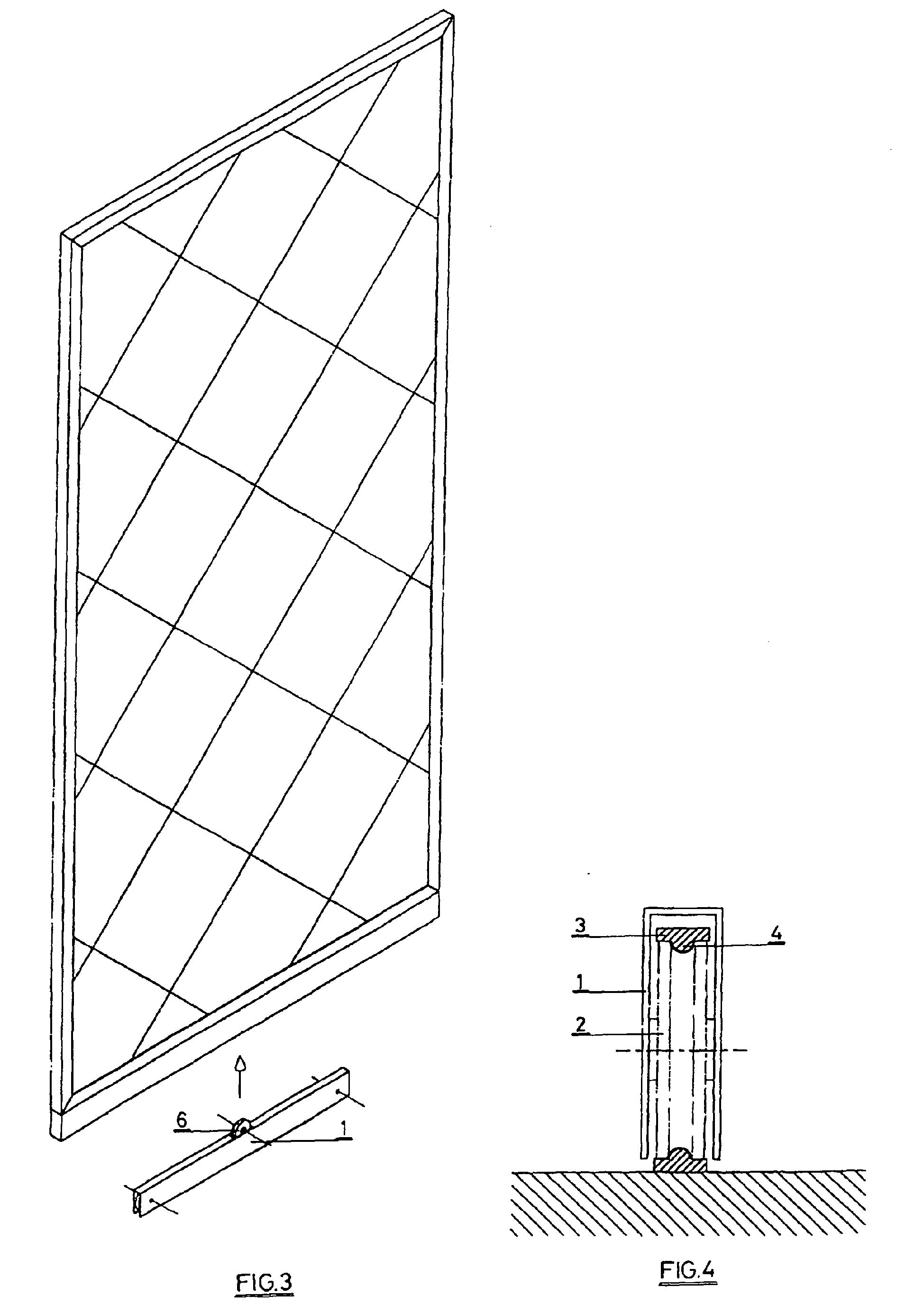
|
| (51) |
International Patent Classification (IPC):
|
|
| (54) |
Sliding system for exhibitor panels
Schiebesystem für Ausstellungstafeln
Système coulissant pour des panneaux d'exposition
|
| (84) |
Designated Contracting States: |
|
AT BE CH CY DE DK ES FI FR GB GR IE IT LI LU MC NL PT SE TR |
| (43) |
Date of publication of application: |
|
26.06.2002 Bulletin 2002/26 |
| (73) |
Proprietor: Moidecar, S.L. |
|
12530 Burriana (Castellon) (ES) |
|
| (72) |
Inventor: |
|
- Perez Esteban, José
12530 Burriana (Castellon) (ES)
|
| (74) |
Representative: Carvajal y Urquijo, Isabel |
|
Clarke, Modet & Co.,
C/ Goya No. 11
28001 Madrid
28001 Madrid (ES) |
| (56) |
References cited: :
US-A- 3 693 293
US-A- 5 109 994
|
US-A- 3 732 633
|
|
| |
|
|
|
|
| |
|
| Note: Within nine months from the publication of the mention of the grant of the European
patent, any person may give notice to the European Patent Office of opposition to
the European patent
granted. Notice of opposition shall be filed in a written reasoned statement. It shall
not be deemed to
have been filed until the opposition fee has been paid. (Art. 99(1) European Patent
Convention).
|
PURPOSE
[0001] The purpose to which the invention protected by this Patent refers consists of a
"Sliding system for exhibitor panels".
[0002] The system is to be preferably applied to the sliding and rectangular exhibitor panels
in which the piece of furniture has a front width twice that of the one corresponding
to a panel to permit each one to be optionally removed from the block formed by the
rest, in order to exhibit the samples of which it is composed.
HISTORY
[0003] The exhibitors are commercial furniture components intended to exhibit the materials
on sale in order to stimulate the purchasing interests of the potential purchasers.
For this reason, their efficiency is proportional to the ease with which the purchasers
are able to examine, by means of visual and even tactile verification, the characteristics
of said materials.
[0004] In the specific case of the sliding panel exhibitors, all of them are removable,
each on its own plane, in a movement guided along the upper part by hanging pulleys
located on the narrower, upper side which runs along parallel guides constituting
the ceiling of the exhibitor; and on the lower part by means of a guide consisting
of a profile or inverted part, arranged on the floor in a perpendicular way to the
parallel planes of the sliding panels, with a transversal hole through each panel
at the same distance as the former and with the necessary width for them to be guided
through. Such an arrangement is known, for example, from US-A-3732633.
[0005] The described lower guiding system establishes a reduced contact between the smaller
lower side of the frame of each panel and the corresponding holes of the guide profile,
which may allow undesirable movements during sliding of the panels resulting in harmful
consequences for the exhibited materials, such as detachment or rubbing among the
materials in adjoining panels.
DESCRIPTION OF THE INVENTION
[0006] The purpose of the invention of this Patent consists in eliminating the disadvantages
of the known lower guiding system of the sliding panels for exhibitors described above,
which has been conceived and designed taking into account this priority objective.
[0007] The principle on which the new system is based is to achieve a larger contact surface
between the narrower, lower side of the panel frame and its guiding means to obtain
better stability of the panel during its sliding.
[0008] The apparatus according to the invention is defined by claim 1.
[0009] The friction pulley can alternately perform two different functions:
a) Passive, pulled by the dynamic driving means as its tightener
b) Active, pulling the dynamic driving means as its driving force
[0010] In the first case, sliding of the panel is worked manually, whilst in the second
it is motorized through the friction pulley.
[0011] The overall mounting of all the described structural components is inserted into
the smaller lower side of each panel, introduced through its base in the area near
its external end so that it cannot be seen.
BRIEF DESCRIPTION OF THE DRAWINGS
[0012] To complete the description of the invention and facilitate the interpretation of
its formal, structural and functional characteristics, attached are drawings in which
the different aspects of a preferred performance of the "Sliding system for exhibitor
panels" constituting the object of this Patent.
[0013] In said drawings:
- Figure 1 represents a perspective view of the claimed system with all its structural
components mounted.
- Figure 2 represents a perspective view of the arrangement of the dynamic driving means.
- Figure 3 shows in an indicative way the insertion of the mounted system into the base
of the smaller lower side of each panel.
- Figure 4 is a transversal section of the mounted system.
DESCRIPTION OF A PREFERRED PERFORMANCE
[0014] In order to clearly show the nature and scope of the advantageous application of
the "Sliding system for exhibitor panels", constituting the object of the invention,
the following is a description of its application and structure, making reference
to the drawings which, on representing a preferred performance of the device and its
components for information purposes, must be considered in the widest sense and not
limitative of the application and content of the claimed invention.
[0015] The claimed sliding system is of the type where each of the panels is able to slide
along its own plane, in a movement guided on the upper part by hanging pulleys that
run along parallel individual guides integrated on the ceiling of the exhibitor, and
on the lower part by a specific independent means.
[0016] The lower guiding means is constructed using the components as set out in claim 1.
[0017] The friction pulley (6) performs a passive function where it is pulled by the dynamic
driving belt (3) and acts as its tightener, or alternately an active function where
it pulls the belt (3) and acts as its driving force.
[0018] The set of all the structural components duly mounted is inserted into the narrower,
lower side of each panel, introduced through its base in the area near its external
end so that it cannot be seen.
1. Sliding system for exhibitor panels of the type where each panel is able to slide
along its own plane, in a movement guided on the upper part by hanging pulleys that
run along parallel individual guides integrated on the ceiling of the exhibitor, and
on the lower part by a specific independent means, characterized by the fact that the lower guiding means slides along the floor by means of the following
components: an inverted U-shape (1), with long and closely separated flanks, that
constitutes the support of the guiding means; two equal pulleys (2), housed in the
U-shape (1) near its ends, the turning axles of which pass through the flanks of said
shape and are supported by them; a dynamic driving ring belt (3) that joins the two
pulleys (2) in a continuous loop by means of an interior central ridge (4) tightly
coupled to the grooves of the pulleys (2), whilst the lower intermediate section (5)
of the driving belt (3) rests on the floor and is affixed to it by its smooth exterior
surface; a friction pulley (6) that establishes tangential contact with the dynamic
driving belt (3) in the center of its upper intermediate section (7) by its smooth
external face through a hole (8) made in the upper surface of the U-shape (1).
2. Sliding system for exhibitor panels, according to claim 1, characterized by the fact that the friction pulley (5) performs a passive function where it is pulled
by the dynamic driving belt (3) and acts as its tightener; or alternatively an active
function where it pulls the belt (3) and operates as its driving force when driven
by a separate motor.
3. Sliding system for exhibitor panels, according to claims 1 or 2, characterized by the fact that the set of all the duly mounted structural elements is inserted into
the narrower, lower side of each panel, introduced through its base and into an area
near the lower external angle of the panel so that it cannot be seen.
1. Gleitsystem für Schaukästen, bei dem jeder Schaukasten in seiner eigenen Ebene gleitbar
angeordnet ist und oben durch in parallel zueinander an der Innenseite des Displaygerät-Oberteils
angeordneten Einzelführungen geführte hängende Laufrollen und unten durch eine bestimmte,
davon unabhängige Vorrichtung bewegbar geführt wird,
dadurch gekennzeichnet, dass die untere Führungsvorrichtung mittels der folgenden Komponenten dem Boden entlang
gleitet:
- ein Gehäuse in Form eines umgekehrten "U" mit langgestreckten und zueinander eng
beabstandet angeordneten Schenkeln, welches den Träger für die Führungsvorrichtung
bildet;
- zwei gleichförmige Riemenscheiben (2), die in den Endbereichen des U-förmigen Gehäuses
(1) eingebaut sind, wobei deren Drehachsen die Schenkel des U-förmigen Gehäuses durchqueren
und durch sie getragen werden;
- ein dynamischer ringförmiger Antriebsriemen (3), der als geschlossene Schleife die
beiden Riemenscheiben (2) miteinander mittels eines zentralen Innenwulstes (4) verbindet,
der sich an den Rillen der Riemenscheiben (2) anschmiegt, während der untere Zwischenteil
(5) des Antriebsriemens auf dem Boden liegt und durch seine glatte Oberfläche daran
haftet; und
- eine Reibungsrolle (6), die mit ihrer glatten Außenseite einen tangentialen Kontakt
mit dem dynamischen Antriebsriemen (3) in der Mitte seines oberen Zwischenteils (7)
durch eine Öffnung in der Oberseite des U-förmigen Gehäuses (1) hindurch herstellt.
2. Gleitsystem für Schaukästen gemäss Anspruch 1, dadurch gekennzeichnet, dass die Reibungsrolle (5) eine passive Funktion ausübt, indem sie durch den dynamischen
Antriebsriemen (3) gezogen wird und als dessen Spanner wirkt; oder aber eine aktive
Funktion ausübt, indem sie als ziehende Antriebskraft für den Riemen (3) wirkt, wenn
sie durch einen eigenständigen Motor angetrieben wird.
3. Gleitsystem für Schaukästen gemäss Anspruch 1 oder 2, dadurch gekennzeichnet, dass der Satz aller ordnungsgemäß montierter struktureller Elemente in die untere Schmalseite
eines jeden Schaukastens eingesetzt und durch deren Grundfläche derart in einen Bereich
nah des unteren Endes des Schaukastens eingeführt wird, dass er von außen nicht sichtbar
ist.
1. Système coulissant pour panneaux d'exposition du type où chaque panneau est capable
de coulisser le long de son propre plan, dans un mouvement guidé sur la partie supérieure
par des poulies de suspension qui se déplacent le long de guides individuels parallèles
intégrés sur le plafond de l'exposition, et sur la partie inférieure par un moyen
indépendant spécifique, caractérisé par le fait que le moyen de guidage inférieur coulisse le long du plancher au moyen des composants
suivants : une forme en U inversé (1), avec des flancs étroitement séparés et longs,
qui constitue le support des moyens de guidage ; deux poulies égales (2), logées dans
la forme en U (1) à proximité de ses extrémités, dont les essieux tournants traversent
les flancs de ladite forme et sont supportés par ceux-ci ; une courroie à anneau de
transmission dynamique (3) qui relie les deux poulies (2) dans une boucle continue
au moyen d'une saillie centrale intérieure (4) couplée de manière serrée aux rainures
des poulies (2), tandis que la section intermédiaire inférieure (5) de la courroie
de transmission (3) repose sur le plancher et y est attachée par sa surface extérieure
lisse ; une poulie à friction (6) qui établit un contact tangentiel avec la courroie
de transmission dynamique (3) dans le centre de sa section intermédiaire supérieure
(7) par sa face externe lisse à travers un orifice (8) fabriqué dans la surface supérieure
de la forme en U (1).
2. Système coulissant pour panneaux d'exposition, selon la revendication 1, caractérisé par le fait que la poulie à friction (5) exécute une fonction passive où elle est tirée par la courroie
de transmission dynamique (3) et lui sert de tendeur ; ou en variante une fonction
active où elle tire la courroie (3) et fonctionne comme sa force motrice lorsqu'elle
est entraînée par un moteur séparé.
3. Système coulissant pour panneaux d'exposition, selon les revendications 1 ou 2, caractérisé par le fait que l'ensemble de tous les éléments structuraux montés en bonne et due forme est inséré
à l'intérieur du côté inférieur le plus étroit de chaque panneau, introduit à travers
sa base et à l'intérieur d'une zone à proximité de l'angle externe inférieur du panneau
de façon à ce qu'il ne puisse pas être vu.