|
(11) | EP 1 220 243 B2 |

| (12) | NEW EUROPEAN PATENT SPECIFICATION |
| After opposition procedure |
|
|
| (54) |
Electrical steel sheet for low-noise transformer and low-noise transformer Elektrostahlblech für geräuscharmen Transformator und geräuscharmer Transformator Tôle d'acier électrique pour transformateur à faible bruit et transformateur à faible bruit |
|
|
|||||||||||||||||||||||||||||||
[0002] With respect to a magnetic material widely used in electrical and electronic apparatuses, the degree of a change in the length of the material when a magnetic field is imposed thereon (such degree of a change is called magnetostriction) is one of the important evaluation items in quality control since it causes transformer noise. In recent years, regulations against the noise of electrical apparatuses have been tightened with the increase in demands for better living environments. Because of this, research into the lowering of noise by reducing magnetostriction are being carried out intensively.
[0003] Among magnetic materials, as grain-oriented electrical steel sheets used for the cores of transformers, there is a method of reducing magnetostriction by decreasing closure domains. The closure domain cited here is a domain having magnetization oriented in a direction perpendicular to the direction where a magnetic field is imposed. Magnetostriction is generated when the magnetization moves toward a direction parallel to that of the magnetic field due to the imposed magnetic field. Therefore, the smaller the amount of closure domains is, the smaller the magnetostriction is. The following methods are known as major methods for reducing magnetostriction:
- ① A method of arranging the <001> directions of crystal grains in the direction of rolling and preventing the generation of closure domains which cause a change in their shape due to magnetization rotation (T. Nozawa et al, "Relationship Between Total Losses under Tensile Stress in 3 Percent Si-Fe Single Crystals and Their Orientations near (110) [001]," IEEE Trans. on Mag., Vol. MAG-14, No.4, 1978),
- ② A method of eliminating closure domains by releasing plastic strain (JP-A-7-305115; "Development of Epoch-making Grain-Oriented Silicon Steel Sheet, Orient Core Hi-B"; OHM 1972.2),
- ③ A method of eliminating closure domains by imposing a film tension on a steel sheet (T. Nozawa et al, "Relationship between Total Losses under Tensile Stress in 3 Percent Si-Fe Single Crystals and Their Orientations near (110) [001]," IEEE Trans. on Mag., Vol. MAG-14, No.4, 1978).
[0004] On the other hand, noise can be lowered by the methods of suppressing the generation of vibration, besides the methods of reducing magnetostriction. The methods for lowering noise by suppressing the generation of vibration include, for example; a method of disposing an air space or a silicone rubber to cut off the propagation of vibration (JP-A-5-251246), methods of lowering noise by disposing a vibration damping material and a sound absorbing material outside each core leg (JP-A-8-45751, JP-A-2000-82622, JP-A-2000-124044), a method of fixing the gap parts of a reactor by the use of an adhesive capable of suppressing vibration (JP-A-8-111322), and a method of using an electrical steel sheet provided with an intermediate resin layer (JP-A-8-250339).
[0005] The noise of electrical apparatuses have so far been lowered mainly by those methods of reducing magnetostriction or vibration.
[0006] WO 99/33156 discloses a stator, rotor or transformer article having vibration damping material layers having a thickness of 0.005 to about 1.3 mm.
[0007] Demands for further lowering the noises of electrical apparatuses are increasing and more sophisticated technologies are required to meet the demands. Research into lowering noise has so far been focused mainly on reducing magnetostriction by eliminating closure domains. However, when a magnetic field which changes with the passage of time is imposed on steel sheets incorporated into a transformer core, the expansion and contraction generated therein are changed into vibration perpendicular to the surfaces of the steel sheets because they are not necessarily flat. This vibration produces the waves of condensation and rarefaction in air and the waves spread out as sound. Until now, for lowering such vibration by reducing the magnetostriction of a steel sheet, techniques of sharpening the distribution of crystal orientations, releasing plastic strain, imposing a tension and the like, as mentioned above, have been established as prior arts. Apart from those, there is a measure of disposing a vibration proof structure that prevents vibration from being transmitted to the exterior. However, to cope with the demands for further noise reduction, another method to suppress the plane vibration of steel sheets that causes air particles to vibrate is required.
[0008] As a means to solve this problem, already proposed has been a core composed of electrical steel sheets having intermediate resin layers. However, the space factor of the core is low because the intermediate resin layers are placed in the core at the intervals of every two laminated steel sheets. Therefore, it is necessary to increase the area of the iron portions in the cross-section of the core.
[0009] The object of the present invention is to provide an electrical steel sheet for a low-noise transformer with lowered vibration and the low-noise transformer, which realize noise reduction effectively by finding conditions for suppressing vibration perpendicular to the surfaces of the steel sheet.
[0010] DE 2 223 494 A discloses a laminated iron core for transformers in which plastic layers are distributed between core layers for reducing noise. In particular, a vibration-dampening polymer foil consisting of polyvinylacetate and a second monomeric component is laminated after at least every tenth and at the most every third individual sheet of the core. The thickness of the polymer foil preferable is the same as the thickness of the individual sheets.
[0014] Fig. 2 is a graph showing the effects of viscoelastic layers on the noise of the transformer, and
[0016] As mentioned above, the current major methods have been focused on lowering in-plane vibration by reducing magnetostriction, or on employing a vibration proof structure that prevents vibration from being transmitted to the exterior. On the other hand, the inventors of the present invention focused on a research for more effectively realizing the noise reduction by reducing the in-plane vibration of steel sheets in a method of inserting viscoelastic layers with both viscosity and elasticity into the gaps of the steel sheet lamination layers in the core of a transformer. The embodiments of the present invention are hereunder explained based on experiment.
[0017] Small-sized transformers of 300 mm × 180 mm × 10 mm (Fig. 1) were manufactured and their noises were measured (Fig. 2). The noises were compared between two cores; a core made of multi-layered electrical steel sheets each of which had a viscoelastic layer 20 µm in thickness between every two electrical steel sheets (the total thickness of the viscoelastic layers being 0.42 mm) and the other core having viscoelastic layers 30 µm in each thickness inserted therein randomly at the ratio of one viscoelastic layer to four steel sheet layers so that the layers were not regularly arrayed (the total thickness of viscoelastic layers being 0.30 mm). As a result of this experiment, the core with the viscoelastic layers randomly inserted therein at the ratio of one to four was lower in noise even though the total thickness of the viscoelastic layers was thinner.
[0018] Exact reason for this effect is not clear, but the inventors assume that a larger thickness of each viscoelastic layer is more effective in absorbing vibration and the effect in this case is larger than that in the case where a greater number of thinner viscoelastic layers are dispersed in a core.
[0019] Apart from this, the resonance frequency of a core is determined by its weight when its material quality is given. When viscoelastic layers are inserted into a core at equal intervals, the core is divided into the steel sheet blocks of equal weight, and therefore the blocks have the same resonance frequency which causes a vibration to be amplified by resonance. On the contrary, when the intervals of viscoelastic layers are random, their resonance frequencies are different from each other and therefore a large vibration at a particular frequency is hardly generated, which the present inventors' assumption.
[0020] Space factors obtained by these methods are shown in Fig. 3. The core having a greater number of viscoelastic layers dispersed therein according to a conventional method has a lower space factor than the laminated core according to the present invention because the core according to a conventional method has a greater number of viscoelastic layers even though the thickness of each of the viscoelastic layers is as small as 20 µm. According to the present invention, the absorption of vibration is improved by the thicker viscoelastic layers, and therefore not only can noise be lowered but also space factors can be increased.
[0021] From the above viewpoint, the present inventors have thought that the prior arts of merely reducing magnetostriction are insufficient to lower noises and it is also important to suppress in-plane vibration. The present inventors have found that the conditions required for suppressing plane vibration are satisfied by randomly inserting viscoelastic layers between steel sheets and the noise of electric apparatuses such as transformers can be effectively lowered by applying such electrical steel sheets thereto, and have attained the present invention.
[0023] A noise reduction effect intensifies as the thickness of a viscoelastic layer increases. According to the method disclosed in JP-A-7-85457, vibration can be suppressed by inserting an impregnant in a laminated core of 6.5 % Si. In this case, the thickness of the impregnant is estimated to be at most about 10 µm since the surface roughness Rmax of the laminated steel sheets is specified to be 3.5 µm or more and the core is vacuum-impregnated after it is tightened. On the other hand, in case of the present invention, viscoelastic layers of 40 to 60 µm, in thickness are used in order to intensify the effect of suppressing vibration.
[0024] In case of general transformer cores, the temperature range during their operation is 20 to 200°C and therefore it is preferable that the peak of the loss factor of the viscoelastic body lies in this temperature range. At what temperature within this range the loss factor should have a peak may be determined according to the environment where the core is used. It is already known that polyisobutylene has a peak of its loss factor at 0°C, polyester at 100°C, and nitrile rubber at 20°C.
[0025] With respect to a core of the present invention, the expression (n-1)/m is determined to be 3 or more, because the space factor remarkably decreases if viscoelastic layers are inserted in the core at the ratio of one or more viscoelastic layers to three steel sheet layers. At the same time, the (n-1)/m is determined to be 30 or less, because the absorption of vibration weakens if viscoelastic layers are inserted in the core at the ratio of one to 30.
[0026] The reason why viscoelastic layers are inserted between steel sheets at unequal random layer intervals is to disperse the resonance frequencies and to avoid the amplification of vibration caused by the resonance.
Example 1
[0027] The following laminated cores A, B, C and D were manufactured using grain-oriented electrical steel sheets 0.23 mm in thickness produced by a usual method: core A with nothing inserted therein, core B with polyester resin inserted therein at the ratio of one resin layer to 10 steel sheet layers and at unequal layer intervals, core C with olefinic film resin inserted therein at the ratio of one to 10 and at unequal layer intervals, and core D with polyisobutylene resin inserted in all the layer gaps between steel sheets. 500 kVA three-phase transformers were assembled using the cores A, B, C and D respectively and then the noise was measured when the cores were magnetized in 1.6 T at 50 Hz. The thickness of each resin layer was 20 µm for the core D and 50 µm for the others, and the total thickness of the laminated layers of each transformer was 50 mm. The results of the measurement are shown in Table 1.
[0028] The transformer cores B and C manufactured using the materials satisfying the conditions of the present invention had lower noise.
Table 1
| Sample number | Noise | Remarks |
| A | 50.6 db(A) | Prior art |
| B | 44.4 db(A) | Present invention |
| C | 42.7 db(A) | Present invention |
| D | 48.9 db(A) | Prior art |
| (B, C: 50 µm resin layers D: 20 µm resin layers inserted in all layer gaps) |
Example 2
[0029] The following laminated cores E, F, G, H and I were manufactured using grain-oriented electrical steel sheets 0.27 mm in thickness produced by a usual method: core E with nothing inserted therein, core F with olefinic film resin inserted therein at the ratio of one resin layer to 10 steel sheet layers, core G with the same resin inserted therein at the ratio of one to 20, core H with the same resin inserted therein at the ratio of one to 30, and core I with the same resin inserted therein at the ratio of one to 40. 500 kVA three-phase transformers were assembled using the cores E, F, G, H and I respectively and then the noise was measured when the cores were magnetized in 1.4 T at 50 Hz. The thickness of each resin layer was 50 µm and the total thickness of the laminated layers of each transformer was 50 mm. The results of the measurement are shown in Table 2. The core G with the resin layers inserted therein at the ratio of one to 20 exhibited the minimum noise.
[0030] As described above, the transformer cores F, G and H manufactured using the materials satisfying the conditions of the present invention had lower noise.
Table 2
| Sample number | Noise | Remarks |
| E | 50.6 DB(A) | Prior art |
| F | 42.8 DB(A) | Present invention |
| G | 41.6 DB(A) | Present invention |
| H | 45.9 DB(A) | Present invention |
| I | 48.4 DB(A) | Prior art |
Example 3
[0031] The following laminated cores J, K, L and M were manufactured using grain-oriented electrical steel sheets 0.27 mm in thickness produced by a usual method: core J with nothing inserted therein, core K with olefinic film resin inserted therein at the ratio of one resin layer to 10 steel sheet layers, core L with the same number of resin layers as core K inserted therein at the ratio of one to three in such a manner as to be concentrated in the middle part of the core, and core M with the same number of resin layers as core K inserted therein at the ratio of one to three in such a manner as to be concentrated in the surface parts of the core. 500 kVA three-phase transformers were assembled using the cores J, K, L and M respectively and then the noise was measured when the cores were magnetized in 1.4 T at 50 Hz. The thickness of each resin layer was 50 µm and the total thickness of the laminated layers of each transformer was 50 mm. The results of the measurement are shown in Table 3.
[0032] As described above, the transformer cores K and L manufactured using the materials satisfying the conditions of the present invention had lower noise.
Table 3
| Sample number | Noise | Remarks |
| J | 50.6 dB(A) | Prior art |
| K | 42.1 dB(A) | Present invention |
| L | 41.0 dB(A) | Present invention |
| M | 44.1 dB(A) | Present invention |
[0033] As explained above, the present invention can provide a low-noise transformer, which suppresses vibration perpendicular to the surfaces of the steel sheet and effectively realizes noise reduction and lower vibration, and thus can achieve the noise reduction of electrical apparatuses. Therefore the present invention can offer an exceedingly great industrial benefit.
1. A low-noise transformer having a transformer core formed by laminating n pieces of
electrical steel sheets comprising viscoelastic layers of 40 to 60 µm in thickness
placed at m gaps among the n-1 gaps of laminated layers, m satisfying the following
formula:
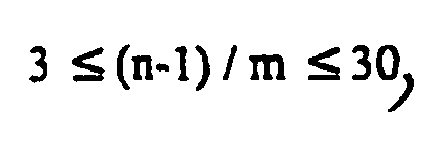
wherein the viscoelastic layers are inserted at random in the core formed by using the electrical steel sheets so that the viscoelastic layers are not regularly arrayed in the low-noise transformer.
wherein the viscoelastic layers are inserted at random in the core formed by using the electrical steel sheets so that the viscoelastic layers are not regularly arrayed in the low-noise transformer.
2. A low-noise transformer according to claim 1 wherein a viscoelastic layer has a loss
factor having one or more peaks at temperatures within the range from 20 to 200 °C.
1. Geräuscharmer Transformator, der einen durch Laminieren von n Elektrostahlblechen
gebildeten Transformatorkern hat, mit viskoelastischen Schichten mit 40 bis 60 µm
Dicke, die an m Lücken unter den n-1 Lücken laminierter Schichten platziert sind,
wobei m die folgende Formel erfüllt:

wobei die viskoelastischen Schichten in den mit Hilfe der Elektrostahlbleche gebildeten Kern so willkürlich eingefügt sind, dass die viskoelastischen Schichten im geräuscharmen Transformator nicht regelmäßig gruppiert sind.
wobei die viskoelastischen Schichten in den mit Hilfe der Elektrostahlbleche gebildeten Kern so willkürlich eingefügt sind, dass die viskoelastischen Schichten im geräuscharmen Transformator nicht regelmäßig gruppiert sind.
2. Geräuscharmer Transformator nach Anspruch 1, wobei eine viskoelastische Schicht einen
Verlustfaktor mit einem oder mehreren Peaks bei Temperaturen im Bereich von 20 bis
200°C hat.
1. Transformateur à faible bruit comportant un noyau de transformateur formé en laminant
n pièces de tôles magnétiques en acier comprenant des couches viscoélastiques étant
épaisses de 40 à 60 µm et placées à m espaces parmi les n-1 espaces de couches laminées,
m satisfaisant la formule suivante :
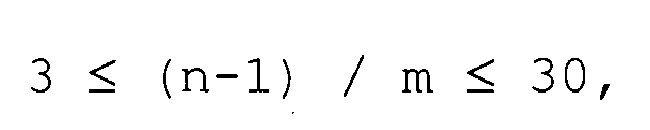
dans lequel les couches viscoélastiques sont insérées de manière aléatoire dans le noyau formé en utilisant les tôles magnétiques en acier de telle sorte que les couches viscoélastiques ne soient pas disposées de manière régulière dans le transformateur à faible bruit.
dans lequel les couches viscoélastiques sont insérées de manière aléatoire dans le noyau formé en utilisant les tôles magnétiques en acier de telle sorte que les couches viscoélastiques ne soient pas disposées de manière régulière dans le transformateur à faible bruit.
2. Transformateur à faible bruit selon la revendication 1, dans lequel une couche viscoélastique
a un facteur de perte comportant un ou plusieurs pics à des températures dans la plage
de 20 à 200° C.
REFERENCES CITED IN THE DESCRIPTION
This list of references cited by the applicant is for the reader's convenience only. It does not form part of the European patent document. Even though great care has been taken in compiling the references, errors or omissions cannot be excluded and the EPO disclaims all liability in this regard.
Patent documents cited in the description
- JP7305115A [0003]
- JP5251246A [0004]
- JP8045751A [0004]
- JP2000082622A [0004]
- JP2000124044A [0004]
- JP8111322A [0004]
- JP8250339A [0004]
- WO9933156A [0006]
- DE2223494A [0010]
- JP7085457A [0023]
Non-patent literature cited in the description
- T. NOZAWA et al.Relationship Between Total Losses under Tensile Stress in 3 Percent Si-Fe Single Crystals and Their Orientations near (110) [001IEEE Trans. on Mag., 1978, vol. MAG-14, 4 [0003]
- T. NOZAWA et al.Relationship between Total Losses under Tensile Stress in 3 Percent Si-Fe Single Crystals and Their Orientations near (110) [001IEEE Trans. on Mag., 1978, vol. MAG-14, 4 [0003]