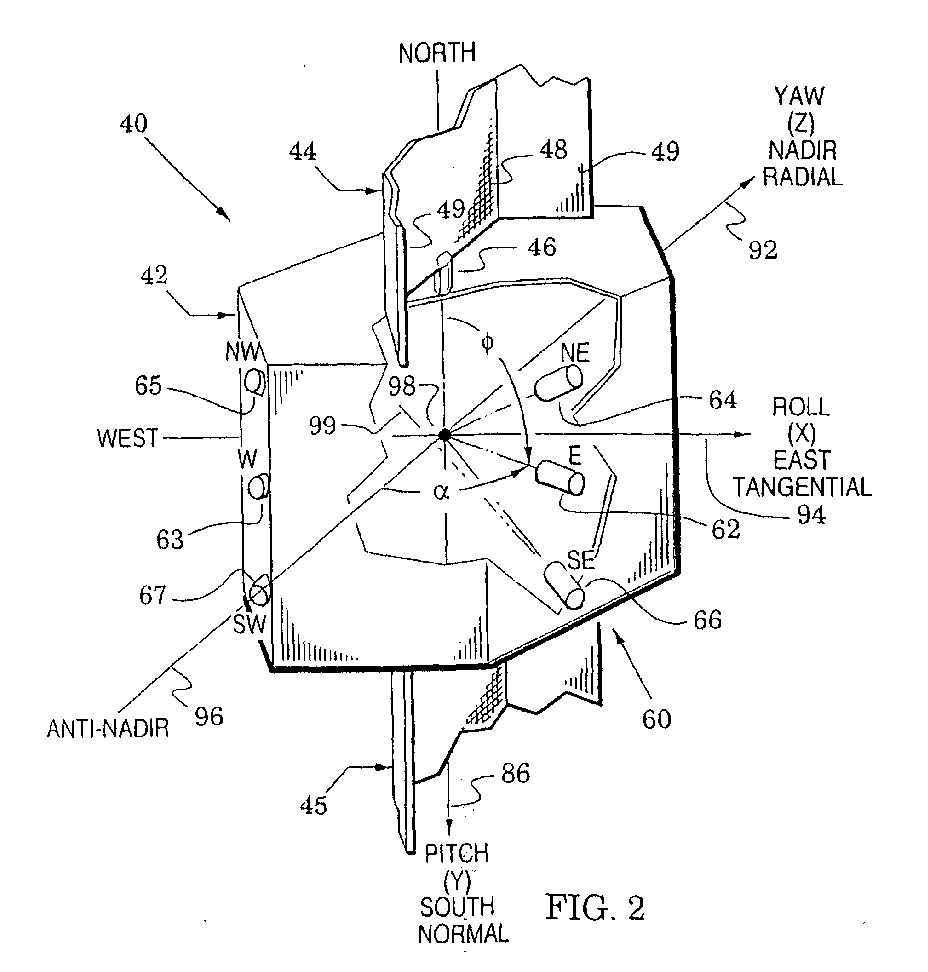
(57) Spacecraft thruster systems (60) are provided that can realize station changing,
station keeping and momentum dumping in spacecraft (40) while minimizing loss of spacecraft
service time. The systems (60) are formed with pairs of E and W thrusters (62, 63),
NE and SE thrusters (64, 66) and NW and SW thrusters (65, 67) whose thrust directions
are each defined by respective polar angles (Ø) and slew angles (α). The E and W thrusters
(62, 63) are especially suited for rapid station changing while the remaining thrusters
(64-67) generate normal, tangential and radial components required for station keeping.
Because all thrusters (62-67) are directed through the space-craft's center (98) of
mass during station changing and station keeping firings, the spacecraft's attitude
is not disturbed and loss of service time is avoided. The thrusters (62-67) are preferably
gimbaled so that they can track spatial changes of the spacecraft's center (98) of
mass or, for momentum dumping, be offset (99) from the center (98) of mass. The normal,
tangential and radial thrust components of these thruster systems (60) are arranged
so that station changing, station keeping and momentum dumping are still realized
after the failure of any thruster pair (Fig. 2).
|
|
