| (19) |
 |
|
(11) |
EP 1 232 163 B1 |
| (12) |
EUROPEAN PATENT SPECIFICATION |
| (45) |
Mention of the grant of the patent: |
|
02.05.2003 Bulletin 2003/18 |
| (22) |
Date of filing: 15.11.2000 |
|
| (51) |
International Patent Classification (IPC)7: C07F 7/08 |
| (86) |
International application number: |
|
PCT/US0031/493 |
| (87) |
International publication number: |
|
WO 0103/8333 (31.05.2001 Gazette 2001/22) |
|
| (54) |
PRODUCTION OF DISUBSTITUTED PENTAFULVENS VIA LITHIATED SILYL-(HALO)ARENE INTERMEDIATES
HERSTELLUNG VON DISUBSTITUIERTEN PENTAFULVENEN ÜBER LITHIIERTE SILYL(HALO)AROMATEN
ALS ZWISCHENSTUFEN
PRODUCTION DE PENTAFULVENES DISUBSTITUES VIA DES PRODUITS INTERMEDIAIRES SILYL-(HALO)ARENES
LITHIES
|
| (84) |
Designated Contracting States: |
|
AT BE CH CY DE DK ES FI FR GB GR IE IT LI LU MC NL PT SE TR |
| (30) |
Priority: |
22.11.1999 US 444765
|
| (43) |
Date of publication of application: |
|
21.08.2002 Bulletin 2002/34 |
| (73) |
Proprietor: ALBEMARLE CORPORATION |
|
Baton Rouge,
Louisiana 70801 (US) |
|
| (72) |
Inventors: |
|
- BERRIS, Bruce, C.
Baton Rouge, LA 70810 (US)
- OWENS, David, W.
Baton Rouge, LA 70808 (US)
- MATHUR, Rajeer, S.
Baton Rouge, LA 70809 (US)
|
| (74) |
Representative: UEXKÜLL & STOLBERG |
|
Patentanwälte
Beselerstrasse 4
22607 Hamburg
22607 Hamburg (DE) |
| (56) |
References cited: :
|
| |
|
|
- KURATA, HIROYUKI ET AL: "Tandem reactions of N,N-dialkylamides with organolithium
compounds and cyclopentadiene. A new efficient synthesis of pentafulvenes" TETRAHEDRON
LETT., vol. 34, no. 21, 1993, pages 3445-3448, XP002163223
|
|
| |
|
| Note: Within nine months from the publication of the mention of the grant of the European
patent, any person may give notice to the European Patent Office of opposition to
the European patent
granted. Notice of opposition shall be filed in a written reasoned statement. It shall
not be deemed to
have been filed until the opposition fee has been paid. (Art. 99(1) European Patent
Convention).
|
BACKGROUND
[0001] Lithiated haloarenes are useful as intermediates in the synthesis of various end
products, such as ligands for metallocene polymerization catalysts, and starting materials
for the synthesis of agricultural chemicals and pharmaceuticals. Unfortunately, however,
lithiation of polyhaloarenes, can be hazardous since unstable, shock sensitive compounds
can be formed in this manner. EP-A-O 403713 relates to the process for the preparation
of a trialkylsilylhaloarene. Kurata, Hiroyuki et al., "Tandem Reactions of N,N-dialkylamides
with Organolithium Compounds and Cyclopentadiene. A New Efficient Synthesis of Pentafulvenes,"
Tetrahedron Letters, vol. 34, no. 21, 1993, pages 3445-3448, XP002163223 discloses the preparation of
6,6-disubstituted pentafulvenes by the reaction of cyclopentadiene with metallated
N,N-dialkylamides.
SUMMARY OF THE INVENTION
[0002] This invention involves the discovery that it is possible to avoid such hazards by
conducting the reaction of a polyhaloarene with a hydrocarbyl lithium compound in
the presence of another reactant so that the lithiated haloarene, if formed at all,
exists as a transitory intermediate in low concentration. In this way, transitory-lithiated
haloarene which may be, and presumably is, formed in the reaction is converted into
a non-hazardous functionally-substituted haloarene essentially as soon as such lithiated
haloarene is formed.
[0003] More particularly, this invention provides in one of its embodiments a process which
comprises concurrently reacting (i) an arene having a halogen atom of atomic number
greater than 9 substituted on at least two non-adjacent carbon atoms with (ii) a halotrihydrocarbylsilane
in which the halogen atom has an atomic number greater than 9, and (iii) a hydrocarbyl
lithium compound, inproportions such that a haloarene having at least one trihydrocarbylsilyl
ring substituent is formed. To minimize interaction between (i) and (iii), it is preferable
to perform the reaction by adding (iii) to a mixture of (i) and (ii). However it is
also possible to perform the reaction by concurrently but separately adding (ii) and
(iii) to (i).
[0004] Another embodiment of this invention is a process which comprises forming a mixture
from components comprising (i) an arene having a halogen atom of atomic number greater
than 9 substituted on at least two non-adjacent carbon atoms with (ii) a halotrihydrocarbylsilane
in which the halogen atom has an atomic number greater than 9, and (iii) a hydrocarbyl
lithium compound, with the proviso that (i) and (iii) are not mixed together in the
absence of (ii), and wherein these components are proportioned such that reaction
takes place and a haloarene having at least one trihydrocarbylsilyl ring substituent
is formed. Typically the reaction engendered in this manner requires no application
of heat energy to the reaction mixture. In fact, it is preferred to initiate the reaction
at temperatures below room temperature to ensure that the reaction does not proceed
at an overly-rapid rate.
[0005] Still another embodiment is to react a hydrocarbyl lithium compound with a haloarene
having at least one trihydrocarbylsilyl ring substituent formed pursuant to this invention,
to form a lithiated haloarene having at least one trihydrocarbylsilyl ring substitutent.
This in turn enables the production of still other desirable compounds. For example,
in a preferred embodiment of this invention the following sequence of reactions is
performed:
A) forming a mixture from components comprising (i) 1,4-dihalobenzene such as 1,4-dibromobenzene,
(ii) a chlorotrialkylsilane or a bromotrialkylsilane in which the alkyl groups each
contain in the range of 1 to about 4 carbon atoms, and (iii) a hydrocarbyl lithium
compound, with the proviso that (i) and (iii) are not mixed together in the absence
of (ii), and wherein these components are proportioned such that reaction takes place
and a 4-halo-1-(trialkylsilyl)benzene is formed;
B) forming a mixture of 4-halo-1-(trialkylsilyl)benzene from A) and a hydrocarbyl
lithium compound such that the halogen atom of the 4-halo-1-(trialkylsilyl)benzene
is replaced by a lithium atom thereby forming a 4-lithio-1-(trialkylsilyl)benzene;
C) forming a mixture of 4-lithio-1-(trialkylsilyl)benzene from B) and a dihydrocarbylcarbamyl
halide such that bis(4-trialkylsilylphenyl)dihydrocarbylamidomethoxy lithium, a tertiary
alkoxide intermediate is formed; and
D) forming a mixture of bis(4-trialkylsilylphenyl)dihydrocarbylamidomethoxy lithium
from C) and monomeric substituted or unsubstituted cyclopentadiene or indene hydrocarbon
such that a 6,6-di(4-(trialkylsilylphenyl)pentafulvenoid compound is formed.
Most preferably steps A) through D) are conducted in the same reactor without isolation
of the reaction products from A), B) or C). In addition, it is particularly preferred
to conduct steps A) through C) in an ether solvent other than tetrahydrofuran so that
the reactions can be initiated and performed at temperatures near 0°C without by-product
bromohydrocarbon reacting with haloaryllithium or hydrocarbyllithium. Suppression
of such adverse side reactions in the presence of tetrahydrofuran requires temperatures
below about -50°C. Tetrahydrofuran can, however, be utilized to advantage in the conduct
of step D).
[0006] The above and other embodiments and features of this invention will be still further
apparent from the ensuing description and appended claims.
FURTHER DETAILED DESCRIPTION
Concurrent Lithiation and Silylation Processes
[0007] One or a mixture of arenes having a halogen atom of atomic number greater than 9
substituted on at least two non-adjacent carbon atoms are used as one of the reactants
in the processes of this invention. While such haloarene can contain inert ring substitution
as well as the two or more halogen atoms individually substituted on non-adjacent
carbon atoms, preferably the haloarene reactant is free of substitution by functional
groups other than the halogen atom of atomic number greater than 9 substituted on
at least two non-adjacent carbon atoms.
[0008] Illustrative examples of such haloarenes include 1,3-dihalobenzenes, 1,4-dihalobenzenes,
1-hydrocarbyl-3,5-dihalobenzenes (
e.g., where the hydrocarbyl group in the 1-position is an alkyl, cycloalkyl, aryl, aralkyl,
or other univalent group consisting of carbon and hydrogen atoms and that is either
saturated or that contains only aromatic unsaturation), 1,3,5-trihalobenzenes, dihalobiphenyls
in which one halogen atom is on each ring, trihalobiphenyls in which two halogen atoms
are on one ring and one halogen atom is on the other ring, tetrahalobiphenyls in which
three halogen atoms are on one ring and one halogen atom is on the other ring, tetrahalobiphenyls
in which two halogen atoms are on one ring and two halogen atoms are on the other
ring, pentahalobiphenyls in which three halogen atoms are on one ring and two halogen
atoms are on the other ring, hexahalobiphenyls in which three halogen atoms are on
one ring and three halogen atoms are on the other ring, dihalonaphthalenes in which
one halogen atom is on each ring, dihalonaphthalenes in which both halogen atoms are
on the same ring, trihalonaphthalenes in which two halogen atoms are on one ring and
one halogen atom is on the other ring, tetrahalonaphthalenes in which two halogen
atoms are on one ring and two halogen atoms are on the other ring, or a mixture of
any two or more of the foregoing. Typically the haloarene reactant will contain at
least two ring halogen atoms and in the range of 6 to 24 carbon atoms in the molecule.
While the halogen atoms can be iodine atoms or mixtures of two or all three of the
halogens, chlorine, bromine and iodine atoms, the preferred reactants are those in
which all ring halogen atoms thereof are chlorine atoms or bromine atoms. Particularly
preferred reactant is 1,4-dibromobenzene.
[0009] A second reactant in the processes of this invention is a halotrihydrocarbylsilane
in which the halogen atom has an atomic number greater than 9. The halogen atom can
be an iodine atom, but preferably is a bromine or especially, a chlorine atom. Each
hydrocarbyl group is typically an alkyl, cycloalkyl, aryl, aralkyl, or other univalent
group consisting of carbon and hydrogen atoms, and preferably is one that is either
saturated or that contains only aromatic unsaturation and contains no more than about
36 carbon atoms. Bromotrialkylsilanes and chlorotrialkylsilanes in which each alkyl
group contains up to about 12 carbon atoms are particularly preferred.
[0010] The third reaction component used in the process is a hydrocarbyl lithium compound
such as a lithium alkyl. Lithium alkyls in which the alkyl group has up to about 10
carbon atoms are preferred. Most preferred are lithium alkyls having in the range
of 1 to 4 carbon atoms in the alkyl group. The hydrocarbyl lithium reactant can be,
and typically is, used in the form of a solution in an inert solvent such as a paraffinic
hydrocarbon.
[0011] The reaction is performed in the liquid phase and thus an inert solvent is typically
used as a liquid reaction medium. Preferred solvents are one or more liquid aliphatic
monoethers or polyethers, or one or more liquid paraffinic, cycloparaffinic or aromatic
hydrocarbons, or mixtures of such ethers and/or such hydrocarbons. However other inert
solvents can be used if desired.
[0012] As noted above, the reaction is preferably initiated at a temperature below room
temperature --
i.e., preferably the reaction is initiated at a temperature below about 20°C, and preferably
is initiated at a temperature in the range 10 to 15°C. However, it is possible to
initiate the reaction at higher temperatures than these, provided that care is taken
to ensure that the reaction does not become uncontrollable. Pressure is not an important
factor in the conduct of the process.
[0013] The process produces a haloarene in which at least one ring halogen atom of the initial
haloarene reactant has been replaced by a trihydrocarbylsilyl (R
3Si-) group. Depending on the proportions used, more than one such halogen atom can
be so-replaced. However the reaction can be conducted such that at least one ring
halogen atom of the haloarene reactant remains on the ring. Accordingly, the reactants
are proportioned such that the desired number of ring halogen atoms are replaced by
trihydrocarbylsilyl groups. The halotrihydrocarbylsilane and the hydrocarbyl lithium
compound are usually employed in approximately equimolar amounts relative to each
other,
e.g., in a mole ratio of 0.8-1.2:1, and most preferably 1:1. Likewise the molar amount
of the halotrihydrocarbylsilane relative to the haloarene reactant used is typically
approximately equivalent to the number of moles of ring halogen atoms to be replaced
by trihydrocarbylsilyl groups. For example if the haloarene is a dihaloarene, one
halogen atom is to be replaced by a trihydrocarbylsilyl group, and thus the molar
ratio of the dihaloarene to the halotrihydrocarbylsilane should be about 1:1. In such
case the preferred molar ratio of the dihaloarene:halotrihydrocarbylsilane:hydrocarbyl
lithium compound (RLi) is about 1:1:1. In the case where the haloarene contains, say,
three ring halogen atoms, the molar ratio will depend upon the product desired. If
only one ring halogen atom is to be replaced, the preferred molar ratio of the dihaloarene:halotrihydrocarbylsilane:hydrocarbyl
lithium compound (RLi) is about 1:1:1. But if two of the ring halogen atoms are to
be replaced, then the preferred dihaloarene:halotrihydrocarbylsilane:hydrocarbyl lithium
compound (RLi) mole ratio is about 1:2:2 (or 0.5:1:1), respectively. Small variations
in proportions are acceptable but in general should be kept to a minimum if product
of highest purity is desired.
[0014] Reaction time depends somewhat on temperature of the reaction mass. However, with
reactions performed at 10 to 15°C times in the range of 0.5 to 2 hours are usually
suitable to achieve good yields. The process can be monitored by GC analysis of samples
taken during the reaction.
Subsequent Lithiation Process
[0015] Any of the above hydrocarbyl lithium compounds can be employed in the embodiment
of this invention wherein a hydrocarbyl lithium compound is reacted with a haloarene
having at least one trihydrocarbylsilyl ring substituent formed pursuant to this invention
to form a lithiated haloarene having at least one trihydrocarbylsilyl ring substituent.
Preferably this reaction is conducted in the same reaction vessel as the reaction
in which the haloarene having at least one trihydrocarbylsilyl ring substituent was
formed. It is unnecessary to isolate the halo(trihydrocarbylsilyl)arene formed by
use of the above concurrent lithiation and silylation process of this invention.
[0016] This lithiation process provides a lithiated product which is amenable to a wide
variety of reactions to produce useful end products in which the trihydrocarbyl silyl
ring substituent(s) remain(s) in the product or in which such substituent(s) no longer
remain(s) in the product. One especially desirable use of the subsequent lithiation
process of this invention is in a sequence of reactions for the production of 6,6-di(4-(trialkylsilylphenyl)pentafulvenoids.
Such pentafulvenoids can in turn be converted by reaction with lithiated fluorenides
directly into cyclopentadienyl-fluorenyl ligands useful in the production of bridged
metallocene olefin polymerization catalysts.
Production of 6,6-Di(4-(trialkylsilylphenyl)pentafulvenoids
[0017] It will be recalled that these pentafulvenoids are produced pursuant to this invention
by a process which comprises:
A) forming a mixture from components comprising (i) 1,4-dihalobenzene such as 1,4-dibromobenzene,
(ii) a chlorotrialkylsilane or a bromotrialkylsilane in which the alkyl groups each
contain in the range of 1 to about 12 carbon atoms, and (iii) a hydrocarbyl lithium
compound, with the proviso that (i) and (iii) are not mixed together in the absence
of (ii) (preferably by adding (iii) to a mixture of (i) and (ii)), and wherein these
components are proportioned such that reaction takes place and a 4-halo-1-(trialkylsilyl)benzene
is formed;
B) forming a mixture of 4-halo-1-(trialkylsilyl)benzene from A) and a hydrocarbyl
lithium compound (preferably by adding the hydrocarbyl lithium compound to the 4-halo-1-(trialkylsilyl)benzene
without isolating the latter), such that the halogen atom of the 4-halo-1-(trialkylsilyl)benzene
is replaced by a lithium atom thereby forming a 4-lithio-1-(trialkylsilyl)benzene;
C) forming a mixture of 4-lithio-1-(trialkylsilyl)benzene from B) and a dihydrocarbylcarbamyl
halide (preferably by adding the dihydrocarbylcarbamyl halide to the 4-lithio-1-(trialkylsilyl)benzene
without isolating the latter); such that bis(4-trialkylsilylphenyl)dihydrocarbylamidomethoxy
lithium is formed; and
D) forming a mixture of bis(4-trialkylsilylphenyl)dihydrocarbylamidomethoxy lithium
from C) and monomeric substituted or unsubstituted cyclopentadiene or indene hydrocarbon
(preferably by adding the cyclopentadiene or indene hydrocarbon to the 4,4'-(trialkylsilyl)diphenylketone
without isolating the latter) such that a 6,6-di(4-(trialkylsilylphenyl)pentafulvenoid
compound is formed.
[0018] Each of the reactions of A), B), C), and D) is preferably initiated at a temperature
below about 25°C, but can be performed, respectively, at temperatures in ranges of
about 0 to about 20°C, about 0 to about 40°C, about 0 to about 40°C, and about 10
to about 40°C. It is particularly preferred to conduct steps A) through C) in an ether
solvent other than tetrahydrofuran so that the reactions can be initiated and performed
at temperatures near 0°C without by-product bromohydrocarbon reacting with haloaryllithium
or hydrocarbyllithium. Suppression of such adverse side reactions in the presence
of tetrahydrofuran requires temperatures below about -50°C. Tetrahydrofuran can, however,
be utilized to advantage in the conduct of step D).
[0019] The dihydrocarbylcarbamyl halide reactant used in step C) has a halogen atom of atomic
number above 9, preferably a bromine atom, and most preferably a chlorine atom. The
hydrocarbyl groups can be alkyl, cycloalkyl, aryl, aralkyl, or other univalent group
consisting of carbon and hydrogen atoms, and preferably is one that is either saturated
or that contains only aromatic unsaturation and contains no more than about 18 carbon
atoms. Preferred are dialkylcarbamyl bromides, and especially dialkylcarbamyl chlorides.
The most preferred reactants for the reaction of step C) are dimethylcarbamyl chloride,
and diethylcarbamyl chloride.
[0020] Of the monomeric substituted or unsubstituted cyclopentadiene hydrocarbons used as
the reactant in step D), freshly prepared monomeric cyclopentadienyl hydrocarbons
are preferred. Such compounds are typically prepared by thermal treatment of a dimeric
cyclopentadiene hydrocarbon to "crack" the dimer and thereby produce the monomeric
form. Examples of suitable monomeric cyclopentadiene hydrocarbons include cyclopentadiene,
methylcyclopentadiene, dimethylcyclopentadiene, trimethylcyclopentadiene, tetramethylcyclopentadiene,
and corresponding higher alkyl-substituted cyclopentadienes, as well as cycloalkyl-substituted
cyclopentadienes, aryl-substituted cyclopentadienes, and cyclopentadiene substituted
by one or more other hydrocarbyl groups such as benzyl, vinyl, allyl, or cyclopropylcarbinyl.
Cyclopentadiene hydrocarbons having at least two different hydrocarbyl substituents
on the ring can also be used. Typically the monomeric cyclopentadiene hydrocarbon
will contain in the range of 5 to 18 carbon atoms in the molecule, and of these cyclopentadiene
and the methyl-substituted cyclopentadienes are preferred.
[0021] It is also possible pursuant to this invention to use in step D) monomeric cyclopentadiene
substituted by one or more functional groups which do not interfere with the reaction
of step D). In such cases the functional substituent(s) on the cyclopentadiene reactant
will remain in the resultant 6,6-di(4-(trialkylsilylphenyl)pentafulvenoid compound.
Examples of such substituents include, for example, alkoxy (methoxy, ethoxy) and aryloxy
(phenoxy), dialkylamino (dimethylamino, diethylamino) and diarylamino (diphenylamino).
[0022] The following Example is illustrates the practice and advantages of various embodiments
of this invention. This Example is presented for the purposes of illustration, and
is not intended to limit, and should not be construed as limiting, the scope of this
invention.
EXAMPLE
[0023] A flask was charged with a solution of 2.59 g of 1,4-dibromobenzene (11.0 mmol) and
1.69 g of chlorotriethylsilane (11.0 mmol) in 25 g of ether. The mixture was cooled
to 15 °C and 4.4 mL of 2.5 M n-BuLi in hexanes (11.0 mmol) were added. A sample analyzed
by GC showed 91% 4-bromotriethylsilylbenzene, 4% dibromobenzene, and 5% 4-bis(triethylsilyl)benzene.
Another 4.4 mL of BuLi solution at 15°C was added and the mixture stirred at room
temperature for one hour. (A sample was removed to check for completeness of the lithiation
by GC, after quenching the sample with water. Upon completion, the quenched reaction
mixture showed only a trace of 4-bromotriethylsilylbenzene and mainly triethylsilylbenzene).
Dimethylcarbamyl chloride (0.57 g 5.3 mmol) was added while cooling the reaction mixture
in ice, and the mixture stirred for one hour at room temperature. With stirring, 0.93
g (14.1 mmol) of freshly cracked cyclopentadiene and 11 g of THF were added. The reaction
mixture turned yellow-orange in a few minutes. After 5 h, the reaction mixture was
treated with 19 g of water, the organic phase isolated and washed with 14 g of water.
Toluene (26 g) was added and the reaction mixture was concentrated in a vacuum leaving
4.3 g of red liquid, 84 wt% of the 6,6-di(4-(triethylsilylphenyl)pentafulvenoid product
having the formula:
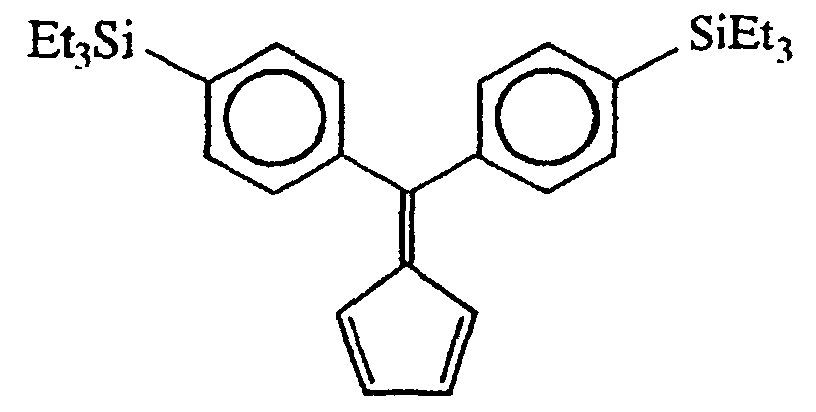
[0024] It is not necessary to carry out the aqueous workup procedure described in the above
example. The reaction mass produced from the reaction with cyclopentadiene, preferably
after filtration, can be subjected to further reactions to produce the desired end
product. For example, the reaction mass can be treated with lithium fluorenides to
make cyclopentadienyl-fluorenyl ligands directly.
[0025] It will be seen from the above Example that the concurrent lithiation and silylation
reactions are made possible by the facts that:
1) lithiation of the 1,4-dibromobenzene is faster than lithiation of 4-bromotriethylsilylbenzene.
Otherwise, 1,4-bis(triethylsilyl)benzene would form. Only small amounts of this impurity
were noted.
2) silylation of 4-bromophenyllithium is faster than silylation of butyllithium. Otherwise,
butyltriethylsilane would form.
3) lithiation of 4-bromophenyllithium is slower than its silylation. If the lithiation
were faster, this would also result in formation of 1,4-bis(triethylsilyl)benzene.
[0026] Thus, the reaction rates are such that they work in concert to produce a high yield
of the desired halo(trihydrocarbylsilyl)arene.
[0027] It is to be understood that the reactants and components referred to by chemical
name or by formula anywhere in the specification or claims hereof, whether referred
to in the singular or plural, are identified as they exist prior to coming into contact
with another substance referred to by chemical name or chemical type (
e.g., another reactant, or a solvent). It matters not what preliminary chemical changes,
transformations and/or reactions, if any, take place in the resulting mixture or solution
or reaction medium as such changes, transformations and/or reactions are the natural
result of bringing the specified reactants and/or components together under the conditions
called for pursuant to this disclosure. Thus the reactants and components are identified
as ingredients to be brought together in connection with performing a desired chemical
reaction or in forming a mixture to be used in conducting a desired reaction. Accordingly,
even though the claims hereinafter may refer to substances, components and/or ingredients
in the present tense ("comprises", and/or "is"), the reference is to the substance,
component or ingredient as it existed at the time just before it was first contacted,
blended or mixed with one or more other substances, components and/or ingredients
in accordance with the present disclosure.
1. A process which comprises concurrently reacting (i) an arene having a halogen atom
of atomic number greater than 9 substituted on at least two non-adjacent carbon atoms
with (ii) a halotrihydrocarbylsilane in which the halogen atom has an atomic number
greater than 9, and (iii) a hydrocarbyl lithium compound, in proportions such that
a haloarene having at least one trihydrocarbylsilyl ring substituent is formed.
2. A process according to Claim 1 wherein the reaction is performed by adding (iii) to
a mixture of (i) and (ii).
3. A process according to Claim 1 wherein the reaction is performed by concurrently but
separately adding (ii) and (iii) to (i).
4. A process according to Claim 1 wherein (i) is free of substitution by functional groups
other than said halogen atom of atomic number greater than 9 substituted on at least
two non-adjacent carbon atoms.
5. A process according to Claim 1 wherein at least two of said non-adjacent carbon atoms
of (i) are each substituted by a chlorine atom or by a bromine atom.
6. A process according to Claim 1 wherein (i) is free of substitution by functional groups
other than said halogen atom of atomic number greater than 9 substituted on at least
two non-adjacent carbon atoms, and wherein each said halogen atom of (i) is either
a bromine atom or a iodine atom.
7. A process according to Claim 1 wherein the halotrihydrocarbylsilane of (ii) is a chlorotrihydrocarbylsilane
in which each hydrocarbyl group has in the range of 1 to 12 carbon atoms, or a bromotrihydrocarbylsilane
in which each hydrocarbyl group has in the range of 1 to 12 carbon atoms.
8. A process according to Claim 1 wherein the hydrocarbyl lithium compound of (iii) is
a lithium alkyl having in the range of 1 to 10 carbon atoms in the molecule.
9. A process according to Claim 6 wherein the reaction is performed by adding (iii) to
a mixture of (i) and (ii).
10. A process according to Claim 7 wherein the reaction is performed by adding (iii) to
a mixture of (i) and (ii).
11. A process according to Claim 8 wherein the reaction is performed by adding (iii) to
a mixture of (i) and (ii).
12. A process according to Claim 1 wherein (i) is free of substitution by functional groups
other than said halogen atom of atomic number greater than 9 substituted on at least
two non-adjacent carbon atoms, wherein each said halogen atom of (i) is either a chlorine
atom or a bromine atom, and wherein the halotrihydrocarbylsilane of (ii) is a chlorotrihydrocarbylsilane
in which each hydrocarbyl group has in the range of 1 to 12 carbon atoms, or a bromotrihydrocarbylsilane
in which each hydrocarbyl group has in the range of 1 to 12 carbon atoms.
13. A process according to Claim 1 wherein (i) is free of substitution by functional groups
other than said halogen atom of atomic number greater than 9 substituted on at least
two non-adjacent carbon atoms, wherein each said halogen atom of (i) is either a bromine
atom or a iodine atom, and wherein the hydrocarbyl lithium compound of (iii) is a
lithium alkyl having in the range of 1 to 10 carbon atoms in the molecule.
14. A process according to Claim 1 wherein the halotrihydrocarbylsilane of (ii) is a chlorotrihydrocarbylsilane
in which each hydrocarbyl group has in the range of 1 to 8 carbon atoms, or a bromotrihydrocarbylsilane
in which each hydrocarbyl group has in the range of 1 to 8 carbon atoms, and wherein
the hydrocarbyl lithium compound of (iii) is a lithium alkyl having in the range of
1 to 6 carbon atoms in the molecule.
15. A process according to Claim 12 wherein the reaction is performed by adding (iii)
to a mixture of (i) and (ii).
16. A process according to Claim 13 wherein the reaction is performed by adding (iii)
to a mixture of (i) and (ii).
17. A process according to Claim 14 wherein the reaction is performed by adding (iii)
to a mixture of (i) and (ii).
18. A process according to Claim 1 wherein (i) is free of substitution by functional groups
other than said halogen atom of atomic number greater than 9 substituted on at least
two non-adjacent carbon atoms, wherein each said halogen atom of (i) is either a chlorine
atom or a bromine atom, wherein the halotrihydrocarbylsilane of (ii) is a chlorotrihydrocarbylsilane
in which each hydrocarbyl group has in the range of 1 to 8 carbon atoms, or a bromotrihydrocarbylsilane
in which each hydrocarbyl group has in the range of 1 to 8 carbon atoms, and wherein
the hydrocarbyl lithium compound of (iii) is a lithium alkyl having in the range of
1 to 6 carbon atoms in the molecule.
19. A process according to Claim 18 wherein the reaction is performed by adding (iii)
to a mixture of (i) and (ii).
20. A process according to Claim 1 wherein the reaction is initiated at a temperature
below room temperature.
21. A process according to Claim 1 wherein (i) is a 1,3-dihalobenzene, a 1,4-dihalobenzene,
a 1-hydrocarbyl-3,5-dihalobenzene, a 1,3,5-trihalobenzene, a dihalobiphenyl in which
one halogen atom is on each ring, a trihalobiphenyl in which two halogen atoms are
on one ring and one halogen atom is on the other ring, a tetrahalobiphenyl in which
three halogen atoms are on one ring and one halogen atom is on the other ring, a tetrahalobiphenyl
in which two halogen atoms are on one ring and two halogen atoms are on the other
ring, a pentahalobiphenyl in which three halogen atoms are on one ring and two halogen
atoms are on the other ring, or a hexahalobiphenyl in which three halogen atoms are
on one ring and three halogen atoms are on the other ring, a dihalonaphthalene in
which one halogen atom is on each ring, a dihalonaphthalene in which both halogen
atoms are on the same ring, a trihalonaphthalene in which two halogen atoms are on
one ring and one halogen atom is on the other ring, a tetrahalonaphthalene in which
two halogen atoms are on one ring and two halogen atoms are on the other ring, or
a mixture of any two or more of the foregoing, all with the proviso that all ring
halogen atoms of (i) are chlorine atoms or bromine atoms.
22. A process according to Claim 21 wherein (i) is free of substitution by functional
groups other than said chlorine or bromine atoms.
23. A process according to Claim 21 wherein (ii) is a chlorotrialkylsilane or a bromotrialkylsilane
in which the alkyl groups each contain in the range of 1 to 4 carbon atoms.
24. A process according to Claim 23 wherein (i) is free of substitution by functional
groups other than said chlorine or bromine atoms, and wherein (iii) is a lithium alkyl
having in the range of 1 to 4 carbon atoms in the molecule.
25. A process according to Claim 1 wherein (i) is 1,4-dibromobenzene, (ii) is a chlorotrialkylsilane
or a bromotrialkylsilane in which the alkyl groups each contain in the range of 1
to 4 carbon atoms, and (iii) is a lithium alkyl having in the range of 1 to 4 carbon
atoms in the molecule.
26. A process according to Claim 25 wherein (i) is 1,4-dibromobenzene, (ii) is chlorotriethylsilane,
and wherein the reaction is initiated at a temperature below room temperature.
27. A process which comprises forming a mixture from components comprising (i) an arene
having a halogen atom of atomic number greater than 9 substituted on at least two
non-adjacent carbon atoms with (ii) a halotrihydrocarbylsilane in which the halogen
atom has an atomic number greater than 9, and (iii) a hydrocarbyl lithium compound,
with the proviso that (i) and (iii) are not mixed together in the absence of (ii),
and wherein said components are proportioned such that reaction takes place and a
haloarene having at least one trihydrocarbylsilyl ring substituent is formed.
28. A process according to Claim 27 wherein (i) is a 1,3-dihalobenzene, a 1,4-dihalobenzene,
a 1-hydrocarbyl-3,5-dihalobenzene, a 1,3,5-trihalobenzene, a dihalobiphenyl in which
one halogen atom is on each ring, a trihalobiphenyl in which two halogen atoms are
on one ring and one halogen atom is on the other ring, a tetrahalobiphenyl in which
three halogen atoms are on one ring and one halogen atom is on the other ring, a tetrahalobiphenyl
in which two halogen atoms are on one ring and two halogen atoms are on the other
ring, a pentahalobiphenyl in which three halogen atoms are on one ring and two halogen
atoms are on the other ring, or a hexahalobiphenyl in which three halogen atoms are
on one ring and three halogen atoms are on the other ring, a dihalonaphthalene in
which one halogen atom is on each ring, a dihalonaphthalene in which both halogen
atoms are on the same ring, a trihalonaphthalene in which two halogen atoms are on
one ring and one halogen atom is on the other ring, a tetrahalonaphthalene in which
two halogen atoms are on one ring and two halogen atoms are on the other ring, or
a mixture of any two or more of the foregoing, all with the proviso that all ring
halogen atoms of (i) are chlorine atoms or bromine atoms.
29. A process according to Claim 28 wherein (i) is free of substitution by functional
groups other than said chlorine or bromine atoms.
30. A process according to Claim 28 wherein (ii) is a chlorotrialkylsilane or a bromotrialkylsilane
in which the alkyl groups each contain in the range of 1 to about 4 carbon atoms.
31. A process according to Claim 30 wherein (i) is free of substitution by functional
groups other than said chlorine or bromine atoms, and wherein (iii) is a lithium alkyl
having in the range of 1 to about 4 carbon atoms in the molecule.
32. A process according to Claim 27 wherein the mixture is formed at a temperature below
room temperature.
33. A process according to Claim 27 wherein (i) is 1,4-dibromobenzene, (ii) is a chlorotrialkylsilane
or a bromotrialkylsilane in which the alkyl groups each contain in the range of 1
to about 4 carbon atoms, and (iii) is a lithium alkyl having in the range of 1 to
about 4 carbon atoms in the molecule.
34. A process according to Claim 33 wherein (i) is 1,4-dibromobenzene, (ii) is chlorotriethylsilane,
and wherein the mixture is formed at a temperature below room temperature.
35. A process according to any of Claims 27-34 wherein the haloarene having at least one
trihydrocarbylsilyl ring substituent formed in the reaction is then reacted with a
hydrocarbyl lithium compound to form a lithiated haloarene having at least one trihydrocarbylsilyl
ring substituent
36. A process which comprises
A) forming a mixture from components comprising (i) 1,4-dibromobenzene, (ii) a chlorotrialkylsilane
or a bromotrialkylsilane in which the alkyl groups each contain in the range of 1
to about 4 carbon atoms, and (iii) a hydrocarbyl lithium compound, with the proviso
that (i) and (iii) are not mixed together in the absence of (ii), and wherein said
components are proportioned such that reaction takes place and a 4-halo-1-(trialkylsilyl)benzene
is formed;
B) forming a mixture of 4-halo-1-(trialkylsilyl)benzene from A) and a hydrocarbyl
lithium compound wich that the halogen atom of the 4-halo-1-(trialkylsilyl)benzens
is replaced by a lithium atom thereby forming a 4-lithio-1-(trialkylsilyl)benzene;
C) forming a mixture of 4-lithio-1-(trialkylsilyl)benzene from B) and a dihydrocarbylcarbamyl
halide such that bis(4-trialkylsilylphenyl)dihydrocarbylamidomethoxy lithium is formed;
and
D) forming a mixture of bis(4-trialkylsilylphenyl)dihydrocarbylamidomethoxy lithium
from C) and a monomeric substituted or unsubstituted cyclopentadiene or substituted
or unsubstituted indene such that a 6,6-di(4-(trialkylsilylphenyl)pentafulvene compound
is formed.
37. A process according to Claim 36 wherein steps A) through D) are conducted successively
in the same reaction vessel without isolation of the reaction products from A), B)
or C).
38. A process according to Claim 36 wherein (i) is 1,4-dibromobenzene, wherein (ii) is
chlorotriethylsilane, wherein (iii) is a lithium alkyl having in the range of 1 to
about 4 carbon atoms in the molecule, wherein the hydrocarbyl lithium compound used
in B) is a lithium allyl having in the range of 1 to about 4 carbon atoms in the molecule,
wherein the dihydrocarbylcarbamyl halide used in C) is a dialkylcarbamyl chloride
in which each alkyl group has in the range of 1 to 4 carbon atoms, wherein the monomeric
substituted or unsubstituted cyclopentadiene or substituted or unsubstituted indene
used in D) is a monomeric substituted or unsubstituted cyclopentadiene hydrocarbon,
and wherein the reactions in A), B) and C) are initiated at temperatures below room
temperature.
39. A process according to Claim 38 wherein steps A) through D) are conducted successively
in the same reaction vessel without isolation of the reaction products from A), B)
or C), and wherein at least the reactions of A), B), and C) are conducted in an ether
solvent other than tetrahydrofuran.
40. A process according to Claim 39 wherein the reaction of D) is conducted in the presence
of both tetrahydrofuran and an ether solvent other than tetrahydrofuran.
41. A process according to Claim 39 wherein the reaction of D) is conducted in an ether
solvent other than tetrahydrofuran.
1. Verfahren, bei dem gleichzeitig (i) ein Aren, das an mindestens zwei nicht benachbarten
Kohlenstoffatomen mit einem Halogenatom mit einer Ordnungszahl größer als 9 substituiert
ist, mit (ii) einem Halogentrikohlenwasserstoffsilan, wobei das Halogenatom eine Ordnungszahl
größer als 9 hat, und (iii) einer Kohlenwasserstofflithiumverbindung in solchen Anteilen
umgesetzt wird, dass ein Halogenaren mit mindestens einem Trikohlenwasserstoffsilylringsubstituenten
gebildet wird.
2. Verfahren nach Anspruch 1, bei dem die Umsetzung durch Zugabe von (iii) zu einer Mischung
von (i) und (ii) durchgeführt wird.
3. Verfahren nach Anspruch 1, bei dem die Umsetzung durch gleichzeitige, jedoch getrennt
erfolgende Zugabe von (ii) und (iii) zu (i) durchgeführt wird.
4. Verfahren nach Anspruch 1, bei dem (i) frei von Substitution durch funktionelle Gruppen
ist, die von dem Halogenatom mit der Ordnungszahl größer als 9 verschieden sind, das
an mindestens zwei nicht benachbarten Kohlenstoffatomen substituiert ist.
5. Verfahren nach Anspruch 1, bei dem mindestens zwei der nicht benachbarten Kohlenstoffatome
von (i) jeweils durch ein Chloratom oder durch ein Bromatom substituiert sind.
6. Verfahren nach Anspruch 1, bei dem (i) frei von Substitution durch funktionelle Gruppen
ist, die von dem Halogenatom mit der Ordnungszahl größer als 9 verschieden sind, das
an mindestens zwei nicht benachbarten Kohlenstoffatomen substituiert ist, und bei
dem jedes Halogenatom von (i) entweder ein Bromatom oder ein Iodatom ist.
7. Verfahren nach Anspruch 1, bei dem das Halogentrikohlenwasserstoffsilan von (ii) ein
Chlortrikohlenwasserstoffsilan, wobei jede Kohlenwasserstoffgruppe im Bereich von
1 bis 12 Kohlenstoffatomen aufweist, oder ein Bromtrikohlenwasserstoffsilan ist; wobei
jede Kohlenwasserstoffgruppe im Bereich von 1 bis 12 Kohlenstoffatomen aufweist.
8. Verfahren nach Anspruch 1, bei dem die Kohlenwasserstofflithiumverbindung von (iii)
ein Lithiumalkyl mit im Bereich von 1 bis 10 Kohlenstoffatomen im Molekül ist.
9. Verfahren nach Anspruch 6, bei dem die Umsetzung durch Zugabe von (iii) zu einer Mischung
von (i) und (ii) durchgeführt wird.
10. Verfahren nach Anspruch 7, bei dem die Umsetzung durch Zugabe von (iii) zu einer Mischung
von (i) und (ii) durchgeführt wird.
11. Verfahren nach Anspruch 8, bei dem die Umsetzung durch Zugabe von (iii) zu einer Mischung
von (i) und (ii) durchgeführt wird.
12. Verfahren nach Anspruch 1, bei dem (i) frei von Substitution durch funktionelle Gruppen
ist, die von dem Halogenatom mit der Ordnungszahl größer als 9 verschieden sind, das
an mindestens zwei nicht benachbarten Kohlenstoffatomen substituiert ist, wobei jedes
Halogenatom von (i) entweder ein Chloratom oder ein Bromatom ist, und bei dem das
Halogentrikohlenwasserstoffsilan von (ii) ein Chlortrikohlenwasserstoffsilan, wobei
jede Kohlenwasserstoffgruppe im Bereich von 1 bis 12 Kohlenstoffatomen aufweist, oder
ein Bromtrikohlenwasserstoffsilan ist, wobei jede Kohlenwasserstoffgruppe im Bereich
von 1 bis 12 Kohlenstoffatomen aufweist.
13. Verfahren nach Anspruch 1, bei dem (i) frei von Substitution durch funktionelle Gruppen
ist, die von dem Halogenatom mit der Ordnungszahl größer als 9 verschieden sind, das
an mindestens zwei nicht benachbarten Kohlenstoffatomen substituiert ist, wobei jedes
Halogenatom von (i) entweder ein Bromatom oder ein Iodatom ist, und bei dem die Kohlenwasserstofflithiumverbindung
von (iii) ein Lithiumalkyl mit im Bereich von 1 bis 10 Kohlenstoffatomen im Molekül
ist.
14. Verfahren nach Anspruch 1, bei dem das Halogentrikohlenwasserstoffsilan von (ii) ein
Chlortrikohlenwasserstoffsilan, wobei jede Kohlenwasserstoffgruppe im Bereich von
1 bis 8 Kohlenstoffatomen aufweist, oder ein Bromtrikohlenwasserstoffsilan ist, wobei
jede Kohlenwasserstoffgruppe im Bereich von 1 bis 8 Kohlenstoffatomen aufweist, und
bei dem die Kohlenwasserstofflithiumverbindung von (iii) ein Lithiumalkyl mit im Bereich
von 1 bis 6 Kohlenstoffatomen in dem Molekül ist.
15. Verfahren nach Anspruch 12, bei dem die Umsetzung durch Zugabe von (iii) zu einer
Mischung von (i) und (ii) durchgeführt wird.
16. Verfahren nach Anspruch 13, bei dem die Umsetzung durch Zugabe von (iii) zu einer
Mischung von (i) und (ii) durchgeführt wird.
17. Verfahren nach Anspruch 14, bei dem die Umsetzung durch Zugabe von (iii) zu einer
Mischung von (i) und (ii) durchgeführt wird.
18. Verfahren nach Anspruch 1, bei dem (i) frei von Substitution durch funktionelle Gruppen
ist, die von dem Halogenatom mit der Ordnungszahl größer als 9 verschieden sind, das
an mindestens zwei nicht benachbarten Kohlenstoffatomen substituiert ist, wobei jedes
Halogenatom von (i) entweder ein Chloratom oder ein Bromatom ist, bei dem das Halogentrikohlenwasserstoffsilan
von (ii) ein Chlortrikohlenwasserstoffsilan, wobei jede Kohlenwasserstoffgruppe im
Bereich von 1 bis 8 Kohlenstoffatomen aufweist, oder ein Bromtrikohlenwasserstoffsilan
ist, wobei jede Kohlenwasserstoffgruppe im Bereich von 1 bis 8 Kohlenstoffatomen aufweist,
und bei dem die Kohlenwasserstofflithiumverbindung von (iii) ein Lithiumalkyl mit
im Bereich von 1 bis 6 Kohlenstoffatomen im Molekül ist.
19. Verfahren nach Anspruch 18, bei dem die Umsetzung durch Zugabe von (iii) zu einer
Mischung von (i) und (ii) durchgeführt wird.
20. Verfahren nach Anspruch 1, bei dem die Umsetzung bei einer Temperatur unterhalb Raumtemperatur
initiiert wird.
21. Verfahren nach Anspruch 1, bei dem (i) ein 1,3-Dihalogenbenzol, ein 1,4-Dihalogenbenzol,
ein 1-Kohlenwasserstoff-3,5-dihalogenbenzol, ein 1,3,5-Trihalogenbenzol, ein Dihalogenbiphenyl,
bei dem sich an jedem Ring ein Halogenatom befindet, ein Trihalogenbiphenyl, bei dem
sich zwei Halogenatome an einem Ring und ein Halogenatom an dem anderen Ring befindet,
ein Tetrahalogenbiphenyl, bei dem sich drei Halogenatome an einem Ring und ein Halogenatom
an dem anderen Ring befindet, ein Tetrahalogenbiphenyl, bei dem sich zwei Halogenatome
an einem Ring befinden und zwei Halpgenatome an dem anderen Ring befinden, ein Pentahalogenbiphenyl,
bei dem sich drei Halogenatome an einem Ring befinden und zwei Halogenatome an dem
anderen Ring befinden, oder ein Hexahalogenbiphenyl, bei dem sich drei Halogenatome
an einem Ring befinden und drei Halogenatome an dem anderen Ring befinden, ein Dihalogennaphthalin,
bei dem sich an jedem Ring ein Halogenatom befindet, ein Dihalogennaphthalin, bei
dem sich beide Halogenatome an demselben Ring befinden, ein Trihalogennaphthalin,
bei dem sich zwei Halogenatome an einem Ring befinden und ein Halogenatom an dem anderen
Ring befindet, ein Tetrahalogennaphthalin, bei dem sich zwei Halogenatome an einem
Ring befinden und zwei Halogenatome an dem anderen Ring befinden, oder eine Mischung
von irgendwelchen zwei oder mehr der vorher genannten ist, alle mit der Maßgabe, dass
alle Ringhalogenatome von (i) Chloratome oder Bromatome sind.
22. Verfahren nach Anspruch 21, bei dem (i) frei von Substitution durch funktionelle Gruppen
ist, die von den Chlor- und Bromatomen verschieden sind.
23. Verfahren nach Anspruch 21, bei dem (ii) ein Chlortrialkylsilan oder ein Bromtrialkylsilan
ist, bei dem die Alkylgruppen jeweils im Bereich von 1 bis 4 Kohlenstoffatomen enthalten.
24. Verfahren nach Anspruch 23, bei dem (i) frei von Substitution durch funktionelle Gruppen
ist, die von den Chlor- und Bromatomen verschieden sind, und bei dem (iii) Lithiumalkyl
mit im Bereich von 1 bis 4 Kohlenstoffatomen im Molekül ist.
25. Verfahren nach Anspruch 1, bei dem (i) 1,4-Dibrombenzol ist, (ii) ein Chlortrialkylsilan
oder ein Bromtrialkylsilan ist, bei dem die Alkylgruppen jeweils im Bereich von 1
bis 4 Kohlenstoff atomen enthalten, und (iii) ein Lithiumalkyl mit im Bereich von
1 bis 4 Kohlenstoffatomen im Molekül ist.
26. Verfahren nach Anspruch 25, bei dem (i) 1,4-Dibrombenzol ist, (ii) Chlortriethylsilan
ist, und bei dem die Umsetzung bei einer Temperatur unterhalb Raumtemperatur initiiert
wird.
27. Verfahren, bei dem eine Mischung aus Komponenten gebildet wird, die (i) ein Aren,
das an mindestens zwei nicht benachbarten Kohlenstoffatomen mit einem Halogenatom
mit einer Ordnungszahl größer als 9 substituiert ist, (ii) ein Halogentrikohlenwasserstoffsilan,
wobei das Halogenatom eine Ordnungszahl größer als 9 hat, und (iii) eine Kohlenwasserstofflithiumverbindung
umfassen, mit der Maßgabe, dass (i) und (iii) nicht in Abwesenheit von (ii) miteinander
gemischt werden, bei dem die Komponenten so proportioniert werden, dass eine Umsetzung
stattfindet und ein Halogenaren mit mindestens einem Trikohlenwasserstoffsilylringsubstituenten
gebildet wird.
28. Verfahren nach Anspruch 27, bei dem (i) ein 1,3-Dihalogenbenzol, ein 1,4-Dihalogenbenzol,
ein 1-Kohlenwasserstoff-3,5-dihalogenbenzol, ein 1,3,5-Trihalogenbenzol, ein Dihalogenbiphenyl,
bei dem sich an jedem Ring ein Halogenatom befindet, ein Trihalogenbiphenyl, bei dem
sich zwei Halogenatome an einem Ring und ein Halogenatom an dem anderen Ring befindet,
ein Tetrahalogenbiphenyl, bei dem sich drei Halogenatome an einem Ring und ein Halogenatom
an dem anderen Ring befindet, ein Tetrahalogenbiphenyl, bei dem sich zwei Halogenatome
an einem Ring befinden und zwei Halogenatöme an dem anderen Ring befinden, ein Pentahalogenbiphenyl,
bei dem sich drei Halogenatome an einem Ring befinden und zwei Halogenatome an dem
anderen Ring befinden, oder ein Hexahalogenbiphenyl, bei dem sich drei Halogenatome
an einem Ring befinden und drei Halogenatome an dem anderen Ring befinden, ein Dihalogennaphthalin,
bei dem sich an jedem Ring ein Halogenatom befindet, ein Dihalogennaphthalin, bei
dem sich beide Halogenatome an demselben Ring befinden, ein Trihalogennaphthalin,
bei dem sich zwei Halogenatome an einem Ring befinden und ein Halogenatom an dem anderen
Ring befindet, ein Tetrahalogennaphthalin, bei dem sich zwei Halogenatome an einem
Ring befinden und zwei Halogenatome an dem anderen Ring befinden, oder eine Mischung
von irgendwelchen zwei oder mehr der vorher genannten ist, alles mit der Maßgabe,
dass alle Ringhalogenatome von (i) Chloratome oder Bromatome sind.
29. Verfahren nach Anspruch 28, bei dem (i) frei von Substitution durch funktionelle Gruppen
ist, die von den Chlor- und Bromatomen verschieden sind.
30. Verfahren nach Anspruch 28, bei dem (ii) ein Chlortrialkylsilan oder ein Bromtrialkylsilan
ist, wobei'die Alkylgruppen jeweils im Bereich von 1 bis etwa 4 Kohlenstoffatomen
enthalten.
31. Verfahren nach Anspruch 30, bei dem (i) frei von Substitution durch funktionelle Gruppen
ist, die von den Chlor- und Bromatomen verschieden sind, und bei dem (iii) Lithiumalkyl
mit im Bereich von 1 bis etwa 4 Kohlenstoffatomen im Molekül ist.
32. Verfahren nach Anspruch 27, bei dem die Mischung bei einer Temperatur unterhalb Raumtemperatur
gebildet wird.
33. Verfahren nach Anspruch 27, bei dem (i) 1,4-Dibrombenzol ist, (ii) ein Chlortrialkylsilan
oder ein Bromtrialkylsilan ist, wobei die Alkylgruppen jeweils im Bereich von 1 bis
etwa 4 Kohlenstoffatomen enthalten, und bei dem (iii) ein Lithiumalkyl mit im Bereich
von 1 bis etwa 4 Kohlenstoffatomen im Molekül ist.
34. Verfahren nach Anspruch 33, bei dem (i) 1,4-Dibrombenzol ist, (ii) Chlortriethylsilan
ist und bei dem die Mischung bei einer Temperatur unterhalb Raumtemperatur gebildet
wird.
35. Verfahren nach einem der Ansprüche 27 bis 34, bei dem das Halogenaren mit mindestens
einem Trikohlenwasserstoffsilylringsubstituenten, das bei der Umsetzung Reaktion gebildet
wird, anschließend mit einer Kohlenwasserstofflithiumverbindung unter Bildung eines
lithiierten Halogenarens mit mindestens einem Trikohlenwasserstoffsilylringsubstituenten
umgesetzt wird.
36. Verfahren, bei dem
A) eine Mischung aus Komponenten gebildet wird, die (i) 1,4-Dibrombenzol, (ii) ein
Chlortrialkylsilan oder ein Bromtrialkylsilan, wobei die Alkylgruppen jeweils im Bereich
von 1 bis etwa 4 Kohlenstoffatome enthalten, und (iii) eine Kohlenwasserstofflithiumverbindung
umfassen; mit der Maßgabe, dass (i) und (iii) nicht zusammen in Abwesenheit von (ii)
gemischt werden, und wobei die Komponenten so proportioniert werden, dass eine Umsetzung
stattfindet und ein 4-Halogen-1-(trialkylsilyl)benzol gebildet wird;
B) eine Mischung aus 4-Halogen-1-(trialkylsilyl)benzol aus A) und einer Kohlenwasserstofflithiumverbindung
gebildet wird, so dass das Halogenatom des 4-Halogen-1-(trialkylsilyl)benzols durch
ein Lithiumatom ersetzt wird, wodurch ein 4-Lithium-1-(trialkylsilyl)benzol gebildet
wird;
C) eine Mischung aus 4-Lithium-l-(trialkylsilyl)benzol aus B) und einem Dikohlenwasserstoffcarbamylhalogenid
gebildet wird, so dass (4-Trialkylsilylphenyl)dikohlenwasserstoffamidomethoxylithium
gebildet wird; und
D) eine Mischung aus Bis(4-trialkylsilylphenyl)dikohlenwasserstoffamidomethoxylithium
aus C) und einem monomeren substiutierten oder unsubstituierten Cyclopentadien oder
substituierten oder unsubstituierten Inden gebildet wird, so dass eine 6,6-Di(4-(trialkylsilylphenyl)pentafulvenverbindung
gebildet wird.
37. Verfahren nach Anspruch 36, bei dem die Stufen A) bis D) nacheinander in dem selben
Reaktionsgefäß durchgeführt werden, ohne die Reaktionsprodukte von A), B) oder C)
zu isolieren.
38. Verfahren nach Anspruch 36, bei dem (i) 1,4-Dibrombenzol ist, (ii) Chlortriethylsilan
ist, (iii) ein Lithiumalkyl mit im Bereich von 1 bis etwa 4 Kohlenstoffatomen im Molekül
ist, wobei die in B) verwendete Kohlenwässerstofflithiumverbindung ein Lithiumalkyl
mit im Bereich von 1 bis etwa 4 Kohlenstoffatomen im Molekül ist, das in C) verwendete
Dikohlenwasserstoffcarbamylhalogenid ein Dialkylcarbamylchlorid ist, bei dem jede
Alkylgruppe im Bereich von 1 bis 4 Kohlenstoffatomen aufweist, das in D) verwendete
monomere substituierte oder unsubstituierten Cyclopentadien oder substituierte oder
unsubstituierte Inden ein monomerer substituierter oder unsubstituierter Cyclopentadienkohlenwasserstoff
ist und die Reaktionen in A), B) und C) bei Temperaturen unterhalb Raumtemperatur
initiiert werden.
39. Verfahren nach Anspruch 38, bei dem die Stufen A) bis D) nacheinander in demselben
Reaktionsgefäß durchgeführt werden, ohne die Reaktionsprodukte von A), B) oder C)
zu isolieren, und mindestens die Umsetzungen von A), B) und C) in einem von Tetrahydrofuran
verschiedenen Etherlösungsmittel durchgeführt werden.
40. Verfahren nach Anspruch 39, bei dem die Umsetzung von D) in Gegenwart von sowohl Tetrahydrofuran
als auch einem von Tetrahydrofuran verschiedenen Etherlösungsmittel durchgeführt wird.
41. Verfahren nach Anspruch 39, bei dem die umsetzung von D) in einem von Tetrahydrofuran
verschiedenen Etherlösungsmittel durchgeführt wird.
1. Procédé qui comprend la réaction simultanée de (i) un arène ayant un atome d'halogène
de nombre atomique supérieur à 9, substitué sur au moins deux atomes de carbone non
adjacents, avec (ii) un halotrihydrocarbylsilane dans lequel l'atome d'halogène a
un nombre atomique supérieur à 9, et (iii) un composé hydrocarbyle du lithium, en
des proportions telles qu'on forme un haloarène ayant au moins un substituant trihydrocarbylsilyle
cyclique.
2. Procédé selon la revendication 1, dans lequel la réaction est réalisée en ajoutant
(iii) à un mélange de (i) et de (ii).
3. Procédé selon la revendication 1, dans lequel la réaction est réalisée par addition
simultanée, mais séparée de (ii) et de (iii) à (i).
4. Procédé selon la revendication 1, dans lequel (i) est exempt d'une substitution par
des radicaux fonctionnels autres que ledit atome d'halogène de nombre atomique supérieur
à 9, substitué sur au moins deux atomes de carbone non adjacents.
5. Procédé selon la revendication 1, dans lequel au moins deux des atomes de carbone
non adjacents de (i) sont chacun substitués par un atome de chlore ou un atome de
brome.
6. Procédé selon la revendication 1, dans lequel (i) est exempt d'une substitution par
des radicaux fonctionnels autres que ledit atome d'halogène de nombre atomique supérieur
à 9, substitué sur au moins deux atomes de carbone non adjacent, et dans lequel chaque
atome d'halogène de (i) est un atome de brome ou un atome d'iode.
7. Procédé selon la revendication 1, dans lequel l'halotrihydrocarbylsilane de (ii) est
un chlorotrihydrocarbylsilane, dans lequel chaque radical hydrocarbyle a de 1 à 12
atomes de carbone ou un bromotrihydrocarbylsilane, dans lequel chaque radical hydrocarbyle
a de 1 à 12 atomes de carbone.
8. Procédé selon la revendication 1, dans lequel le composé hydrocarbyle du lithium de
(iii) est un alkyllithium ayant dans l'intervalle de 1 à 10 atomes de carbone dans
la molécule.
9. Procédé selon la revendication 6, dans lequel la réaction est réalisée en ajoutant
(iii) à un mélange de (i) et de (ii).
10. Procédé selon la revendication 7, dans lequel la réaction est réalisée en ajoutant
(iii) à un mélange de (i) et de (ii).
11. Procédé selon la revendication 8, dans lequel la réaction est réalisée en ajoutant
(iii) à un mélange de (i) et de (ii).
12. Procédé selon la revendication 1, dans lequel (i) est exempt d'une substitution par
des radicaux fonctionnels autres que ledit atome d'halogène de nombre atomique supérieur
à 9, substitué sur au moins deux atomes de carbone non adjacents, dans lequel chaque
atome d'halogène de (i) est un atome de chlore ou un atome de brome et dans lequel
l'halotrihydrocarbylsilane de (ii) est un chlorotrihydrocarbylsilane, dans lequel
chaque radical hydrocarbyle a dans l'intervalle de 1 à 12 atomes de carbone ou un
bromotrihydrocarbylsilane, dans lequel chaque radical hydrocarbyle a dans l'intervalle
de 1 à 12 atomes de carbone.
13. Procédé selon la revendication 1, dans lequel (i) est exempt d'une substitution par
des radicaux fonctionnels autres que ledit atome d'halogène de nombre atomique supérieur
à 9, substitué sur au moins deux atomes de carbone non adjacents, dans lequel chaque
atome d'halogène de (i) est un atome de brome ou un atome d'iode et dans lequel le
composé hydrocarbyle du lithium de (iii) est un alkyllithium ayant dans l'intervalle
de 1 à 10 atomes de carbone dans la molécule.
14. Procédé selon la revendication 1, dans lequel l'halotrihydrocarbylsilane de (ii) est
un chlorotrihydrocarbylsilane, dans lequel chaque radical hydrocarbyle a de 1 à 8
atomes de carbone ou un bromotrihydrocarbylsilane, dans lequel chaque radical hydrocarbyle
a de 1 à 8 atomes de carbone et dans lequel le composé hydrocarbyle du lithium de
(iii) est un alkyllithium ayant de 1 à 6 atomes de carbone dans la molécule.
15. Procédé selon la revendication 12, dans lequel la réaction est réalisée en ajoutant
(iii) à un mélange de (i) et de (ii).
16. Procédé selon la revendication 13, dans lequel la réaction est réalisée en ajoutant
(iii) à un mélange de (i) et de (ii).
17. Procédé selon la revendication 14, dans lequel la réaction est réalisée en ajoutant
(iii) à un mélange de (i) et de (ii).
18. Procédé selon la revendication 1, dans lequel (i) est exempt d'une substitution par
des radicaux fonctionnels autres que ledit atome d'halogène de nombre atomique supérieur
à 9, substitué sur au moins deux atomes de carbone non adjacents, dans lequel chaque
atome d'halogène de (i) est un atome de chlore ou un atome de brome, dans lequel l'halotrihydrocarbylsilane
de (ii) est un chlorotrihydrocarbylsilane, dans lequel chaque radical hydrocarbyle
a de 1 à 8 atomes de carbone ou un bromotrihydrocarbylsilane, dans lequel chaque radical
hydrocarbyle a de 1 à 8 atomes de carbone et dans lequel le composé hydrocarbyle du
lithium de (iii) est un alkyllithium ayant de 1 à 6 atomes de carbone dans la molécule.
19. Procédé selon la revendication 18, dans lequel la réaction est réalisée en ajoutant
(iii) à un mélange de (i) et de (ii).
20. Procédé selon la revendication 1, dans lequel la réaction est initiée à une température
inférieure à la température ambiante.
21. Procédé selon la revendication 1, dans lequel (i) est un 1,3-dihalobenzène, un 1,4-dihalobenzène,
un 1-hydrocarbyl-3,5-dihalobenzène, un 1,3,5-trihalobenzène, un dihalobiphényle dans
lequel un atome d'halogène se trouve sur chaque cycle, un trihalobiphényle dans lequel
deux atomes d'halogène sont sur un cycle et un atome d'halogène est sur l'autre cycle,
un tétrahalobiphényle dans lequel trois atomes d'halogène sont sur un cycle et un
atome d'halogène est sur l'autre cycle, un tétrahalobiphényle dans lequel deux atomes
d'halogène sont sur un cycle et deux atomes d'halogène sont sur l'autre cycle, un
pentahalobiphényle dans lequel trois atomes d'halogène sont sur un cycle et deux atomes
d'halogène sont sur l'autre cycle, ou un hexahalobiphényle dans lequel trois atomes
d'halogène sont sur un cycle et trois atomes d'halogène sont sur l'autre cycle, un
dihalonaphtalène dans lequel un atome d'halogène se trouve sur chaque cycle, un dihalonaphtalène
dans lequel les deux atomes d'halogène sont sur le même cycle, un trihalonaphtalène
dans lequel deux atomes d'halogène sont sur un cycle et un atome d'halogène est sur
l'autre cycle, un tétrahalonaphtalène dans lequel deux atomes d'halogène sont sur
un cycle et deux atomes d'halogène sont sur l'autre cycle, ou un mélange de deux quelconques
ou plus des précédents, tous avec la condition que tous les atomes d'halogène de (i)
sont des atomes de chlore ou des atomes de brome.
22. Procédé selon la revendication 21, dans lequel (i) est exempt d'une substitution par
des radicaux fonctionnels autres que lesdits atomes de chlore ou de brome.
23. Procédé selon la revendication 21, dans lequel (ii) est un chlorotrialkylsilane ou
un bromotrialkylsilane dans lequel les radicaux alkyle contiennent chacun dans l'intervalle
de 1 à 4 atomes de carbone.
24. Procédé selon la revendication 23, dans lequel (i) est exempt d'une substitution par
des radicaux fonctionnels autres que lesdits atomes de chlore ou de brome et dans
lequel (iii) est un alkyllithium ayant dans l'intervalle de 1 à 4 atomes de carbone
dans la molécule.
25. Procédé selon la revendication 1, dans lequel (i) est le 1,4-dibromobenzène, (ii)
est un chlorotrialkylsilane ou un bromotrialkylsilane dans lequel les radicaux alkyle
contiennent chacun dans l'intervalle de 1 à 4 atomes de carbone et (iii) est un alkyllithium
ayant dans l'intervalle de 1 à 4 atomes de carbone dans la molécule.
26. Procédé selon la revendication 25, dans lequel (i) est le 1,4-dibromobenzène, (ii)
est le chlorotriéthylsilane et dans lequel la réaction est initiée à une température
inférieure à la température ambiante.
27. Procédé qui comprend la formation d'un mélange des composants comprenant (i) un arène
ayant un atome d'halogène de nombre atomique supérieur à 9, substitué sur au moins
deux atomes de carbone non adjacents, avec (ii) un halotrihydrocarbylsilane dans lequel
l'atome d'halogène a un nombre atomique supérieur à 9, et (iii) un composé hydrocarbyle
du lithium, avec la condition que (i) et (iii) ne sont pas mélangés ensemble en l'absence
de (ii), et dans lequel lesdits composants sont présents en des proportions telles
qu'une réaction se produise et que l'on forme un haloarène ayant au moins un substituant
trihydrocarbylsilyle cyclique.
28. Procédé selon la revendication 27, dans lequel (i) est un 1,3-dihalobenzène, un 1,4-dihalobenzène,
un 1-hydrocarbyl-3,5-dihalobenzène, un 1,3,5-trihalobenzène, un dihalobiphényle dans
lequel un atome d'halogène se trouve sur chaque cycle, un trihalobiphényle dans lequel
deux atomes d'halogène sont sur un cycle et un atome d'halogène est sur l'autre cycle,
un tétrahalobiphényle dans lequel trois atomes d'halogène sont sur un cycle et un
atome d'halogène est sur l'autre cycle, un tétrahalobiphényle dans lequel deux atomes
d'halogène sont sur un cycle et deux atomes d'halogène sont sur l'autre cycle, un
pentahalobiphényle dans lequel trois atomes d'halogène sont sur un cycle et deux atomes
d'halogène sont sur l'autre cycle, ou un hexahalobiphényle dans lequel trois atomes
d'halogène sont sur un cycle et trois atomes d'halogène sont sur l'autre cycle, un
dihalonaphtalène dans lequel un atome d'halogène se trouve sur chaque cycle, un dihalonaphtalène
dans lequel les deux atomes d'halogène sont sur le même cycle, un trihalonaphtalène
dans lequel deux atomes d'halogène sont sur un cycle et un atome d'halogène est sur
l'autre cycle, un tétrahalonaphtalène dans lequel deux atomes d'halogène sont sur
un cycle et deux atomes d'halogène sont sur l'autre cycle, ou un mélange de deux quelconques
ou plus des précédents, tous avec la condition que tous les atomes d'halogène de (i)
sont des atomes de chlore ou des atomes de brome.
29. Procédé selon la revendication 28, dans lequel (i) est exempt d'une substitution par
des radicaux fonctionnels autres que lesdits atomes de chlore ou de brome.
30. Procédé selon la revendication 28, dans lequel (ii) est un chlorotrialkylsilane ou
un bromotrialkylsilane dans lequel les radicaux alkyle contiennent chacun dans l'intervalle
de 1 à 4 atomes de carbone.
31. Procédé selon la revendication 30, dans lequel (i) est exempt d'une substitution par
des radicaux fonctionnels autres que lesdits atomes de chlore ou de brome et dans
lequel (iii) est un alkyllithium ayant dans l'intervalle de 1 à 4 atomes de carbone
dans la molécule.
32. Procédé selon la revendication 27, dans lequel le mélange est formé à une température
inférieure à la température ambiante.
33. Procédé selon la revendication 27, dans lequel (i) est le 1,4-dibromobenzène, (ii)
est un chlorotrialkylsilane ou un bromotrialkylsilane dans lequel les radicaux alkyle
contiennent chacun dans l'intervalle de 1 à 4 atomes de carbone et (iii) est un alkyllithium
ayant dans l'intervalle de 1 à 4 atomes de carbone dans la molécule.
34. Procédé selon la revendication 33, dans lequel (i) est le 1,4-dibromobenzène, (ii)
est le chlorotriéthylsilane et dans lequel le mélange est formé à une température
inférieure à la température ambiante.
35. Procédé selon l'une quelconque des revendications 27 à 34, dans lequel l'haloarène
ayant au moins un substituant trihydrocarbylsilyle cyclique formé dans la réaction,
est mis à réagir avec un composé hydrocarbyle du lithium pour former un haloarène
lithié ayant au moins un substituant trihydrocarbylsilyle cyclique.
36. Procédé qui comprend les étapes consistant à :
A) former un mélange à partir de composants comprenant (i) le 1,4-dibromobenzène,
(ii) un chlorotrialkylsilane ou un bromotrialkylsilane, dans lequel les radicaux alkyle
contiennent chacun dans la gamme de 1 à environ 4 atomes de carbone, et (iii) un composé
hydrocarbyle du lithium, avec la condition que (i) et (iii) ne sont pas mélangés ensemble
en l'absence de (ii), et dans lequel ces composants sont présents en des proportions
telles que la réaction se produise et que l'on forme un 4-halo-1-(trialkylsilyl)benzène
;
B) former un mélange du 4-halo-1-(trialkylsilyl)benzène de A) et d'un composé hydrocarbyle
du lithium de sorte que l'atome d'halogène du 4-halo-1-(trialkylsilyl)benzène soit
remplacé par un atome de lithium pour ainsi former un 4-lithio-1-(trialkylsilyl)benzène
;
C) former un mélange du 4-lithio-1-(trialkylsilyl)benzène de B) et d'un halogénure
de dihydrocarbylcarbamyle de sorte que l'on forme un bis(4-trialkylsilylphényl)dihydrocarbylamidométhoxylithium,
et
D) former un mélange du bis(4-trialkylsilylphényl)dihydrocarbylamidométhoxylithium
de C) et d'hydrocarbure cyclopentadiène ou indène substitué ou non substitué monomère
de sorte que l'on forme un composé 6,6-di(4-(trialkylsilyl)phényl)pentafulvénoïde.
37. Procédé selon la revendication 36, dans lequel les étapes A) à D) sont réalisées successivement
dans le même ballon de réaction sans isolement des produits de réaction de A), B)
ou C).
38. Procédé selon la revendication 36, dans lequel (i) est le 1,4-dibromobenzène, (ii)
est le chlorotriéthylsilane, dans lequel (iii) est un alkyllithium ayant dans l'intervalle
de 1 à 4 atomes de carbone dans la molécule, dans lequel le composé hydrocarbyle du
lithium utilisé en B) est un alkyllithium ayant dans l'intervalle de 1 à environ 4
atomes de carbone dans la molécule, dans lequel l'halogénure de dihydrocarbylcarbamide
utilisé en C) est un chlorure de dialkylcarbamide, dans lequel chaque radical alkyle
a de 1 à 4 atomes de carbone, dans lequel le cyclopentadiène monomère substitué ou
non substitué ou l'indène substitué ou non substitué utilisé en D) est un hydrocarbure
cyclopentadiène monomère substitué ou non substitué, et dans lequel les réactions
A), B) et C) sont initiées à des températures inférieures à la température ambiante.
39. Procédé selon la revendication 38, dans lequel les étapes A) à D) sont réalisées successivement
dans le même ballon de réaction sans isolement des produits de réaction de A), B)
ou C) et dans lequel on réalise au moins les réactions de A), B) et C) dans un solvant
éther autre que le tétrahydrofuranne.
40. Procédé selon la revendication 39, dans lequel la réaction de D) est réalisée en présence
de tétrahydrofuranne et d'un solvant éther autre que le tétrahydrofuranne.
41. Procédé selon la revendication 39, dans lequel la réaction de D) est réalisée en présence
d'un solvant éther autre que le tétrahydrofuranne.