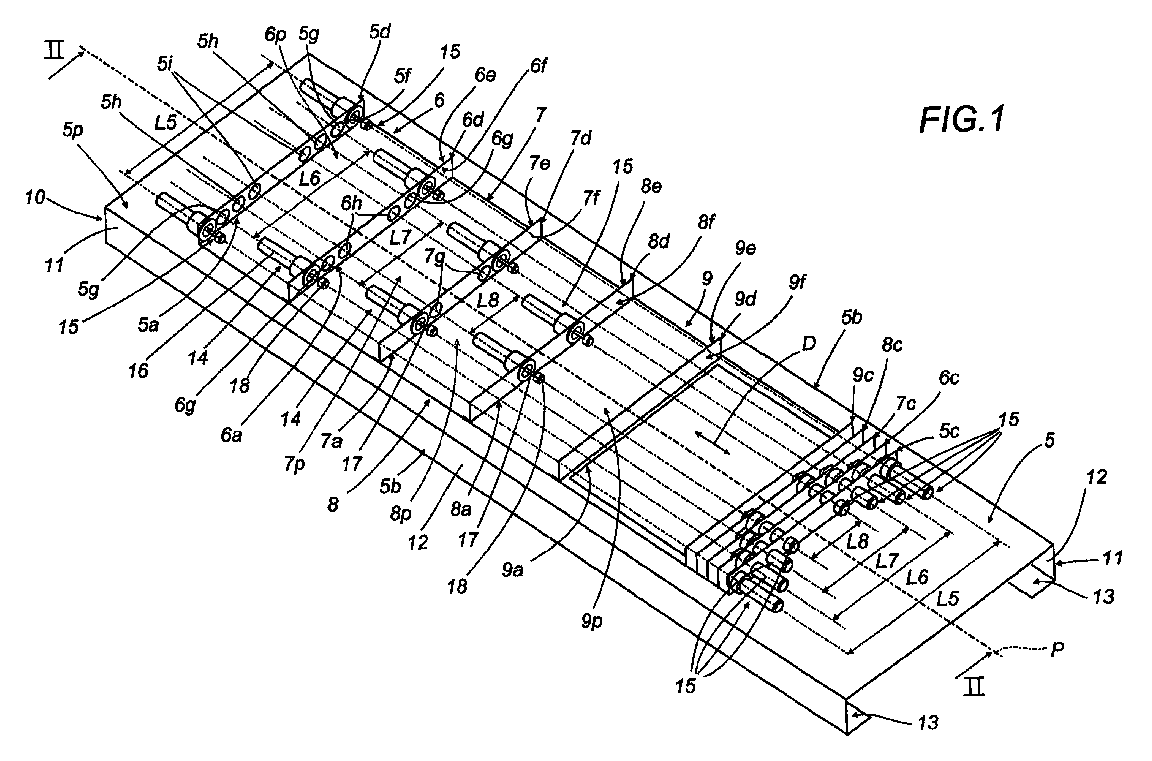
(57) A protective covering device (1) for machinery and equipment where a mobile tool
(2) moves in at least one direction (D; D1, D2) along a defined path (P), comprises
a set of cover elements (5, 6, 7, 8, 9; 5, 6, 7, 8) which are slidably coupled to
each other and consist of a first cover element (5) attached to the machine or piece
of equipment at an area to be protected, and a plurality of mobile cover elements
(6, 7, 8, 9; 6, 7, 8) that move relative to each other and relative to the first cover
element (5) along the defined path (P) followed by the tool (2). Each cover element
(5, 6, 7, 8, 9; 5, 6, 7, 8) comprises an opening (5a, 6a, 7a, 8a, 9a; 5a, 6a, 7a,
8a) for the passage of the mobile tool (2) to which one (9; 8) of the mobile cover
elements (6, 7, 8, 9; 6, 7, 8) is attached, and at least one pair of drive and/or
stop flanges (5c, 5d, 6c, 6d, 7c, 7d, 8c, 8d, 9c, 9d; 5c, 5d, 6c, 6d, 7c, 7d, 8c,
8d) to move and/or stop the mobile cover elements (6, 7, 8, 9; 6, 7, 8). Between the
flanges (5c, 5d, 6c, 6d, 7c, 7d, 8c, 8d, 9c, 9d; 5c, 5d 6c, 6d, 7c, 7d, 8c, 8d) facing
each adjacent cover element (5, 6, 7, 8, 9; 5, 6, 7, 8) there is at least one energy
dissipating element (15) to reduce the relative speed of the faster cover element
(6, 7, 8, 9; 6, 7, 8) as it approaches the slower cover element (5, 6, 7, 8; 5, 6,
7) without allowing energy to return between the two elements (5, 6, 7, 8, 9; 5, 6,
7, 8), so as to avoid swinging and rocking of the mobile tool (2).
|
|
