| (19) |
 |
|
(11) |
EP 1 260 671 B1 |
| (12) |
EUROPEAN PATENT SPECIFICATION |
| (45) |
Mention of the grant of the patent: |
|
08.09.2004 Bulletin 2004/37 |
| (22) |
Date of filing: 20.05.2002 |
|
|
| (54) |
Check valve for rig top drive
Rückschlagventil für Kraftdrehkopf
Soupape de retenue pour tête d'entraînement
|
| (84) |
Designated Contracting States: |
|
DE FR GB IT NL |
| (30) |
Priority: |
24.05.2001 US 865089
|
| (43) |
Date of publication of application: |
|
27.11.2002 Bulletin 2002/48 |
| (73) |
Proprietor: Halliburton Energy Services, Inc. |
|
Duncan,
Oklahoma 73536 (US) |
|
| (72) |
Inventor: |
|
- Szarka, David D.
Duncan,
Oklahoma 73533 (US)
|
| (74) |
Representative: Wain, Christopher Paul et al |
|
A.A. Thornton & Co.
235 High Holborn
London WC1V 7LE
London WC1V 7LE (GB) |
| (56) |
References cited: :
EP-A- 0 543 642
US-A- 2 128 352
US-A- 3 901 333
US-A- 4 248 264
|
WO-A-98/14688
US-A- 3 802 521
US-A- 4 100 969
US-A1- 2002 084 069
|
|
| |
|
|
|
|
| |
|
| Note: Within nine months from the publication of the mention of the grant of the European
patent, any person may give notice to the European Patent Office of opposition to
the European patent
granted. Notice of opposition shall be filed in a written reasoned statement. It shall
not be deemed to
have been filed until the opposition fee has been paid. (Art. 99(1) European Patent
Convention).
|
[0001] The present invention relates generally to the drilling and completion of wells and,
more particularly, to a check valve used to prevent spillage of well drilling fluids
from the fluid circulating system of a top drive of a drilling rig.
[0002] Casing installed in subsea completions and casing installed as a liner in land and
subsea completions is positioned within the well with a landing string, typically
a drill string, which has a small internal diameter than that of the casing. The use
of a landing string is necessary for liners and subsea wells because the casing strings
do not extend back to the well surface. As the casing is being lowered into the well,
an automatic valve at the bottom of the casing opens to permit well fluids in the
wellbore to flow into and fill the casing. Unless the pipe is lowered very slowly,
a reverse flow of drilling fluids is induced through the smaller diameter drill string
being used to install the casing. Special measure must be taken to confine any reverse
flow of drilling fluid from the drill pipe at the well surface.
[0003] Drilling rigs that are equipped with top drives can contain the back flow by making
up the threaded end of the top drive into each joint or stand of drill pipe as the
pipe is being run into the well. The requirement to repeatedly make up and disengage
the top drive threads, however, is time consuming and therefore expensive, particularly
in offshore installations.
[0004] US 2,128,352 describes a valve apparatus for use in a wellbore. One prior art drill
pipe fill up tool for top drives permits drilling mud to back flow through the top
drive and associated piping into the rig's mud pits. The fill up tool slides into
the top f the drill string and seals with the drill string to contain displaced fluid
as the string is being lowered. The prior art system permits rapid lowering of the
drill string without danger of spilling the overflow onto the rig flow. However, while
the prior art fill up tool contains the back flow of drilling fluid as the string
is being lowered into the well, once the drill string is suspended from slips on the
rig floor and the fill up tool is withdrawn from the top of the drill pipe string,
the fluid in the top drive and associated flexible piping is freed to flow out onto
the rig floor.
[0005] We have now found a way of overcoming this problem.
[0006] The present invention provides a pressure reversible check valve, comprising: an
axially extending tubular tool body having an inlet end and an outlet end, an axially
movable check valve assembly disposed within said tubular tool body intermediate said
inlet end and said outlet end, said check valve assembly being movable between first
and second axially spaced locations within said tubular tool body, a flow passage
extending within said check valve assembly for conducting fluids in said tubular tool
body through said check valve assembly, a valve closure element in said check valve
assembly movable between opened and closed flow passage positions respectively permitting
fluid flow through said flow passage and preventing fluid flow through said flow passage,
a bypass flow passage in said tubular body for conducting fluids from a location within
said tubular body to a location external to said tubular body, said bypass flow passage
being closed to fluid flow when said check valve assembly is at said first location
and being opened to fluid flow when said check valve assembly is at said second location,
and a biasing element for exerting a biasing force to urge said check valve assembly
from said second location toward said first location.
[0007] In accordance with the invention, a check valve assembly is connected to the end
of the rig top drive. The valve opens to permit drilling fluid to flow in reverse
through the drill pipe as the drill string and casing string are being lowered into
the wellbore. The check valve closes to prevent drainage or forward fluid flow from
the top drive and associated piping to prevent fluid spillage onto the rig floor when
the top drive is disconnected from the drill string. The check valve assembly may
be pressure activated by initiating pumping in the circulating system to overcome
a spring bias to thereby enable high-pressure flow in the forward-checked direction.
The check valve thus functions to permit reverse flow as required to fill the casing,
prevents spillage onto the drilling rig floor when the top drive is extracted from
the drill string and permits forward fluid flow as necessary to establish circulation
when the top drive is connected to the drill string.
[0008] Accordingly, it will be appreciated that a general object of the present invention
is to provide a tool for preventing spillage of fluids from a drilling rig system
used to position well pipe in a well.
[0009] Another object to the present invention is to provide a tool for automatically permitting
either reverse flow or forward circulation flow of fluid through a well string as
a function of the pressure of the fluid acting across the tool.
[0010] A specific object of the present invention is to provide a tool for use in a top
drive drilling system that accommodates return flow of well fluids from a casing string
being installed with a drill string and that prevents leakage of fluid from the top
drive and associated piping when the top drive is separated from the drill string
while selectively permitting forward pumping circulation through the top drive and
drill string as the drill string and casing are being lowered into the well.
[0011] It is also an object of the present invention to provide a fill up tool that permits
the safe running of subsea completion strings and casing liners from drilling rigs
using a top drive unit while maintaining minimal drilling fluid loss and greatly reducing
adverse environmental impact.
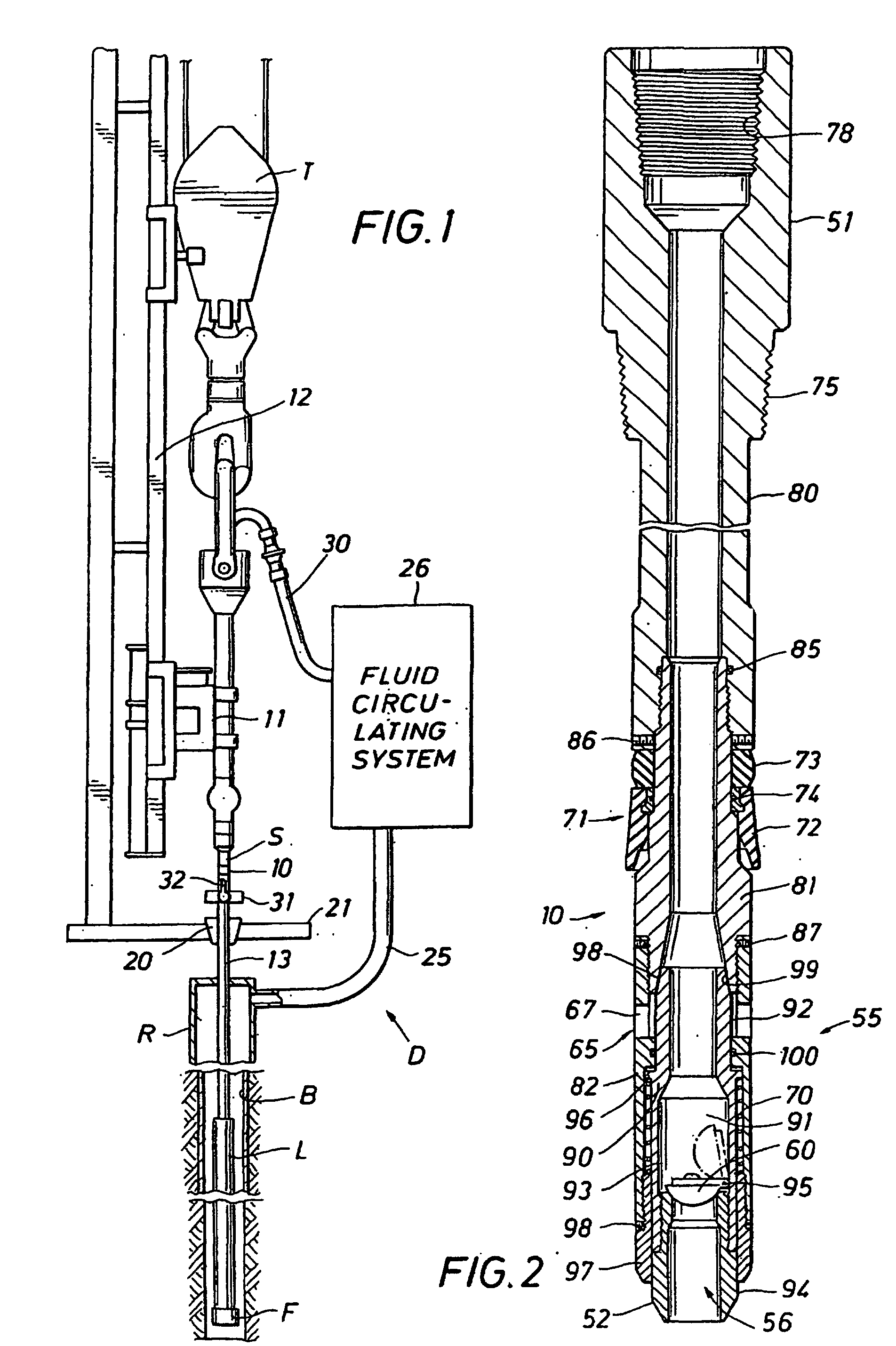
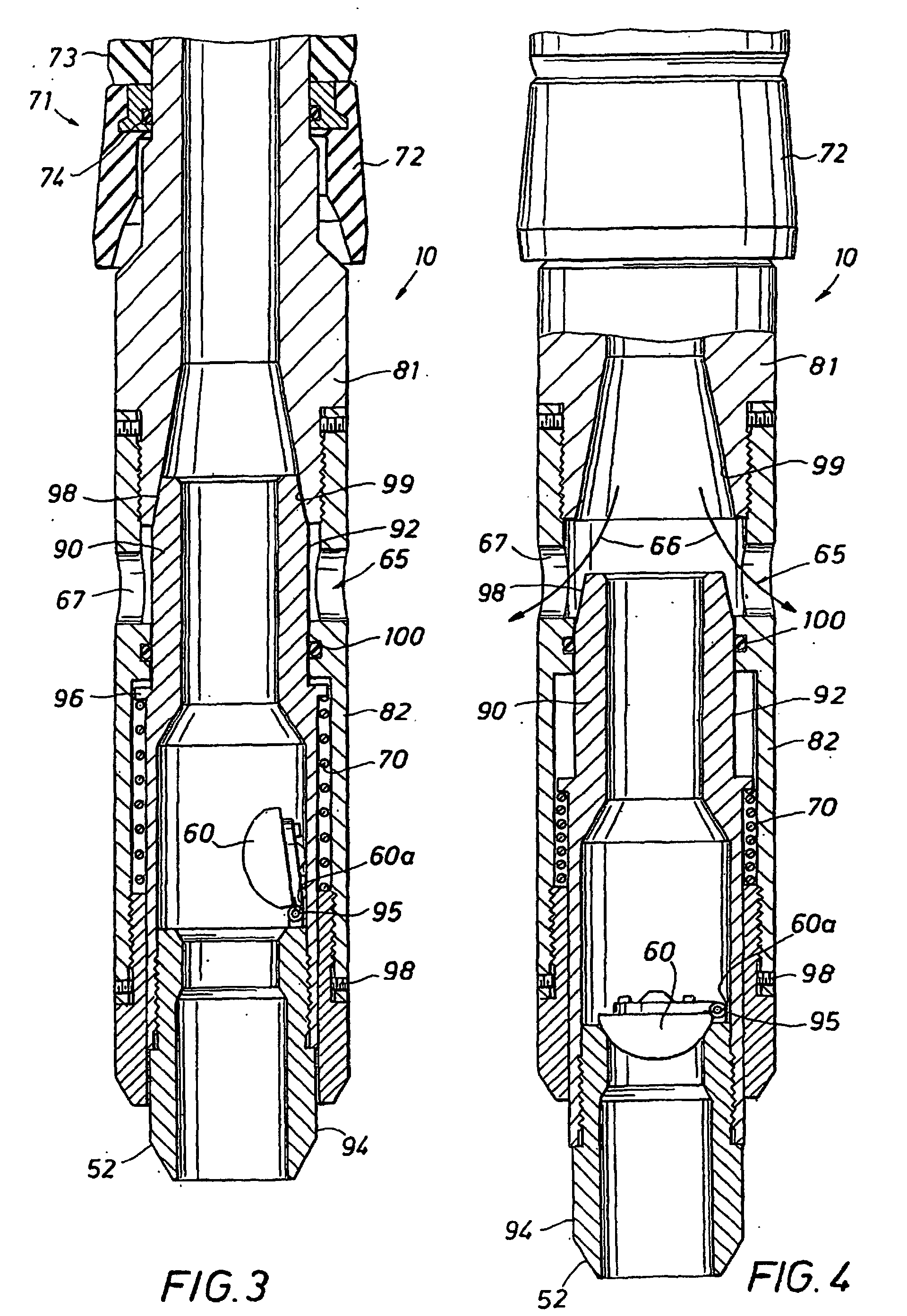
[0012] In order that the invention may be more fully understood, reference is made to the
accompanying drawings, wherein:
Figure 1 is a vertical elevation, partially in section, schematically illustrating
a top drive drilling system employing a tool of the present invention;
Figure 2 is a vertical sectional view illustrating details of one embodiment of tool
of the present invention;
Figure 3 is a partial vertical sectional view illustrating the tool of Figure 2 with
the flapper of the check valve in its open position permitting reverse flow of fluids;
and
Figure 4 is a partial vertical sectional view of the tool of Figure 2 with the flapper
of the check valve in its closed position and with the bypass flow passage opened
for forward circulation.
[0013] Figure 1 illustrates a top drive fill up and mud saver tool of the present invention,
indicated generally at 10, included as part of an offshore drilling system, indicated
generally at D. The drilling system D is equipped with a top drive 11 supported for
vertical movement along a torque track 12 in a conventional manner. The top of the
tool 10 connects to the top drive through a saver sub S.
[0014] The tool 10 is illustrated connected to the top of a drill string 13, which is supported
by slips 20 from a floor 21 of the drilling system D. The drill string 13 supports
a casing liner L being run into a well bore B. An automatic fill up shoe F at the
bottom of the liner L automatically opens to allow drilling fluids in the bore to
flow into the liner. A well pipe, which may be a riser R, extends from the wellbore
B to return fluid in the wellbore into a returns line 25 that connects with the system's
fluid circulating system 26. The circulating system contains pumps, tanks, filtration
and separation mechanisms and other well-known, conventional components. A flexible
fluid hose 30 communicates fluids between the circulating system 26 and the vertically
movable top drive 11. A drill pipe elevator 31 secured to elevator bales 32 extending
from the top drive 11 moves the drill string 13 vertically with the top drive. The
top drive 11 is raised and lowered by a travelling block T.
[0015] As illustrated in Figure 1, the liner L is lowered into the wellbore B by lowering
the top drive 11 and attached drill string 13 vertically. The downward motion of the
liner L through the drilling fluid produces a ramming action that forces fluid flow
upwardly through the liner and attached drill string 13. The reverse fluid flow through
the drill string is contained by the connection with the top drive system 11 so that
the returning fluid is forced into the fluid circulating system 26.
[0016] The liner is lowered into the wellbore B by adding drill pipe sections to the drill
string 13. When the tool 10 is separated from the drill string 13 to add another length
of drill pipe, well fluid contained within the tool 10, saver sub S, top drive 11
and flexible hose 30, unless checked, is free to fall or drain onto the rig floor.
The tool 10 of the present invention prevents such fluid loss.
[0017] As best illustrated in Figure 2, the tool 10 comprises an axially extending tubular
tool body having an inlet end 51 and an outlet end 52. An axially movable check valve
assembly, indicated generally at 55, is disposed within the tubular tool body intermediate
the inlet end 51 and the outlet end 52. A flow passage 56 extends through the check
valve assembly 55 for conducting fluids in the body of the tool 10 through the check
valve assembly. A valve closure element, indicated by a flapper valve element 60,
is moveable between open and closed flow passage positions that respectively permit
and prevent fluid flow through the flow passage 56. The flapper element 60 is biased
by a small spring 60a toward the closed flow passage position.
[0018] Referring jointly to Figures 3 and 4, a bypass flow passage 65 permits flow in a
direction indicated by the arrows 66 in Figure 4, from a location within the tubular
body through radial ports 67 to a location external to the tubular body. Such flow
is prevented when the check valve assembly 55 is in the axial position illustrated
in Figure 3 and is permitted when the check valve assembly is in the position illustrated
in Figure 4. A coil spring 70, disposed coaxially with the tool 10, biases the check
valve assembly 55 into the closed position illustrated in Figure 3. The bypass flow
passage 65 is opened by pump pressure exerted against the closed check valve to permit
forward circulation through the drill string and liner.
[0019] The tool 10 is provided with an annular, external seal indicated generally at 71,
extending radially from the external surface of the tubular body intermediate the
tool inlet end 51 and the outlet end 52. The seal 71 comprises a swab cup type sealing
element 72 and an annular packer type compression seal 73. The packer seal 73 is compressibly
set when a sufficiently high hydraulic pressure acts against the swab cup sealing
element 72. Setting the packer seal 73 reinforces the seal between the tool 10 and
the surrounding wall of the drill pipe is increasing pressure of the well fluid in
the drill string. An elastomeric O-ring 74 seals the swab cup to the external surface
of the tool 10.
[0020] An annular external threaded area 75 is provided immediate the inlet end 51 and the
outlet end 52 of the tool 10. The threaded area 75 functions as a tool joint pin to
engage the tool joint box threads at the top of the drill string 13. The tool 10 is
inserted into the top of the drill pipe 13 and rotated to engage the threaded pin
area 75 with the box threads of the drill string. The inlet end of the tool 10 is
provided with internal box threads 78 that are used to secure the tool to the pin
threads extending from the saver sub S.
[0021] The tool 10 is comprised of a tubular tool joint section 80, an intermediate tubular
seal carrier 81 and a tubular check valve housing 82. The seal carrier 81 is threaded
to the tool joint section 80. An elastomeric O-ring seal 85 is disposed between the
section 80 and the carrier 81. Lock pins 86 prevent unthreading of the carrier 81
and tool joint sections 80. Threads secure the check valve housing 82 to the lower
end of the seal carrier 81. Lock pins 87 maintain the two components in threaded engagement.
[0022] The axially movable check valve assembly 55 is comprised of a central internal sleeve
or mandrel 90 having an upper bypass seal section 92 and a lower valve support section
93. Threads at the bottom of the mandrel 91 secure a tubular check valve mount 94.
The check valve element 60 and spring 60a are hinged to the valve mount 94 by a hinge
pin 95. As best illustrated in Figure 2, the valve element 60 pivots open about the
pin 95 against the bias of the spring 60a to allow reverse flow and pivots closed
under the influences of the flapper element weight, the bias of the spring 60a and
the effect of flow of fluid to prevent forward flow through the central passage 56.
[0023] The coil spring 70 is coaxially disposed radially between the check valve housing
and the mandrel or valve support section 93. The coil spring 70 is confined axially
between a radial mandrel shoulder 96 and a keeper bushing 97 threaded into the base
of the valve housing 82. Lock pins 98A prevent the threads of the keeper bushing 97
and valve housing 82 from disengaging.
[0024] As may best be appreciated by reference to Figure 3, the mandrel 91 is urged toward
a bypass closing position by the coil spring 70, which is compressed axially between
the base of the keeper bushing 94 and the mandrel shoulder 96. The upper end of the
mandrel 91 is provided with a frustoconical external surface 98 that engages a correspondingly
shaped frustoconical interior surface 99 at the base of the seal carrier 81. When
engaged, the two frustoconical seal surfaces 98 and 99 form a first seal that cooperates
with an annular, elastomeric O-ring seal 100 carried within the valve housing 82 that
forms a second seal to prevent flow of fluids through the radial ports 67 of the flow
passage 65. The biasing force of the spring 70 is selected to be sufficiently great
that it will keep the flow passage 65 closed against the hydrostatic pressure produced
by the standing column of well fluids in the tool 10, saver sub S, top drive 11 and
hose section 30.
[0025] In operation, when adding a joint of drill pipe to the string 13, the fill up tool
at the bottom of the top drive 11 is stabbed into the top of the joint and the top
drive is advanced toward the joint until the pipe elevators 31 can be latched beneath
the "bottleneck" of the tool joint. In this position, the annular seal 71 of the tool
10 engages and seals against the internal surface of the newly added pipe joint. The
pin of the added joint is threaded into the box of the string 13 extending from the
rig floor and the added joint and the attached drill string are raised sufficiently
to release the string from the slips 20.
[0026] As the drill pipe 13 and the attached liner L are lowered into a wellbore, upward
flow of fluid through the drill string increases the pressure against the flapper
60 causing it to pivot against the bias force of the spring 60a into the open position
permitting the fluid to flow in reverse through the tool 10, top drive 11, flexible
line 30 and into the fluid circulating system 26. Once the added joint has been lowered
to the rig floor and hung off in the slips 20, the elevators are unlatched and the
top drive is raised to break the sealing connection between the drill pipe and the
tool 10. Before the connection is broken, the pressure in the tool above the flapper
valve is greater than that below the flapper valve, allowing the standing column of
fluid above the valve to attempt to flow into the drill string, allowing the spring
60a to return the check valve flapper 60 to the closed position. Once the flapper
valve 60 is closed, drainage of the standing column of fluid behind the valve is stopped.
With the tool 10 removed from the drill string 13 and the valve flapper 60 in the
closed position, the spring force of the spring 70 is greater than the opening force
exerted by the hydrostatic pressure of the standing fluid column so that the mandrel
92 remains in its uppermost, closed position as illustrated in Figure 2.
[0027] In the course of lowering the string into the well, it may become necessary to circulate
fluid in a forward direction to wash through a bridge, condition the hole, circulate
out a gas bubble or otherwise perform a function requiring forward circulation through
the system. Forward circulation can be initiated by overcoming the spring force that
maintains the mandrel 92 in its upper position in which the sealing surfaces 98 and
99 are engaged. Initiating pumping in the circulating system raises the pressure above
the closed check valve flapper 60 sufficiently to overcome the force of the spring
70. Under the influence of the pumping pressure, the mandrel 92 shifts axially downwardly
into an axial position that opens the bypass 65. When the mandrel is shifted into
the position illustrated in Figure 4, fluid is free to flow from the interior of the
tool 10 through the radial ports 67 and into the drill pipe 13.
[0028] The increasing pressure of the fluid in the drill string acts against the swab cup
seal 72 to shift the seal axially toward the annular compression seal 73. The axial
movement of the seal 72 compresses the seal 73 against the base of the tool joint
section 80 to exert an increasing radial sealing force against the surrounding drill
pipe wall.
[0029] If it becomes necessary to rotate the drill string and liner while circulating, the
slips are set to hold the string 13 and the threaded tool joint pin area 75 on the
tool 10 is lowered and made up into the top box connection of the drill pipe string.
When thus engaged with the drill string 13, the top drive 11 can rotate and reciprocate
the drill string during foreword circulation.
1. A pressure reversible check valve, comprising: an axially extending tubular tool body
having an inlet end (51 ) and an outlet end (52), an axially movable check valve assembly
(55) disposed within said tubular tool body intermediate said inlet end (51) and said
outlet end (52), said check valve assembly (55) being movable between first and second
axially spaced locations within said tubular tool body, a biasing element (70) for
exerting a biasing force to urge said check valve assembly (55) from said second location
toward said first location, a flow passage (56) extending within said check valve
assembly (55) for conducting fluids in said tubular tool body through said check valve
assembly (55), a valve closure element (60) in said check valve assembly (55) movable
between opened and closed flow passage positions respectively permitting fluid flow
through said flow passage (56) and preventing fluid flow through said flow passage
(56), a bypass flow passage (65) in said tubular body for conducting fluids from a
location within said tubular body to a location external to said tubular body, said
bypass flow passage (65) being closed to fluid flow when said check valve assembly
(55) is at said first location and being opened to fluid flow when said check valve
assembly (55) is at said second location, wherein the check valve assembly (55) is
movable from the first position to the second position to open the bypass flow passage
(65) to fluid flow, and characterised in that the check valve assembly (55) is movable from the second position to the first position
to close the bypass flow passage (65) to fluid flow.
2. A valve as defined in claim 1, further comprising an annular external seal (71), preferably
a swab cup type seal (72), extending radially from an external surface of said tubular
tool body intermediate said inlet end (51) and said outlet end (52) for sealing said
external surface with an internal surface of a surrounding, axially extending tubular
body.
3. A valve as defined in claim 1 or 2, further comprising an annular external threaded
area (75) extending radially from an outer external surface of said tubular tool body
intermediate said inlet end (51) and said outlet end (52) for threadedly engaging
said tubular tool body with internal threads formed on an internal surface of a surrounding,
axially extending tubular body.
4. A valve as defined in claim 2 and 3, wherein said annular external threaded areas
(75) is disposed axially intermediate said inlet end (51) and said annular external
seal (71) and wherein an outlet for said bypass flow passage (65) is disposed axially
intermediate said outlet end (52) and said annular external seal (71).
5. A valve as defined in any of daim 1 to 4 wherein said inlet end (51) is threaded preferably
internally threaded, for receiving a mating threaded end of a tubular conductor.
6. A valve as defined in any of claims 1 to 5, wherein said check valve assembly (55)
comprises an axially movable valve sleeve (90) and wherein said valve closure element
(60) is carried in said valve sleeve (90).
7. A valve as defined in claim 6, wherein said valve closure element (60) comprises a
flapper valve closure member pivotally mounted within said valve sleeve (90) for pivotal
movement between said first and second flow passage positions.
8. A valve as defined in claim 6 or 7, wherein said biasing element (70) comprises a
coil spring coaxially disposed with said axially movable valve sleeve (90), said coil
spring being preferably disposed radially between said axially movable valve sleeve
(90) and said tubular tool body.
9. A valve as defined in any of claims 1 to 8, further comprising first (100) and second
(98,99) axially spaced annular internal sleeve seals disposed on an internal surface
of said tubular tool body and wherein said bypass flow passage (65) comprises one
or more radial openings (67) through said tubular tool body intermediate said first
(100) and second (98,99) sleeve seals.
10. A valve as defined in claim 9 wherein said valve sleeve (90) is axially movable into
and out of sealing engagement with said second annular internal sleeve seal (98,99)
to respectively prevent and permit fluid flow through said bypass flow passage (65).
11. A valve as defined in claim 5, wherein said inlet end (51) is threaded for receiving
a mating threaded end of a tubular connector extending from a top drive (11) of a
drilling rig.
12. A valve as defined in claim 4, wherein said annular external threaded (75) area is
threaded for engaging an internally threaded box of a drill string (13) or is a pin
thread for connection with a box thread of a drill string (13).
13. A valve as defined in claims 1 to 12, wherein the biasing force of said biasing element
(70) is greater than a reverse force attributable to a first value of hydrostatic
fluid pressure of fluid in said tubular body to maintain said bypass flow passage
(65) closed to flow of fluids.
14. A valve as defined in any of claims 1 to 13, wherein said valve closure element (60)
is moved to said open flow passage position when fluid pressure at said outlet end
(52) is greater than fluid pressure at said inlet end (51), and/or wherein said valve
closure element (60) is moved to said closed flow passage position when fluid pressure
at said inlet end (51) is greater than fluid pressure at said outlet end (52).
15. A valve as defined in any of claims 1 to 14, wherein said bypass flow passage (65)
is closed to fluid flow when fluid pressure at said outlet end (52) is greater than
fluid pressure at said inlet end (51), and/or wherein said bypass flow passage (65)
is open to fluid flow when fluid pressure at said inlet (51) exceeds said first value
of hydrostatic fluid pressure in said tubular body.
16. A valve as defined in claim 2, wherein said annular external seal further comprises
a packer type seal (73) actuated by axial movement of said swab cup type seal (72)
for increasing a sealing pressure between said external surface and said internal
surface of said surrounding tubular body.
1. Ein Druckumkehrrückschlagventil, welches das Folgende umfasst: einen sich axial erstreckenden,
rohrförmigen Werkzeugkörper mit einem Einlaßende (51) und einem Auslaßende (52), einer
axial bewegbaren Rückschlagventileinheit (55), welche innerhalb des vorgenannten rohrförmigen
Werkzeugkörpers zwischen dem vorgenannten Einlaßende (51) und dem vorgenannten Auslaßende
(52) positioniert ist, wobei die vorgenannte Rückschlagventilmontage (55) zwischen
einem ersten und einem zweiten axial angeordneten Standort innerhalb des vorgenannten
rohrförmigen Werkzeugkörpers bewegbar ist, ein Vorspannelement (70) für das Auferlegen
einer Vorspannkraft, für das Verdrängen der vorgenannten Rückschlagventilmontage (55)
von ihrem vorgenannten zweiten Standort in Richtung des vorgenannten ersten Standortes,
einen Fließdurchgang (56), welcher sich innerhalb der vorgenannten Rückschlagventilmontage
(55) erstreckt, für das Leiten von Flüssigkeit innerhalb des vorgenannten rohrförmigen
Werkzeugkörpers durch die Rückschlagventilmontage (55), ein Ventilschließelement (60)
innerhalb der vorgenannten Rückschlagventilmontage (55), welches zwischen geöffneten
und geschlossenen Fließdurchgangspositionen bewegt werden kann, welche jeweils einen
Flüssigkeitsdurchfluß durch den vorgenannten Fließdurchgang (56) ermöglichen und einen
Flüssigkeitsdurchfluß durch den vorgenannten Fließdurchgang (56) verhindern, einen
Beipassfließdurchgang (65) in dem vorgenannten rohrförmigen Körper, für das Leiten
von Flüssigkeiten von einem Standort innerhalb des vorgenannten rohrförmigen Körpers
an einen Standort ausserhalb des vorgenannten rohrförmigen Körpers, wobei der vorgenannte
Beipassfließdurchgang (65) gegenüber eines Flüssigkeitsdurchflusses verschlossen ist,
wenn die vorgenannte Rückschlagventilmontage (55) sich an dem vorgenannten ersten
Standort befindet, und wenn dieselbe gegenüber eines Flüssigkeitsdurchflusses geöffnet
ist, wenn sich die vorgenannte Rückschlagventilmontage (55) an ihrem zweiten Standort
befindet, wobei die Rückschlagventilmontage (55) von der ersten Position auf die zweite
Position bewegt werden kann, um den Beipassfließdurchgang (65) gegenüber eines Flüssigkeitsdurchflusses
zu öffnen, und dadurch gekennzeichnet, dass die Rückschlagventilmontage (55) von der zweiten Position auf die erste Position
bewegt werden kann, um den Beipassfließdurchgang (65) gegenüber eines Flüssigkeitsdurchflusses
zu schliessen.
2. Ein Ventil nach Anspruch 1, welches weiter einen ringförmigen externen Sitz (71) umfasst,
vorzugsweise eine Pistonierkolbendichtung (72), welche sich radial von einer Aussenfläche
des vorgenannten rohrförmigen Werkzeugkörpers zwischen dem vorgenannten Einlaßende
(51) und dem vorgenannten Auslaßende (52) erstreckt, für das Abdichten der vorgenannten
Aussenfläche mit einer internen Fläche eines dieselbe umgebenden, sich axial erstreckenden
rohrfömigen Körpers.
3. Ein Ventil nach Anspruch 1 oder 2, welches weiter einen ringförmigen, externen Gewindebereich
(75) umfasst, welcher sich radial von einer Aussenfläche des vorgenannten rohrförmigen
Werkzeugkörpers zwischen dem vorgenannten Einlaßende (51) und dem vorgenannten Auslaßende
(52) erstreckt, für das Einschrauben des vorgenannten rohrförmigen Körpers mit dem
Innengewinde, welches auf einer Innenfläche eines denselben umgebenden, sich axial
erstreckenden rohrförmigen Körper positioniert ist.
4. Ein Ventil nach Anspruch 2 und 3, bei welchem die vorgenannten ringförmigen Aussengewindebereiche
(75) axial zwischen dem vorgenannten Einlaßende (51) und der vorgenannten ringförmigen
Aussendichtung (71) positioniert sind, wobei ein Auslaß für den vorgenannten Beipassfließdurchgang
(65) axial zwischen dem vorgenannten Auslaßende (52) und der vorgenannten ringförmigen
Aussendichtung (71) positioniert ist.
5. Ein Ventil nach einem der obigen Ansprüche 1 bis 4, bei welchem das vorgenannte Einlaßende
(51) ein Gewinde umfasst, vorzugsweise ein Innengewinde, für das Empfangen eines passenden
Gewindeendes einer rohrförmigen Verbindung.
6. Ein Ventil nach einem der obigen Ansprüche 1 bis 5, bei welchem die vorgenannte Rückschlagventilmontage
(55) eine axial bewegbare Ventilhülse (90) umfasst, und bei welcher das vorgenannte
Ventilschließelement (60) innerhalb der vorgenannten Ventilhülse (90) positioniert
ist.
7. Ein Ventil nach Anspruch 6, bei welchem das vorgenannte Ventilschließelement (60)
ein Klappenventilschließteil umfasst, welches drehbar innerhalb der vorgenannten Ventilhülse
(90) befestigt ist, für eine Drehbewegung zwischen den vorgenannten ersten und zweiten
Fließdurchgangspositionen.
8. Ein Ventil nach Anspruch 6 oder 7, bei welchem das vorgenannte Vorspannelement (70)
eine Spulenfeder umfasst, welche koaxial mit der vorgenannten axial bewegbaren Ventilhülse
(90) positioniert ist, wobei die vorgenannte Spulenfeder vorzugsweise radial zwischen
der vorgenannten axial bewegbaren Ventilhülse (90) und dem vorgenannten rohrförmigen
Werkzeugkörper positioniert ist.
9. Ein Ventil nach einem der obigen Ansprüche 1 bis 8, welches weiter erste (100) und
zweite (98, 99) axial angeordnete ringförmige interne Hülsendichtungen umfasst, welche
auf einer Innenfläche des vorgenannten rohrförmigen Werkzeugkörpers positioniert sind,
wobei der vorgenannte Beipassfließdurchgang (65) eine oder mehrere radiale Öffnungen
(67) durch den vorgenannten rohrförmigen Werkzeugkörper hindurch zwischen den ersten
(100) und zweiten (98, 99) Hülsendichtungen umfasst.
10. Ein Ventil nach Anspruch 9, bei welchem die vorgenannte Ventilhülse (90) axial in
einen abdichtenden Kontakt mit der vorgenannten zweiten ringförmigen internen Hülsendichtung
(98, 99) hinein und aus einem abdichtenden Kontakt mit derselben heraus bewegt werden
kann, um den Flüssigkeitsdurchfluß durch den vorgenannten Beipassfließdurchgang (65)
jeweils zu verhindern oder zu ermöglichen.
11. Ein Ventil nach Anspruch 5, bei welchem das vorgenannte Einlaßende (51) ein Gewinde
umfasst, für das Empfangen eines passenden Gewindeendes einer rohrförmigen Verbindung,
welche sich von einem Oberantrieb (11) Bohrinsel herab erstreckt.
12. Ein Ventil nach Anspruch 4, bei welchem der vorgenannte ringförmige Aussengewindebereich
(75) ein Gewinde umfasst, für das Empfangen einer Innengewindebox eines Bohrgestänges
(13), oder ein Zapfengewinde, für eine Verbindung mit dem Boxgewinde eines Bohrgestänges
(13).
13. Ein Ventil nach den obigen Ansprüchen 1 bis 12, bei welchem die Vorspannkraft des
vorgenannten Vorspannelementes (70) grösser ist als die Rückstellkraft, welche einem
ersten Wert eines hydrostatischen Flüssigkeitsdrucks der Flüssigkeit innerhalb des
vorgenannten rohrförmigen Körpers zugeschrieben werden kann, so dass der vorgenannte
Beipassfließdurchgang (65) gegenüber einem Durchfluß von Flüssigkeit geschlossen gehalten
werden kann.
14. Ein Ventil nach einem der obigen Ansprüche 1 bis 13, bei welchem das vorgenannte Ventilschließelement
(60) auf die vorgenannte offene Fließdurchgangsposition bewegt wird, wenn der Flüssigkeitsdruck
an dem vorgenannten Auslaßende (52) grösser ist als der Flüssigkeitsdruck an dem vorgenannten
Einlaßende (51), und/oder bei welchem das vorgenannte Ventilschließelement (60) auf
die vorgenannte geschlossene Fließdurchgangsposition bewegt wird, wenn der Flüssigkeitsdruck
an dem vorgenannten Einlaßende (51) grösser ist als der Flüssigkeitsdruck an dem vorgenannten
Auslaßende (52).
15. Ein Ventil nach einem der obigen Ansprüche 1 bis 14, bei welchem der vorgenannte Beipassfließdurchgang
(65) gegen einen Flüssigkeitsdurchfluß geschlossen ist, wenn der Flüssigkeitsdruck
an dem vorgenannten Auslaßende (52) grösser ist als der Flüssigkeitsdruck an dem vorgenannten
Einlaßende (51), und/oder bei welchem der vorgenannte Beipassfließdurchgang (65) für
einen Flüssigkeitsdurchfluß geöffnet ist, wenn der Flüssigkeitsdruck an dem vorgenannten
Einlaß (51) den vorgenannten ersten Wert des hydrostatischen Flüssigkeitsdrucks in
dem vorgenannten rohrförmigen Körper übersteigt.
16. Ein Ventil nach Anspruch 2, bei welchem die vorgenannte ringförmige Aussendichtung
weiter eine Packerdichtung (73) umfasst, welche durch eine axiale Bewegung der vorgenannten
Pistonierkolbendichtung (72) betätigt wird, für das Steigern eines Dichtungsdrucks
zwischen der vorgenannten Aussenfläche und der vorgenannten Innenfläche des vorgenannten,
dieselben umgebenden rohrförmigen Körpers.
1. Clapet de retenue réversible en pression, comprenant: un corps d'outil tubulaire s'étendant
axialement ayant une extrémité d'entrée (51) et une extrémité de sortie (52), un clapet
de retenue équipé mobile axialement (55) disposé à l'intérieur dudit corps d'outil
tubulaire entre ladite extrémité d'entrée (51) et ladite extrémité de sortie (52),
ledit clapet de retenue équipé (55) étant mobile entre un premier point et un second
point espacés axialement à l'intérieur dudit corps d'outil tubulaire, un élément de
polarisation (70) servant à appliquer une force de polarisation pour faire passer
ledit clapet de retenue équipé (55) dudit second point vers ledit premier point, un
passage d'écoulement (56) s'étendant à l'intérieur dudit clapet de retenue équipé
(55) pour acheminer les fluides dans ledit corps d'outil tubulaire à travers ledit
clapet de retenue équipé (55), un élément de fermeture de valve (60) dans ledit clapet
de retenue équipé (55) mobile entre une position de passage d'écoulement ouverte et
une position de passage d'écoulement fermée permettant respectivement un écoulement
de fluide entre ledit passage d'écoulement (56) et empêchant l'écoulement de fluide
à travers ledit passage d'écoulement (56), un passage d'écoulement de dérivation (65)
dans ledit corps tubulaire pour acheminer les fluides depuis un point situé dans ledit
corps tubulaire vers un point externe audit corps tubulaire, ledit passage d'écoulement
de dérivation (65) étant fermé à l'écoulement de fluide lorsque ledit clapet de retenue
équipé (55) est situé audit premier point et étant ouvert à l'écoulement de fluide
lorsque ledit clapet de retenue équipé (55) est situé audit second point, tandis que
le clapet de retenue équipé (55) est mobile de la première position à la seconde position
pour ouvrir le passage d'écoulement de dérivation (65) à l'écoulement de fluide, et
caractérisé en ce que le clapet de retenue équipé (65) est mobile de la seconde position à la première
position pour refermer le passage d'écoulement de dérivation (65) à l'écoulement de
fluide.
2. Clapet selon la revendication 1, comprenant en outre un joint externe annulaire (71),
de préférence un joint de type coupelle de pistonnage (72, s'étendant radialement
depuis une surface externe dudit corps d'outil tubulaire entre ladite extrémité d'entrée
(51) et ladite extrémité de sortie (52) pour assurer l'étanchéité de ladite surface
externe avec une surface interne d'un corps tubulaire environnant, s'étendant axialement.
3. Clapet selon la revendication 1 ou 2, comprenant en outre une zone filetée externe
annulaire (75) s'étendant axialement depuis une surface externe dudit corps d'outil
tubulaire entre ladite extrémité d'entrée (51) et ladite extrémité de sortie (52)
pour engrener par filetage ledit corps d'outil tubulaire avec les filets internes
formés sur une surface interne d'un corps tubulaire environnant, s'étendant axialement.
4. Clapet selon les revendications 2 et 3, dans lequel ladite zone filetée externe annulaire
(75) est disposé axialement entre ladite extrémité d'entrée (51) et ledit joint externe
annulaire (71) et dans lequel une sortie est prévue pour ledit passage d'écoulement
de dérivation (65) axialement entre ladite extrémité de sortie (52) et ledit joint
annulaire externe (71).
5. Clapet selon l'une quelconque des revendications 1 à 4, dans lequel ladite extrémité
d'entrée (51) est fileté, de préférence par un filetage interne, pour recevoir une
extrémité filetée correspondante d'un connecteur tubulaire.
6. Clapet selon l'une quelconque des revendications 1 à 5, dans lequel ledit clapet de
retenue équipé (55) comprend un manchon de valve mobile axialement (90) et dans lequel
ledit élément de fermeture de valve (60) est porté dans ledit manchon de valve (90).
7. Clapet selon la revendication 6, dans lequel ledit élément de fermeture de valve (60)
comprend un élément de fermeture de valve à volet obturateur monté de façon pivotante
à l'intérieur dudit manchon de valve (90) pour assurer un mouvement pivotant entre
ladite première position de passage d'écoulement et ladite seconde position de passage
d'écoulement.
8. Clapet selon la revendication 6 ou 7, dans lequel l'élément de polarisation (70) comprend
un ressort hélicoïdal disposé coaxialement par rapport audit manchon de valve mobile
axialement (90), ledit ressort hélicoïdal étant disposé de préférence entre ledit
manchon de valve mobile axialement (90) et ledit corps d'outil tubulaire.
9. Clapet selon l'une quelconque des revendications 1 à 8, comprenant en outre un premier
joint de manchon interne annulaire (100) et des seconds joints de manchon internes
annulaires (98, 99) espacés axialement, disposés à la surface interne dudit corps
d'outil tubulaire et dans lequel ledit passage d'écoulement de dérivation (65) comprend
une ou plusieurs ouvertures radiales (67) à travers ledit corps d'outil tubulaire
entre ledit premier joint de manchon (100) et lesdits seconds joints de manchon (98,
99).
10. Clapet selon la revendication 9, dans lequel ledit manchon de valve (90) est mobile
axialement pour s'engager et se dégager hermétiquement desdits seconds joints de manchon
internes annulaires (98, 99) pour respectivement empêcher et permettre un écoulement
de fluide à travers ledit passage d'écoulement de dérivation (65).
11. Clapet selon la revendication 5, dans lequel ladite extrémité d'entrée (51) est filetée
pour recevoir une extrémité filetée correspondante d'un connecteur tubulaire s'étendant
depuis un système d'entraînement supérieur (11) d'une plate-forme de forage.
12. Clapet selon la revendication 4, dans lequel ladite zone filetée externe annulaire
(75) est filetée pour engrener un filetage femelle interne dans une colonne de forage
(13) ou bien constitue un filetage mâle pour se raccorder au filetage femelle d'une
colonne de forage (13).
13. Clapet selon l'une quelconque des revendications 1 à 12, dans lequel la force de polarisation
dudit élément de polarisation (70) est supérieure à une force inverse imputable à
une première valeur de pression de fluide hydrostatique dans ledit corps tubulaire
pour maintenir ledit passage d'écoulement de dérivation (65) fermé à l'écoulement
de fluides.
14. Clapet selon l'une quelconque des revendications 1 à 13, dans lequel ledit élément
de fermeture de valve (60) adopte ladite position ouverte de passage d'écoulement
lorsque la pression de fluide au niveau de ladite extrémité de sortie (52) est supérieure
à la pression de fluide au niveau de ladite extrémité d'entrée (51) et/ou dans lequel
ledit élément de fermeture de valve (60) adopte ladite position fermée de passage
d'écoulement lorsque la pression de fluide au niveau de ladite extrémité d'entrée
(51) est supérieure à la pression de fluide au niveau de ladite extrémité de sortie
(52).
15. Clapet selon l'une quelconque des revendications 1 à 14, dans lequel ledit passage
d'écoulement de dérivation (65) est fermé à l'écoulement de fluide lorsque la pression
de fluide au niveau de ladite extrémité de sortie (52) est supérieure à la pression
de fluide au niveau de ladite extrémité d'entrée (51) et/ou dans lequel ledit passage
d'écoulement de dérivation (65) est ouvert à l'écoulement de fluide lorsque la pression
de fluide au niveau de ladite entrée (51) dépasse ladite première valeur de pression
de fluide hydrostatique dans ledit corps tubulaire.
16. Clapet selon la revendication 2, dans lequel ledit joint externe annulaire comprend
en outre un joint de type garniture (73) actionné par le mouvement axial dudit joint
de type coupelle de pistonnage (72) pour augmenter une pression d'étanchéité entre
ladite surface externe et ladite surface interne dudit corps tubulaire environnant.