|
(11) | EP 1 261 431 B1 |

| (12) | EUROPEAN PATENT SPECIFICATION |
|
|
| (54) |
APPARATUS FOR GRINDING OF PARTICULATE MATERIAL VORRICHTUNG ZUR ZERKLEINERUNG VON KÖRNIGEM MATERIAL APPAREIL DE BROYAGE D'UNE SUBSTANCE PARTICULAIRE |
|
|
|||||||||||||||||||||||||||||||
| Note: Within nine months from the publication of the mention of the grant of the European patent, any person may give notice to the European Patent Office of opposition to the European patent granted. Notice of opposition shall be filed in a written reasoned statement. It shall not be deemed to have been filed until the opposition fee has been paid. (Art. 99(1) European Patent Convention). |
[0001] The present invention relates to an apparatus for grinding of particulate material such as cement raw materials, cement clinker or similar materials, in a roller mill, such as a roller press, ring-roller mill, vertical mill or a similar unit. The shaft being of substantially vertical configuration and with a downwardly reduced cross-section.
[0002] An apparatus of the aforementioned kind is prior art as for example disclosed in GB 963088 A.
[0003] In recent years, developments in grinding technology have primarily been devoted to impriving the cost efficiency of the grinding process. In this context, the primary focus has been to improve the operating economy of the grinding process and to reduce the capital cost of the grinding machines relative to their capacity ratings. A method widely used to lower the investments costs involves uprating of the operating speed of a machine, and hence its productivity. Needless to say, the operating speed of a machine can only be increased up to a certain point, and, furthermore, it is a recongnized fact that problems are likely to occur in connection with the operation of, for example, a roller press if the peripheral velocity of the rollers is increased arbitrarily.
[0004] Such operating problems may be ascribable to many different causes. On explanation could be the difficulty of achieving an acceleration of the material shich is to be ground in the roller press to an extent which corresponds to the peripheral velocity of the rollers. Such acceleration of the material is usually achieved by means of the rollers by physical contact with the latter and/or through the action of gravity. However, the capability of the rollers is restricted to a very short range of operation, thereby severly limiting the rate of acceleration, and in a shaft the force of gravity will either be counteracted by the friction of the material against the shaft and/or the friction present in the material itself. Also, acceleration accomplished in a traditional shaft will also entail significant admixture of air, which is undesirable, and this will also adversely affect the grinding process. Use of a vertical shaft with a circular or rectangular cross-section and with an identical cross-sectional area across the entire length will enable the force of gravity to accelerate the material to a high velocity, but in this scenario there will be a simultaneous increase in the distance between the particles, thereby decreasing the density of the material an involving air admixture. By using a shaft of a pyrimidal or conical configuration, it will be possible to maintain the distance between the particles, but in a shaft of this type the material will be influenced by forces of friction which are so substantial that the terminal velocities attainable are quite small. In such ordinary shafts the cross-sectional circumference is a liniarly decreasing function of the height. The reduction of the cross-sectional circumference per height unit thus remains constant for these shafts.
[0005] It is the objective of the present, invention to provide an apparatus for remedying the aforementioned deficiencies.
[0006] This is achieved by an apparatus of the kind mentioned in the introduction, and being characterized in that the reduction of the shaft's cross-sectional circumference per heiht unit is downwardly decreasing.
[0007] The described configuration of the feed shaft has, surprisingly, proved that the material over a given height of fall may attain high velocities, and that this is feasible without involving admixture of air into the material. It has thus been established that it will be possible for the material to attain velocities which are close to the velocity achievable in connection with the free fall of individual particles.
[0008] The material can be accelerated to a velocity of more than 1.5 m/s. However, it is preferred that the material be accelerated to a velocity of more than 5 m/s, and preferably of more than 10 m/s.
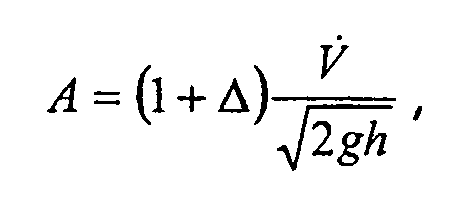
[0009] An example of the cross-sectional characteristics according to the invention is known from the form of a free-falling water jet, for example from a slow-running water tap. At the top, at the outlet of the water tap, the water flow rate is quite small, with the width of the water jet corresponding roughly to the outlet. Further downstream of the jet the force of gravity has increased the water flow rate, but since the water flow throughout the jet is the same, and since the density throughout the jet is also the same, this means that the cross-section of the water jet is smaller. In this way the water jet will attain an almost hyperbolic shape and the characteristics of the cross-sectional area as a function of the height of fall can be expressed by means of the formula:
where
A is the cross-sectional area
V̇ is the volume flow
g is the gravity acceleration
h is the height of fall
Δ is a correction element which describes the friction in the material, assuming for water a small value which is close to 0
[0010] The water jet must be assumed to roughly circular and, therefore, its circumference can be calculated on the basis cf the formula:
where
O is the circumference
D is the diameter of the water jet
[0011] As it appears from the aforementioned formula, the circumference is proportional not to the height of fall but to the height of fall to power ÷¼.
[0012] According to the invention it is preferred that the shaft be configured so that its cross-sectional area as a function of the fall of height is essentially as defined in the formula above. To make allowance for the friction which occurs when feeding particulate material via a shaft according to the invention, the correction element Δ must be within the range 0 and 0.2, preferably lower than 0.1.
[0013] The shaft may, for example, be made up of a number of pyramidal or conical sections so that the reduction of the cross-sectional circumference of the shaft exhibits a gradual, downwardly decreasing trend. To ensure that the shape of such a shaft does not deviate too much from the formula (1) indicated above, it is preferred that the number of sections incorporated is at least 3, but preferably at least 5, and most preferably at least 10.
[0014] However, it is preferred that the reduction of the cross-sectional circumference of the shaft exhibits a continuous downwardly decrease, and that for example the shaft is of a trumpet-shaped configuration.
[0015] In principle, it will be possible to use the shaft according to the invention for conveying any particulate material from one level to a lower level by the action of gravity, and for this purpose the shaft should be of a substantially vertical configuration, with a downwardly reduced cross-section where the reduction of the cross-sectional circumference of the shaft is downwardly decreasing.
[0016] The invention will be explained in further details in the following with reference being made to the drawing, which is diagrammatical, and where
[0018] In Fig. 1 is seen a roller press installation comprising a roller press 1 with two oppositely rotating rollers 3 and 5. During the operation of the roller press, the material to be ground is fed from a bin 7 via a feed conveyor 9 and a feed shaft 11 to a grinding zone 13 between the rollers 3 and 5.
[0019] According to the invention the depicted shaft is formed with a downwardly reduced cross-section in such a way that the reduction of the shafts cross-sectional circumference per height unit is also downwardly decreasing. Ideally the shaft is formed with a downwardly decreasing cross-section which is inversely proportional to the steadily downwardly increasing velocity of the material due to the gravity-induced acceleration. Hence it will be possible for the material to achieve a velocity close to the velocity of a free fall without admixture of air, allowing the roller press to be operated at higher roller velocities, thereby increasing its rate of production.
[0020] The applicant filing the present patent application has conducted tests with a shaft configured in accordance with the aforementioned guidelines, with a final cross section of 0.1 x 0.1 metres and a height of 5 metres, and has recorded a material velocity which is close to 10 m/s without air admixture.
1. An apparatus for grinding of particulate material such as cement raw materials, cement
clinker or similar materials, which apparatus comprises a roller mill (1) as well
as a shaft (11) for feeding particulate material to the grinding zone (13) of the
roller mill, the shaft (11) being of a substantially vertical configuration and with
a downwardly reduced cross-section characterized in that the reduction of the shaft's cross-sectional circumference per height unit is downwardly
decreasing.
2. An apparatus according to claim 1 the cross-sectional area of the shaft as a function
of the height of fall is in accordance with the formula
where
A is the cross-sectional area
V is the volume flow
g is the gravity acceleration
h is the height of fall
Δ is within the range 0 and 0.2, preferably lower than 0.1.
where
A is the cross-sectional area
V is the volume flow
g is the gravity acceleration
h is the height of fall
Δ is within the range 0 and 0.2, preferably lower than 0.1.
3. An apparatus according to claim 1 characterized in that the shaft is made up of at least 3 pyramical or conical sections.
4. An apparatus according to claim 1 or 2 characterized in that the reduction of the cross-sectional circumference of the shaft exhibits a continuous
downwardly decrease.
5. An apparatus according to claim 4 characterized in that the shaft is of a trumpet-shaped configuration.
1. Vorrichtung zum Mahlen von Partikel-Material wie etwa Zement-Grundstoffen, Zementklinker
oder ähnlichen Materialien, wobei die Vorrichtung eine Walzenmühle (1) ebenso wie
einen Schacht (11) aufweist, um der Mahlzone (13) der Walzenmühle Partikel-Material
zuzuführen, wobei der Schacht (11) einen im Wesentlichen vertikalen Aufbau und einen
nach unten hin verringerten Querschnitt aufweist,
dadurch gekennzeichnet, dass
die Verringerung des Querschnittsumfangs des Schachts pro Höheneinheit nach unten hin abnimmt.
dadurch gekennzeichnet, dass
die Verringerung des Querschnittsumfangs des Schachts pro Höheneinheit nach unten hin abnimmt.
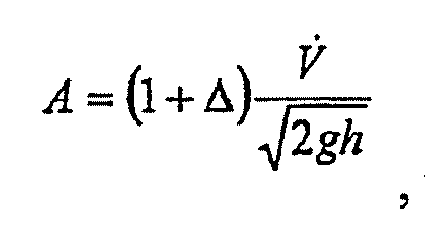
2. Vorrichtung nach Anspruch 1, wobei die Querschnittsfläche des Schachts als eine Funktion
der Fallhöhe der folgenden Formel entspricht
wobei
A die Querschnittsfläche ist;
V der Volumenstrom ist;
g die Erdbeschleunigung ist;
h die Fallhöhe ist;
Δ im Bereich 0 und 0,2 liegt, bevorzugt kleiner als 0,1.
wobei
A die Querschnittsfläche ist;
V der Volumenstrom ist;
g die Erdbeschleunigung ist;
h die Fallhöhe ist;
Δ im Bereich 0 und 0,2 liegt, bevorzugt kleiner als 0,1.
3. Vorrichtung nach Anspruch 1, dadurch gekennzeichnet, dass der Schacht von mindestens drei pyramidenförmigen oder konischen Abschnitten gebildet
wird.
4. Vorrichtung nach Anspruch 1 oder 2, dadurch gekennzeichnet, dass die Verringerung des Querschnittsumfangs des Schachts eine kontinuierliche Abnahme
nach unten hin zeigt.
5. Vorrichtung nach Anspruch 4, dadurch gekennzeichnet, dass der Schaft einen trompetenförmigen Aufbau aufweist.
1. Appareil pour le broyage de matériaux particulaires tel que des matériaux crus à ciment,
des clinker de ciment ou des matériaux similaires, lequel appareil comprend un broyeur
à cylindres (1) ainsi qu'une cuve (11) pour approvisionner les matériaux particulaires
à la zone de broyage (13) du broyeur à cylindres, la cuve (11) ayant une configuration
substantiellement verticale et ayant une section qui va en se réduisant du haut vers
le bas, caractérisé en ce que la réduction de la circonférence de la cuve en section transversale par unité de
hauteur va en décroissant du haut vers le bas.
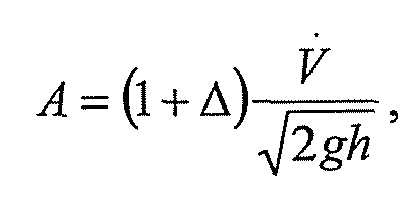
2. Appareil selon la revendication 1, dans lequel l'aire de la section transversale de
la cuve en fonction de la hauteur de chute est conforme à la formule :
où
A est l'aire de la section transversale
V est le débit volumique
g est l'accélération de la pesanteur
h est la hauteur de chute
Δ est compris dans l'intervalle allant de 0 à 0,2, de préférence est inférieur à 0,1.
où
A est l'aire de la section transversale
V est le débit volumique
g est l'accélération de la pesanteur
h est la hauteur de chute
Δ est compris dans l'intervalle allant de 0 à 0,2, de préférence est inférieur à 0,1.
3. Appareil selon la revendication 1, caractérisé en ce que la cuve est composée d'au moins 3 sections pyramidales ou coniques.
4. Appareil selon la revendication 1 ou la revendication 2, caractérisé en ce que la réduction de la circonférence de la section transversale de la cuve présente une
diminution croissante du haut vers le bas.
5. Appareil selon la revendication 4, caractérisé en ce que la cuve adopte une configuration en forme de trompette.
REFERENCES CITED IN THE DESCRIPTION
This list of references cited by the applicant is for the reader's convenience only. It does not form part of the European patent document. Even though great care has been taken in compiling the references, errors or omissions cannot be excluded and the EPO disclaims all liability in this regard.
Patent documents cited in the description