|
(11) | EP 1 262 479 A1 |

| (12) | EUROPEAN PATENT APPLICATION |
|
|
|
|
|||||||||||||||||||||||
| (54) | Lactam-aldehyde compound and process of preparing same |
| (57) A lactam-aldehyde compound represented by the formula (I) shown in the specification.
The lactam-aldehyde compound may be prepared by subjecting a lactone-imine compound
represented by formula (III) shown in the specification to an isomerization reaction.
The compounds of the present invention can be utilizable for various applications, for example, as a molecular recognition agent for use in neurotransmission studies, an intermediate for a protein-resembling compound; a surfactant, a protective group and a host-guest complex for use as a sensor. |
[0002] The present inventors have proposed a 3,5-dioxa-12-azawurtzitane compound represented by the following formula (IV):
wherein R1 represents an alkyl group, R3 represents a group which, together with a -CH(NH2)COOH group, constitutes an α-amino acid of the formula R3CH(NH2)COOH and which may contain one or more substituents and R4 represents a hydroxyl group or a group obtained by removing a hydrogen atom of the terminal amino group of an oligo- or polypeptide or a polyamino acid (EP-A-1153926).
[0003] The 3,5-dioxa-12-azawurtzitane compound does not have any site into which other functional groups may be introduced.
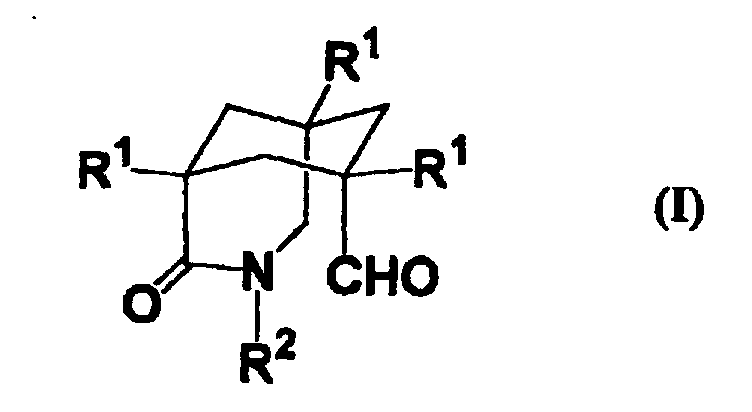
[0005] In accordance with one aspect of the present invention, there is provided a lactam-aldehyde compound represented by the following formula (I):
wherein R1 represents an alkyl group, R2 represents an organic group.
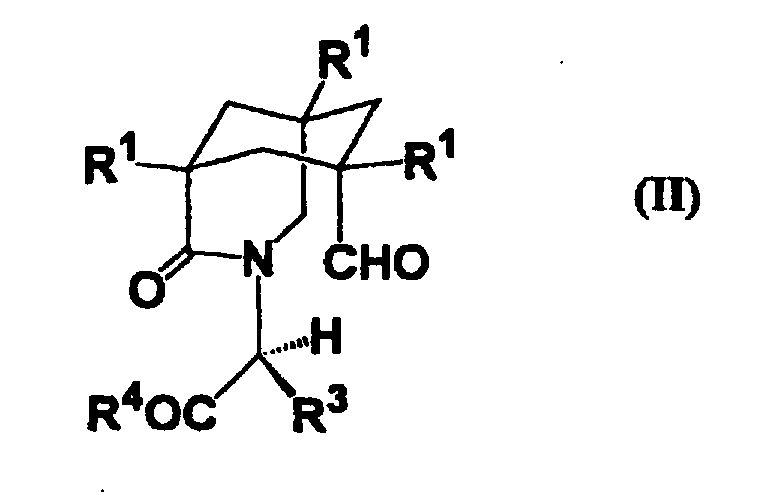
[0006] In another aspect, the present invention provides a lactam-aldehyde compound as claimed in claim 1, and represented by the following formula (II)
wherein R1 is as defined above, R3 is an amino acid side chain group and R4 is a hydroxyl group or a peptide chain.
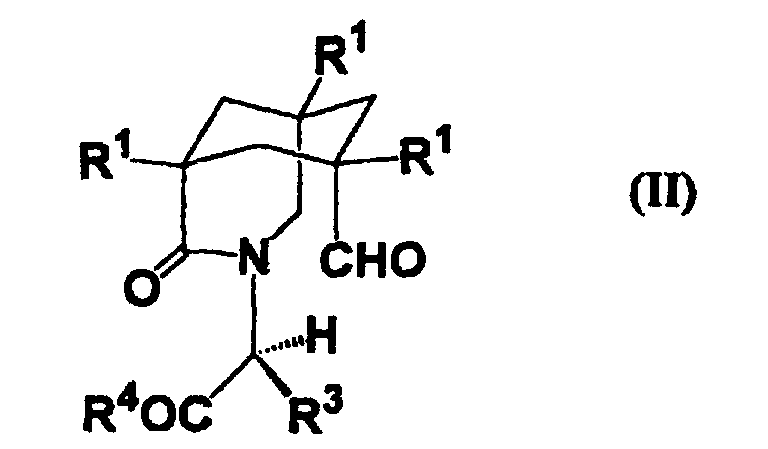
[0007] The present invention further provides a process for the production of a lactam-aldehyde compound of the following formula (II):
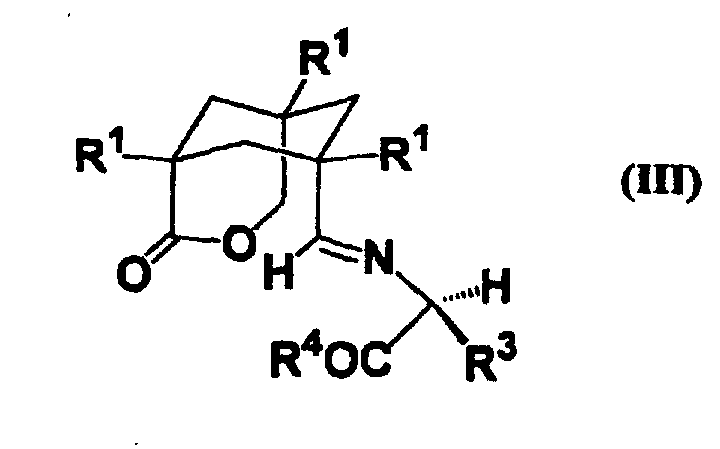
wherein R1 represents an alkyl group, R3 is an amino acid side chain group and R4 is a hydroxyl group or a peptide chain, said process comprising subjecting a lactone-imine compound to an isomerization reaction, said lactone-imine compound being represented by the following formula (III):
wherein R1, R3 and R4 are as defined above.
[0008] In the present specification and claims, the three R1s bonded to the carbon atoms of the lactam-aldehyde compound of the formula (I) or (II) may be the same or different alkyl groups.
[0009] The new class of lactam-aldehyde compounds of the present invention have a lactam site and a formyl group into which other functional groups may be introduced and are able to possess a structure similar to an amino acid or a polypeptide. Therefore, the compounds of the present invention will be utilizable for various applications, for example, as a molecular recognition agent for use in neurotransmission studies, an intermediate for a protein-resembling compound, a surfactant, a protective group and a host-guest complex for use as a sensor.
[0011] A lactam-aldehyde compound of the present invention is represented by the above formula (I). In the formula (I), R1 represents an alkyl group preferably having 1-12 carbon atoms. Illustrative of suitable alkyl groups of R1 are methyl, ethyl, propyl, butyl, pentyl, hexyl, heptyl, octyl, nonyl, decyl and structural isomers thereof.
[0012] The symbol R2 represents an organic group. The organic group is preferably a group represented by the formula -Z-Y in which Z represents a direct bond or an alkylene group and Y represents a group having an active hydrogen. Specific examples of the organic group include carboxyl, carboxyalkyl, amino, aminoalkyl, imidazolyl, imidazolylalkyl, indolyl, indolylalkyl, hydroxyphenyl, hydroxyphenylalkyl, pyridyl, pyridylalkyl, aminophenyl, aminophenylalkyl, hydroxyl, hydroxyalkyl, glycoloyl, glycoloylalkyl, glyceroyl, glyceroylalkyl, mercapto, mercaptoalkyl, carboxyaminoethylenedithio and carboxyaminoethylenedithioalkyl.
[0013] Another class of preferred organic group R2 is represented by -CHR3COR4 where R3 is an amino acid side chain group and R4 is a hydroxyl group or a peptide chain.
[0014] The term "amino acid side chain group" as used herein refers to the amino acid functional "R" side chains of any amino acid-based compound, including but not limited to any of the known twenty two amino acids, including aspartic acid, glutamic acid, lysine, arginine, histidine, tyrosine, cysteine, asparagine, glutamine, serine, threonine, glycine, alanine, valine, leucine, isoleucine, methionine, proline, phenylalanine, tryptophan, cystine, and hydroxyproline, i.e., the substituents on the amino acid carbon atom located between the amino group and carboxylic acid functionalities of the amino acids such as described above. The amino acid side chain group may contain one or more substituents such as an alkyl group, an acetyl group, an alkoxy group, a benzoxycarbonyl group, a tert-butoxycarbonyl group, a 9-fluorenylmethoxycarbonyl group and a 1,7,9-trialkyl-3,5-dioxa-12H-azawurtzitan-12-yl group.
[0015] The peptide chain R4 may be an oligopeptide (composed of 2 to 9 amino acids), a polypeptide (composed of 10 or more amino acids, generally 10-100 amino acids) or a polyamino acid (composed of two or more same amino acids) and is linked through a terminal amino group thereof to the carbonyl group of -CHR3COR4. The amino acids constituting the peptide chain R4 may be, for example, those as described previously.
[0016] Some examples of lactam-aldehyde compounds of the present invention are shown in Table 1 in which R1, R3 and R4 are the symbols of the formula (II). The lactam-aldehyde compounds of the present invention, however, are of course not limited to those specifically exemplified compounds. For example, the groups R1, R3 and R4 listed in Table 1 may be arbitrarily selected for any desired combination.
[0018] The lactam-aldehyde compounds of the formula (II) may be prepared by subjecting a lactone-imine compound of the above formula (III) to isomerization.
[0019] The isomerization may be carried out by dissolving the lactone-imine compound in an aqueous solvent or a hydrophilic polar organic solvent to obtain a solution. The solution is then allowed to stand at a temperature and for a period sufficient to obtain the lactam-aldehyde compound. The reaction temperature is not specifically limited but is generally in the range of 0-70°C. The reaction time is generally 10 hours to 1 month.
[0020] The hydrophilic polar organic solvent may be, for example, an aprotic solvent such as acetonitrile, acetone, dimethylsulfoxide or dimethylformamide. The aqueous solvent may be, for example, water, an aqueous buffer solution or a mixed solvent containing water and a hydrophilic polar organic solvent.
[0021] After the isomerization reaction, the solvent is removed by any known method preferably by distillation under a reduced pressure or by lyophilization. The crude product thus obtained may be purified by any conventional method such as chromatography.
[0022] The lactone-imine compound of the above formula (III) may be produced by hydride rearrangement of a 3,5-dioxa-12-azawurtzitane compound represented by the above formula (IV). The preparation of the 3,5-dioxa-12-azawurtzitane compound is disclosed in EP-A-1153926, the disclosure of which is hereby incorporated by reference herein.
[0023] The rearrangement reaction of the 3,5-dioxa-12-azawurtzitane compound may be carried out by dissolving the 3,5-dioxa-12-azawurtzitane compound in an aqueous solvent or a hydrophilic polar organic solvent to obtain a solution. The solution is then allowed to stand at a temperature and for a period sufficient to obtain the lactone-imine compound. The reaction temperature is not specifically limited but is generally in the range of 0-70°C. The reaction time is generally 10 hours to 10 days.
[0024] The hydrophilic polar organic solvent may be, for example, an aprotic solvent such as acetonitrile, acetone, dimethylsulfoxide or dimethylformamide. The aqueous solvent may be, for example, water, an aqueous buffer solution or a mixed solvent containing water and a hydrophilic polar organic solvent. After the rearrangement reaction, the solvent is removed by any known method preferably by distillation under a reduced pressure or by lyophilization. The crude product thus obtained may be purified by any conventional method such as recrystallization and/or chromatography.
Example 1
Preparation of Lactone-Imine Compound:
[0026] 3,5-Dioxa-12-azawurtzitane compound (50 mg) of the formula (IV) in which R1 is a methyl group, R3 is a hydrogen atom and R4 is -OK was dissolved in a mixed solvent composed of water and acetonitrile and the solution was stirred for 3 days at room temperature. The solvent was then removed from the reaction mixture under a reduced pressure to obtain a crude product. This was purified by an ion-exchange chromatography to obtain 38 mg (yield: 87 %) of a lactone-imine compound of the formula (III) in which R1 is a methyl group, R3 is a hydrogen atom and R4 is a hydroxyl group. The results of the NMR analysis of the product are shown below. 1H NMR (acetonitrile-d3/D2O): δ 0.99 (s, 3H, methyl H), 1.07 (s, 3H, methyl H), 1.11 (d, 1H, J=14.0 Hz, methylene H), 1.29 (s, 3H, methyl H), 1.34 (d, 2H, J=13.7 Hz, methylene H), 1.59 (d, 1H, J=12.9 Hz, methylene H), 2.34 (d, 1H, J=14.0 Hz, methylene H), 2.51 (d, 1H, J=13.9 Hz, methylene H), 3.54 (s, 2H, methylene H), 4.01 (d, 1H, J=15.9 Hz, methylene H), 4.34 (d, 1H, J=15.9 Hz, methylene H), 8.23 (s, 1H, imine H).
Preparation of Lactam-Aldehyde Compound:
[0027] Lactone-imine compound (25 mg) of the formula (III) in which R1 is a methyl group, R3 is a hydrogen atom and R4 is -OK was dissolved in dimethylsulfoxide and the solution was stirred for 5 days at room temperature. The solvent was then removed from the reaction mixture with heating under a reduced pressure to obtain a crude product. This was purified by an ion-exchange chromatography to obtain 20 mg (yield: 91 %) of a lactam-aldehyde compound of the formula (II) in which R1 is a methyl group, R3 is a hydrogen atom and R4 is a hydroxyl group. The results of the NMR analysis of the product are shown below. 1H NMR (acetonitrile-d3/D2O) : δ 0.82 (s, 3H, methyl H), 0.91 (s, 3H, methyl H), 1.06 (s, 3H, methyl H), 1.15 (d, 1H, J=14.1 Hz, methylene H), 1.25 (dd, 1H, J= 12.8 Hz, J = 1.8 Hz, methylene H), 1.25 (d, 1H, J=14.2 Hz, methylene H), 1.80 (d, 1H, J=12.8 Hz, methylene H), 2.15 (d, 1H, J=14.1 Hz, methylene H), 2.21 (d, 1H, J=14.2 Hz, methylene H), 2.71 (dd, 1H, J=12.4 Hz, J=1.8 Hz, methylene H), 2.81 (d, 1H, J=16.9 Hz, methylene H), 3.26 (d, 1H, J=12.4 Hz, methylene H), 4.13 (d, 1H, J=16.9 Hz, methylene H), 9.09 (s, 1H, formyl H).
Example 2
Preparation of Lactone-Imine Compound:
[0028] 3,5-Dioxa-12-azawurtzitane compound (128 mg) of the formula (IV) in which R1 is a methyl group, R3 is a hydrogen atom and R4 is -ONa was dissolved in a mixed solvent composed of water and acetonitrile and the solution was stirred for 5 days at room temperature. The solvent was then removed from the reaction mixture under reduced pressure to obtain a crude product. This was recrystallized to obtain 109 mg (yield: 85 %) of a lactone-imine compound of the formula (III) in which R1 is a methyl group, R3 is a hydrogen atom and R4 is -ONa. The results of the NMR analysis of the product are shown below. 1H NMR (acetonitrile-d3/D2O): δ 0.97 (s, 3H, methyl H), 0.98 (s, 3H, methyl H), 1.05 (d, 1H, J=14.1 Hz, methylene H), 1.23 (d, 1H, J= 13.7 Hz, methylene H), 1.26 (s, 3H, methyl H), 1.30 (d, 1H, J=12.8 Hz, methylene H), 1.55 (d, 1H, J=12.8 Hz, methylene H), 2.34 (d, 1H, J=14.1 Hz, methylene H), 2.51 (d, 1H, J=13.7 Hz, methylene H), 3.47 (d, 1H, J=15.9 Hz, methylene H), 3.58 (d, 1H, J=15.9 Hz, methylene H), 4.02 (d, 1H, J=16.2 Hz, methylene H), 4.35 (d, 1H, J=16.2 Hz, methylene H), 8.15 (s, 1H, imine H). The results of MS(ESI): m/z 266 (M-Na)
Preparation of Lactam-Aldehyde Compound:
[0029] The lactone-imine compound obtained above (10 mg) was dissolved in dimethylsulfoxide and the solution was stirred for 7 days at room temperature. The solvent was then removed from the reaction mixture under reduced pressure to obtain a crude product. This was purified by chromatography to obtain 6 mg (yield: 60 %) of a lactam-aldehyde compound of the formula (II) in which R1 is a methyl group, R3 is a hydrogen atom and R4 is -ONa. The results of the NMR analysis of the product are shown below. 1H NMR (DMSO-d6): δ 0.79 (s, 3H, methyl H), 0.88 (s, 3H, methyl H), 1.03 (s, 3H, methyl H), 1.09 (dt, 1H, J=13.6 Hz, J=1.7 Hz, J=1.0 Hz, methylene H), 1.20 (d, 1H, J=13.7 Hz, methylene H), 1.27 (dd, 1H, J= 12.5 Hz, J = 2.1 Hz, methylene H), 1.64 (d, 1H, J=12.5 Hz, methylene H), 2.10 (d, 1H, J=13.6 Hz, methylene H), 2.16 (d, 1H, J=13.7 Hz, methylene H), 2.27 (d, 1H, J=15.9 Hz, methylene H), 2.46 (dd, 1H, J=11.8 Hz, J=2.1 Hz, methylene H), 3.40 (dd, 1H, J=11.8 Hz, J=1.7 Hz, methylene H), 4.05 (d, 1H, J=15.9 Hz, methylene H), 9.00 (d, 1H, J=1.0 Hz, formyl H).
Example 3
Preparation of Lactone-Imine Compound:
[0030] 3,5-Dioxa-12-azawurtzitane compound (58 mg) of the formula (IV) in which R1 is a methyl group, R3 is a hydrogen atom and R4 is -Gly (carboxyl group of Gly is in the form of -COOK) was dissolved in a mixed solvent composed of water and acetonitrile and the solution was stirred for 7 days at 50°C. The solvent was then removed from the reaction mixture under reduced pressure to obtain a crude product. This was recrystallized to obtain 35 mg (yield: 60 %) of a lactone-imine compound of the formula (III) in which R1 is a methyl group, R3 is a hydrogen atom and R4 is -Gly (carboxyl group of Gly is in the form of -COOK). The results of the NMR analysis of the product are shown below. 1H NMR (acetonitrile-d3/D2O): δ 8.31 (s, 1H, imine H).
Preparation of Lactam-Aldehyde Compound:
[0031] The lactone-imine compound obtained above (35 mg) was dissolved in a mixed solvent composed of water and acetonitrile and the solution was stirred for 3 weeks at 50°C. The solvent was then removed from the reaction mixture under reduced pressure to obtain a crude product. This was purified by chromatography to obtain 8 mg (yield: 23 %) of a lactam-aldehyde compound of the formula (II) in which R1 is a methyl group, R3 is a hydrogen atom and R4 is -Gly (carboxyl group of Gly is in the form of -COOK). The results of the NMR analysis of the product are shown below. 1H NMR (acetonitrile-d3/D2O) : δ 9.11 (s, 1H, formyl H)
1. A lactam-aldehyde compound represented by the following formula (I):
wherein R1 represents an alkyl group, R2 represents an organic group.
wherein R1 represents an alkyl group, R2 represents an organic group.
2. A lactam-aldehyde compound as claimed in claim 1, and represented by the following
formula (II)
wherein R1 is as defined above, R3 is an amino acid side chain group and R4 is a hydroxyl group or a peptide chain.
wherein R1 is as defined above, R3 is an amino acid side chain group and R4 is a hydroxyl group or a peptide chain.
3. A lactam-aldehyde compound as claimed in claim 1, wherein the organic group is represented
by the formula -Z-Y in which Z represents a direct bond or an alkylene group and Y
represents a group having an active hydrogen.
4. A lactam-aldehyde compound as claimed in claim 1, wherein the organic group is selected
from carboxyl, carboxyalkyl, amino, aminoalkyl, imidazolyl, imidazolylalkyl, indolyl,
indolylalkyl, hydroxyphenyl, hydroxyphenylalkyl, pyridyl, pyridylalkyl, aminophenyl,
aminophenylalkyl, hydroxyl, hydroxyalkyl, glycoloyl, glycoloylalkyl, glyceroyl, glyceroylalkyl,
mercapto, mercaptoalkyl, carboxyaminoethylenedithio and carboxyaminoethylenedithioalkyl.
5. A process for the production of a lactam-aldehyde compound of the following formula
(II):
wherein R1 represents an alkyl group, R3 is an amino acid side chain group and R4 is a hydroxyl group or a peptide chain, said process comprising subjecting a lactone-imine compound to an isomerization reaction, said lactone-imine compound being represented by the following formula (III):
wherein R1, R3 and R4 are as defined above.
wherein R1 represents an alkyl group, R3 is an amino acid side chain group and R4 is a hydroxyl group or a peptide chain, said process comprising subjecting a lactone-imine compound to an isomerization reaction, said lactone-imine compound being represented by the following formula (III):
wherein R1, R3 and R4 are as defined above.