| (19) |
 |
|
(11) |
EP 1 271 064 A2 |
| (12) |
EUROPEAN PATENT APPLICATION |
| (43) |
Date of publication: |
|
02.01.2003 Bulletin 2003/01 |
| (22) |
Date of filing: 21.06.2002 |
|
| (51) |
International Patent Classification (IPC)7: F24F 1/00 |
|
| (84) |
Designated Contracting States: |
|
AT BE CH CY DE DK ES FI FR GB GR IE IT LI LU MC NL PT SE TR |
|
Designated Extension States: |
|
AL LT LV MK RO SI |
| (30) |
Priority: |
29.06.2001 IT BO20010408
|
| (71) |
Applicant: Ungarelli, Fabrizio |
|
40069 Zola Predosa (Bologna) (IT) |
|
| (72) |
Inventor: |
|
- Ungarelli, Fabrizio
40069 Zola Predosa (Bologna) (IT)
|
| (74) |
Representative: Dalle Nogare, Roberto |
|
c/o Ufficio Internazionale Brevetti
INIP
Via Ruggi, 5
40137 Bologna
40137 Bologna (IT) |
|
| |
|
| (54) |
Heating and air conditioning modular apparatus |
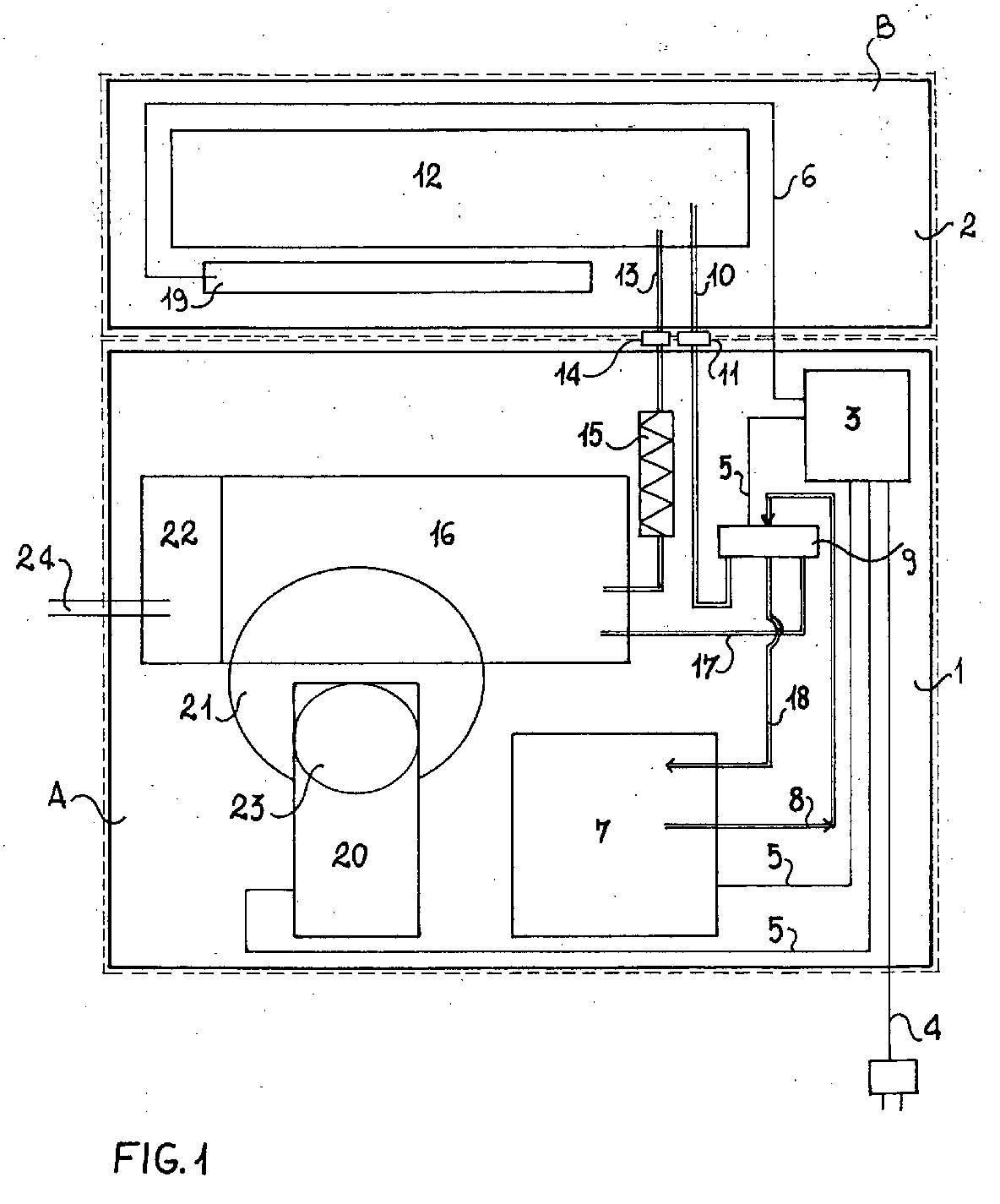
(57) The modular apparatus consists of a first body (1) and a smaller second body (2)
inside which a set of parts A and B are connected for the cooling and the heating
of the air with reversible refrigerating cycle with cooling compression and with heating
exchangers fed with electric energy. Said bodies (1 and 2) in mounting to be placed
in fastened or separated position making the connection between them by couplings.
|
|
[0001] In the art of the heating/air conditioning plants is known an apparatus for the air
treatment into the rooms of the modern building, whether or not residential, described
in the Italian Patent B099A 000001 and in the European Patent 99106745.5. Said apparatus
consists of an only one integrated group, for the differentiating heating and air
conditioning plants inside a containment and disposition body, so being satisfying
both the necessities of air treatment into the room by using one body onto the outside
wall occupying about the same space to be current used for the only one heating unit.
Particularly, in the indirect building, whether or not residential, while the central
or single heating plant comes to be part of the work given by the builder, the sole
air conditioning plants are within the province of the resident. And as the outside
walls of a room in the current building are considered aesthetic element and consequently
subjected to architectur and town-planning limitations, with the outside parts installation
of the air conditioning plant is created an alteration to this aesthetics not always
possible. On this base the builders have the problem to realize said outside parts
with bodies having reduced dimensions so to limit the inside wall to be covered and
also to reduce the aesthetics variations onto the outside wall. Said apparatus permits
to fit out with heating or air conditioning plants the rooms without both these plants
and also to fit out with an air conditioning plant other rooms already having the
heating plant so permitting the elimination of heating units like radiators and heat
converctors. All the plant using the setting out space of the heating units to install
the said integrated apparatus. Otherwise it is to be used the existing body of the
already present heating unit or enclosing said body inside the wall. In this way is
permitted to use the already present heating plants with the changing of the conventional
radiator and using the same piping of the hot water circulation for the heating through
a particular incorporated radiator. The apparatus described in the cited patents is
also to be equipped with an inside reversible refrigerating cycle with cooling compression
so permitting the elimination of all the plumbing used for the hot water circulation
for the heating with elimination of the main boiler and of all the connected plant
engineering comprising the elimination of the wall works for the laying of the pipings
or other; so elimining in time a lot of different problems and maintenances for encrustments
and oxidations. Moreover is not necessary to put onto the outside wall particular
elements like exchangers, containers, air propellers, condensers or thermal systems
in general. In comparison with this kwnon apparatus, the invented apparatus provides
the disposition of the cooling and heating plants in two divided elements A and B
to be placed in fastening or separated and spaced out each other on the wall or enclosed
with the joining between the two elements by push nipples. Said foundamental characteristic
to permit the spacing out of the two elements gives: a) a dimension reduction of all
the apparatus as for, being the two elements A and B placed in two different positions,
less is the eye impact of the visible body; b) the possibility of better integrated
the conditioning air plant in room already equipped with heating unit as it is easier
the connection between the two divided elements; c) to intervene in the future only
on one element without enter in contact with the other. The invented modular apparatus
consists of a first body 1 and of a smaller second body 2 into which are connected
a set of elements A and B for the cooling and the heating of the air with inside reversible
refrigerating cycle with cooling compression and placing said bodies 1 and 2 during
the mounting in fastened or separated position.
[0002] In a preferred and theorical embodiment is provided the combination of the different
elements, on the base of diagrams and size of the elements for solution of minimum
encumbrance, onto the inside walls of the bodies 1 and 2 to be driven through a power
swithboard 3 to be fed from electric current on line 4. The same on lines 5 starts
the different parts of the element A for the production of hot air while on line 6
starts the different components of the element B for the production of cold air. The
apparatus moreover provides a refrigerators compressor 7 for the compression of coolant
through a piping 8 and the directional valve 9. On the base of the working the directional
valve 9 sends the coolant in two directions to have hot air or cold air. For the production
of hot air, through, the directional valve 9, the very hot coolant flows through the
pipe 10 and, by the coupling 11, comes into the exchanger 12 where is transformed
from steam to liquid given heat. Said coolant then passes through the pipe 13 and
the coupling. 14 so arriving to the rolling element 15 and at the end inside the exchanger
16 where passes again in steam assorbing heat. Through the pipe 17 and the directional
valve 9 the steam is sucked up to the compressor 7 through the pipe 18 to repeat the
cycle. The cold air coming from the room is pushed, by the fan 19, through the exchager
12 absorbing the heat given to the coolant to go back in the room heated through louvers.
In the same time the outside air is sucked up from the fun 20 through a wall hole
21 and is forced to cool the compressor 7 and is made to cross in sequence the exchangers
22 and 16 into which the coolant evaporated with more lower temperature of the air
temperature that cross the same. The air gives heat through the exchanger 16 to the
cooler coolant and it is got out through the conduit 23 inserted inside the hole 21.
If the outside air temperature is so cold to no give a thermic help to the exchanger
6, the same air is heating connecting the integrated exchanger 22 to the line of the
existing heating plant 24. Said solution permits a big energetic saving, it permits
to maintain the water temperature inside the pipes with lower temperatures of what
currently necessary for the conventional radiators and it reduces the thermic dispersion
and it prolongs the boiler life. For the production of cold air, through the directional
valve 9, the very hot coolant flows through the pipe 17 inside the exchanger 16 where
is transformed from steam to liquid given heat. The coolant through rolling element
15, the coupling 14 and the pipe 13 flows inside of the exchanger 12 where passes
at the state of steam absorbing again heat. Through the coupling 11, the pipe 10 and
the directional valve 9, the steam is sucked up by means of the pipe 18 from the compressor
7 to repeat the cycle.
[0003] The hot air coming from the room is pressed by the fun 19 through the exchanger 12
given heat to. the coolant to return in the room cooling through suitable slits. In
the same time the outside air is sucked from the fun 20 through a wall hole 21, it
is forced to cool the compressor 7 and to pass through the exchagers 22 and 16.
[0004] The air is then got out through the conduit 23 inserted inside the hole 21. The two
sectors A and B have the function to avoid that the outside air comes to mix with
the inside air already treated and in the same time it isolates from heat loss and
from pollution coming from outside.
[0005] Foundamental characteristic of the invented apparatus is that the two parts A and
B are to be placed in different positions so to permit a better dimension fitness
to the rooms, a better distribution of the space to be used for the disposition of
the components and a better furnishing of the building. Diagram of the 'apparatus
working with the two parts A and B and view of the placing in the embodiment with
the bodies 1 and 2 fastening and in the embodiment with the bodies 1 and 2 separated
is illustrated in merely indicative views in the drawings of sheets 1, 2, 3, 4 and
5. In sheet 1 fig. 1 is schematic view of the working of the two parts A and B inside
the bodies 1 and 2. In sheet 2 fig. 2 is section to show the placing of the two parts
A and B one near the other on the wall. In sheet 3 fig. 3 is perspective view of the
invented apparatus with the near parts A and B. In sheet 4 fig. 4 is view in section
of the fastened parts A and B connected each other through the couplings 11 and 14.
In sheet 5 fig. 5 is perspective view of the invented apparatus with the parts A and
B in the scomposed embodiment and in fastening.
1. Modular apparatus with heating and air conditioning plants to be fitted to the room
dimension consists of a first body (1) and a smaller second body (2); characterized in that
inside these bodies (1 and 2) are connected a set of parts A and B for the cooling
and the heating of the air with reversible refrigerating cycle with cooling compression
and with heating exchangers fed with electric energy; and in that
the bodies (1 and 2) in mounting are placed in fastened or separated position making
the connection between them by couplings.
2. Modular apparatus with heating and air conditioning plants to be fitted to the room
dimension, as per claim 1, characterized in that in the realization is provided the combination of the different elements, on the
base of diagrams and size of the elements for solution of minimum encumbrance, onto
the inside walls of the bodies (1 and 2) to be driven through a power swithboard (3)
to be fed from electric current on line (4); the same on lines (5) starts the different
parts of the 'element A for the production of hot air while on line (6) starts the
different components of the element B for the production of cold air.
3. Modular apparatus with heating and air conditioning plants to be fitted to the room
dimension, as per claim 1, characterized in that the two parts .A and B are to be distantiated each other by means of coupling (11
and 14) so to permit a better dimension fitness to the rooms.
4. Modular apparatus with heating and air conditioning plants to be fitted to the room
dimension, as per claim 1, characterized in that a refrigerator compressor (7) is provided for the compression of coolant through
a piping (8) and a directional valve (9), on the base of the working the directional
valve (9) sends the coolant in two directions to have hot air or cold air; for the
production of hot air, through the directional valve (9), the very hot coolant flows
through the pipe (10) and, by the coupling (11), comes into the exchanger (12) where
is transformed from steam to liquid given heat; said- coolant then passes through
the pipe (13) and the coupling (14) so arriving to the rolling element (15) and at
the end inside the exchanger (16) where passes again in steam absorbing heat; through
the pipe (17) and the directional valve (9) the steam is sucked up to the compressor
(7) through the pipe (18) to repeat the cycle; the cold air coming from the room is
pushed, by the fan (19), through the exchanger (12) absorbing the heat given to the
coolant to go back in the room heated through louvers; in the same time the outside
air is sucked up from the fun (20) through a wall hole (21) and is forced to cool
the compressor (7) and is made to cross in sequence the exchangers (22 and 16) into
which the coolant evaporated with more lower temperature of the air temperature that
cross the same; the air gives heat through the exchanger (16) to the cooler coolant
and it is got out through the conduit (23) inserted inside the hole (21); for the
production of cold air, through the directional valve (9), the very hot coolant flows
through the pipe (17) inside the exchanger (16) where is transformed from steam to
liquid given heat; the coolant through rolling element (15), the coupling (14) and
the pipe (13) flows inside of the exchanger (12) where passes at the state of steam
absorbing again heat; through the coupling (11), the pipe (10) and the directional
valve (9), the stema is sucked up by means of the pipe (18) from the compressor (7)
to repeat the cycle.