| (19) |
 |
|
(11) |
EP 1 271 289 B1 |
| (12) |
EUROPEAN PATENT SPECIFICATION |
| (45) |
Mention of the grant of the patent: |
|
23.09.2009 Bulletin 2009/39 |
| (22) |
Date of filing: 18.06.2001 |
|
| (51) |
International Patent Classification (IPC):
|
|
| (54) |
Power supply management device and method for a computer equipment having powered
I/O ports in standby mode
Stromversorgungs-Verwaltungsgerät und -Verfahren für Computer mit im Standby-Modus
versorgten Ein/Ausgabe-Ports
Appareil et procédé de gestion d'alimentation pour ordinateur ayant des portes d'entrées-sorties
alimentées en mode de veille
|
| (84) |
Designated Contracting States: |
|
DE FR GB |
| (43) |
Date of publication of application: |
|
02.01.2003 Bulletin 2003/01 |
| (73) |
Proprietor: HEWLETT-PACKARD DEVELOPMENT COMPANY, L.P. |
|
Houston, TX 77070 (US) |
|
| (72) |
Inventor: |
|
- Navarro Sanchez, Samuel
38000 Grenoble (FR)
|
| (74) |
Representative: Schoppe, Fritz et al |
|
Schoppe, Zimmermann, Stöckeler & Zinkler
Patentanwälte
Postfach 246
82043 Pullach bei München
82043 Pullach bei München (DE) |
| (56) |
References cited: :
WO-A-01/20433
US-B1- 6 243 831
|
US-A- 4 907 183
|
|
| |
|
|
|
|
| |
|
| Note: Within nine months from the publication of the mention of the grant of the European
patent, any person may give notice to the European Patent Office of opposition to
the European patent
granted. Notice of opposition shall be filed in a written reasoned statement. It shall
not be deemed to
have been filed until the opposition fee has been paid. (Art. 99(1) European Patent
Convention).
|
[0001] The present invention generally relates to power supply management in electronic
equipment such as personal computers or the like. More particularly, although not
exclusively, the present invention relates to a power control system and method for
avoiding loss of memory contents in standby mode of a computer in the event of excessive
voltage drop on a power supply line powering the memory chips.
Background of the invention
[0002] When computer equipment is brought into standby mode (known in the art as the "S3"
mode), the working memory (RAM) of the computer is kept powered so as to preserve
the data therein ready for a next power-up of the computer. The RAM is conventionally
powered in the S3 condition by a specific power source, or "standby rail". Computer
equipment is generally provided with input/output (I/O) ports including a power supply
conductor for powering peripheral devices connected to such ports. The same standby
rail which powers the RAM is also conventionally used for providing power to these
I/O ports. This is also typically the case for Universal Serial Bus (USB) ports, which
need to have power active during the standby mode of the computer.
[0003] In such a situation, that is, when a USB peripheral device is connected to a USB
port, the peripheral can draw significant current from the power conductor of said
port. On the other side, the standby rail of a conventional computer is typically
capable of delivering a current of 1 or 2 Amps, this value being primarily governed
by the current which is drawn by the RAM chips during S3 mode.
[0004] Therefore, should a USB peripheral draw a high current from the USB port, this can
cause the standby rail voltage to drop, to the extent that the RAM chips will be no
longer properly powered and data stored therein will be lost.
[0005] It has been proposed to provide dedicated power supply chips for handling such situations
in relation to USB ports or in other environments. Such solutions are however expensive
as they are based on a per -port approach. Thus if the number of I/O ports is increased,
and given that there is nowadays a tendency to provide personal computers with 6 or
8 USB ports or even more, the number of dedicated supply chips also has to be increased.
This is costly and additionally requires appropriate room on the USB board or mother
board.
[0006] A further drawback of these known supply chips is that they individually act as current
limiters, without taking into account the fact that a plurality of USB ports may altogether
draw a cumulative current that will still cause the voltage source to drop and cause
loss of RAM contents.
[0007] Therefore, this known technique is expensive and cumbersome while failing to safely
prevent data losses, in particular when numerous USB ports are provided.
Summary of the invention
[0008] According to a first aspect, the present invention provides a power management device
for computer equipment including electrically powered memory and a power supply conductor
for at least one input/output port, wherein during at least one mode of operation
of the computer equipment, said memory and said power supply conductor are connected
to a common power supply unit, said power supply conductor being connected to said
common power supply unit through a controlled switch which is closed during that mode,
wherein said power management device includes a detector adapted to detect a value
representative of the total current consumption through said power supply conductor
and to open said controlled switch when said total current consumption exceeds a limit.
[0009] Preferred but non limiting features of the power supply management device and computer
equipment as defined above are as follows:
- said memory is RAM, said mode of operation is a standby mode, and said common power
supply unit is a standby power supply unit.
- said controlled switch has an on-state internal resistance, and said detector is adapted
to determine when a voltage drop across said controlled switch exceeds a given threshold.
- said detector comprises a voltage divider for generating a predetermined fraction
of the output voltage of said common power supply unit, and a comparator receiving
on one input said predetermined voltage fraction and on another input the voltage
at the power supply conductor.
- a logic gate is provided for combining an output signal of said comparator and a standby
mode control signal generated by a control logic, an output of said logic gate being
connected for controlling said controlled switch.
- said voltage divider has a first mode of operation where it generates a first voltage
fraction and a second mode of operation where it generates a second voltage fraction
lower than said first voltage fraction.
- said first voltage fraction is generated while said comparator detects no excess current
consumption and said second voltage fraction is generated while said comparator detects
said excess current consumption.
- said voltage divider comprises first and second resistors forming a divider bridge,
the midpoint of which is connected to said one input of said comparator, and a third
resistor connected between said one input and the output of comparator.
[0010] According to a second aspect, the present invention provides, in computer equipment
including a CPU, an electrically powered memory, a common power supply unit, a power
supply conductor associated with at least one input/output port of the equipment,
a controlled switch connected between said common power supply unit and said power
supply conductor, wherein during at least one mode of operation of the computer equipment,
said controlled switch is closed and said memory and said power supply conductor are
connected to said common power supply unit: a method of managing power supply to said
memory and said power supply conductor, the method comprising the steps of:
- detecting a value representative of the total current consumption through said power
supply conductor, and
- opening said controlled switch when said total current consumption exceeds a limit.
[0011] Preferred aspects of the above method are as follows:
- said memory is a RAM memory, said mode of operation is a standby mode, and said common
power supply unit is a standby power supply unit.
- said controlled switch has an on-state internal resistance, and said detecting step
comprises determining when a voltage drop across said controlled switch exceeds a
given threshold.
- said determination comprises generating a predetermined fraction of the output voltage
of said common power supply unit and comparing said predetermined voltage fraction
with the voltage at the power supply conductor.
- the method further comprises the step of logically combining a signal generated from
said comparison with a standby mode control signal generated by a control logic of
the equipment, and controlling said controlled switch with an output of said logical
combination.
- the method further comprises the step of lowering said voltage fraction once an excess
current consumption has been detected.
Brief description of the drawing
[0012] A preferred but non-limiting embodiment, or example, of the present invention will
now be described in detail with reference to the appended drawing, in which:
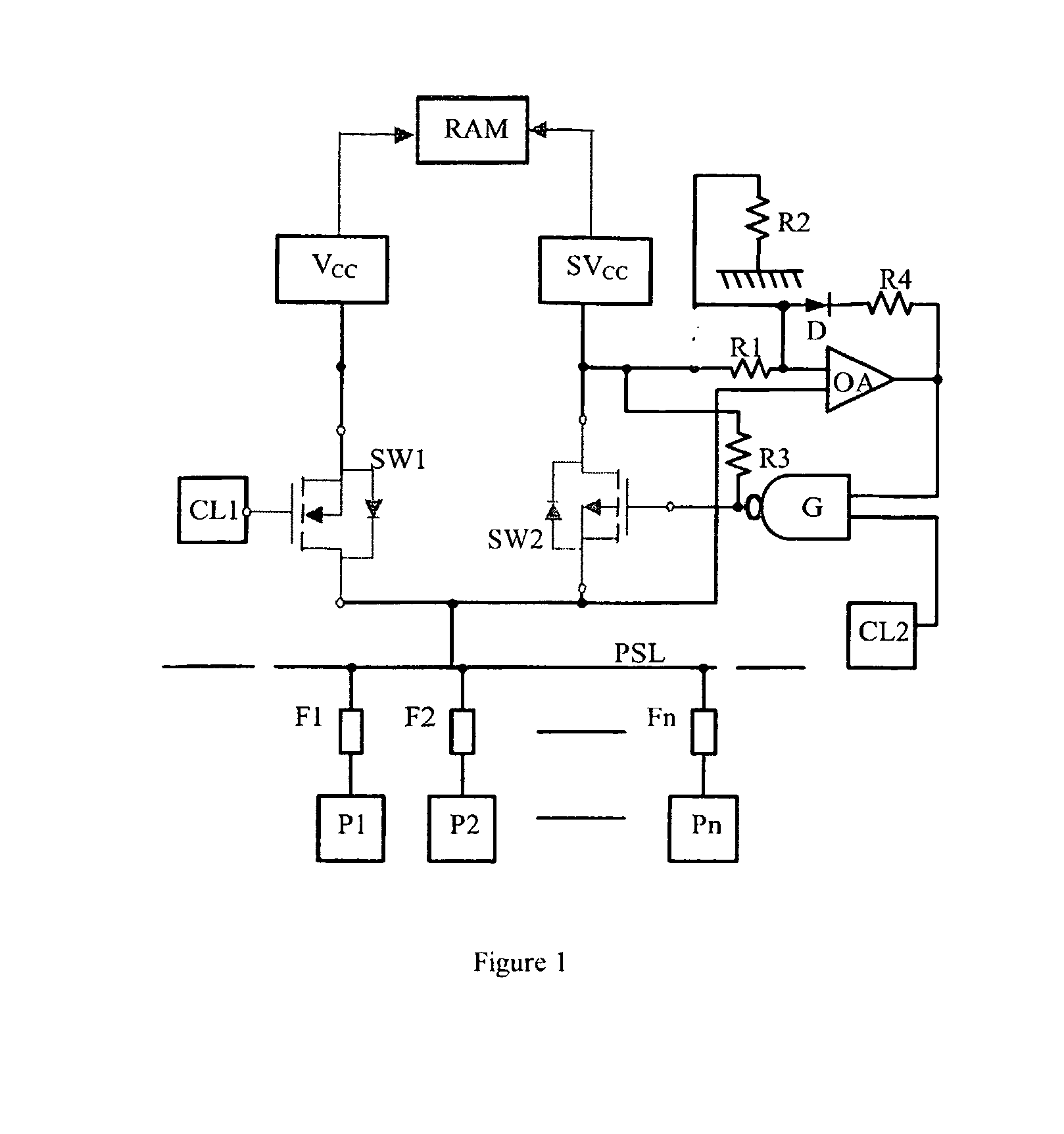
Fig. 1 is a schematic diagram of a power supply management circuit.
Detailed description of the preferred embodiment
[0013] Referring to Fig. 1, a circuit is shown which comprises a main power supply control
switch SW1, (here, preferably in the form of a N-MOS transistor), the gate of which
is connected to the output of a control logic circuit CL1. This controls the switch
SW1 according to the status of a computer equipment (on, standby, off, etc.), in a
known manner.
[0014] The switch SW1 is connected between a main power supply source Vcc (typically + 5
V=) and a power supply line PSL connected to a plurality of USB ports P1 to Pn of
the computer equipment through respective circuit breakers F1 to Fn.
[0015] A second switch SW2, typically a P-MOS transistor, is connected between a standby
power supply source SVcc (also typically + 5 V=) and the power supply line PSL.
[0016] The main power supply Vcc is used by the computer equipment during its normal operation.
In that case, switch SW1 is closed to connect the source to the power supply line
PSL, while other parts of the equipment are connected to the same source (not shown).
[0017] Also in known manner, the standby power source SVcc is used by the computer equipment
in standby (or "S3") mode for the main following purposes:
- powering electrically powered working memory RAM of the computer (see figure 1) which
in such condition has to continue storing the data and programs which were residing
in said RAM at the time standby mode was activated;
- providing limited power to any USB device (or other peripheral devices) which is or
will be connected to the computer equipment during standby mode. Such power is necessary,
for example, for a computer keyboard to remain active during standby mode. This allows
a user to bring the equipment back to active mode by pressing a keyboard key., Power
is also necessary to accomodate any other computer tasks that are to be performed
in standby mode.
[0018] A resistor divider bridge R1, R2 is connected between SVcc and ground, and the middle
point of this bridge is connected to the inverting input of an operational amplifier
OA serving as a comparator. The non-inverting input of comparator OA is directly connected
to the power supply line PSL. A diode D and a resistor R4 are connected in series
between the inverting input of comparator OA and its output.
[0019] The output of comparator OA is also connected to a first input of an NAND gate G,
the second input of which is connected to a control logic circuit CL2 (CL2 = CL1#).
This outputs a logic signal which varies according to the status of the computer equipment
(on, standby, off, etc.).
[0020] The output of gate G is connected to a pull-up resistor R3 and drives the gate of
a second switch SW2 so as to turn it on or off according to specific given conditions
as will be explained.
[0021] The circuit operates as follows.
[0022] When the computer equipment is in normal activity (the "S0" state), the control logic
CL1 continuously applies to the gate of SW1 a signal with a high logic level so as
to keep it turned on (i.e. closed).
[0023] In these circumstances, the Vcc power supply source is connected to the power supply
line PSL of the USB ports so as to power USB devices as necessary. The RAM is also
powered by Vcc (not shown).
[0024] When the computer equipment is brought into standby, or S3, mode, the control logic
CL1 applies a low logic signal to switch SW1, and at the same time the control logic
CL2 applies a high logic signal to the corresponding input of NAND gate G. Assuming
that the other input of gate G is at that time at a high logic level, then gate G
applies to the second switch SW2 a low logic signal which turns SW2 on (i.e. closed).
As a consequence, the power supply line PSL of the USB ports is powered by the standby
voltage supply SVcc.
[0025] The values of R1 and R2 are selected so as to apply to the inverting input of OA,
a voltage equal to a given fraction of SVcc. The voltage drop through SW2 will depend
on its ON state resistance (Rdson). The maximum allowed voltage drop through SW2 will
be equal to Rdson multiplied by the maximum allowed current (Imax). Therefore, we
will use the following formula: (SVcc x R2)/(R1 + R2) = SVcc - Imax x Rdson e.g. 0.95
times SVcc, i.e. 4.75 volts in the present example.
[0026] So long as the voltage at the power supply line PSL remains above 4.75 volts, the
comparator OA keeps outputting a high logic signal, so that gate G keeps outputting
a low logic signal, whereby switch SW2 remains turned on and the loads in the USB
devices are properly powered.
[0027] As soon as a USB device draws a high current from standby voltage source SVcc through
the power supply line PSL, the voltage drop across switch SW2 due to its conducting
resistance Rdson increases. Thus the voltage at supply line PSL will decrease. When
this voltage drops below the threshold value of 4.75 volts, comparator OA delivers
a low logic signal, whereby gate G applies to second switch SW2 a high logic signal
which turns the latter off (i.e. opens it). The power supply line is therefore no
longer connected to the power supply source SVcc, so that no USB device can longer
draw any current. As a consequence, the risk that the standby power supply voltage
drops to a level insufficient for ensuring proper RAM operation is avoided. Thus the
RAM contents of the computer equipment is preserved.
[0028] It should be noted here that this power line supply shutdown is not reversible. More
particularly, as soon as the switch SW2 is turned off as explained above, the voltage
at the power supply line PSL goes to a level of zero (ground) or close to zero, so
that the output of comparator OA remains at low level and SW2 remains turned off.
This in particular avoids the safety PSL shutdown process entering into undesirable
oscillation.
[0029] When the computer equipment in standby mode is brought back to normal active mode,
the control logic circuit CL2 generates a low logic signal and control logic circuit
CL1 delivers a high logic signal. Therefore, switch SW2 is opened (or remains off
if the safety turning off as described above did occur) and switch SW1 is closed,
whereby the power supply line PSL is again powered from voltage source Vcc for normal
activity through SW1.
[0030] It should be noted here that there are situations where, at the initial power-up
of the computer equipment, the actual value of Vcc can be somewhat lower than the
nominal value of 5 volts This may be caused by sharp current demand from the various
parts of the computer on power-up, or because the tolerance on +5V rail is higher
(typically +/-10%) than tolerance on stby rail (typically +/-1%). In this last case,
we could have +5V at a value of 4.5V, and +5Vstby at +5.05V.
[0031] In this case, diode D and resistor R4 connected between the output of comparator
OA and its inverting input make the circuit behave as follows: as soon as the output
of comparator OA has gone to the zero logic level (i.e. substantially to ground),
causing power supply line shutdown as explained above, the divider bridge R1, R2 is
affected by R4 being connected in parallel with R2, so that the reference voltage
at the inverting input of comparator OA decreases to a lower reference voltage. For
example, the value of R4 can be selected to as to have a lower reference voltage approximately
equal to 4.3 volts.
[0032] In that case, when the main power supply Vcc is switched on again, even if the initial
value of Vcc is quite low, and typically between 4,5 volts and its nominal value,
the output of comparator OA will safely return to high logic level. In this manner,
when the equipment enters again into standby mode (i.e. control logic CL2 delivers
a high logic signal) the NAND gate G will deliver a low logic circuit. Thus switch
SW2 will be effectively turned on.
[0033] Although the invention has been described by way of example and with reference to
particular embodiments it is to be understood that modification and/or improvements
may be made without departing from the scope of the appended claims.
1. A power management device for computer equipment including electrically powered memory
(RAM) and a power supply conductor (PSL) for at least one input/output port (P1, P2,...,
Pn), wherein during at least one mode of operation of the computer equipment, said
memory (RAM) and said power supply conductor (PSL) are connected to a common power
supply unit (SVcc), characterized in that said power supply conductor (PSL) is connected to said common power supply unit (SVcc)
through a controlled switch (SW2) closed during that mode, wherein said power management
device includes a detector adapted to detect a value representative of the total current
consumption through said power supply conductor (PSL) and to open said controlled
switch (SW2) when said total current consumption exceeds a limit.
2. A power supply management device according to claim 1, wherein said memory is a RAM,
said mode of operation corresponds to a standby mode, and said common power supply
unit is a standby power supply unit (SVcc).
3. A power supply management device according to claim 1, wherein said controlled switch
(SW2) has an on-state internal resistance, and said detector is adapted to determine
when a voltage drop across said controlled switch exceeds a given threshold.
4. A power supply management device according to claim 3, wherein said detector comprises
a voltage divider (R1,R2) adapted to generate a predetermined fraction of the output
voltage of said common power supply unit (SVcc), and a comparator (OA) receiving on
one input said predetermined voltage fraction and on another input the voltage at
the power supply conductor (PSL).
5. A power supply management device according to claim 4, further including a logic gate
(G) which receives as input an output signal of said comparator (OA) and a standby
mode control signal generated by a control logic, an output of said logic gate being
connected so as to control said controlled switch (SW2).
6. A power supply management device according to claim 4, wherein said voltage divider
(R1,R2) has a first mode of operation whereby it generates a first voltage fraction
and a second mode of operation where it generates a second voltage fraction lower
than said first voltage fraction.
7. A power supply management device according to claim 6, wherein said first voltage
fraction is generated while said comparator (OA) detects no excess current consumption
and said second voltage fraction is generated while said comparator (OA) detects said
excess current consumption.
8. A power supply management device according to claim 7, wherein said voltage divider
comprises first and second resistors forming a divider bridge (R1,R2), the midpoint
of which is connected to said one input of said comparator (OA) and a third resistor
(R4) connected between said one input and the output of comparator (OA).
9. A power management device of one of the claims 1 to 8, wherein during at least one
mode of operation of the computer equipment, said controlled switch (SW2) is closed
and said memory (RAM) and said power supply conductor (PSL) are connected to said
common power supply unit (SVcc).
10. A method of managing power supply to an electrically powered memory (RAM) in a computer,
the computer including a CPU, said electrically powered memory (RAM), a common power
supply unit (SVcc), a power supply conductor (PSL) associated with at least one input/output
port (P1, P2,...Pn) of the equipment, a controlled switch (SW2) connected between
said common power supply unit (SW2) and said power supply conductor (PSL), wherein
during at least one mode of operation of the computer equipment, said controlled switch
(SW2) is closed and said memory (RAM) and said power supply conductor (PSL) are connected
to said common power supply unit, the method comprising the steps of:
- detecting a value representative of the total current consumption through said power
supply conductor (PSL), and
- opening said controlled switch (SW2) when said total current consumption exceeds
a limit.
11. A method according to claim 10, wherein said memory is a RAM, said mode of operation
is a standby mode, and said common power supply unit is a standby power supply unit
(SVcc).
12. A method according to claim 10, wherein said controlled switch (SW2) has an on-state
internal resistance and said detecting step comprises determining when a voltage drop
across said controlled switch (SW2) exceeds a given threshold.
13. A method according to claim 10, wherein said determination comprises generating a
predetermined fraction of the output voltage of said common power supply unit and
comparing said predetermined voltage fraction with the voltage at the power supply
conductor.
14. A method according to claim 13, further comprising the step of logically combining
a signal generated from said comparison with a standby mode control signal generated
by a control logic of the equipment, and controlling said controlled switch with an
output of said logical combination.
15. A method according to claim 13, further comprising the step of lowering said voltage
fraction once an excess current consumption has been detected.
1. Eine Leistungsverwaltungsvorrichtung für eine Computerausrüstung, die einen mit elektrischer
Leistung versorgten Speicher (RAM) und einen Leistungsversorgungsleiter (PSL) für
zumindest ein Eingangs-/Ausgangstor (P1, P2, ..., Pn) umfasst, wobei während zumindest
eines Betriebsmodus der Computerausrüstung der Speicher (RAM) und der Leistungsversorgungsleiter
(PSL) mit einer gemeinsamen Leistungsversorgungseinheit (SVcc) verbunden sind, dadurch gekennzeichnet, dass der Leistungsversorgungsleiter (PSL) mit der gemeinsamen Leistungsversorgungseinheit
(SVcc) durch einen gesteuerten Schalter (SW2) verbunden ist, der während dieses Modus
geschlossen ist, wobei die Leistungsverwaltungsvorrichtung einen Detektor - umfasst,
der angepasst ist, um einen Wert zu erfassen, der den Gesamtleistungsverbrauch durch
den Leistungsversorgungsleiter (PSL) darstellt, und den gesteuerten Schalter (SW2)
zu öffnen, wenn der Gesamtleistungsverbrauch eine Grenze überschreitet.
2. Eine Leistungsverwaltungsvorrichtung gemäß Anspruch 1, bei der der Speicher ein RAM
ist, der Betriebsmodus einem Bereitschaftsmodus entspricht und die gemeinsame Leistungsversorgungseinheit
eine Bereitschaftsleistungsversorgungseinheit (SVcc) ist.
3. Eine Leistungsverwaltungsvorrichtung gemäß Anspruch 1, bei der der gesteuerte Schalter
(SW2) einen internen Ein-Zustand-Widerstandswert aufweist und der Detektor angepasst
ist, um zu bestimmen, wann ein Spannungsabfall über den gesteuerten Schalter eine
gegebene Schwelle überschreitet.
4. Eine Leistungsversorgungsverwaltungsvorrichtung gemäß Anspruch 3, bei der der Detektor
einen Spannungsteiler (R1, R2), der angepasst ist, um einen vorbestimmten Bruchteil
der Ausgangsspannung der gemeinsamen Leistungsversorgungseinheit (SVcc) zu erzeugen,
und einen Komparator (OA) aufweist, der an einem Eingang den vorbestimmten Spannungsbruchteil
und an einem anderen Eingang die Spannung an dem Leistungsversorgungsleiter (PSL)
empfängt.
5. Eine Leistungsversorgungsverwaltungsvorrichtung gemäß Anspruch 4, die ferner ein Logikgatter
(G) umfasst, das als eine Eingabe ein Ausgangssignal des Komparators (OA) und ein
Bereitschaftsmodussteuersignal empfängt, das durch eine Steuerlogik erzeugt wird,
wobei ein Ausgang des Logikgatters so verbunden ist, um den gesteuerten Schalter (SW2)
zu steuern.
6. Eine Leistungsversorgungsverwaltungsvorrichtung gemäß Anspruch 4, bei der der Spannungsteiler
(R1, R2) einen ersten Betriebsmodus, wodurch derselbe einen ersten Spannungsbruchteil
erzeugt, und einen zweiten Betriebsmodus aufweist, in dem derselbe einen zweiten Spannungsbruchteil
erzeugt, der geringer als der erste Spannungsbruchteil ist.
7. Eine Leistungsversorgungsverwaltungsvorrichtung gemäß Anspruch 6, bei der der erste
Spannungsbruchteil erzeugt wird, während der Komparator (OA) keinen überschüssigen
Stromverbrauch erfasst, und der zweite Spannungsbruchteil erzeugt wird, während der
Komparator (OA) den übermäßigen Spannungsverbrauch erfasst.
8. Eine Leistungsversorgungsverwaltungsvorrichtung gemäß Anspruch 7, bei der der Spannungsteiler
einen ersten und einen zweiten Widerstand aufweist, die eine Teilerbrücke (R1, R2)
bilden, deren Mittenpunkt mit dem einen Eingang des Komparators (OA) und einem dritten
Widerstand (R4) verbunden ist, der zwischen den einen Eingang und den Ausgang des
Komparators (OA) geschaltet ist.
9. Eine Leistungsverwaltungsvorrichtung gemäß einem der Ansprüche 1 bis 8, bei der während
zumindest einem Betriebsmodus der Computerausrüstung der gesteuerte Schalter (SW2)
geschlossen ist und der Speicher (RAM) und der Leistungsversorgungsleiter (PSL) mit
der gemeinsamen Leistungsversorgungseinheit (SVcc) verbunden sind.
10. Ein Verfahren zum Verwalten einer Leistungsversorgung zu einem mit elektrischer Leistung
versorgten Speicher (RAM) in einem Computer, wobei der Computer eine CPU, den mit
elektrischer Leistung versorgten Speicher (RAM), eine gemeinsame Leistungsversorgungseinheit
(SVcc), einen Leistungsversorgungsleiter (PSL), der zumindest einem Eingangs-/Ausgangstor
(P1, P2, ..., Pn) der Ausrüstung zugeordnet ist, einen gesteuerten Schalter (SW2)
umfasst, der zwischen die gemeinsame Leistungsversorgungseinheit (SW2) und den Leistungsversorgungsleiter
(PSL) geschaltet ist, wobei während zumindest einem Betriebsmodus der Computerausrüstung
der gesteuerte Schalter (SW2) geschlossen ist und der Speicher (RAM) und der Leistungsversorgungsleiter
(PSL) mit der gemeinsamen Leistungsversorgungseinheit verbunden sind, wobei das Verfahren
folgende Schritte aufweist:
- Erfassen eines Werts, der den Gesamtstromverbrauch durch den Leistungsversorgungsleiter
(PSL) darstellt, und
- Öffnen des gesteuerten Schalters (SW2), wenn der Gesamtleistungsverbrauch eine Grenze
überschreitet.
11. Ein Verfahren gemäß Anspruch 10, bei dem der Speicher ein RAM ist, der Betriebsmodus
ein Bereitschaftsmodus ist und die gemeinsame Leistungsversorgungseinheit eine Bereitschaftsleistungsversorgungseinheit
(SVcc) ist.
12. Ein Verfahren gemäß Anspruch 10, bei dem der gesteuerte Schalter (SW2) einen internen
Ein-Zustand-Widerstandswert aufweist und der Erfassungsschritt ein Bestimmen aufweist,
wann ein Spannungsabfall über den gesteuerten Schalter (SW2) eine gegebene Schwelle
überschreitet.
13. Ein Verfahren gemäß Anspruch 10, bei dem die Bestimmung ein Erzeugen eines vorbestimmten
Bruchteils der Ausgangsspannung der gemeinsamen Leistungsversorgungseinheit und Vergleichen
des vorbestimmten Spannungsbruchteils mit der Spannung an dem Leistungsversorgungsleiter
aufweist.
14. Ein Verfahren gemäß Anspruch 13, das ferner den Schritt eines logischen Kombinierens
eines Signals, das aus dem Vergleich erzeugt wird, mit einem Bereitschaftsmodussteuersignal,
das durch eine Steuerlogik der Ausrüstung erzeugt wird, und ein Steuern des gesteuerten
Schalters mit einer Ausgabe der logischen Kombination aufweist.
15. Ein Verfahren gemäß Anspruch 13, das ferner den Schritt eines Senkens des Spannungsbruchteils
aufweist, wenn einmal ein übermäßiger Stromverbrauch erfasst wurde.
1. Dispositif de gestion d'alimentation électrique pour un équipement informatique comprenant
une mémoire (RAM) alimentée électriquement et un conducteur d'alimentation électrique
(PSL) pour au moins un port d'entrée/sortie (P1, P2, ..., Pn), dans lequel au cours
d'au moins un mode de fonctionnement de l'équipement informatique, ladite mémoire
(RAM) et ledit conducteur d'alimentation électrique (PSL) sont connectés à une unité
d'alimentation électrique commune (SVcc), caractérisé en ce que ledit conducteur d'alimentation électrique (PSL) est connecté à ladite unité d'alimentation
électrique commune (SVcc) à travers un commutateur commandé (SW2) fermé au cours de
ce mode, dans lequel ledit dispositif de gestion d'alimentation électrique comprend
un détecteur apte à détecter une valeur représentative de la consommation totale de
courant à travers ledit conducteur d'alimentation électrique (PSL) et à ouvrir ledit
commutateur commandé (SW2) lorsque ladite consommation totale de courant dépasse une
limite.
2. Dispositif de gestion d'alimentation électrique selon la revendication 1, dans lequel
ladite mémoire est une RAM, ledit mode de fonctionnement correspond à un mode de veille,
et ladite unité d'alimentation électrique commune est une unité d'alimentation électrique
de veille (Svcc).
3. Dispositif de gestion d'alimentation électrique selon la revendication 1, dans lequel
ledit commutateur commandé (SW2) a une résistance interne d'état activé, et ledit
détecteur est apte à déterminer lorsqu'une baisse de tension à travers ledit commutateur
commandé dépasse un seuil donné.
4. Dispositif de gestion d'alimentation électrique selon la revendication 3, dans lequel
ledit détecteur comprend un diviseur de tension (R1, R2) apte à générer une fraction
prédéterminée de la tension de sortie de ladite unité d'alimentation électrique commune
(SVcc), et un comparateur (OA) recevant sur une entrée ladite fraction de tension
prédéterminée et sur une autre entrée la tension au niveau du conducteur d'alimentation
électrique (PSL).
5. Dispositif de gestion d'alimentation électrique selon la revendication 4, comprenant
en outre une poste logique (G) qui reçoit en entrée un signal de sortie dudit comparateur
(OA) et un signal de commande de mode de veille généré par une logique de commande,
une sortie de ladite poste logique étant connectée de manière à commander ledit commutateur
commandé (SW2).
6. Dispositif de gestion d'alimentation électrique selon la revendication 4, dans lequel
le diviseur de tension (R1, R2) a un premier mode de fonctionnement de telle manière
qu'il génère une première fraction de tension et un deuxième mode de fonctionnement
de telle manière qu'il génère une deuxième fraction de tension inférieure à ladite
première fraction de tension.
7. Dispositif de gestion d'alimentation électrique selon la revendication 6, dans lequel
ladite première fraction de tension est générée pendant que ledit comparateur (OA)
ne détecte pas de consommation de courant excessive et ladite deuxième fraction de
tension est générée pendant que ledit comparateur (OA) détecte ladite consommation
de courant excessive.
8. Dispositif de gestion d'alimentation électrique selon la revendication 7, dans lequel
ledit diviseur de tension comprend des première et deuxième résistances formant un
pont diviseur (R1, R2), dont le milieu est connecté à ladite entrée dudit comparateur
(OA) et une troisième résistance (R4) connectée entre ladite entrée et la sortie du
comparateur (OA).
9. Dispositif de gestion d'alimentation électrique selon l'une des revendications 1 à
8, dans lequel au cours d'au moins un mode de fonctionnement de l'équipement informatique,
ledit commutateur commandé (SW2) est fermé et ladite mémoire (RAM) et ledit conducteur
d'alimentation électrique (PSL) sont connectés à ladite unité d'alimentation électrique
commune (SVcc).
10. Procédé de gestion de l'alimentation électrique d'une mémoire (RAM) alimentée électriquement
dans un équipement informatique, l'ordinateur comprenant une unité centrale, ladite
mémoire (RAM) alimentée électriquement, une unité d'alimentation électrique commune
(SVcc), un conducteur d'alimentation électrique (PSL) associé à au moins un port d'entrée/sortie
(P1, P2, ..., Pn) de l'équipement, un commutateur commandé (SW2) connecté entre ladite
unité d'alimentation électrique commune (SVcc) et ledit conducteur d'alimentation
électrique (PSL), dans lequel au cours d'au moins un mode de fonctionnement de l'équipement
informatique, ledit commutateur commandé (SW2) est fermé et ladite mémoire (RAM) et
ledit conducteur d'alimentation électrique (PSL) sont connectés à ladite unité d'alimentation
électrique commune (SVcc), le procédé comprenant les étapes consistant à :
■ détecter une valeur représentative de la consommation totale de courant à travers
ledit conducteur d'alimentation électrique (PSL), et
■ ouvrir ledit commutateur commandé (SW2) lorsque ladite consommation totale de courant
dépasse une limite.
11. Procédé selon la revendication 10, dans lequel ladite mémoire est une RAM, ledit mode
de fonctionnement est un mode de veille, et ladite unité d'alimentation électrique
commune est une unité d'alimentation électrique de veille (SVcc).
12. Procédé selon la revendication 10, dans lequel ledit commutateur commandé (SW2) a
une résistance interne d'état activé et ladite étape de détection comprend l'étape
consistant à déterminer lorsqu'une baisse de tension à travers ledit commutateur commandé
(SW2) dépasse un seuil donné.
13. Procédé selon la revendication 10, dans lequel ladite étape de détermination comprend
l'étape consistant à générer une fraction prédéterminée de la tension de sortie de
ladite unité d'alimentation électrique commune (SVcc) et l'étape consistant à comparer
ladite fraction de tension prédéterminée à la tension au niveau du conducteur d'alimentation
électrique (PSL).
14. Procédé selon la revendication 13, comprenant en outre l'étape consistant à combiner
logiquement un signal généré par ladite comparaison avec un signal de commande de
mode de veille généré par une logique de commande de l'équipement, et l'étape consistant
à commander ledit commutateur commandé (SW2) avec une sortie de ladite combinaison
logique.
15. Procédé selon la revendication 13, comprenant en outre l'étape consistant à réduire
ladite fraction de tension une fois qu'une consommation de courant excessive a été
détectée.