(57) A system and methods are provided to learn and infer the time until a user will be
available for communications, collaboration, or information access, given evidence
about such observations as time of day, calendar, location, presence, and activity.
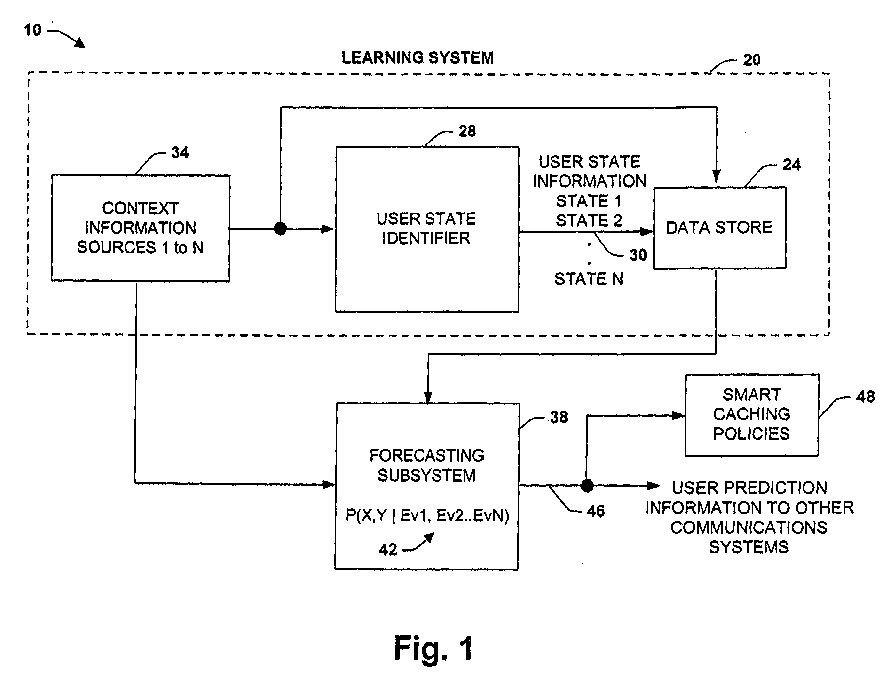
The methods can be harnessed to coordinate communications between parties via particular modalities of interaction. The system includes a user state identifier
that determines a user's state from background knowledge, the flow of time, or one
or more context information sources. A data log can be employed to store information
about user state changes and observational evidence to accumulate statistics and build
inferential models of the availability and unavailability of users for different kinds
of communication, collaboration, and information access. A forecaster is constructed
from the accumulated statistics and/or learned models to enable a determination of
a user's likely return, or, more generally, the probability distribution over a user's
likely return to particular states of availability. The forecaster can be employed
to cache information for offline access, drive displays of availability and unavailability,
to send messages that include availability forecasts, and to automatically perform
scheduling or rescheduling of communications.
|
|
