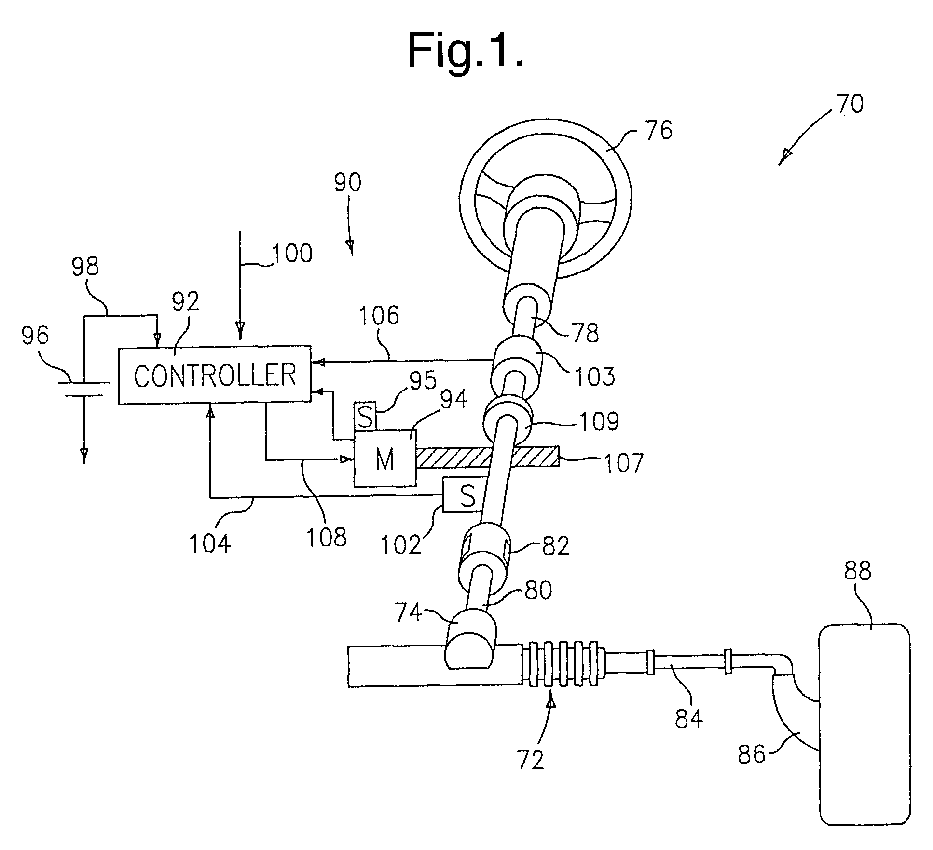
(57) A vehicular system (70) includes a controller (92) and an electric motor (94) in
signal communication with the controller (92) for receiving current and rotating at
speed; while the controller (92) includes a first function (18) responsive to a signal
indicative of the speed of the electric motor (94), a filter (14) responsive to a
signal indicative of the heat generation rate of the vehicular system (70), a second
function (16) in signal communication with the first function (18) and the filter
(14), and a limit calculation function (26, 126) in signal communication with the
second function (16) for providing a motor current limit (10, 110, 210) responsive
to the second function (16); wherein a method for controlling the vehicular system
(70) includes receiving a signal indicative of the heat generation rate of the vehicular
system (70), receiving a signal indicative of a speed of the electric motor (94),
providing a scale factor or an overload value in response to the received signal indicative
of speed, filtering the received signal indicative of heat generation rate in correspondence
with a time constant, processing the filtered signal by executing a multiplication
by the scale factor or a comparison with the overload value to produce a signal indicative
of compliance with a duty cycle requirement, and calculating a motor current limit
in correspondence with the processed signal to thereby protect the system from thermal
overload while maximizing its performance.
|
|
