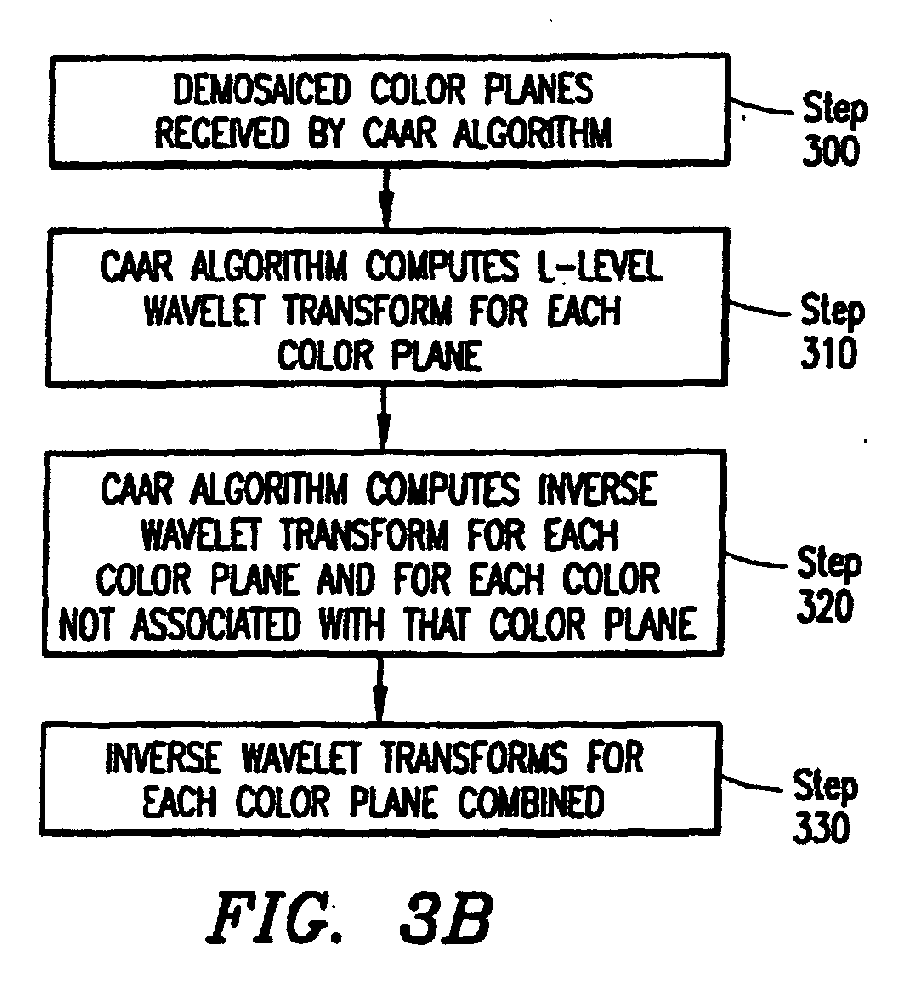
(57) A system and method is provided for processing a demosaiced image using a color aliasing
artifact reduction (CAAR) algorithm in order to reduce color aliasing artifacts. The
CAAR algorithm computes the L level wavelet transform for the demosaiced color planes
R, G and B. Thereafter, the CAAR algorithm estimates the correct color value at each
pixel location for the colors not associated with that pixel location. For example,
to determine the green value at red pixel locations, the CAAR algorithm performs an
inverse wavelet transform using the green approximation signal and the red detail
signals. This process is repeated for each of the colors (e.g., green values at blue
pixel locations, red values at green pixel locations, etc.). In addition, the CAAR
algorithm performs an inverse wavelet transform on each of the color planes themselves,
so that the pixel values of the color associated with each pixel location are not
altered. Thereafter, the inverse wavelet transform of each color plane is combined
(46) with the inverse wavelet transform of each of the estimated color values for
that color plane to produce correlated R, G and B color planes. It is these correlated
R, G and B color planes that may later be compressed using a wavelet-based image compression
method, such as the JPEG 2000 standard.
|
|
