|
(11) | EP 1 280 879 B1 |

| (12) | EUROPEAN PATENT SPECIFICATION |
|
|
| (54) |
SOIL RELEASE POLYMERS AND LAUNDRY DETERGENT COMPOSITIONS CONTAINING THEM SCHMUTZLÖSENDE POLYMERE UND DIESE ENTHALTENDE WASCHMITTELZUSAMMENSETZUNGEN POLYMERES ELIMINANT LES SALISSURES ET COMPOSITIONS DE DETERGENTS DE BLANCHISSERIE LES CONTENANT |
|
|
|||||||||||||||||||||||||||||||
| Note: Within nine months from the publication of the mention of the grant of the European patent, any person may give notice to the European Patent Office of opposition to the European patent granted. Notice of opposition shall be filed in a written reasoned statement. It shall not be deemed to have been filed until the opposition fee has been paid. (Art. 99(1) European Patent Convention). |
TECHNICAL FIELD
[0001] The present invention relates to novel soil release polymers for detergent formulations capable of enhancing soil removal from cotton or polyester fabric or their blends and a process for the preparation of the same.
BACKGROUND OF THE INVENTION
[0002] The washing of soiled fabrics with a laundry detergent is essentially a two step process. In the first stage, the detergent must remove the soil particles from the fabric and suspend them in the soil solution. In the second stage the detergent must prevent soil particles and other insolubles from re-depositing on the cloth before and after the fabric is removed from the soil solution or the rinse solution. Polymers are known to aid both processes - soil release polymers enhance soil removal from the fabric whilst antiredeposition polymers prevent the deterged soil from depositing on the fabric.
[0003] The thrust in recent times has been the development of soil release polymers (SRPs), which can be incorporated into detergent formulations, to enhance the removal of soil from the fabric. SRPs adsorb on the fabric surface, modifying properties like the hydrophilic or hydrophobic nature of the fabric and its surface energy. Consequent soil removal is greater than what is possible with a conventional detergent formulation.
[0004] Soil release polymers disclosed in the literature address the problem of removal of oily or fatty soils from polyester. Polyester is a hydrophobic fabric and removal of hydrophobic, oily soils from the fabric has historically been a problem. The problem has been circumvented in part by using soil release polymers which combine hydrophobic and hydrophilic segments. The polymers adsorb strongly on the fabric, are easily dispersed or dissolved in a surfactant and are compatible with the components of the detergent formulation. When incorporated in a detergent formulation, they aid oily soil removal.
[0005] Various soil release polymers have been disclosed in the prior art for removal of oily soils from polyester. A vast majority are polyesters that have been hydrophilically modified. US3959230 and US4116885 disclose modified polyesters as soil release agents for detergent formulations.
[0006] GB2322137 discloses the hydrophobic modification of starch (starch is the hydrophilic segment) and its use as a soil release polymer, in particular for detergency of oily soil from polyester fabric. Hydrophobic modification was carried out by graft copolymerising starch with hydrophobic monomers.
[0007] US5227446 discloses a polysaccharide modified with a) a monoethylenically unsaturated dicarboxylic acid/anhydride/alkali metal salt, b) monoethylenically unsaturated carboxylic acid/alkali metal salt and c) monomer containing two or more ethylenically unsaturated, nonconjugated double bonds in the molecule.
[0008] SRPs for removal of oily soil from cotton have also been disclosed. US3948838 discloses the use of copolymers of hydrophobic acrylic monomers and water soluble monomers like acrylic acid, as oily soil release agents for cotton fabrics.
[0009] Hence, polymers are known in the prior art for removal of oily soil from cotton or polyester. However, polymers that can aid removal of oily and particulate soil or their mixtures from cotton and polyester have not been disclosed.
SUMMARY OF THE INVENTION
[0010] Thus according to the present invention, novel soil release polymers that are anionic, hydrophobic graft copolymers of polysaccharides are provided. The soil release polymers can be incorporated in detergent formulations and aid the removal of oily and particulate soil from cotton, polyester or their blends. The polymers can also be used in rinse conditioners. A process for making these soil release polymers comprising the steps of anionic modification and graft copolymerisation is also provided.
DEFINITION OF THE INVENTION
[0011] According to a first aspect of the present invention, there is provided an anionic, hydrophobic polysaccharide which is a graft copolymer of a polysaccharide having anionic substituents with an ethylenically unsaturated monomer, the copolymer having a polysaccharide backbone carrying grafted hydrophobic vinyl polymeric groups derived from the ethylenically unsaturated monomer, and anionic substituents, preferably a group which possesses a carboxylic or a sulphonic acid head group or a salt thereof.
[0012] More specifically the invention provides an anionic, hydrophobic polysaccharide having the general formula I:
wherein R is a hydrophobic vinyl polymer, R' and R'' which may or may not be the same represents a group which possesses a carboxylic or a sulphonic acid head group or a salt thereof and G is a monosaccharide or substituted monosaccharide.
[0013] According to a second aspect of the present invention there is provided a process for the preparation of an anionic, hydrophobic polysaccharide as previously defined, comprising the steps of graft copolymerisation and anionic modification of a polysaccharide.
[0014] According to a third aspect of the present invention there is provided a fabric treatment composition comprising a fabric treatment agent and from 0.01 to 10 wt% of a anionic, hydrophobic polysaccharide as previously defined.
[0015] According to a fourth aspect of the present invention there is provided a detergent composition comprising from 5 to 60 wt% of a detersive surfactant and from 0.01 to 10 wt% of an anionic, hydrophobic polysaccharide as previously defined.
DETAILED DESCRIPTION OF THE INVENTION
The anionic, hydrophobic polysaccharide
[0016] The anionic, hydrophobic graft copolymer of polysaccharide of the current invention has the general structure given below:
wherein R is a hydrophobic vinyl polymer, R' and R'' which may or may not be the same, represent a group which possesses a carboxylic or a sulphonic acid head group or a salt thereof and G is a monosaccharide or substituted monosaccharide.
[0018] In a first preferred embodiment, R' and R" are polymeric vinyl sulphonate groups such as -(CH2-CHSO3H)n and -(CH2-CHSO3-M+)n, wherein M is an alkali or alkaline earth metal and n has a value of from 5 to 100. In a second preferred embodiment, R' and R'' are alkylene carboxylates of the general form -R3-COOH and -R3-COO-M+, wherein R3 is a C1 to C4 alkylene group, C1 being especially preferred, and M is an alkali or alkaline earth metal.
[0019] The hydrophobic vinyl polymer can be attached to the polysaccharide backbone through the hydroxyl group or through any of the carbon atoms on the sugar. The polymer chains can be present at irregular intervals on the polysaccharide chain and it is not critical that they be present at regular intervals. Up to 50% homopolymer may be present without impairing soil release performance. The anionic group is attached to the polysaccharide backbone through the hydroxyl group, either primary or secondary. It is not essential that anionic substituents be present on each of the sugar rings.
[0020] It is not essential to remove any unreacted polysaccharide that may be present in the final product obtained by graft copolymerisation and anionic modification of the polysaccharide.
[0021] The polysaccharide, which is the hydrophilic part of the molecule, is preferably chosen from cellulose, guar gum, starch and tamarind kernel powder but is not limited by the same. More preferably the polysaccharide is starch. The starch can be any native starch and includes those derived from wheat, rice, oat, tapioca, maize, potato, sorghum, arrowroot or their mixtures thereof. Alternatively, acid or enzymatically degraded starch or oxidised starch or their mixtures or their mixtures thereof with the native starches can also be used.
[0022] When starch is the preferred polysaccharide, it may be in the native form or gelatinised form. The term gelatinisation refers to rupture of the starch granule at elevated temperatures in presence of water.
[0023] The hydrophobic modification is provided by a hydrophobic vinyl polymer (R in Formula I) grafted onto the polysaccharide backbone. The polymers of vinyl monomers like acrylic monomers, vinyl acetate, styrene and substituted styrenes are especially preferred. The molecular weight of each of the hydrophobic vinyl polymer chains is preferably 500-5,000,000, more preferably from 2000-500,000 and most preferably from 5000-100,000.
[0024] The amount of the hydrophobic vinyl polymer is preferably 0.1-10% by weight of the polysaccharide, more preferably from 1-5% by weight of the polysaccharide.
[0025] Preferably, acrylic monomers are used for graft copolymerisation. The hydrophobic acrylic polymers especially suitable for the present invention are shown below having the general formula II:
wherein R1 and R1' may or may not be the same and represent -H, -CH3, -C2H5.
and wherein R2 and R2' may or may not be the same and represent -COOCH3, -COOC2H5, -COOC3H7.
[0027] The anionic group, which may be a group which possesses a carboxylic or a sulphonic acid head group or a salt thereof, is distributed along the backbone of the polysaccharide. The compounds of the invention may contain both groups with carboxylic acid or sulphonic acid head groups (or their salts) as anionic substituents.
[0028] The amount of the anionic substituent is preferably 0.1-10% by weight of the polysaccharide, more preferably from 0.1-5% by weight of the polysaccharide.
[0029] Preferred examples of anionic reagents for effecting anionic modification of the polysaccharide are halocarboxylic acids or their salts and vinyl sulphonic acid or their salts or their mixtures thereof. More preferably the halocarboxylic acids are used as anionic reagents. Chloroacetic acid is especially preferred.
Examples of preferred modified polysaccharides
[0030] The following formulae are representative examples of anionic, hydrophobic polysaccharides of the invention (formula I).
Preparation of the anionic, hydrophobic polysaccharides
[0032] The soil release polymers of the invention are prepared by a) graft copolymerisation and b) anionic modification of the polysaccharide. It is not particularly relevant for the present invention as to which step is carried out first. Preferably, the step of graft copolymerisation of the polysaccharide is carried out first, followed by anionic modification.
[0033] Both graft copolymerisation and anionic modification of the polysaccharide can take place through the primary and/or the secondary hydroxyl groups on the polysaccharide backbone. Graft copolymerisation can also be initiated by H abstraction from the monosaccharide residue.
[0034] Graft copolymerisation is carried out by contacting the redox initiator, such as ferrous ammonium sulphate and hydrogen peroxide or ceric ammonium nitrate and dilute nitric acid, with the polysaccharide in an aqueous medium. A preferred temperature range is 20-60°C., more preferably from 30-40°C. It is preferable to add an entrainer, an example of which is urea. When the ferrous ammonium sulphate and hydrogen peroxide system is used as the redox initiatior, it is preferable to also add ascorbic acid. The hydrophobic monomer is added and subsequent polymerisation takes place to yield the polymer of the invention.
[0035] The hydrophobic graft copolymer so prepared is preferably reacted with a carboxylating or sulphonating reagent selected from halocarboxylic acid, an alkali or alkaline earth metal salt of a halocarboxylic acid, vinyl sulphonic acid or the alkali or alkaline earth metal salt of the vinyl sulphonic acid. It is preferable to use haloacetic acid, more preferably chloroacetic acid, to provide anionic groups on the polysaccharide. The process of anionic modification may be carried out in presence of a solvent such as water/isopropanol mixtures or as a dry process.
[0036] When the soil release polymer of the invention is prepared from native starch, it is preferred to subject the same to a temperature of 70-90°C in presence of water, to make the soil release polymer water soluble.
Fabric treatment and detergent compositions
[0037] The soil release polymer of the invention may be used to treat fabric by incorporating it into detergent compositions, rinse conditioners or other fabric treatment compositions. It can also be used simply as an aqueous solution which can be applied to the fabric to enhance soil removal from the fabric.
[0038] The polymers of the invention are suitably incorporated at the level of 0.01-10 wt%, preferably 0.5-5 wt%, of the detergent or fabric treatment composition.
[0039] The soil release polymers may advantageously be incorporated into built laundry detergent compositions suitable for heavy duty use. A preferred detergent composition in accordance with the invention may contain from 5 to 40 wt% of detersive surfactant (detergent-active material), from 5 to 80 wt% of detergency builder, and from 0.01 to 10 wt%, preferably from 0.5 to 5 wt%, of the soil release polymer of the invention.
[0040] Apart from the polymers of the invention, the detergent formulations also contain as in conventional formulations, detergent actives (surfactants) and builders and auxiliaries. Auxiliaries include sequestrants, dye-transfer inhibitors, perfumes, bleaches, enzymes, flourescers, optical brighteners, fungicides, germicides, hydrotropes etc.
[0041] The detergent composition may be in any physical form, for example, powder, tablet, bar, paste or liquid.
[0042] The detergent active material is generally chosen from anionic, nonionic, cationic, zwitterionic detergent active compounds and mixtures thereof.
[0043] Anionic surfactants which can be used in the compositions of the invention are both soap and non-soap detergents compounds. Especially suitable anionic detergent active compounds are water soluble salts of organic sulphuric reaction products having in the molecular structure an alkyl radical containing from 8 to 22 carbon atoms, and a radical chosen from sulphonic acid or sulphur acid ester radicals and mixtures thereof.
[0044] The preferred water-soluble synthetic anionic detergent active compounds are the alkali metal (such as sodium and potassium) and alkaline earth metal (such as calcium and magnesium) salts of higher alkyl benzene sulphonates and mixtures with olefin sulphonates and higher alkyl sulphates, and the higher fatty acid monoglyceride sulphates. The most preferred anionic detergent active compounds are higher alkyl aromatic sulphonates such as higher alkyl benzene sulphonates containing from 6 to 20 carbon atoms in the alkyl group in a straight or branched chain, particular examples of which are sodium salts of higher alkyl benzene sulphonates or of higher-alkyl toluene, xylene or phenol sulphonates, alkyl naphthalene sulphonates, ammonium diamyl naphthalene sulphonate, and sodium dinonyl naphthalene sulphonate.
[0045] Suitable nonionic detergent active compounds can be broadly described as compounds produced by the condensation of alkylene oxide groups, which are hydrophilic in nature, with an organic hydrophobic compound which may be aliphatic or alkyl aromatic in nature. The length of the hydrophilic or polyoxyalkylene radical which is condensed with any particular hydrophobic group can be readily adjusted to yield a water-soluble compound having the desired degree of balance between hydrophilic and hydrophobic elements.
[0046] Particular examples include the condensation product of aliphatic alcohols having from 8 to 22 carbon atoms in either straight or branched chain configuration with ethylene oxide, such as a coconut oil ethylene oxide condensate having from 2 to 15 moles of ethylene oxide per mole of coconut alcohol; condensates of alkylphenols whose alkyl group contains from 6 to 12 carbon atoms with 5 to 25 moles of ethylene oxide per mole of alkylphenol; condensates of the reaction product of ethylenediamine and propylene oxide with ethylene oxide, the condensate containing from 40 to 80% of polyoxyethylene radicals by weight and having a molecular weight of from 5,000 to 11,000; tertiary amine oxides of structure R3NO, where one group R is an alkyl group of 8 to 18 carbon atoms and the others are each methyl, ethyl or hydroxyethyl groups, for instance dimethyldodecylamine oxide; tertiary phosphine oxides of structure R3PO, where one group R is an alkyl group of from 10 to 18 carbon atoms, and the others are each alkyl or hydroxyalkyl groups of 1 to 3 carbon atoms, for instance dimethyldodecylphosphine oxide; and dialkyl sulphoxides of structure R2SO where the group R is an alkyl group of from 10 to 18 carbon atoms and the other is methyl or ethyl, for instance methyltetradecyl sulphoxide; fatty acid alkylolamides; alkylene oxide condensates of fatty acid alkylolamides and alkyl mercaptans.
[0047] Suitable amphoteric detergent-active compounds that optionally can be employed are derivatives of aliphatic secondary and tertiary amines containing an alkyl group of 8 to 18 carbon atoms and an aliphatic radical substituted by an anionic water-solubilizing group, for instance sodium 3-dodecylamino-propionate, sodium 3-dodecylaminopropane sulphonate and sodium N-2-hydroxydodecyl-N-methyltaurate. Suitable cationic detergent-active compounds are quaternary ammonium salts having an aliphatic radical of from 8 to 18 carbon atoms, for instance cetyltrimethyl ammonium bromide.
[0048] Suitable zwitterionic detergent-active compounds that optionally can be employed are derivatives of aliphatic quaternary ammonium, sulphonium and phosphonium compounds having an aliphatic radical of from 8 to 18 carbon atoms and an aliphatic radical substituted by an anionic water-solubilising group, for instance 3-(N-N-dimethyl-N-hexadecylammonium), propane-1-sulphonate betaine, 3-(dodecylmethyl sulphonium) propane-1-sulphonate betaine and 3-(cetylmethylphosphonium) ethane sulphonate betaine.
[0049] Further examples of suitable detergent-active compounds are compounds commonly used as surface-active agents given in the well-known textbooks "Surface Active Agents", Volume I by Schwartz and Perry and "Surface Active Agents and Detergents", Volume II by Schwartz, Perry and Berch.
[0050] The detergency builders used in the formulation are preferably inorganic and suitable builders include alkali metal aluminosilicates (zeolites), alkali metal carbonate, sodium tripolyphosphate (STPP), tetrasodium pyrophosphate (TSPP), citrates, sodium nitrilotriacetate (NTA) and combinations of these. Builders may suitably be used in amounts ranging from 5 to 80 wt%, preferably from 10 to 60 wt%.
[0051] The detergent compositions of the invention may also contain any other suitable ingredients. These may be selected from, but are not limited to, bleaches, bleach precursors, bleach stabilisers (heavy metal sequestrants), photobleaches, enzymes, other polymers, foam boosters, foam controllers, fluorescers, fillers, flow aids, fabric conditioning agents, perfumes, colourants, and coloured speckles.
[0052] The polymers of the invention may also be used as part of a fabric washing kit, as part of a sachet or can be microencapsulated.
[0053] A fabric washing kit may comprise two enclosures separated from each other. It is preferred that one enclosure is big and the other small. The big enclosure contains the detergent formulation and the small enclosure the polymer. An instruction sheet contains directions for the use of the two components including the proportions and conditions under which these are to be used. The kit may also contain a dispensing means to aid the washing using the two components in the desired proportions.
[0054] A preferred kit according to the invention is a plastic container having two separate chambers. A first bigger chamber holds the detergent composition. The second small chamber has a volume capacity not greater than about 10% of the big chamber and holds the soil release polymer of the invention.
[0055] The polymer/detergent composition may also be packaged in single dose sachet having a compartment in which the two components are housed in a manner such that they come into contact when the contents are discharged from the sachet. It is also possible to microencapsulate the polymer and provide the product in a premixed form. Other forms of packagings are also included within the scope of invention.
[0056] The invention is illustrated further by the following nonlimiting examples, in which parts and percentages are by weight unless otherwise stated.
EXAMPLES
Example 1
Synthesis of Soil Release Polymer
[0057] 100 g urea was dissolved in 1 litre of distilled water in a flask equipped with a stirrer and a thermometer. 1 kg of tapioca starch, 1 g ferrous ammonium sulphate and 5 g ascorbic acid, 50 ml methyl acrylate were added sequentially and the mixture was stirred. 10 ml hydrogen peroxide (30% w/v) was then added, the reaction mixture stirred and then filtered. The reaction was conducted at 30°C. The starch-graft-poly (methyl acrylate) obtained was repeatedly washed with water and then dried at 100°C.
[0058] 250 g of chloroacetic acid and 240 g of sodium hydroxide was dissolved in water and mixed under stirring maintaining a temperature of <20°C. 40 g urea was then added to the mixture. 1 kg of the above starch-graft-poly (methyl acrylate) was taken in a mixer and the chloroacetic acid-sodium hydroxide mixture was then sprayed on to the same under stirring. The mixture was left for 24 hours at 60°C and then dried to 11% moisture.
Example 2
Demonstration of soil removal properties of the polymer
[0059] A standard detergent formulation without a soil release polymer was formulated (Comparative Example A). A detergent formulation incorporating the polymer of Example 1 was also prepared. The formulation details are presented in Table 1.
Table 1
| Composition % wt. | Comparative Example A | Example 1 |
| Linear alkyl benzene sulphonate | 20 | 20 |
| Sodium tripolyphosphate | 27 | 27 |
| Soda | 15 | 15 |
| Alkaline silicate | 10 | 10 |
| Fillers | 15 | 15 |
| Soil Release Polymer | - | 2 |
| Water | To 100 | To 100 |
[0061] 100% cotton and 100% polyester fabric were used in the study. The fabric was cut into swatches of dimension 5" X 5". The swatches were soiled using a) oily soil and b) particulate soil (carbon soot). The oily soil could be sebum prepared in the lab or motor oil. A red dye at a concentration of 0.025% is added to the oil to clearly determine oil removal from the fabric.
[0062] Commercially available fabrics presoiled with a mixture of oily and particulate soil (WFK 30D was pre-soiled polyester and WFK 10D was pre-soiled cotton) were also used.
[0063] 0.2g of soil along with oil red dye at a concentration of 0.025% was loaded on to each of the test swatches and the stain was allowed to wick for a period of 24 hrs. Initial reflectance measurement at 520 nm was taken, on a Milton Roy Color Scan II. 520 nm is the wavelength at which the red dye absorbs, hence it is used to monitor soil removal.
[0064] For particulate soil loading, carbon soot was deposited to the cloth piece to get a reflectance of 55. The reflectance was determined at 460 nm.
[0065] The fabrics mentioned above were washed using the detergent compositions of Comparative Example A and Example 1, maintaining 10 replicates for each. Detergent solutions of concentration 5g/l were then prepared.
[0066] Test swatches were washed in a tergotometer in the detergent solution for a period of 15 minutes. Reflectance measurements were taken at 520nm (for oily soil) or 460 nm (for particulate soil and WFK 10D and 30D). The difference in reflectance of the soiled fabrics before and after washing was noted and represented as ΔR520* or ΔR460*.
[0068] The improvement in soil removal for particulate and mixtures of oily and particulate was determined as follows:
[0069] The results of the tergotometer washes following the above detergency test procedure for removal of soils from polyester are presented in Table 2. Test results for cotton are presented in Table 3.
Table 2 -
| Polyester | ||
| Particulate soil | ΔΔR460* | 2.4 |
| Artificial sebum | ΔΔR520* | 1.6 |
| Motor oil | ΔΔR520* | 2.5 |
| Mixture of oily and particulate soil | ΔΔR460* | 2.0 |
Table 3 -
| Cotton | ||
| Particulate soil | ΔΔR460* | 3.0 |
| Artificial sebum | ΔΔR520* | 0.5 |
| Motor oil | ΔΔR520* | 0.5 |
| Mixture of oily and particulate soil | ΔΔR460* | 2.0 |
1. Anionic, hydrophobic polysaccharide characterised in that it is a graft copolymer of a polysaccharide having anionic substituents with an ethylenically
unsaturated monomer, the copolymer having a polysaccharide backbone carrying grafted
hydrophobic vinyl polymeric groups derived from the ethylenically unsaturated monomer,
and anionic substituents.
2. Anionic, hydrophobic polysaccharide according to claim 1, characterised in that the anionic substituents are selected from groups which possess a carboxylate or
a sulphonate head group.
3. Anionic, hydrophobic polysaccharide characterised by the general formula I:
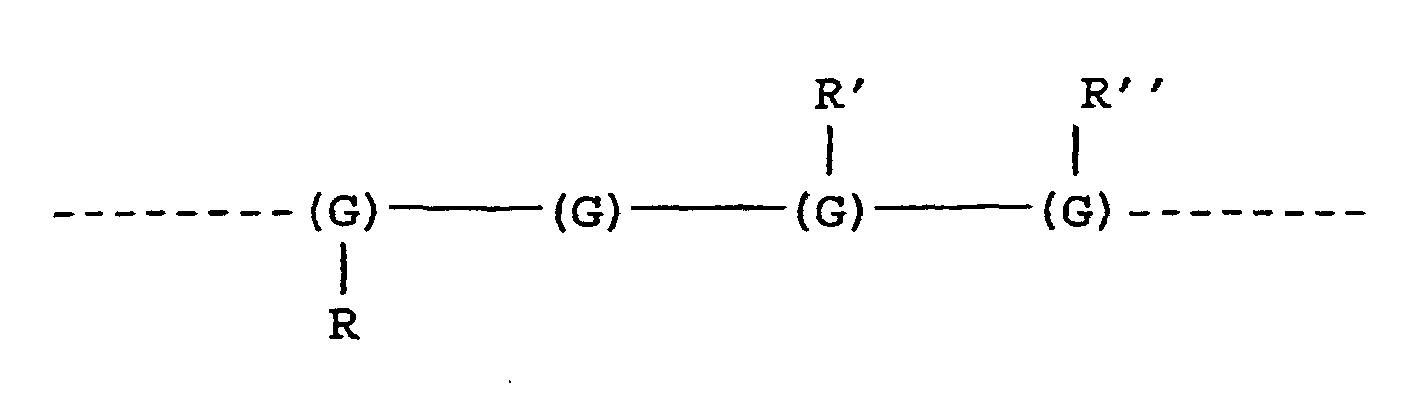
wherein R is a hydrophobic vinyl polymer, R' and R'', which may or may not be the same, represent a group which possesses a carboxylic acid or a sulphonic acid head group or salts thereof and G is a monosaccharide or substituted monosaccharide.
wherein R is a hydrophobic vinyl polymer, R' and R'', which may or may not be the same, represent a group which possesses a carboxylic acid or a sulphonic acid head group or salts thereof and G is a monosaccharide or substituted monosaccharide.
4. Anionic, hydrophobic polysaccharide according to claim 3, characterised in that R' and R'', which may or may not be the same, are polymeric vinyl sulphonates selected
from -(CH2-CHSO3H)n and -(CH2-CHSO3-M+)n, wherein M is an alkali or alkaline earth metal and n has a value of from 5 to 100.
5. Anionic, hydrophobic polysaccharide according to claim 3, characterised in that R' and R'', which may or may not be the same, are selected from -R3-COOH and -R3-COO-M+, wherein R3 is a C1 to C4 alkylene group and M is an alkali or alkaline earth metal.
6. Anionic, hydrophobic polysaccharide according to claim 5, characterised in that R' = R'' = -CH2-COOH or its metal salt.
7. Anionic, hydrophobic polysaccharide according to any preceding claim, characterised in that the amount of the hydrophobic vinyl polymer is 0.1-10% by weight of the polysaccharide.
8. Anionic, hydrophobic polysaccharides according to claim 7, characterised in that the amount of the hydrophobic vinyl polymer is 1-5% by weight of the polysaccharide.
9. Anionic, hydrophobic polysaccharide according to any preceding claim, characterised in that the amount of anionic substituent is 0.1-10% by weight of the polysaccharide.
10. Anionic, hydrophobic polysaccharide according to claim 9, characterised in that the amount of anionic substituent is 0.1-5% by weight of the polysaccharide.
11. Anionic, hydrophobic polysaccharide according to any preceding claim, characterised in that the hydrophobic vinyl polymer has a molecular weight from 500 to 5,000,000.
12. Anionic, hydrophobic polysaccharide according to claim 11, characterised in that the hydrophobic vinyl polymer has a molecular weight from 2000 to 500,000.
13. Anionic, hydrophobic polysaccharide according to claim 12, characterised in that the hydrophobic vinyl polymer has a molecular weight from 5000 to 100,000.
14. Anionic, hydrophobic polysaccharide according to any one of claims 3 to 13, characterised in that R is an acrylic polymer, having the general formula II
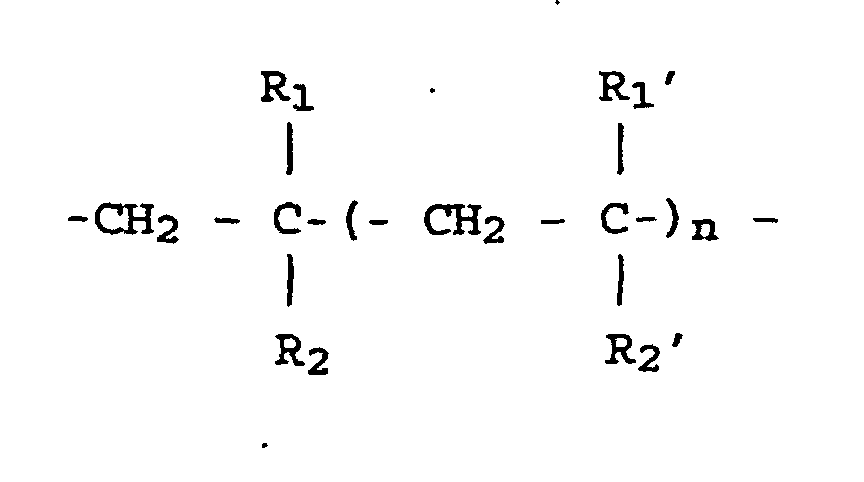
wherein R1 and R1' may or may not be the same and represent -H, -CH3, -C2H5 , and wherein R2 and R2' may or may not be the same and represent -COOCH3, -COOC2H5, -COOC3H7.
wherein R1 and R1' may or may not be the same and represent -H, -CH3, -C2H5 , and wherein R2 and R2' may or may not be the same and represent -COOCH3, -COOC2H5, -COOC3H7.
15. Anionic, hydrophobic polysaccharide according to claim 14, characterised in that R1 = R1' = H and R2 = R2' = -COOCH3.
16. Anionic, hydrophobic polysaccharide according to any preceding claim, characterised in that the polysaccharide is selected from starch, modified starches, cellulose, guar gum,
and tamarind gum.
17. Anionic, hydrophobic polysaccharide according to claim 16, characterised in that the polysaccharide is starch.
18. A process for the preparation of an anionic, hydrophobic polysaccharide according
to any one of claims 1 to 17, characterised in that it comprises graft copolymerisation and anionic modification of a polysaccharide.
19. A process according to claim 18, characterised in that it comprises graft copolymerisation of the polysaccharide or the anionically modified
polysaccharide using a redox initiator.
20. A process according to claim 19, characterised in that it comprises graft copolymerisation of the polysaccharide or the anionically modified
polysaccharide using ferrous ammonium sulphate and hydrogen peroxide as the redox
initiator.
21. A process according to any one of claims 18 to 20, characterised in that it comprises anionic modification of the polysaccharide or the graft copolymerised
polysaccharide using halocarboxylic acid or its salt or mixtures thereof.
22. A process according to claim 21, characterised in that the halocarboxylic acid is chloroacetic acid.
23. A process according to any one of claims 18 to 20, characterised in that it comprises anionic modification of the polysaccharide or the graft copolymerised
polysaccharide using a vinyl sulphonic acid or its salt or mixtures thereof.
24. A fabric treatment composition comprising a fabric treatment agent, characterised in that it further comprises from 0.01 to 10 wt% of an anionic, hydrophobic polysaccharide
according to any one of claims 1 to 17.
25. A detergent composition comprising from 5 to 60 wt% of a detersive surfactant, characterised in that it further comprises from 0.01 to 10 wt% of an anionic, hydrophobic polysaccharide
according to any one of claims 1 to 17.
26. A detergent composition according to claim 25, characterised in that it is a built laundry detergent composition comprising from 5 to 40 wt% of detersive
surfactant, and from 5 to 80 wt% of detergency builder.
27. A detergent compositions according to claim 25 or claim 26, characterised in that it comprises from 0.5 to 5 wt% of the anionic, hydrophobic polysaccharide according
to any one of claims 1 to 17.
1. Anionisches, hydrophobes Polysaccharid, dadurch gekennzeichnet, dass es ein Pfropfcopolymer eines Polysaccharids mit anionischen Substituenten mit einem
ethylenisch ungesättigten Monomer darstellt, wobei das Copolymer ein Polysaccharidgerüst,
das gepfropfte hydrophobe Vinylpolymergruppen trägt, die von dem ethylenisch ungesättigten
Monomer abgeleitet sind, und anionische Substituenten aufweist.
2. Anionisches, hydrophobes Polysaccharid nach Anspruch 1, dadurch gekennzeichnet, dass die anionischen Substituenten ausgewählt sind aus Gruppen, die eine Carboxylat- oder
eine Sulfonatkopfgruppe besitzen.
3. Anionisches, hydrophobes Polysaccharid, gekennzeichnet durch die allgemeine Formel I:
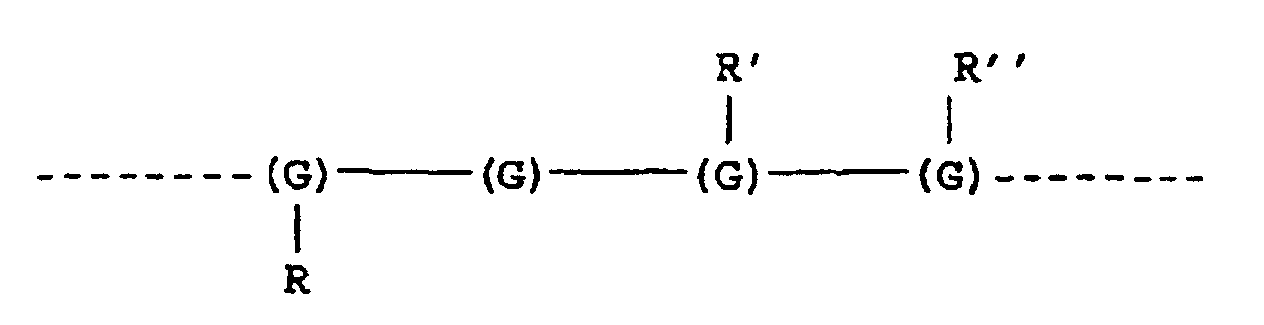
worin R ein hydrophobes Vinylpolymer darstellt, R' und R'', die gleichen oder nicht sein können, eine Gruppe wiedergeben, die eine Carbonsäure oder eine Sulfonsäurekopfgruppe oder Salze davon besitzt, und G ein Monosaccharid oder substituiertes Monosaccharid darstellt.
worin R ein hydrophobes Vinylpolymer darstellt, R' und R'', die gleichen oder nicht sein können, eine Gruppe wiedergeben, die eine Carbonsäure oder eine Sulfonsäurekopfgruppe oder Salze davon besitzt, und G ein Monosaccharid oder substituiertes Monosaccharid darstellt.
4. Anionisches, hydrophobes Polysaccharid nach Anspruch 3, dadurch gekennzeichnet, dass R' und R", die die gleichen oder nicht sein können, polymere Vinylsulfonate darstellen,
ausgewählt aus -(CH2-CHSO3H)n und -(CH2-CHSO3-M+)n, worin M ein Alkali- oder Erdalkalimetall darstellt und n einen Wert von 5 bis 100
aufweist.
5. Anionisches, hydrophobes Polysaccharid nach Anspruch 3, dadurch gekennzeichnet, dass R' und R", die die gleichen oder nicht sein können, ausgewählt sind aus -R3-COOH und -R3-COO-M+, worin R3 eine C1-C4-Alkylengruppe darstellt und M ein Alkali- oder Erdalkalimetall darstellt.
6. Anionisches, hydrophobes Polysaccharid nach Anspruch 5, dadurch gekennzeichnet, dass R' = R'' = -CH2-COOH oder ein Metallsalz davon.
7. Anionisches, hydrophobes Polysaccharid nach einem vorangehenden Anspruch, dadurch gekennzeichnet, dass die Menge des hydrophoben Vinylpolymers 0,1-10 Gewichtsprozent des Polysaccharids
ist.
8. Anionische, hydrophobe Polysaccharide nach Anspruch 7, dadurch gekennzeichnet, dass die Menge des hydrophoben Vinylpolymers 1-5 Gewichtsprozent des Polysaccharids ist.
9. Anionisches, hydrophobes Polysaccharid nach einem vorangehenden Anspruch, dadurch gekennzeichnet, dass die Menge an anionischem Substituenten 0,1-10 Gewichtsprozent des Polysaccharids
ist.
10. Anionisches, hydrophobes Polysaccharid nach Anspruch 9, dadurch gekennzeichnet, dass die Menge an anionischem Substituenten 0,1-5 Gewichtsprozent des Polysaccharids ist.
11. Anionisches, hydrophobes Polysaccharid nach einem vorangehenden Anspruch, dadurch gekennzeichnet, dass das hydrophobe Vinylpolymer ein Molekulargewicht von 500 bis 5 000 000 aufweist.
12. Anionisches, hydrophobes Polysaccharid nach Anspruch 11, dadurch gekennzeichnet, dass das hydrophobe Vinylpolymer ein Molekulargewicht von 2000 bis 500 000 aufweist.
13. Anionisches, hydrophobes Polysaccharid nach Anspruch 12, dadurch gekennzeichnet, dass das hydrophobe Vinylpolymer ein Molekulargewicht von 5000 bis 100 000 aufweist.
14. Anionisches, hydrophobes Polysaccharid nach einem der Ansprüche 3 bis 13, dadurch gekennzeichnet, dass R ein Acrylpolymer darstellt mit der allgemeinen Formel II
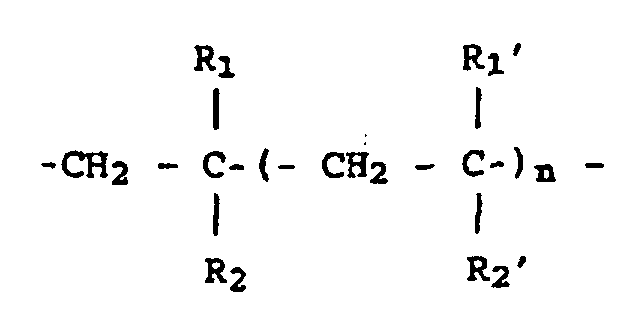
worin R1 und R1' die gleichen oder nicht sein können und -H, -CH3, -C2H5 wiedergeben und worin R2 und R2' die gleichen oder nicht sein können und -COOCH3, -COOC2H5, -COOC3H7 wiedergeben.
worin R1 und R1' die gleichen oder nicht sein können und -H, -CH3, -C2H5 wiedergeben und worin R2 und R2' die gleichen oder nicht sein können und -COOCH3, -COOC2H5, -COOC3H7 wiedergeben.
15. Anionisches, hydrophobes Polysaccharid nach Anspruch 14, dadurch gekennzeichnet, dass R1 = R1' = H und R2 = R2' = -COOCH3.
16. Anionisches, hydrophobes Polysaccharid nach einem vorangehenden Anspruch, dadurch gekennzeichnet, dass das Polysaccharid ausgewählt ist aus Stärke, modifizierten Stärken, Cellulose, Guargummi
und Tamarindengummi.
17. Anionisches, hydrophobes Polysaccharid nach Anspruch 16, dadurch gekennzeichnet, dass das Polysaccharid Stärke ist.
18. Verfahren zur Herstellung eines anionischen, hydrophoben Polysaccharids nach einem
der Ansprüche 1 bis 17, dadurch gekennzeichnet, dass es Pfropfcopolymerisation und anionische Modifizierung eines Polysaccharids umfasst.
19. Verfahren nach Anspruch 18, dadurch gekennzeichnet, dass es Pfropfcopolymerisation des Polysaccharids oder des anionisch modifizierten Polysaccharids,
unter Verwendung eines Redoxstarters, umfasst.
20. Verfahren nach Anspruch 19, dadurch gekennzeichnet, dass es Pfropfcopolymerisation des Polysaccharids oder des anionisch modifizierten Polysaccharids,
unter Verwendung von Eisen(II)ammoniumsulfat und Wasserstoffperoxid als Redoxstarter,
umfasst.
21. Verfahren nach einem der Ansprüche 18 bis 20, dadurch gekennzeichnet, dass es anionische Modifizierung des Polysaccharids oder des gepfropften, copolymerisierten
Polysaccharids, unter Verwendung von Halogencarbonsäure oder deren Salz oder Gemischen
davon, umfasst.
22. Verfahren nach Anspruch 21, dadurch gekennzeichnet, dass die Halogencarbonsäure Chloressigsäure ist.
23. Verfahren nach einem der Ansprüche 18 bis 20, dadurch gekennzeichnet, dass es anionische Modifizierung des Polysaccharids oder des gepfropften, copolymerisierten
Polysaccharids, unter Verwendung einer Vinylsulfonsäure oder deren Salz oder Gemischen
davon, umfasst.
24. Textilbehandlungszusammensetzung, umfassend ein Textilbehandlungsmittel, dadurch gekennzeichnet, dass es weiterhin 0,01 bis 10 Gewichtsprozent eines anionischen, hydrophoben Polysaccharids
nach einem der Ansprüche 1 bis 17 umfasst.
25. Waschmittelzusammensetzung, umfassend 5 bis 60 Gewichtsprozent eines Waschtensids,
dadurch gekennzeichnet, dass es weiterhin 0,01 bis 10 Gewichtsprozent eines anionischen, hydrophoben Polysaccharids
nach einem der Ansprüche 1 bis 17 umfasst.
26. Waschmittelzusammensetzung nach Anspruch 25, dadurch gekennzeichnet, dass sie eine aufgebaute Waschmittelzusammensetzung ist, die 5 bis 40 Gewichtsprozent
Waschtensid und 5 bis 80 Gewichtsprozent Waschmittelbuilder umfasst.
27. Waschmittelzusammensetzungen nach Anspruch 25 oder 26, dadurch gekennzeichnet, dass sie 0,5 bis 5 Gewichtsprozent des anionischen, hydrophoben Polysaccharids nach einem
der Ansprüche 1 bis 17 umfassen.
1. Polysaccharide hydrophobe, anionique caractérisé en ce qu'il est un copolymère greffé d'un polysaccharide ayant des substituants anioniques
avec un monomère éthyléniquement insaturé, le copolymère ayant un squelette de polysaccharide
portant des groupes polymériques de vinyle hydrophobe greffés, dérivés du monomère
éthyléniquement insaturé, et des substituants anioniques.
2. Polysaccharide hydrophobe, anionique, selon la revendication 1, caractérisé en ce que les substituants anioniques sont choisis dans des groupes qui possèdent un groupe
de tête carboxylate ou sulfonate.
3. Polysaccharide hydrophobe, anionique caractérisé par la formule générale I :
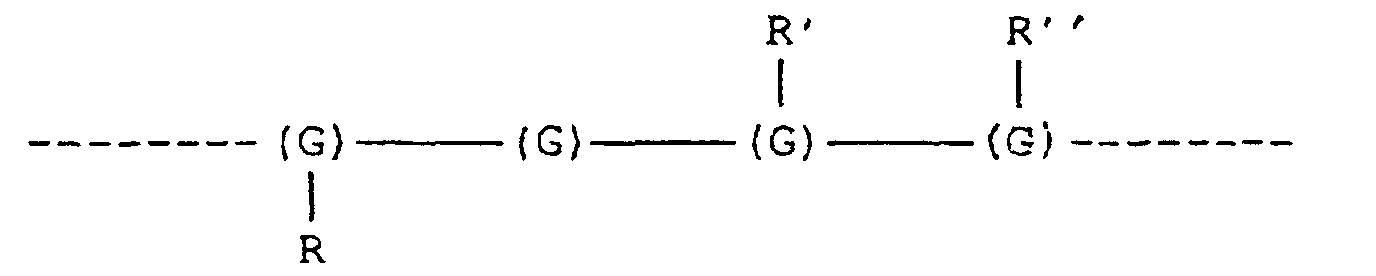
dans laquelle R est un polymère de vinyle hydrophobe, R' et R", qui peuvent être ou ne pas être identiques, représentent un groupe qui possède un groupe de tête acide carboxylique ou acide sulfonique ou des sels de ceux-ci et G est un monosaccharide ou un monosaccharide substitué.
dans laquelle R est un polymère de vinyle hydrophobe, R' et R", qui peuvent être ou ne pas être identiques, représentent un groupe qui possède un groupe de tête acide carboxylique ou acide sulfonique ou des sels de ceux-ci et G est un monosaccharide ou un monosaccharide substitué.
4. Polysaccharide hydrophobe, anionique selon la revendication 3, caractérisé en ce que R' et R", qui peuvent être ou ne pas être identiques, sont des sulfonates de vinyle
polymériques choisis parmi -(CH2-CHSO3H)n et -(CH2-CHSO3-M+)n, dans lesquels M est un métal alcalin ou alcalino-terreux et n a une valeur allant
de 5 à 100.
5. Polysaccharide hydrophobe, anionique, selon la revendication 3, caractérisé en ce que R' et R", qui peuvent être ou ne pas être identiques, sont choisis parmi -R3-COOH- et -R3-COO-M+, dans lesquels R3 est un groupe alkylène en C1 à C4 et M est un métal alcalin ou alcalino-terreux.
6. Polysaccharide hydrophobe, anionique, selon la revendication 5, caractérisé en ce que R' = R" = -CH2COOH ou son sel métallique.
7. Polysaccharide hydrophobe, anionique, selon l'une quelconque des revendications précédentes,
caractérisé en ce que la quantité du polymère de vinyle hydrophobe est de 0,1 à 10 % en poids du polysaccharide.
8. Polysaccharides hydrophobes, anioniques, selon la revendication 7, caractérisés en ce que la quantité du polymère de vinyle hydrophobe est de 1 à 5 % en poids du polysaccharide.
9. Polysaccharide hydrophobe, anionique, selon l'une quelconque des revendications précédentes,
caractérisé en ce que la quantité de substituant anionique est de 0,1 à 10 % en poids du polysaccharide.
10. Polysaccharide hydrophobe, anionique, selon la revendication 9, caractérisé en ce que la quantité de substituant anionique est de 0,1 à 5 % en poids du polysaccharide.
11. Polysaccharide hydrophobe, anionique, selon l'une quelconque des revendications précédentes,
caractérisé en ce que le polymère de vinyle hydrophobe a une masse moléculaire allant de 500 à 5 000 000.
12. Polysaccharide hydrophobe, anionique, selon la revendication 11, caractérisé en ce que le polymère de vinyle hydrophobe a une masse moléculaire allant de 2000 à 500 000.
13. Polysaccharide hydrophobe, anionique, selon la revendication 12, caractérisé en ce que le polymère de vinyle hydrophobe a une masse moléculaire allant de 5000 à 100 000.
14. Polysaccharide hydrophobe, anionique, selon l'une quelconque des revendications 3
à 13, caractérisé en ce que R est un polymère acrylique, ayant la formule générale II :
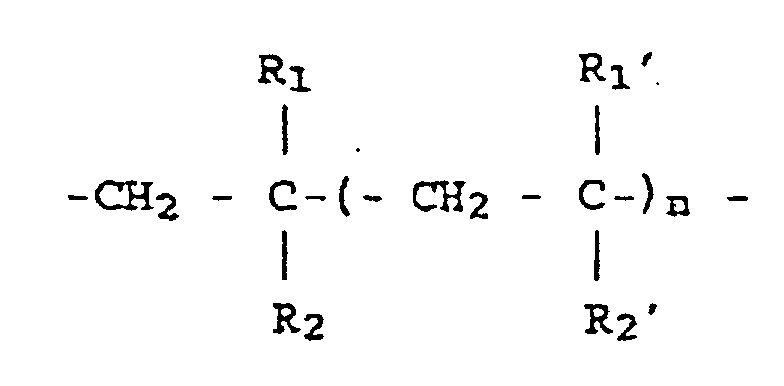
dans laquelle R1 et R1' peuvent être ou ne pas être identiques et représentent -H, -CH3, -C2H5, et dans laquelle R2 et R2' peuvent être ou ne pas être identiques et représentent -COOCH3, -COOC2H5, -COOC3H7.
dans laquelle R1 et R1' peuvent être ou ne pas être identiques et représentent -H, -CH3, -C2H5, et dans laquelle R2 et R2' peuvent être ou ne pas être identiques et représentent -COOCH3, -COOC2H5, -COOC3H7.
15. Polysaccharide hydrophobe, anionique, selon la revendication 14, caractérisé en ce que R1 = R1' = H et R2 = R2' = -COOCH3.
16. Polysaccharide hydrophobe, anionique, selon l'une quelconque des revendications précédentes,
caractérisé en ce que le polysaccharide est choisi parmi l'amidon, les amidons modifiés, la cellulose,
la gomme guar, et la gomme de tamarin.
17. Polysaccharide hydrophobe, anionique, selon la revendication 16, caractérisé en ce que le polysaccharide est l'amidon.
18. Procédé pour la préparation d'un polysaccharide hydrophobe, anionique, selon l'une
quelconque des revendications 1 à 17, caractérisé en ce qu'il comprend une copolymérisation avec greffage et une modification anionique du polysaccharide.
19. Procédé selon la revendication 18, caractérisé en ce qu'il comprend une copolymérisation avec greffage du polysaccharide ou du polysaccharide
modifié anioniquement en utilisant un amorceur redox.
20. Procédé selon la revendication 19, caractérisé en ce qu'il comprend une copolymérisation avec greffage du polysaccharide ou du polysaccharide
modifié anioniquement en utilisant du sulfate d'ammonium ferreux et du peroxyde d'hydrogène
comme amorceur redox.
21. Procédé selon l'une quelconque des revendications 18 à 20, caractérisé en ce qu'il comprend une modification anionique du polysaccharide ou du polysaccharide copolymérisé
greffé en utilisant un acide halogénocarboxylique ou son sel ou des mélanges de ceux-ci.
22. Procédé selon la revendication 21, caractérisé en ce que l'acide halogénocarboxylique est l'acide chloroacétique.
23. Procédé selon l'une quelconque des revendications 18 à 20, caractérisé en ce qu'il comprend une modification anionique du polysaccharide ou du polysaccharide copolymérisé
greffé en utilisant l'acide vinylsulfonique ou son sel ou des mélanges de celui-ci.
24. Composition de traitement de tissu comprenant un agent de traitement de tissu, caractérisée en ce qu'elle comprend en outre de 0,01 à 10 % en poids d'un polysaccharide hydrophobe, anionique,
selon l'une quelconque des revendications 1 à 17.
25. Composition de détergent comprenant de 5 à 60 % en poids d'un agent tensio-actif détersif,
caractérisée en ce qu'elle comprend en outre de 0,01 à 10 % en poids d'un polysaccharide hydrophobe, anionique,
selon l'une quelconque des revendications 1 à 17.
26. Composition de détergent selon la revendication 25, caractérisée en ce qu'elle est une composition de détergent de blanchisserie alcalinisé comprenant de 5
à 40 % en poids d'agent tensio-actif détersif, et de 5 à 80 % en poids d'adjuvant
de détergence.
27. Composition de détergent selon la revendication 25 ou la revendication 26, caractérisée en ce qu'elle comprend de 0,5 à 5 % en poids du polysaccharide hydrophobe, anionique, selon
l'une quelconque des revendications 1 à 17.