|
(11) | EP 1 288 217 B1 |

| (12) | EUROPEAN PATENT SPECIFICATION |
|
|
| (54) |
Preparation of dialkylpyridylboranes Herstellung von Dialkylpyridylboranen Préparation de dialkylpyridylboranes |
|
|
|||||||||||||||||||||||||||||||||||
| Note: Within nine months from the publication of the mention of the grant of the European patent, any person may give notice to the European Patent Office of opposition to the European patent granted. Notice of opposition shall be filed in a written reasoned statement. It shall not be deemed to have been filed until the opposition fee has been paid. (Art. 99(1) European Patent Convention). |
Background of the Invention
[0001] Dialkylpyridylboranes are very useful reagents in cross-coupling reactions to prepare substituted pyridine derivatives. Substituted pyridine derivatives may be used in the synthesis of the compounds of formula (I) referred to in WO 99/57101, published November 11,1999, which are inhibitors of p38 MAP kinase inhibitors. Compounds that inhibit p38 MAP kinase are reported to be effective in inhibiting bone resorption, Inflammation, and other immune and inflammation based pathologies. The present invention relates to an improved process for the preparation of dialkylpyrldylboranes.
[0002] The current process for the synthesis of these materials involves the lithium-bromine exchange on the bromopyridine followed by trapping of the lithlopyridine with diethylmethoxyborane or triethylborane. This type of process is referred to in the following references (a) Ishikura, M.; Mano, T.; Oda, I.; Terashima, M. Heterocycles 1984, 22, 2471-2474; (b) Ishikura, M.; Ohta, T.; Terashima, M. Chem. Pharm. Bull. 1983, 31, 4573-4577; (c) Morris, G.A.; Nguyen, S.T. Tetrahedron Lett. 2001, 42, 2093-2096; (d) Labadie, S.S.; Rotstein, D.M.; Sjogren, E.B.; Talamas, F.X., PCT International Application No. WO 99/57101 and is illustrated in the following scheme.
[0003] The above reaction must be run at low temperature (<-40°C in ether or <-100°C in tetrahydrofuran ("THF")) in order to prevent the anion from migrating, elimination of the bromide to form pyridynes, deprotonation, migration of the halide, and addition of the alkyllithium to the pyridine during the metal-halogen exchange (see, (a) Gilman, H.; Spatz, S.M. J. Org. Chem. 1951, 16, 1485-1494; (b) Mallet, M.; Branger, G.; Marsala, F.; Quenguiner, G. J. Organomet. Chem. 1990, 382, 319-332). The required use of low temperature for this reaction adds to the cost and difficulty of producing large quantities of these materials in an industrial setting. Accordingly, it is desirable to have a method of preparing dialkylpyridylboranes without the use of low temperatures for their commercial production.
Summary of the Invention
[0004] The present invention relates to a method for the preparation of dialkylpyridylboranes comprising reacting a pyridine Grignard reagent and an alkoxydialkylborane or a trialkylborane. The reaction may be performed at a temperature from about 0°C to about 40°C.
[0005] In one preferred embodiment the invention relates to a method for the preparation of a compound of formula 2:
wherein R1 and R2 are each Independently C1-C10 alkyl; R3 is H, C1-C10 alkyl, C2-C10 alkenyl, C2-C10 alkynyl, -C(O)(C1-C10 alkyl), -(CH2)t(C8-C10 aryl), -(CH2)t(4-10 membered heterocyclic), -C(O)(CH2)t(C6-C10 aryl), or -C(O)(CH2)t(5-10 membered heterocyclic), wherein t is an integer from 0 to 5; said alkyl group optionally includes 1 or 2 hetero moieties selected from O, S and -N(R6)- with the proviso that two O atoms, two S atoms, or an O and S atom are not attached directly to each other; said R3 aryl and heterocyclic groups are optionally fused to a C6-C10 aryl group, a C5-C8 saturated cyclic group, or a 5-10 membered heterocyclic group; 1 or 2 carbon atoms in the foregoing heterocyclic moieties are optionally substituted by an oxo (=O) moiety; the -(CH2)t- moieties of the foregoing R3 groups optionally include a carbon-carbon double or triple bond where t is an integer from 2 to 5 and wherein m is 0-4; and the foregoing R3 groups, except H, are optionally substituted by 1 to 3 R4 groups; R4 is C1-C10 alkyl or C1-C10 alkoxy and R8 is H or C1-C10 alkyl, comprising reaction a compound of formula 1,
wherein R3 and m are defined for formula 2 above and X is a halo with a compound of the formula R5BR1R2, wherein R1 and R2 are as defined above for formula 2 and wherein R5 Is C1-C10 alkyl or C1-C10 alkoxy.
[0006] In one preferred embodiment R1 and R2 are each independently C1-C5 alkyl. In another preferred embodiment R1 and R2 are each Independently C1-C3 alkyl. In a more preferred embodiment R1 and R2 are each independently methyl or ethyl.
[0007] In a preferred embodiment of the present invention R3 is H, C1-C10 alkyl, C2-C10 alkenyl, C2-C10 alkynyl, -C(O)(C1-C10 alkyl), -(CH2)1(C6-C10 aryl), wherein t is an integer from 0 to 5; said alkyl group optionally Includes 1 or 2 hetero moieties selected from O, S and -N(R6)-with the proviso that two O atoms, two S atoms, or an O and S atom are not attached directly to each other, said R3 aryl group is optionally fused to a C8-C10 aryl group, a C5-C8 saturated cyclic group, or a 5-10 membered heterocyclic group; the -(CH2)t- moieties of the foregoing R1 groups optionally include a carbon-carbon double or triple bond where t is an integer from 2 to 5; and the foregoing R3 groups, except H, are optionally substituted by 1 to 3 R4 groups; and wherein R4 is C1-C10 alkyl or C1-C10 alkoxy.
[0008] In a preferred embodiment of the present invention X is Cl, Br, or I. In a more preferred embodiment X is Br.
[0009] The term "halo", as used herein, unless otherwise indicated, includes fluoro, chloro, bromo or iodo. Preferred halo groups are chloro, bromo, and iodo.
[0010] The term "alkyl", as used herein, unless otherwise indicated, includes saturated monovalent hydrocarbon radicals having straight, cyclic or branched moieties. It is understood that for cyclic moieties at least three carbon atoms are required in said alkyl group.
[0011] The term "alkenyl", as used herein, unless otherwise indicated, includes monovalent hydrocarbon radicals having at least one carbon-carbon double bond and also having straight, cyclic or branched moieties as provided above in the definition of "alkyl".
[0012] The term "alkynyl", as used herein, unless otherwise indicated, includes monovalent hydrocarbon radicals having at least one carbon-carbon triple bond and also having straight, cyclic or branched moieties as provided above in the definition of "alkyl".
[0013] The term "alkoxy", as used herein, unless otherwise indicated, includes O-alkyl groups wherein "alkyl" Is as defined above.
[0014] The term "aryl", as used herein, unless otherwise indicated, includes an organic radical derived from an aromatic hydrocarbon by removal of one hydrogen, such as phenyl or naphthyl.
[0015] The term "4-10 membered heterocyclic", as used herein, unless otherwise indicated, includes aromatic and non-aromatic heterocyclic groups containing one or more heteroatoms each selected from O, S and N, wherein each heterocyclic group has from 4-10 atoms in its ring system. Non-aromatic heterocyclic groups include groups having only 4 atoms In their ring system, but aromatic heterocyclic groups must have at least 5 atoms In their ring system. An example of a 4 membered heterocyclic group is azetidinyl (derived from azetidine). An example of a 5 membered heterocyclic group is thiazolyl and an example of a 10 membered heterocyclic group is quinolinyl. Examples of non-aromatic heterocyclic groups are pyrrolidinyl, tetrahydrofuranyl, tetrahydrothienyl, tetrahydropyranyl, tetrahydrothiopyranyl, piperidino, morpholino, thiomorpholino, thioxanyl, piperazinyl, azetidinyl, oxetanyl, thietanyl, homopiperldinyl, oxepanyl, thiepanyl, oxazepinyl, diazepinyl, thiazepinyl, 1,2,3,6-tetrahydropyridinyl, 2-pyrrolinyl, 3-pyrrolinyl, indolinyl, 2H-pyranyl, 4H-pyranyl, dioxanyl, 1,3-dioxolanyl, pyrazolinyl, dithianyl, dithiolanyl, dihydropyranyl, dihydrothienyl, dihydrofuranyl, pyrazolidinyl, imidazolinyl, imidazolidinyl, 3-azabicycio[3.1.0]hexanyl, 3-azabicyclo[4.1.0]heptanyl, 3H-indolyl and quinolizinyl. Examples of aromatic heterocyclic groups are pyridinyl, imidazolyl, pyrimidinyl, pyrazolyl, triazolyl, pyrazinyl, tetrazolyl, furyl, thienyl, isoxazolyl, thiazolyl, oxazolyl, isothiazolyl, pyrrolyl, quinolinyl, isoquinolinyl, indolyl, benzimidazolyl, benzofuranyl, cinnolinyl, indazolyl, indolizinyl, phthalazinyl, pyridazinyl, triazinyl, isoindolyl, pteridinyl, purinyl, oxadiazolyl, thiadiazolyl, furazanyl, benzofurazanyl, benzothiophenyl, benzothiazolyl, benzoxazolyl, quinazolinyl, quinoxalinyl, naphthyridinyl, and furopyridinyl. The foregoing groups, as derived from the compounds listed above, may be C-attached or N-attached where such is possible. For instance, a group derived from pyrrole may be pyrrol-1-yl (N-atiached) or pyrrol-3-yl (C-attached).
[0016] The present invention relates to a method for preparing a dialklypyridylborane comprising reacting a pyridine Grignard reagent with an alkoxydialkylborane reagent or a trialkylborane reagent. The pyridine Grignard reagent is prepared by reacting an alkylmagnesium halide or arylmagnesium halide with a halopyridine reagent. Preferably, the pyridine Grignard reagent is prepared in situ. In another preferred embodiment of the present invention the pyridine Grignard reagent is prepared by reacting a halopyridine, Mg(0), and alkyl halide or aryl halide.
[0017] In a preferred embodiment the pyridine Grignard reagent is pyridylmagnesium chloride or pyridylmagnesium bromide.
[0018] In one embodiment of the present invention the alkylmagnesium halide is C1-C10alkylmagnesium halide. In one preferred embodiment the alkylmagnesium halide is C1-C5alkylmagnesium halide. In one more preferred embodiment the alkylmagnesium halide is selected from the group consisting of methylmagnesium chloride, ethylmagnesium chloride, isopropylmagnesium chloride, methylmagnesium bromide, ethylmagnesium bromide, and isopropylmagnesium bromide.
[0019] In one preferred embodiment of the present invention the halopyridine reagent is chloropyridine, bromopyridine, or iodopyridine. In one more preferred embodiment the halopyridine is 3-bromopyridine.
[0020] In one embodiment of the present invention the alkoxydialkylborane Is C1-C10alkoxydi(C1-C10alkyl)borane. More preferably, the alkoxydialkylborane is C1-C10alkoxydl(C1-C6alkyl)borane. Most preferably, the alkoxydialkylborane is C1-C10alkoxydi(C1-C2alkyl)borane. In one preferred embodiment of the present invention the C1-C10 alkoxydialkylborane is C1-C10 alkoxydimethylborane or C1-C10alkoxydiethylborane.
[0021] In another embodiment of the present invention the alkoxydialkylborane is C1-C5alkoxydi(C1-C10alkyl)borane. In a more preferred embodiment the alkoxydialkylborane is C1-C3alkoxydi(C1-C5alkyl)borane. In one embodiment of the present invention the alkoxydialkylborane is methoxydi(C1-C5alkl)borane or ethoxydi(C1-C5alkyl)borane.
[0023] The reaction between said alkoxydialkylborane reagent or said trialkylborane reagent and said Grignard pyridine reagent is performed at temperature from about 0°C to about 40°C. In one preferred embodiment the reaction is performed at temperature from about 10°C to about 25°C.
Detailed Description of the Invention
[0024] The present invention relates to a method to prepare dialkylpyridylboranes by the reaction a pyridine Grignard reagent and an alkoxydialkylborane or a trialkylborane at a temperature of about 0°C to about 40°C. In one preferred embodiment the dialkylpyridylborane is prepared by the reacting an alkylmagnesium halide or an arylmagnesium halide with a halopyridine followed by the addition of a trialkylborane or alkoxydialkylborane.
[0025] Functional pyridines are prepared using a halide-lithium exchange reaction, which has to be performed at low temperatures from -100°C to -40°C depending on the solvent employed. The low temperature prevents side reactions such as deprotonation, elimination of lithium bromide or other reactions from occurring during the halide-metal exchange. If functional pyridines are desired in industrial environment it is often costly and inconvenient to run reactions at low temperatures. It is known in the art that the corresponding Grignard reagents are kinetically stable up to much higher temperatures (>25°C). However, magnesiopyridines are notoriously difficult to generate directly from the corresponding pyridine halide and magnesium (0) ((a) Harris, S.A. Iowa State Coll. J. Sci. 1932, 6, 425; (b) Overhoff, J.; Proost, W. Rec. Trav. Chlm. 1938, 57, 179-184; (c) Proost, W.; Wibaut, J.P. Rec. Trav. Chim. 1940, 59, 971; (d) Lai, Y-H. Synthesis 1981, 585-604; and (e) Nakane, M.; Hutchinson, C.R. J. Org. Chem. 1978, 43, 3922-3931).
[0026] The use of magnesium-halogen exchange reactions to generate heteroaryl Grignard reagents from the heteroaryl halide and an alkyl or aryl magnesium halide is well known. ((a) Abarbri, M.; Thibonnet, J.; Berillon, L.; Dehmel, F.; Rottlaender, M.; Knochel, P. J. Org. Chem. 2000, 65, 4618-4634; (b) Rottlander, M.; Boymond, L.; Berillon, L.; Lepretre, A.; Varchi, G.; Avolio, S.; Laaziri, H.; Queguiner, G.; Ricci, A; Cahiez, G.; Knochel, P. Chem Eur. J. 2000, 6, 767-770; (c) Lepretre, A.; Turck, A.; Ple, N.; Knochel, P.; Queguiner, G. Tetrahedron 2000, 56, 265-273; (d) Shimura, A.; Momotake, A.; Togo, H.; Yokoyama, M. Synthesis 1999, 495-499; (e) Kondo, Y.; Yoshida, A.; Sato, S.; Sakamoto, T Heterocycles 1996, 42, 105-108; (f) Tumer, R.M.; Lindell, S.D.; Ley, S.V. J. Org. Chem. 1991, 56, 5739-5740; (g) Abarbri, M.; Dehmel, F.; Knochel, P. Tetrahedron Lett. 1999, 40, 7449-7453; (h) Dehmel, F.; Abarbri, M.; Knochel, P. Synlett. 2000, 345-346; and (i) Felding, J.; Kristensen, J.; Bjerregaard, T.; Sander, L.; Vedso, P.; Begtrup, M. J. Org. Chem. 1999, 64, 4196-4198). Pyridyl Grignard reagents have also been generated by ligand exchange reactions of aryl pyridyl sulfoxides with Grignard reagents (Shibutani, T.; Fujihara, H.; Furukawa, N. Heteroat. Chem. 1991, 2, 521-531). The heteroaryl Grignard may also be directly generated from the pyridyl halide, magnesium(0), and a reactive alkylhalide such as ethylbromide (Entrainment Method). The formation of pyridyl Grignard reagents via direct reaction with stoichiometric quantities of alkyl or aryl Grignard reagents is well known in the art ((a) Paradies, H.H.; Gorbing, M. Angew. Chem. Int. Ed. 1969, 8, 279; (b) Martin, G.J.; Mechin, B.; Leroux, Y.; Paulmier, C.; Meunier, J.C. J. Organomet. Chem. 1974, 67, 327-339; (c) Furukawa, N.; Shibutani, T.; Fujihara, H. Tetrahedron Lett. 1987, 28, 5845-5848; (d) Trecourt, F.; Breton, G.; Bonnet, V.; Mongin, F.; Marsais, F.; Queguiner, G. Tetrahedron Lett. 1999, 40, 4339-4342; (e) Berillon, L.; Lepretre, A.; Turck, A.; Ple, N.; Queguiner, G.; Cahiez, G.; Knochel, P. Synlett. 1998, 1359-1360; and (f) Trecourt, F.; Breton, G.; Bonnet, V.; Mongin, F.; Marsais, F.; Queguiner, G. Tetrahedron 2000, 56, 1349-1360). This process can be run within a wide temperature range as high as 40°C and generates the halomagnesiopyridine under mild reaction conditions. The halomagnesiopyridine can be converted to the corresponding dialkylpyridylborane by reaction with a dialkylalkoxyborane or a trialkylborane at a temperature of about 0°C to about 40°C. This reaction produces the desired dialkylpyridylborane in comparable yield and quality to that made by the reaction of the corresponding lithiated pyridine at low temperature.
[0027] The method of the present invention may be employed in the synthesis of compounds which require a pyridine substitutent. For example, the pyrazole p38 MAP kinase inhibitors of WO 99/57101 formula (I) shown below:
wherein A, B, R1, R2, R3, R4, R5, and R6 are as defined in WO 99/57101, which is hereby incorporated by reference in its entirety, may include the presence of a pyridine substituent Accordingly, the method of the present invention can be employed to introduce the pyridine in Example 23 (5-Amino-1-(2,4-dimethylphenyl)-4-]3-(pyridin-3-yl)benzoyl]pyrazole HCl salt), shown below, of WO 99/57101, rather than the exemplified method of introducing the pyridine substituent using the traditional reagent n-butyl lithium,
[0028] The compounds of formula (I) and their pharmaceutically acceptable salts and solvates (hereinafter referred to, collectively, as "the therapeutic compounds") can be administered orally, transdermally (e.g., through the use of a patch), parenterally or topically. Oral administration is preferred. In general, compounds of the formula (I) and their pharmaceutically acceptable salts and solvates are most desirably administered in dosages ranging from about 1.0 mg up to about 500 mg per day, preferably from about 1 to about 100 mg per day in single or divided (i.e., multiple) doses. The therapeutic compounds will ordinarily be administered In daily dosages ranging from about 0.01 to about 10 mg per kg body weight per day, in single or divided doses. Variations may occur depending on the weight and condition of the person being treated and the particular route of administration chosen. In some instances, dosage levels below the lower limit of the aforesaid range may be more than adequate, while in other cases still larger doses may be employed without causing any harmful side effect, provided that such larger doses are first divided into several small doses for administration throughout the day.
[0029] The therapeutic compounds may be administered alone or in combination with pharmaceutically acceptable carriers or diluents by any of the routes previously indicated, and such administration may be carried out in single or multiple doses. More particularly, the therapeutic compounds can be administered in a wide variety of different dosage forms, i.e., they may be combined with various pharmaceutically acceptable inert carriers in the form of tablets, capsules, lozenges, troches, hard candies, powders, sprays, creams, salves, suppositories, jellies, gels, pastes, lotions, ointments, elixirs, syrups, and the like. Such carriers include solid diluents or fillers, sterile aqueous media and various non-toxic organic solvents, etc. Moreover, oral pharmaceutical compositions can be suitably sweetened and/or flavored.
[0030] For oral administration, tablets containing various excipients such as microcrystalline cellulose, sodium citrate, calcium carbonate, dicalcium phosphate and glycine may be employed along with various disintegrants such as starch (and preferably corn, potato or tapioca starch), alginic acid and certain complex silicates, together with granulation binders like polyvinylpyrrolidone, sucrose, gelatin and acacia. Additionally, lubricating agents such as magnesium stearate, sodium lauryl sulfate and talc are often very useful for tabletting purposes. Solid compositions of a similar type may also be employed as fillers in gelatin capsules; preferred materials in this connection also include lactose or milk sugar as well as high molecular weight polyethylene glycols. When aqueous suspensions and/or elixirs are desired for oral administration, the active ingredient may be combined with various sweetening or flavoring agents, coloring matter or dyes, and, if so desired, emulsifying and/or suspending agents as well, together with such diluents as water, ethanol, propylene glycol, glycerin and various like combinations thereof.
[0031] For parenteral administration, solutions of a therapeutic compound in either sesame or peanut oil or in aqueous propylene glycol may be employed. The aqueous solutions should be suitably buffered if necessary and the liquid diluent first rendered isotonic. These aqueous solutions are suitable for Intravenous injection purposes. The oily solutions are suitable for intra-articular, intra-muscular and subcutaneous injection purposes. The preparation of all these solutions under sterile conditions is readily accomplished by standard pharmaceutical techniques well-known to those skilled in the art.
[0032] Additionally, it is also possible to administer the therapeutic compounds topically and this may preferably be done by way of creams, jellies, gels, pastes, ointments and the like, in accordance with standard pharmaceutical practice.
[0033] The therapeutic compounds may also be administered to a mammal other than a human. The dosage to be administered to a mammal will depend on the animal species and the disease or disorder being treated. The therapeutic compounds may be administered to animals in the form of a capsule, bolus, tablet or liquid drench. The therapeutic compounds may also be administered to animals by injection or as an implant. Such formulations are prepared in a conventional manner in accordance with standard veterinary practice. As an alternative the therapeutic compounds may be administered with the animal feedstuff and for this purpose a concentrated feed additive or premix may be prepared for mixing with the normal animal feed.
[0034] The compounds of formula (I) exhibit activity as p38 MAP kinase inhibitors and are useful in the treatment of diseases mediated by cykokines, such as Inhibition of bone resorption, inflammation, and other immune and Inflammation-based pathologies. The activity of the compounds of formula (I) as p38 MAP kinase inhibitors can be determined using the assays described in WO 99/57101.
[0035] The following Examples are provided to illustrate aspects of the subject invention. They are not intended, nor should they be construed, to limit the invention as more fully described herein and set forth in the claims.
EXAMPLE 1
Diethyl-3-pyridylborane
[0037] To a 2M solution of isopropyl magnesium chloride in tetrahydrofuran (200 mL, 0.4 mol) at 0°C under nitrogen was added 3-bromopyridine (34.5 mL, 0.36 mol) over 45 min., keeping the temperature of the reaction mixture during the addition between 10°C-25°C. The mixture was stirred for an additional hour at 0°C after the addition. Diethylmethoxyborane (52.6 mL, 0.4 mol) was added drop-wise between 10°C-25°C (coofed with ice bath) over 30 min. The reaction mixture was then stirred at 0°C for 1 hour and then the reaction was allowed to warm to room temperature overnight. The reaction was quenched by 2N HCl (200 mL) at 0°C. The pH of the aqueous layer was adjusted to 7 using sodium carbonate, and the mixture was extracted with ethyl acetate (3x150 mL), washed with brine (150 mL), dried over sodium sulfate, and concentrated in vacuo. The crude material was slurried in lsopropanol and filtered, providing the product as a white solid (41.5 g, 0.282 mol) in 78% yield. The NMR spectrum and melting point recorded for the prepared material was identical to that the NMR spectrum and melting point for diethyl-3-pyridylborane purchased from Aldrich Chemical Company, Millwaukee, Wisconsin.
[0038] 1H NMR (CDCl3) δ 8.0 (d, J=5Hz, 1 H), 7.7 (d, J=6Hz, 1 H), 7.5 (s, 1 H), 7.2 (dd, J=1.9, 8Hz, 1 H), 0.6 (m, 2 H), 0.4 (m, 6 H). 13C NMR (CDCl3) δ 149.3, 144.0, 141.1, 123.6, 14.6, 9.3. mp 172.0°C -175.5°C.
EXAMPLE 2
(5-Bromo-3-pyridyl)diethylborane
[0040] (5-Bromo-3-pyridyl)diethylborane was prepared according to the method described In Example 1 except that 3,5-dibromopyridine was used in place of 3-bromopyridine. The reaction resulted in a recovered yield of 66%.
[0041] 1H NMR (CDCl3): 8.1 (s, 1 H), 7.9 (s, 1 H), 7.4 (s, 1 H), 0.6 (m, 4 H), 0.4 (m, 6 H). 13C NMR (CDCl3): 147.4, 146.8, 142.5, 121.2, 14.6, 9.2. MS: 228.2 (M+1).
EXAMPLE 3
Diethyl-4-pyridylborane
1. A method for preparing a dialkylpyridylborane comprising reacting a pyridine Grignard
reagent with a borane reagent selected from an alkoxydiaikylborane reagent and a trialkylborane
reagent.
2. The method of claim 1, wherein the pyridine Grignard reagent is prepared by reacting
an alkyl magnesium halide or aryl magnesium halide with a halopyridine reagent.
3. The method of claim 1 or 2, wherein the borane reagent is a C1-C10alkoxydi(C1-C10alkyl)borane.
4. The method of any of claims 1, 2 and 3, wherein the borane reagent is a C1-C5alkoxydi(C1-C10alkyl)borane.
5. The method of any of claims 1 to 4, wherein the borane reagent is methoxydlethylborane.
6. The method of any of claims 1 to 5, wherein the reaction between said borane reagent
and said pyridine Grignard reagent is performed at temperature from 0°C to 40°C.
7. The method of any of claims 1 to 6, wherein the reaction is performed at temperature
from about 0°C.
8. The method of any of claims 1 to 7, wherein said pyridine Grignard reagent is prepared
by reacting a halopyridine, Mg(0), and an alkyl halide or aryl halide.
9. The method of any of claims 1 to 8, wherein the pyridine Grignard reagent is pyridylmagnesium
chloride.
10. A method for preparing a dialkylpyridylborane comprising reacting an alkyl magnesium
halide or aryl magnesium halide with a halopyridine followed by the addition of an
alkoxydialkylborane or trialkylborane.
11. The method of claim 10, wherein the alkyl magnesium halide is a C1-C10alkyl magnesium halide.
12. The method of claim 10, wherein the aryl magnesium halide is a C6-C10aryl magnesium halide.
13. The method of any of claims 10 to 12, wherein the halopyridine is chloropyridine,
bromopyridine, or iodopyridine.
14. The method of any of claims 10 to 13, wherein the alkoxydialkylborane or trialkylborane
is a C1-C10alkoxydi(C1-C10alkyl)borane.
15. A method for preparing a compound of formula 2:
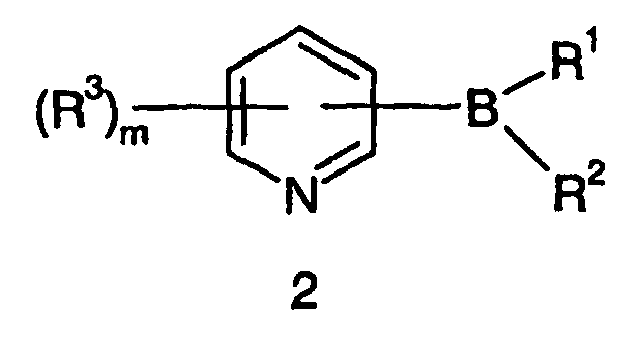
wherein R1 and R2 are each independently C1-C10 alkyl and R3 is H, C1-C10 alkyl, C2-C10 alkenyl, C2-C10 alkynyl, -C(O)(C1-C10 alkyl), -(CH2)t(C6-C10 aryl), -(CH2)t(4-10 membered heterocyclic), -C(O)(CH2)t(C6-C10 aryl), or -C(O)(CH2)t(5-10 membered heterocyclic), wherein t is an integer from 0 to 5; said alkyl group optionally includes 1 or 2 hetero moieties selected from O, S and -N(R8)- with the proviso that two O atoms, two S atoms, or an O and S atom are not attached directly to each other; said R3 aryl and heterocyclic groups are optionally fused to a C6-C10 aryl group, a C6-C8 saturated cyclic group, or a 5-10 membered heterocyclic group; 1 or 2 carbon atoms In the foregoing heterocyclic moieties are optionally substituted by an oxo (=O) moiety; the -(CH2)t- moieties of the foregoing R3 groups optionally include a carbon-carbon double or triple bond where t is an integer from 2 to 5; and the foregoing R3 groups, except H, are optionally substituted by 1 to 3 R4 groups; R4 is C1-C10 alkyl or C1-C10 alkoxy-, R6 is H or C1-C10 alkyl and wherein m is 0 to 4; comprising reacting a compound of formula 1,
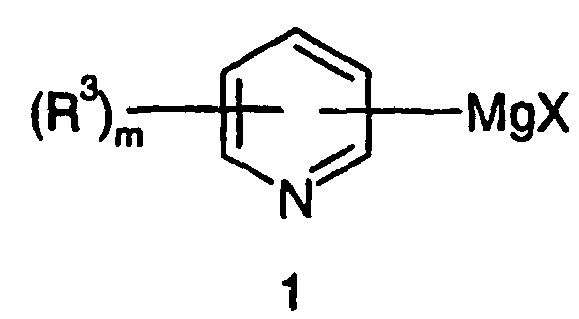
wherein R3 and m are as defined for formula 2 above and X is a halo with a compound of the formula R5BR1R2, wherein R1, R2 are as defined above for formula 2 and wherein R5 is C1-C10 alkyl or C1-C10 alkoxy.
wherein R1 and R2 are each independently C1-C10 alkyl and R3 is H, C1-C10 alkyl, C2-C10 alkenyl, C2-C10 alkynyl, -C(O)(C1-C10 alkyl), -(CH2)t(C6-C10 aryl), -(CH2)t(4-10 membered heterocyclic), -C(O)(CH2)t(C6-C10 aryl), or -C(O)(CH2)t(5-10 membered heterocyclic), wherein t is an integer from 0 to 5; said alkyl group optionally includes 1 or 2 hetero moieties selected from O, S and -N(R8)- with the proviso that two O atoms, two S atoms, or an O and S atom are not attached directly to each other; said R3 aryl and heterocyclic groups are optionally fused to a C6-C10 aryl group, a C6-C8 saturated cyclic group, or a 5-10 membered heterocyclic group; 1 or 2 carbon atoms In the foregoing heterocyclic moieties are optionally substituted by an oxo (=O) moiety; the -(CH2)t- moieties of the foregoing R3 groups optionally include a carbon-carbon double or triple bond where t is an integer from 2 to 5; and the foregoing R3 groups, except H, are optionally substituted by 1 to 3 R4 groups; R4 is C1-C10 alkyl or C1-C10 alkoxy-, R6 is H or C1-C10 alkyl and wherein m is 0 to 4; comprising reacting a compound of formula 1,
wherein R3 and m are as defined for formula 2 above and X is a halo with a compound of the formula R5BR1R2, wherein R1, R2 are as defined above for formula 2 and wherein R5 is C1-C10 alkyl or C1-C10 alkoxy.
1. Verfahren zur Herstellung eines Dialkylpyridylborans, umfassend die Umsetzung eines
Pyridin-Grignard-Reagenses mit einem Boranreagens, das aus einem Alkoxydialkylboranreagens
und einem Trialkylboranreagens ausgewählt wird.
2. Verfahren nach Anspruch 1, wobei das Pyridin-Grignard-Reagens durch Umsetzung eines
Alkylmagnesiumhalogenids oder eines Arylmagnesiumhalogenids mit einem Halogenpyridinreagens
hergestellt worden ist.
3. Verfahren nach Anspruch 1 oder 2, wobei das Boranreagens C1-C10-Alkoxydi(C1-C10-alkyl)boran ist.
4. Verfahren nach einem der Ansprüche 1, 2 und 3, wobei das Boranreagens C1-C5-Alkoxydi(C1-C10-alkyl)boran ist.
5. Verfahren nach einem der Ansprüche 1 bis 4, wobei das Boranreagens Methoxydiethylboran
ist.
6. Verfahren nach einem der Ansprüche 1 bis 5, wobei die Reaktion zwischen dem genannten
Boranreagens und dem genannten Pyridin-Grignard-Reagens bei einer Temperatur von 0°C
bis 40°C durchgeführt wird.
7. Verfahren nach einem der Ansprüche 1 bis 6, wobei die Reaktion bei einer Temperatur
von etwa 0°C durchgeführt wird.
8. Verfahren nach einem der Ansprüche 1 bis 7, wobei das genannte Pyridin-Grignard-Reagens
dadurch hergestellt worden ist, dass ein Halogenpyridin, ein MgO und ein Alkylhalogenid oder
ein Arylhalogenid miteinander umgesetzt worden sind.
9. Verfahren nach einem der Ansprüche 1 bis 8, wobei das Pyridin-Grignard-Reagens Pyridylmagnesiumchlorid
ist.
10. Verfahren zur Herstellung eines Dialkylpyridylborans, umfassend die Umsetzung eines
Alkylmagnesiumhalogenids oder eines Arylmagnesiumhalogenids mit einem Halogenpyridin,
gefolgt von der Zugabe eines Alkoxydialkylborans oder eines Trialkylborans.
11. Verfahren nach Anspruch 10, wobei das Alkylmagnesiumhalogenid ein C1-C10-Alkylmagnesiumhalogenid ist.
12. Verfahren nach Anspruch 10, wobei das Arylmagnesiumhalogenid ein C6-C10-Arylmagnesiumhalogenid ist.
13. Verfahren nach einem der Ansprüche 10 bis 12, wobei das Halogenpyridin Chlorpyridin,
Brompyridin oder Iodpyridin ist.
14. Verfahren nach einem der Ansprüche 10 bis 13, wobei das Alkoxydialkylboran oder das
Trialkylboran C1-C10-Alkoxydi (C1-C10-alkyl) boran ist.
15. Verfahren zur Herstellung einer Verbindung der Formel 2:
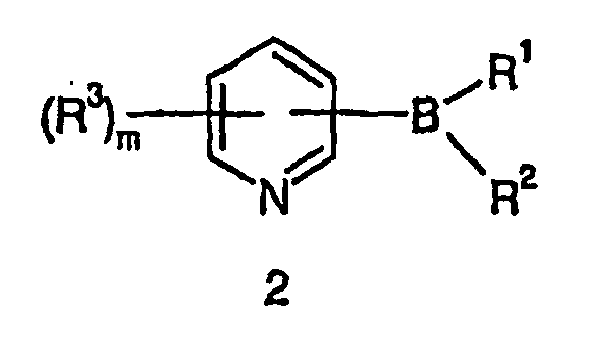
worin R1 und R2 unabhängig voneinander für C1-C10-Alkyl stehen, und R3 für H, C1-C10-Alkyl, C2-C10-Alkenyl, C2-C10-Alkinyl, -C(O)(C1-C10-Alkyl), -(CH2)t(C6-C10-Aryl), -(CH2), (4-10-gliedriges Heterocyclyl), -C(O)(CH2)t(C6-C10-Aryl) oder -C(O)(CH2)t(5-10-gliedriges Heterocyclyl) steht, wobei t eine ganze Zahl von 0 bis 5 ist, wobei die genannte Alkylgruppe gegebenenfalls 1 oder 2 Heterogruppierungen, ausgewählt aus O, S und -N(R6)-, mit der Maßgabe, dass keine zwei O-Atome, zwei S-Atome oder kein O- und S-Atom direkt aneinander angefügt sind, umfasst, wobei die genannten, durch R3 angegebenen Aryl- und Heterocyclylgruppen gegebenenfalls zu einer C6-C10-Arylgruppe, einer gesättigen cyclischen C5-C8-Gruppe oder einer 5-10-gliedrigen heterocyclischen Gruppe kondensiert sind; wobei 1 oder 2 Kohlenstoffatome in den vorstehend genannten heterocyclischen Gruppierungen gegebenenfalls durch eine Oxo(=O)-Gruppierung substituiert ist bzw. sind; wobei die -(CH2)t-Gruppierungen der vorstehend genannten Gruppen R3 gegebenenfalls eine Kohlenstoff-Kohlenstoff-Doppelbindung oder -Dreifachbindung einschließen, wenn t eine ganze Zahl von 2 bis 5 ist; und wobei die vorstehend genannten Gruppen R3, ausgenommen H, gegebenenfalls durch 1 bis 3 R4-Gruppen substituiert sind, wobei R4 für C1-C10-Alkyl oder C1-C10-Alkoxy steht; R6 für H oder C1-C10-Alkyl steht und wobei m einen Wert von 0 bis 4 hat; umfassend die Umsetzung einer Verbindung der Formel 1
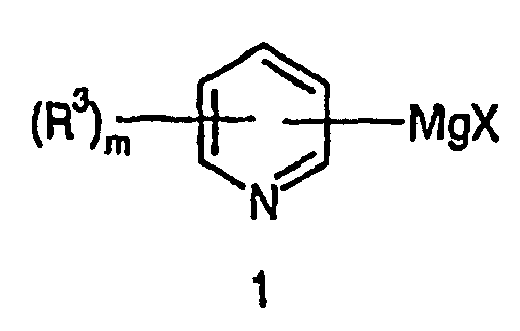
worin R3 und m, wie oben im Zusammenhang mit der Formel 2 angegeben, definiert sind, und X für Halogen steht, mit einer Verbindung der Formel R5BR1R2, worin R1, R2 wie oben im Zusammenhang mit der Formel 2 definiert sind und wobei R5 für C1-C10-Alkyl oder C1-C10-Alkoxy steht.
worin R1 und R2 unabhängig voneinander für C1-C10-Alkyl stehen, und R3 für H, C1-C10-Alkyl, C2-C10-Alkenyl, C2-C10-Alkinyl, -C(O)(C1-C10-Alkyl), -(CH2)t(C6-C10-Aryl), -(CH2), (4-10-gliedriges Heterocyclyl), -C(O)(CH2)t(C6-C10-Aryl) oder -C(O)(CH2)t(5-10-gliedriges Heterocyclyl) steht, wobei t eine ganze Zahl von 0 bis 5 ist, wobei die genannte Alkylgruppe gegebenenfalls 1 oder 2 Heterogruppierungen, ausgewählt aus O, S und -N(R6)-, mit der Maßgabe, dass keine zwei O-Atome, zwei S-Atome oder kein O- und S-Atom direkt aneinander angefügt sind, umfasst, wobei die genannten, durch R3 angegebenen Aryl- und Heterocyclylgruppen gegebenenfalls zu einer C6-C10-Arylgruppe, einer gesättigen cyclischen C5-C8-Gruppe oder einer 5-10-gliedrigen heterocyclischen Gruppe kondensiert sind; wobei 1 oder 2 Kohlenstoffatome in den vorstehend genannten heterocyclischen Gruppierungen gegebenenfalls durch eine Oxo(=O)-Gruppierung substituiert ist bzw. sind; wobei die -(CH2)t-Gruppierungen der vorstehend genannten Gruppen R3 gegebenenfalls eine Kohlenstoff-Kohlenstoff-Doppelbindung oder -Dreifachbindung einschließen, wenn t eine ganze Zahl von 2 bis 5 ist; und wobei die vorstehend genannten Gruppen R3, ausgenommen H, gegebenenfalls durch 1 bis 3 R4-Gruppen substituiert sind, wobei R4 für C1-C10-Alkyl oder C1-C10-Alkoxy steht; R6 für H oder C1-C10-Alkyl steht und wobei m einen Wert von 0 bis 4 hat; umfassend die Umsetzung einer Verbindung der Formel 1
worin R3 und m, wie oben im Zusammenhang mit der Formel 2 angegeben, definiert sind, und X für Halogen steht, mit einer Verbindung der Formel R5BR1R2, worin R1, R2 wie oben im Zusammenhang mit der Formel 2 definiert sind und wobei R5 für C1-C10-Alkyl oder C1-C10-Alkoxy steht.
1. Procédé de préparation d'un dialkylpyridylborane comprenant la réaction d'un réactif
de Grignard pyridine avec un réactif borane sélectionné parmi un réactif alcoxydialkylborane
et un réactif trialkylborane.
2. Procédé selon la revendication 1, dans lequel le réactif de Grignard pyridine est
préparé par réaction d'un halogénure d'alkylmagnésium ou d'un halogénure d'arylmagnésium
avec un réactif halogénopyridine.
3. Procédé selon la revendication 1 ou 2, dans lequel le réactif borane est un (alcoxy
en C1-C10) di (alkyle en C1-C10) borane.
4. Procédé selon l'une quelconque des revendications 1, 2 ou 3, dans lequel le réactif
borane est un (alcoxy en C1-C5)di(alkyle en C1-C10)borane.
5. Procédé selon l'une quelconque des revendications 1 à 4, dans lequel le réactif borane
est le méthoxydiéthylborane.
6. Procédé selon l'une quelconque des revendications 1 à 5, dans lequel la réaction entre
ledit réactif borane et ledit réactif de Grignard pyridine est mise en oeuvre à une
température comprise entre 0°C et 40°C.
7. Procédé selon l'une quelconque des revendications 1 à 6, dans lequel la réaction est
mise en oeuvre à une température d'environ 0°C.
8. Procédé selon l'une quelconque des revendications 1 à 7, dans lequel ledit réactif
de Grignard pyridine est préparé en faisant réagir une halogénopyridine, Mg(0) et
un halogénure d'alkyle ou un halogénure d'aryle.
9. Procédé selon l'une quelconque des revendications 1 à 8, dans lequel le réactif de
Grignard pyridine est le chlorure de pyridylmagnésium.
10. Procédé de préparation d'un dialkylpyridylborane comprenant la réaction d'un halogénure
d'alkylmagnésium ou d'un halogénure d'arylmagnésium avec une halogénopyridine, suivie
par l'addition d'un alcoxydialkylborane ou trialkylborane.
11. Procédé selon la revendication 10, dans lequel l'halogénure d'alkylmagnésium est un
halogénure de (alkyle en C1-C10) magnésium.
12. Procédé selon la revendication 10, dans lequel l'halogénure d'arylmagnésium est un
halogénure de (aryle en C6-C10) magnésium.
13. Procédé selon l'une quelconque des revendications 10 à 12, dans lequel l'halogénopyridine
est la chloropyridine, la bromopyridine ou l'iodopyridine.
14. Procédé selon l'une quelconque des revendications 10 à 13, dans lequel l'alcoxydialkylborane
ou le trialkylborane est un (alcoxy en C1-C10) di (alkyle en C1-C10) borane.
15. Procédé de préparation d'un composé de formule 2 :
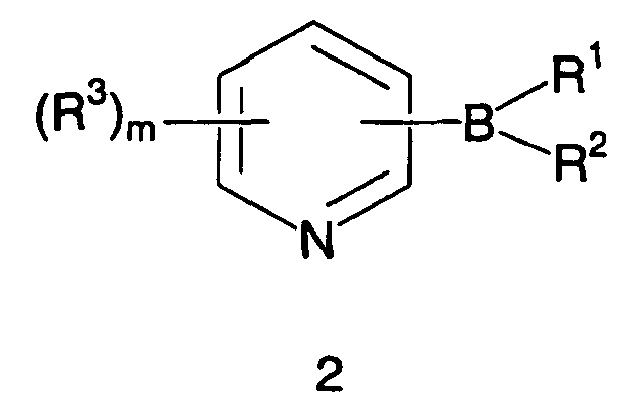
dans laquelle R1 et R2 représentent chacun indépendamment alkyle en C1-C10 et R3 représente H, alkyle en C1-C10, alkényle en C2-C10, alkynyle en C2-C10, -C(O)(alkyle en C1-C10), -(CH2)t(aryle en C6-C10), -(CH2)t(hétérocyclique ayant de 4 à 10 éléments), -C(O)(CH2)t(aryle en C6-C10) ou -C(O)(CH2)t(hétérocyclique ayant de 5 à 10 éléments), où t est un nombre entier compris entre 0 et 5 ; ledit groupe alkyle inclut facultativement 1 ou 2 groupes fonctionnels hétéro sélectionnés parmi O, S et -N(R6)-, étant entendu qu'il n'y a pas deux atomes de O, deux atomes de S, ou un atome de O et un atome de S fixés directement l'un à l'autre ; lesdits groupes aryle et hétérocyclique que représente R3 sont facultativement condensés à un groupe aryle en C6-C10, un groupe cyclique saturé en C5-C8 ou un groupe hétérocyclique ayant de 5 à 10 éléments ; 1 ou 2 atomes de carbone des groupes fonctionnels hétérocycliques précités sont facultativement substitués par un groupe fonctionnel oxo (=0) ; les groupes fonctionnels -(CH2)t- des groupes R3 précités incluant facultativement une double ou triple-liaison carbone-carbone où t est un nombre entier allant de 2 à 5 ; et les groupes R3 précités, excepté H, sont facultativement substitués par de 1 à 3 groupes R4 ; R4 représente alkyle en C1-C10 ou alcoxy en C1-C10 ; R6 représente H ou alkyle en C1-C10, et où m représente de 0 à 4 ; ledit procédé comprenant la réaction d'un composé de formule 1,
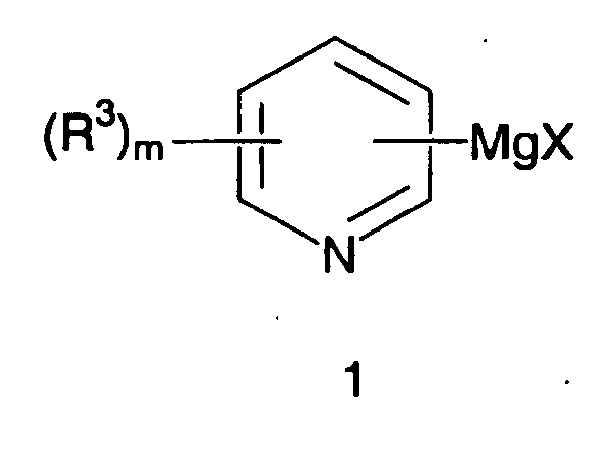
dans laquelle R3 et m sont tels que défini pour la formule 2 ci-dessus et X est un halogène, avec un composé de formule R5BR1R2, où R1 et R2 sont tels que définis ci-dessus pour la formule 2, et où R5 représente alkyle en C1-C10 ou alcoxy en C1-C10.
dans laquelle R1 et R2 représentent chacun indépendamment alkyle en C1-C10 et R3 représente H, alkyle en C1-C10, alkényle en C2-C10, alkynyle en C2-C10, -C(O)(alkyle en C1-C10), -(CH2)t(aryle en C6-C10), -(CH2)t(hétérocyclique ayant de 4 à 10 éléments), -C(O)(CH2)t(aryle en C6-C10) ou -C(O)(CH2)t(hétérocyclique ayant de 5 à 10 éléments), où t est un nombre entier compris entre 0 et 5 ; ledit groupe alkyle inclut facultativement 1 ou 2 groupes fonctionnels hétéro sélectionnés parmi O, S et -N(R6)-, étant entendu qu'il n'y a pas deux atomes de O, deux atomes de S, ou un atome de O et un atome de S fixés directement l'un à l'autre ; lesdits groupes aryle et hétérocyclique que représente R3 sont facultativement condensés à un groupe aryle en C6-C10, un groupe cyclique saturé en C5-C8 ou un groupe hétérocyclique ayant de 5 à 10 éléments ; 1 ou 2 atomes de carbone des groupes fonctionnels hétérocycliques précités sont facultativement substitués par un groupe fonctionnel oxo (=0) ; les groupes fonctionnels -(CH2)t- des groupes R3 précités incluant facultativement une double ou triple-liaison carbone-carbone où t est un nombre entier allant de 2 à 5 ; et les groupes R3 précités, excepté H, sont facultativement substitués par de 1 à 3 groupes R4 ; R4 représente alkyle en C1-C10 ou alcoxy en C1-C10 ; R6 représente H ou alkyle en C1-C10, et où m représente de 0 à 4 ; ledit procédé comprenant la réaction d'un composé de formule 1,
dans laquelle R3 et m sont tels que défini pour la formule 2 ci-dessus et X est un halogène, avec un composé de formule R5BR1R2, où R1 et R2 sont tels que définis ci-dessus pour la formule 2, et où R5 représente alkyle en C1-C10 ou alcoxy en C1-C10.