|
(11) | EP 1 290 131 B1 |

| (12) | EUROPEAN PATENT SPECIFICATION |
|
|
| (54) |
HARD SURFACE CLEANING COMPOSITIONS REINIGUNGSMITTEL FÜR HARTE OBERFLÄCHEN COMPOSITIONS DE NETTOYAGE DE SURFACES DURES |
|
|
|||||||||||||||||||||||||||||||
| Note: Within nine months from the publication of the mention of the grant of the European patent, any person may give notice to the European Patent Office of opposition to the European patent granted. Notice of opposition shall be filed in a written reasoned statement. It shall not be deemed to have been filed until the opposition fee has been paid. (Art. 99(1) European Patent Convention). |
[0001] The invention relates to hard surface cleaning compositions. In particular the invention relates to liquid toilet cleaning compositions for use with dosing devices for toilets. The invention also relates to a toilet cleaning system comprising a toilet cleaning composition and a delivery device.
[0002] Cleaning compositions for toilets, and particularly those which are dosed via a dosing device into the flush water of a toilet, have specific requirements as regards cleaning and deodorising. In particular as such dosing devices deliver a small dose of product with each flush it is generally necessary to incorporate a high level of perfume into the composition to ensure that each dose delivers a sufficient level of perfume. In addition it is also desirable to deliver some level of hygiene into the flush water by means of a suitable oxidising agent. The incompatibility between oxidising agents, particularly peroxidising agents and perfumes has generally made it difficult to combine the two components into a single phase, physically stable composition. With conventional oxidising agents, the use of high levels of perfume usually results in separation of the composition into two layers of differing density. In order to obtain perfume and hygiene agent delivered from such a separated composition, a highly complex dosing device would be required.
[0003] WO 96/27714 describes an in-cistern toilet cleaner and a number of compositions for use therewith. While some of the compositions include the use of the hypohalite oxidising agent, potassium dichlorocyanuric acid, none disclose the use of the perfume with this, or any, oxidising agent. Likewise, US 4,212,089 discloses a cleaning composition for an in-cistern dosing device comprising 1% perfume and 99% of a sanitising composition in which peroxidising agents are absent.
[0004] EP 0 596 493 teaches the use of a fragrance solubilised by surfactant to mask the irritating odour of peracetic acid.
[0005] EP 0 784 091 selects specific fragrance components for use with oxidising agents, in particular persulphate salts, solubilised by surfactants. Although the text mentions up to 5% by weight of perfume, the examples are limited to 0.5% by weight of the fragrance components.
[0006] US 6,010,993 discloses aqueous liquids formed from peroxyacids or peroxides, selected antimicrobial essential oils and surfactants, with examples limited to 3% by weight of essential oils.
[0007] EP 0 905 227 discloses stable anhydrous liquids comprising peracid, solvent and surfactant with perfume.
[0008] It is an object of the invention to provide an aqueous hard surface cleaning composition, and particularly a hard surface cleaning composition suitable for use with toilet dosing devices, which includes effective levels of perfume and effective levels of hygiene agents in the same composition in a stable, single phase composition.
STATEMENT OF INVENTION
[0009] According to the invention there is provided an aqueous liquid hard surface cleaning composition comprising:
- at least 0.1% of an ester peracid oxidising agent;
- at least 2% perfume;
- and one or more surfactants.
[0010] It has been surprisingly discovered that ester peracid oxidising agents can be incorporated into hard surface cleaning composition along with significant amounts of perfume. The resulting aqueous compositions can be made in a single phase form, are stable to phase separation and do not suffer from the irritating odour associated with peracetic acid. This is particularly advantageous for toilet cleaning applications, where the perfume is needed to mask malodour in the environment rather than malodour inherently present in the cleaning composition.
[0011] Suitable ester peracid oxidising agents have the general formula:
Wherein R represents an alkyl group having from 1 to 4 carbon atoms and X is from 1 to 4. Typically, when R has 3 or 4 carbon atoms, the alkyl group may be branched or linear. Thus the alkyl group may be n- or isopropyl, or n-, iso- or tertiary butyl. Ideally R is a methyl group and typically the value of X is 2, 3 or 4. In a preferred embodiment of the invention the composition comprises a mixture of ester peracids where X is 2, 3 or 4, thus a mixture, for example, of the monoesters of peradipic, perglutaric and persuccinic acids. The ester peracids may exist as equilibrium mixtures in aqueous solution in which the ester peracid is in equilibrium with water, hydrogen peroxide and the non-peroxidised acid. In such cases the equilibrium obeys the following general equation in the presence of strong acid:
[0013] There will also be some cleavage and peroxidation at the bond between the R group and the rest of the molecule, leading to the formation of trace amounts of diperacids in the equilibrium mixture.
[0014] Materials of this type are disclosed in WO 95/34537. The above mentioned ester peracid oxidising agents have been found to be particularly suitable for compositions which in use will be substantially diluted such as for example in-cistern and toilet-rim mounted toilet cleaning systems. Generally in such uses, between 0.05 and 5 mls of composition will be dosed into a toilet flush water and the resulting dilution requires a strong oxidising agent.
[0015] Typically, the ester peracid is present in an amount of at least 0.1%, preferably at least 0.3%, more preferably at least 0.5%, more preferably at least 0.7%, most preferably at least 1.0% by weight of ester peracid to composition.
[0016] The compositions according to the invention include at least 2% perfume, however it has been found that greater amounts of perfume can be supported within the compositions which is a great advantage for certain toilet cleaners which need to carry a lot of perfume due to the extreme dilution of the product in the flush water. Thus, the compositions of the invention typically include up to 10%, suitably between 2 and 8% and preferably between 3 and 6% perfume by weight. Suitable perfumes for use in toilet cleaning compositions are those which are chemically stable in the presence of oxidising agents. As discussed in WO 99/57233, this may be determined by screening perfume components to identify those which display stability in the presence of oxidising agents. Such routes are disclosed in WO 92/08780 and EP 299 561. EP 299 561 provides a method for assessing the chemical stability of perfume components in the presence of peracid. Suitable perfumes would be blended from the chemically stable components by those skilled in the art.
The pH of the composition will be suitably between 1 and 3, preferably between 1 and 2. At higher pH's the ester peracid oxidising becomes less stable and loses its activity. Further, as the pH of the composition drops below 1 the ability of the perfume to solubilise in the composition lessens with a resultant decrease in perfume stability in the composition. Typically, the perfume chosen for the invention will, be those that are reasonably stable at pH's between 1 and 3, and especially between 1 and 2.
DETAILED DESCRIPTION OF THE INVENTION
Surfactants
Anionic Surfactants
[0017] In particularly preferred embodiments of the invention the composition will include an anionic surfactant.
Suitable anionic surfactants include the sulphonate hydrotropes. Preferred surfactants are secondary alkane sulphonates such as HOSTAPUR 30 from Clariant or DOWFAX from Dow Chemicals. It is also possible to use alkylarylsulphonates such as salts, particularly alkali metal salts, of toluene, cumene or xylene sulphonate. The preferred anionic surfactant is sodium cumenesulphonate. A suitable material is ELTESOL SC 40™ (ex. Albright and Wilson). Typical levels of anionic surfactant range from 1 to 40 wt% on product.
Nonionic Surfactants
[0019] Suitable nonionic surfactants include alkoxylated alcohols, preferably ethoxylated alcohols. Suitable nonionic detergent active compounds can be broadly described as compounds produced by the condensation of alkylene oxide groups, which are hydrophilic in nature, with an ,organic hydrophobic compound which may be aliphatic or alkyl aromatic in nature.
[0020] The length of the hydrophilic or polyoxyalkylene radical which is condensed with any particular hydrophobic group can be readily adjusted to yield a water-soluble compound having the desired degree of balance between hydrophilic and hydrophobic elements.
[0021] The preferred alkoxylated alcohols are selected from the group comprising ethoxylated alcohols of the general formula:
R1-(OCH2CH2 )m-OH
wherein R1 is straight or branched, C8 to C18 alkyl or hydroxyalkyl and m is, on average, 1-14. Ethoxylated alcohols suitable for use in the present invention include LIAL 111.10EO [TM] available in the marketplace from DAC. Typical levels of nonionic surfactant in products according to the present invention range from 0-15wt%. A particularly suitable non-ionic is Neodol 91-5™ from Shell.
Minors
[0022] Stabilisers can be suitably employed to improve the storage stability of solutions according to the invention, and are particularly useful when the compositions according to the invention include compounds known to cause decomposition such as transition ion metals. Suitable chelating agents are often aminocarboxylic acids or salts thereof such as EDTA or DPTA and/or carboxylic acid substituted N-containing heterocyclics such as 8-hydroxyquinoline or picolinic or dipicolinic acid, and organopolyphosphates including hydroxyethylidinediphosphonic acid, and alkyleneaminomethylene phosphonic acids such as ethylene diaminotetramethylene phosphonic acid and cyclohexane-1,2-diaminotetramethylene phosphonic acid. The amount of chelant in the solution is preferably greater than 0.25%.
[0023] While the combination of the surfactants in the compositions of the invention can in certain instances provide a thickening effect it is possible to add other thickeners. Gums, particularly xanthan gums are suitable thickeners. Preferred xanthan gums are the Kelzan™ series (available from Kelco Corp). Typical levels of xanthan gum range from 0.05-1wt%.
[0024] Metal ion sequestrants such as ethylene diamine tetraacetates, amino-poly phosphonates (such as those in the DEQUEST™ range ex. Monsanto) and phosphates and a wide variety of other poly-functional organic acids and salts, can also optionally be employed. Preferred metal ion complexing agents are selected from dipicolinic acid, ethylene diamine tetra acetic acid (EDTA) and its salts, hydroxy-ethylidene diphosphonic acid (Dequest 2010), ethylenediaminetetra(methylene phosphonic acid) (Dequest 2040), diethylenetriamine-penta(methylene phosphonic acid) (Dequest 2060).
[0025] Optional, minor components also include those typically found in cleaning compositions and are selected from opacifiers, colours and fluorescers.
[0026] The invention also relates to the use of a composition according to the invention in a toilet in-cistern dosing device. In this specification the term "in-cistern" dosing device refers to dosing devices having a chamber for liquid toilet cleaning compositions and a dosing arrangement which delivers a defined dose of the composition into the flush water in the toilet cistern in response to the flushing of the toilet. Many such devices are known from the prior art. For example, US 4,212,089 describes such a device having a chamber for cleaning composition connected to a siphon tube via a u-tube, the arrangement being such that when the toilet cistern is evacuated the downward movement of the water in the cistern exerts a negative pressure in the siphon which pulls a dose of product from the reservoir. Similar devices are described in US 3,953,902 and PCT/GB98/0349.
[0027] An alternative form of in-cistern dosing device is disclosed in US 3,965,497, which device comprises an inverted container having a discharge spout contained within a sleeve wherein discharge of product is automatically controlled by alternate compression and decompression of air within the sleeve arising from rising and falling of the cistern water. In most in-cistern dosing devices the device is adapted to be mounted within the toilet cistern, however the term "in-cistern" in this specification should be taken to include devices which are located outside a toilet cistern but which deliver the dose of active agent into the water in the cistern.
[0028] The invention further relates to the use of a composition according to the invention in toilet-rim dosing devices. The term "toilet-rim dosing device" as used in this specification means dosing devices for liquid compositions which hang from the rim of a toilet. Such a device is disclosed in European patent application EP-A-0,538,957 and comprises a unit having a bottle containing a cleansing and odorising liquid for suspension from the rim of a toilet bowl. The cleansing and odorising liquid seeps from the bottle onto a porous mass when the unit has been suspended in the toilet bowl. The flush water flows over the porous mass and dispenses the active agent around the toilet bowl. European patent application EP-A-0,785,315 relates to a modification of the unit disclosed in European patent application EP-A-0,538,957. The unit includes at least one liquid passage and one air supply opening communicating with the discharge opening of the bottle so that the liquid pressure of the active agent on the porous mass is substantially equal and independent of the liquid level in the bottle.
[0029] The invention also relates to the combination of the above type of toilet dosing devices, i.e. those which upon flushing delivers a dose of product into the toilet flush water, and a toilet cleaning composition according to the invention. Typically the dosing device delivers a dose of cleaning composition which is less than 5 mls, preferably between 0.05 and 2mls and most preferably between 0.1 and 2mls.
Examples
[0030] A product containing monomethylglutaric peracid (MMGPA)was prepared as follows. 11.0 grams of monomethylglutaric acid (ex. Aldrich Chemicals) was dissolved in 60.4 grams of demineralised water and 28.6 grams of a 35 weight % solution of hydrogen peroxide (ex. Degussa). The pH of the solution was adjusted to 1.1 with concentrated sulphuric acid and left to stand at ambient temperature. After 4 weeks, the concentration of peracid was 0.3% by weight of the mixture. Other components of the mixture were unreacted monomethylglutaric acid, glutaric acid, hydrogen peroxide and methanol. Diperoxyglutaric acid was also present in trace amounts in the mixture. Product analysis was carried out using high pressure liquid phase chromatography combined with ultra violet and mass spectrometry detection.
[0031] Subsequently, formulations according to the invention were made using the product mixture, sodium secondary alkane sulphonate (ex. Clariant under the trade name SAS 30 comprising 30% surfactant), alcohol ethoxylate (ex. Shell; Neodol 98-1) and various levels of perfume (ex Quest; LB0146D). The perfume comprises bornyl acetate, limonene, camphene, alpha pinene, diphenyl oxide, eucalyptol, dipropylene glycol, borneol and p-cymene.
[0032] The perfume was soluble in all three formulations, which were homogeneous, colourless and fully transparent.
[0033] Stability was visually assessed for signs of separation after 24 hours storage at ambient temperature.
Table of Examples
1. An aqueous single phase liquid hard surface cleaning composition comprising:
- at least 0.1% by weight of ester peracid oxidising agent;
- at least 2% by weight of perfume;
- and up to 40% by weight of surfactant
2. A composition as claimed in claim 1 in which the ester peracid oxidising agent is
an ester peracid having the general formula:
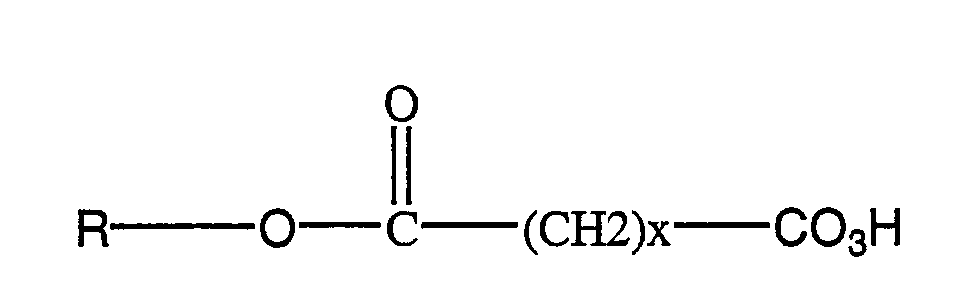
wherein R represents an alkyl group having from 1 to 4 carbon atoms and X is from 1 to 4.
wherein R represents an alkyl group having from 1 to 4 carbon atoms and X is from 1 to 4.
3. A composition as claimed in claims 1 or 2 comprising one or more surfactants selected
from the group of nonionic surfactants and anionic surfactants.
4. A composition as claimed in claim 3 in which the nonionic surfactant is an ethoxylated
alcohol.
5. A composition as claimed in claims 3 or 4 in which the anionic surfactant is a secondary
alkane sulphonate.
6. A composition as claimed in any preceding claim having between 2 and 8% by weight
of perfume.
7. A composition as claimed in claim 6 comprising between 3% and 6% by weight of perfume.
8. A composition as claimed in any preceding claim comprising at least 1% by weight of
surfactant.
9. A composition as claimed in any preceding claim having a pH between 1 and 3, more
preferably between 1.5 and 3, most preferably about 2.5.
10. In combination, a toilet dosing device of the type which upon flushing delivers a
dose of product into the toilet flush water and a toilet cleaning composition according
to any of claims 1 to 9.
1. Wässrige flüssige Einphasen-Reinigungszusammensetzung für harte Oberflächen, umfassend:
- mindestens 0,1 Gew. % Esterpersäure-Oxidationsmittel;
- mindestens 2 Gew. % Duftstoff;
- und bis zu 40 Gew. % Tensid.
2. Zusammensetzung nach Anspruch 1, in der das Esterpersäure-Oxidationsmittel eine Esterpersäure
mit der allgemeinen Formel:
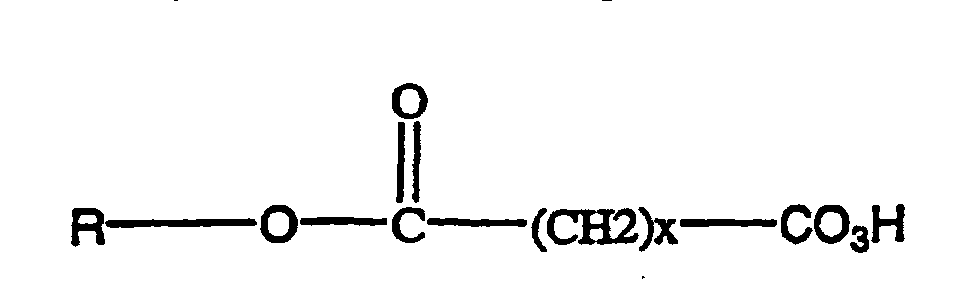
ist, in der R eine Alkylgruppe mit 1 bis 4 Kohlenstoffatomen darstellt und X für 1 bis 4 steht.
ist, in der R eine Alkylgruppe mit 1 bis 4 Kohlenstoffatomen darstellt und X für 1 bis 4 steht.
3. Zusammensetzung nach Anspruch 1 oder 2, umfassend ein oder mehrere Tenside, die aus
der Gruppe von nichtionischen Tensiden und anionischen Tensiden ausgewählt sind.
4. Zusammensetzung nach Anspruch 3, in der das nichtionische Tensid ein ethoxylierter
Alkohol ist.
5. Zusammensetzung nach Anspruch 3 oder 4, in der das anionische Tensid ein sekundäres
Alkansulfonat ist.
6. Zusammensetzung nach irgendeinem vorangehenden Anspruch mit 2 bis 8 Gew. % Duftstoff.
7. Zusammensetzung nach Anspruch 6, die 3 bis 6 Gew. % Duftstoff umfasst.
8. Zusammensetzung nach irgendeinem vorangehenden Anspruch, die mindestens 1 Gew. % Tensid
umfasst.
9. Zusammensetzung nach irgendeinem vorangehenden Anspruch mit einem pH zwischen 1 und
3 und bevorzugter zwischen 1,5 und 3 und am bevorzugtesten von etwa 2,5.
10. Kombination einer Toilettendosierungsvorrichtung der Art, die beim Spülen dem Toilettenspülwasser
eine Produktdosis zuführt, und einer Toilettenreinigungszusammensetzung nach irgendeinem
der Ansprüche 1 bis 9.
1. Composition liquide de nettoyage de surfaces dures en phase aqueuse unique comprenant
:
- au moins 0,1% en poids d'un agent oxydant peracide d'ester ;
- au moins 2% en poids de parfum et
- jusqu'à 40% en poids de tensioactif.
2. Composition selon la revendication 1, dans laquelle l'agent oxydant peracide d'ester
agent oxydant est un peracide d'ester ayant la formule générale :
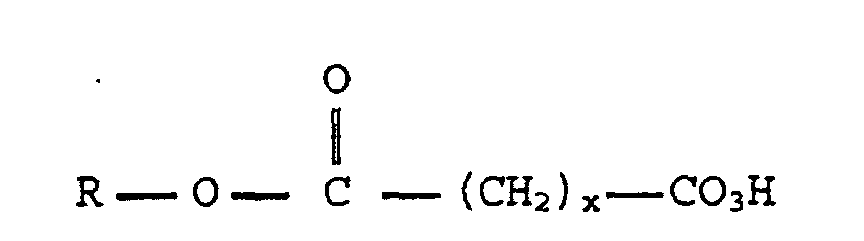
dans laquelle R représente un groupe alkyle ayant de 1 à 4 atomes de carbone et x a une valeur de 1 à 4.
dans laquelle R représente un groupe alkyle ayant de 1 à 4 atomes de carbone et x a une valeur de 1 à 4.
3. Composition selon la revendication 1 ou 2 comprenant un ou plusieurs tensioactifs
choisis dans le groupe des tensioactifs non ioniques et des tensioactifs anioniques.
4. Composition selon la revendication 3, dans laquelle le tensioactif non ionique est
un alcool éthoxylé.
5. Composition selon la revendication 3 ou 4, dans laquelle le tensioactif anionique
est un sulfonate d'alcane secondaire.
6. Composition selon l'une quelconque des revendications précédentes ayant entre 2 et
8% en poids de parfum.
7. Composition selon la revendication 6 comprenant entre 3 et 6% en poids de parfum.
8. Composition selon l'une quelconque des revendications précédentes comprenant au moins
1% en poids de tensioactif.
9. Composition selon l'une quelconque des revendications précédentes ayant un pH compris
entre 1 et 3, de préférence entre 1,5 et 3, et de manière encore préférée d'environ
2,5.
10. En combinaison, dispositif doseur pour toilettes du type qui, quand la chasse d'eau
est tirée, distribue une dose de produit dans l'eau de la chasse et composition de
nettoyage de toilettes selon l'une quelconque des revendications 1 à 9.