| (19) |
 |
|
(11) |
EP 1 296 018 B1 |
| (12) |
EUROPEAN PATENT SPECIFICATION |
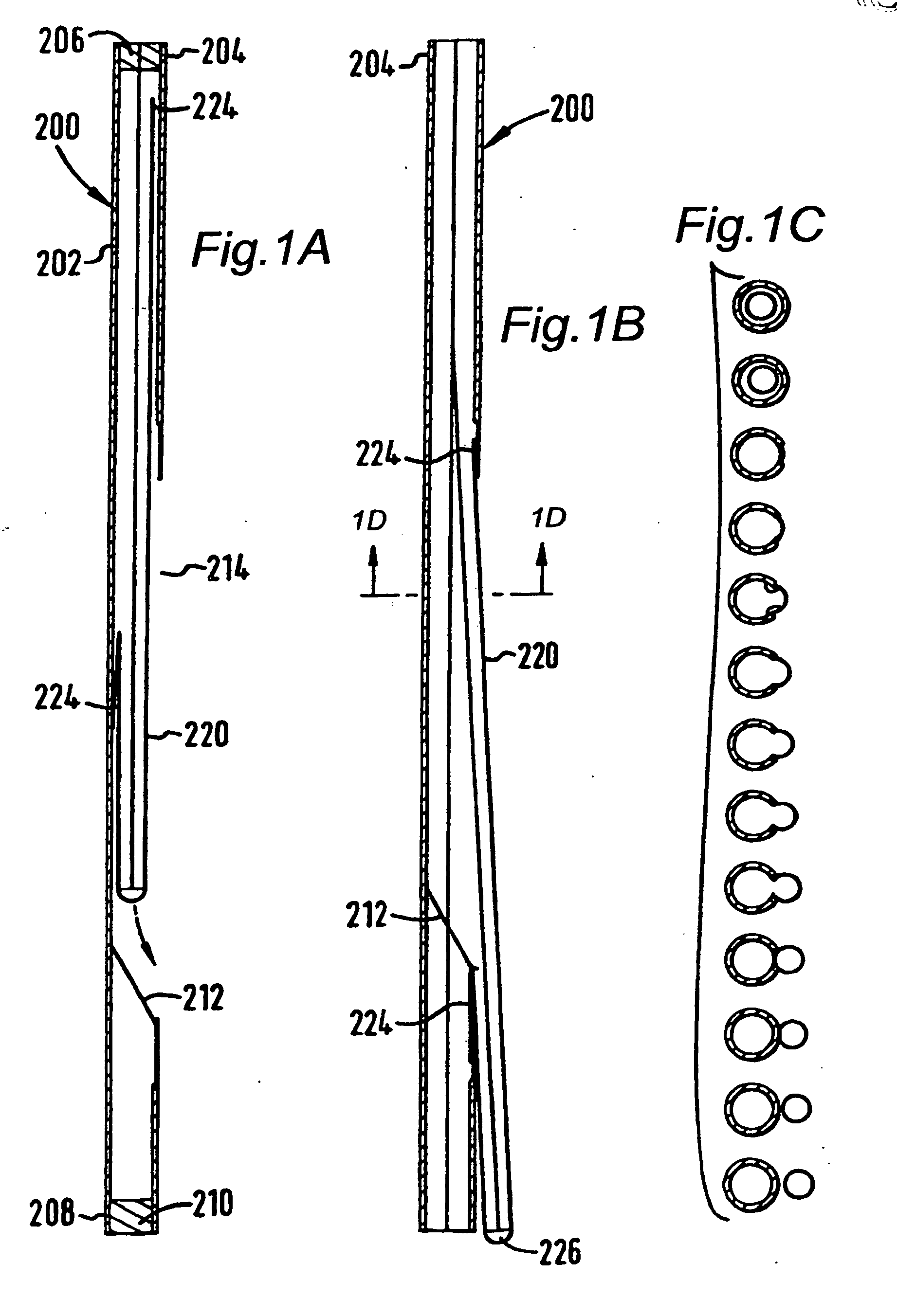
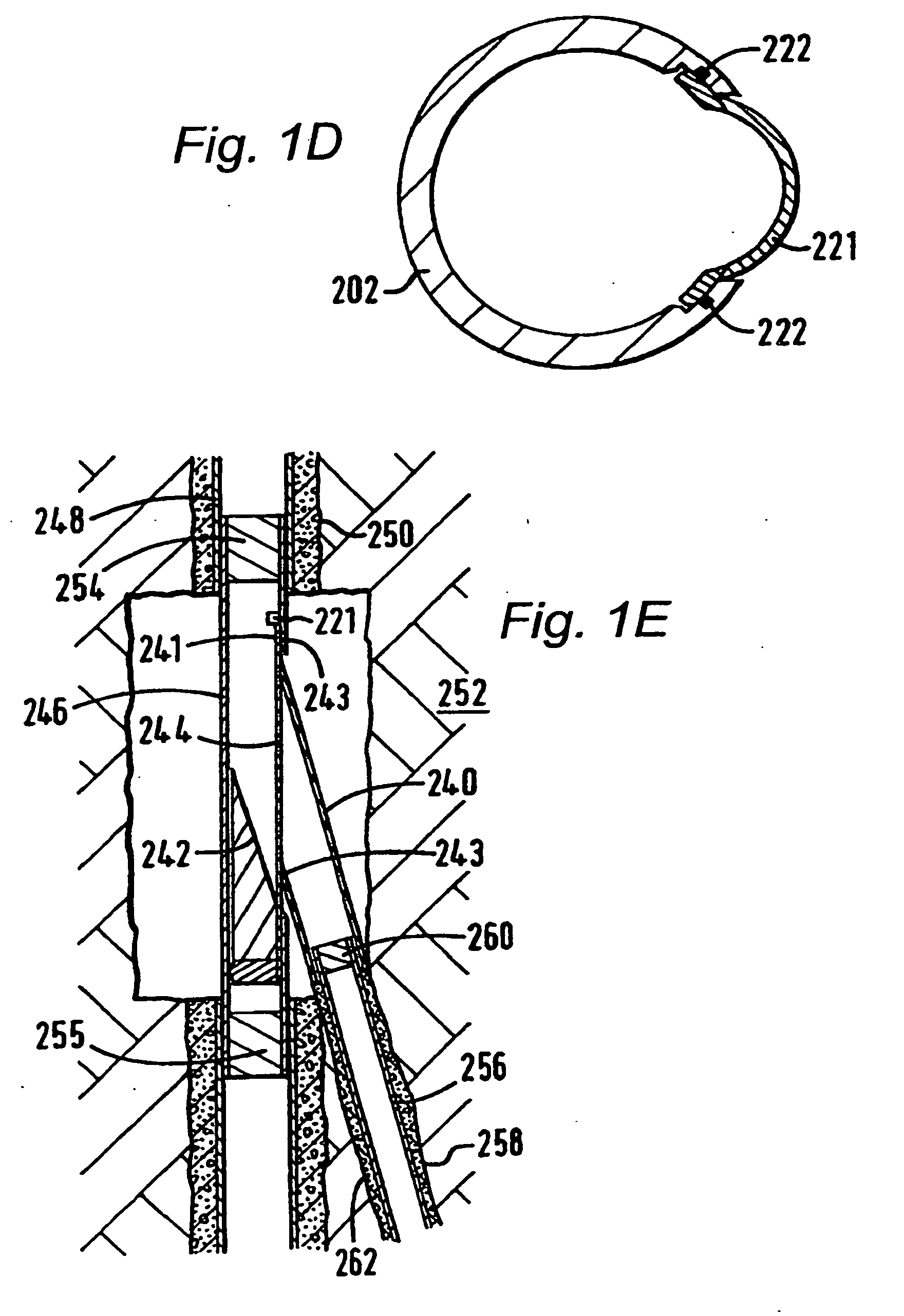
| (45) |
Mention of the grant of the patent: |
|
09.08.2006 Bulletin 2006/32 |
| (22) |
Date of filing: 01.04.1999 |
|
| (51) |
International Patent Classification (IPC):
|
|
| (54) |
Lining a lateral wellbore
Verrohrung einer Seitenbohrung
Installation d' un tubage dans un trou de forage latéral
|
| (84) |
Designated Contracting States: |
|
DE FR GB NL |
| (30) |
Priority: |
01.04.1998 US 53254
|
| (43) |
Date of publication of application: |
|
26.03.2003 Bulletin 2003/13 |
| (62) |
Application number of the earlier application in accordance with Art. 76 EPC: |
|
99913511.4 / 1068425 |
| (73) |
Proprietor: WEATHERFORD/LAMB, INC. |
|
Houston
Texas 77027 (US) |
|
| (72) |
Inventors: |
|
- KUCK, Marc, David
77063, TX Houston (US)
- BAILEY, Thomas, Floyd
77079, TX Houston (US)
- JOHNSON, Monte, Ira
77381, TX The Woodlands (US)
- ROBERTSON, Robert, Eugene
77375, TX Tomball (US)
- CARTER, Thurman B.
77073, TX Houston (US)
- BLIZZARD, William, Alan, Jr.
77059, TX Houston (US)
- SINGLETON, Teme, Forrest
Huoma, TX 70363 (US)
- ROBERTS, John, Douglas
AB12 5YD, Aberdeen (GB)
- SPIELMAN, William, Allen
77381, TX The Woodlands (US)
- HAUGEN, David, Michael
League City, TX 77573 (US)
- BARRY, Andrew, Arthur, Whitaker
Missouri City, TX 77459 (US)
- MCCLUNG, Guy, LaMont
Spring, TX 77379 (US)
|
| (74) |
Representative: Talbot-Ponsonby, Daniel Frederick |
|
Marks & Clerk
4220 Nash Court
Oxford Business Park South
Oxford,
Oxfordshire OX4 2RU
Oxford,
Oxfordshire OX4 2RU (GB) |
| (56) |
References cited: :
GB-A- 2 304 764
US-A- 5 458 209
|
US-A- 2 694 549
US-A- 5 727 629
|
|
| |
|
|
|
|
| |
|
| Note: Within nine months from the publication of the mention of the grant of the European
patent, any person may give notice to the European Patent Office of opposition to
the European patent
granted. Notice of opposition shall be filed in a written reasoned statement. It shall
not be deemed to
have been filed until the opposition fee has been paid. (Art. 99(1) European Patent
Convention).
|
[0001] This invention relates to a well comprising a primary wellbore and a secondary wellbore
leading from said primary wellbore wherein a juncture is formed therebetween, said
juncture lined with a tubular member extending from said primary wellbore into said
secondary wellbore.
[0002] Prior to the present invention, a lateral or secondary wellbore was bored in a formation
from the main or primary wellbore. The primary wellbore is usually cased and the lateral
well is lined with liner. The liner may be hung using a liner hanger, from the cased
primary wellbore. A packer may also be set to seal the annulus between the casing
and the liner. To re-establish fluid flow through the primary wellbore, a mill is
simply run through the wall of the liner to establish an opening into the primary
wellbore.
[0003] A problem has been observed that the mill often mills the wrong part of the liner.
[0004] GB 2304764 describes a downhole completion tool which includes a pre-machined window
joint and a production tube which can be passed through the window joint and into
a pre-drilled and cased lateral.
[0005] In accordance with one aspect of the present invention there is provided a wellbore
junction comprising:
a preformed portion of a lateral wellbore;
a first tubular member having an aperture formed in a wall thereof;
a diversion member disposed within the first tubular member; and
a second tubular member coaxially disposed within the first tubular member,
wherein the first tubular member, the second tubular member, and the diversion member
are insertable into a wellbore in a single run, the second tubular member comprising
a lateral liner member permanently disposable within the preformed portion of the
lateral wellbore to line the lateral wellbore.
[0006] Further aspects and preferred features are set out in claim 2 et
seq.
[0007] For a better understanding of the present invention, reference will now be made,
by way of example, to the accompanying drawings, in which:
Figures 1A, 1B, and 1E are side cross-section views of a liner system in accordance
with the present invention;
Figure 1C shows cross-section views along the length of the system as illustrated
in Figure 1B;
Figure 1D is a cross-section view along line 1D-1D of Figure 1B; and
Figure 1E shows a sleeve of the system of Figure 1A installed in a wellbore.
[0008] Figure 1A shows a system 200 with a tubular member 202 having a top end 204 with
an anchor 206 and a bottom end 208 with a plug, (preferably drillable) 210. An anchor
may be provided at the end 208. A bar, whipstock, or diverter 212 is secured at a
lower end of a pre-formed or pre-machined window 214 to and within the tubular member
202.
[0009] A sleeve 220, e.g. a liner or wellbore tubular, (made e.g. of metal, brass, bronze,
zinc, zinc alloy, aluminium, aluminium alloy, fibreglass, or composite) is releasably
secured in or is inserted into and through the tubular member 202. The sleeve 220
is moved down to contact the diverter 212 which urges the sleeve 212 to a position
as shown in Figure 1B (e.g. into an already underreamed formation portion or into
a lateral bore extending from a main wellbore.
[0010] When the sleeve 220 is in the position shown in Figure 1B an activatable sealing
material 222 disposed around the edge of the window 214 is activated to effect sealing
securement of the sleeve 220 at the window 214. Preferably a flange 224 formed of
or secured to the sleeve 220 extends interiorly beyond the edge of the window 214
to facilitate sealing of the sleeve at the window and to serve as a stop and locking
device.
[0011] Any suitable stored energy medium may be used as the sealing material 222, including,
but not limited to, thermite and other iron oxide-aluminium compounds which react
to form a metal seal or weld between parts and which are activated by heat with suitable
initiation devices as are well known in the art indicated schematically by the device
221, Figure 1E.
[0012] In one aspect, not shown, the sleeve 220 has an open lower end. As shown in Figs.
1A and 1B a pressure-containing drillable shoe or end cap 226 seals off the sleeve's
bottom end.
[0013] In one aspect the diverter 212 is replaceable or removable in the wellbore or at
the surface. The sleeve 220 may be any desired length.
[0014] As shown in Figure 1E a sleeve 240 (like the sleeve 220) with a flange 241 has been
installed at a pre-formed window 244 of a tubular body 246 installed in a casing 248
of a wellbore 250 extending from an earth surface down in an earth formation 252 and
sealed in place with sealing material 243. A top anchor 254 anchors the top of the
tubular body 246 in casing 248. A diverter 242 secured within the body 246 (removable
or not) has urged the sleeve 240 into an underreamed part of the formation 252 and
a liner 256 has been inserted into and through the sleeve 240. The liner 256 (any
desired length) extends down into a lateral wellbore 258. A liner hanger or packoff
liner hanger 260 is at the top of the liner 256. The liner may be cemented into place
with cement 262. An anchor 255 anchors the bottom of the tubular body 246. Alternatively
a plug may be used instead of, or in addition to, the anchor 255.
[0015] In one aspect a system with a sleeve as shown in Figure 1A or 1E is run in a well
and set, or bridged, across an already milled and under-reamed portion of casing.
The sleeve is then pushed down to the diverter and forced out of the pre-machined
window in the tool body. In this position, the flange on the sleeve is adjacent to
a shoulder in the pre-machined window and positioned in place. The stored energy medium
reaction is then initiated creating a pressure-containing seal between the flange
and the tool body. At this point, a lateral open hole may be drilled or an existing
lateral open hole may be lengthened. An additional length of liner may be run into
the drilled open hole and hung off the sleeve and then cemented into place.
[0016] Alternatively, the lateral open hole is first drilled and then an entire liner string
with a flange on top (like, e.g. the flange 241, Figure 1E) is run into place. A seal
is then activated (as with the systems of Figs. 1A and 1E with sealing material 222
or 243). If desired; the liner is then cemented in place.
[0017] In another embodiment, a system as in Figs. 1A or 1E is run into a new well (without
a sleeve or liner in place within the tool body) by placing the tool body directly
in a new casing string while running in hole, with slight modifications (e.g. no anchors
or plugs are needed) to the tool body. The aforementioned procedures are then followed,
with the absence of section milling and under-reaming.
1. A wellbore junction (200) comprising:
a preformed portion of a lateral wellbore (258);
a first tubular member (246) having an aperture (244) formed in a wall thereof;
a diversion member (242) disposed within the first tubular member; and
a second tubular member (240) coaxially disposed within the first tubular member,
wherein the first tubular member, the second tubular member, and the diversion member
are insertable into a wellbore in a single run;
characterised in that the second tubular member comprises a lateral liner member (256) permanently disposable
within the preformed portion of the lateral wellbore to line the lateral wellbore.
2. A wellbore junction as claimed in claim 1, wherein the second tubular member (240)
is slideably disposed within the first tubular member (246).
3. A wellbore junction as claimed in claim 1 or 2, wherein the diversion member (242)
has a tapered surface directed toward the aperture (244).
4. A wellbore junction as claimed in claim 1, 2 or 3, wherein the diversion member (242)
guides the second tubular member (240) towards the aperture (244) such that at least
a portion of the second tubular member extends beyond the aperture.
5. A well bore junction as claimed in any preceding claim, wherein the first tubular
member (246) and the second tubular member (240) are operatively coupled to limit
the distance which the second tubular member may extend outside the aperture (244).
6. A wellbore junction as claimed in any preceding claim, wherein the first tubular member
(246), the lateral liner member (256), and the diversion member (242) form an assembly
that is insertable into a wellbore in a single run.
7. A wellbore junction as claimed in any preceding claim, wherein the diverter member
(242) guides the second tubular member (240) from a first coaxial position within
the first tubular member (246) to a second divergent position through the aperture
(244).
8. A wellbore junction as claimed in any preceding claim, further comprising a locating
device (241) to locate the second tubular member (240) in an extended position relative
to the first tubular member (246).
9. A wellbore junction as claimed in any preceding claim, wherein the second tubular
member (252) is cemented in the preformed portion of the lateral wellbore (258).
10. A wellbore junction as claimed in any preceding claim, wherein the aperture (244)
has an edge therearound to which the top end of the second tubular member (240) is
welded to sealingly secure the second tubular member at the aperture.
11. A wellbore junction as claimed in claim 10, wherein the second tubular member (240)
has a flange (241) for securement around the edge of the aperture (244).
12. A wellbore junction as claimed in claim 10 or 11, wherein the second tubular member
(240) is welded to the aperture's edge by activated sealing material disposed around
the aperture.
13. A method for creating a junction assembly proximate a junction between a main wellbore
(250) and a lateral branch bore (258) comprising:
operatively coupling a first tubular member (246) to a second tubular member (240),
thereby forming an assembly which is insertable into a wellbore;
the first tubular member having an aperture (244) formed in a wall thereof, and having
a diverter member (242) for cooperating with the second tubular member to guide at
least a portion of the second tubular member through the aperture;
inserting the assembly within the main wellbore in a single run;
positioning the assembly proximate the junction; and
guiding the second tubular member through the aperture;
characterised by permanently disposing a lateral liner portion of the second tubular member in the
lateral branch bore so as to line the lateral wellbore.
14. A method as claimed in claim 13, wherein the first tubular (246) and the second tubular
(240) are coaxially coupled.
15. A method as claimed in claim 13 or 14, wherein the portion of the second tubular member
(240) extends outside of the first tubular member (246).
16. A method as claimed in claim 13, 14 or 15, further comprising stopping the first tubular
member (246) at a predetermined point of extension.
17. A method as claimed in any of claims 13 to 16, further comprising anchoring the first
tubular member (246) in the main wellbore (250).
18. A method as claimed in any of claims 13 to 17, further comprising running a drilling
member through the second tubular member (240).
19. A method as claimed in any of claims 13 to 18, further comprising locating the second
tubular member (240) in an extended position so as to form a wellbore junction structure.
20. A method as claimed in claim 19, wherein locating the second tubular member (240)
comprises abutting a locating member (241).
21. A method as claimed in claim 19 or 20, wherein the locating member (241) is a stop
device.
22. A method as claimed in any of claims 13 to 21, further comprising cementing the second
tubular member (252) in the lateral branch bore (258).
23. A method as claimed in any of claims 13 to 22, further comprising effecting a seal
around the edge of the aperture (244) by welding the top end of the second tubular
member (240) to the edge of the aperture.
24. A method as claimed in 23, wherein the step of welding is performed by activating
activatable material (222) disposed around the edge of the aperture.
25. A junction apparatus for installation proximate the intersection of a first wellbore
(250) and a lateral wellbore (258) extending therefrom, comprising:
a first tubular member (246) having an aperture (244) formed in a wall thereof and
a diversion member (242) proximate the aperture; and
a second tubular member (240) operatively connected to the first tubular member, such
that the first and second tubular members are substantially coaxial,
wherein the first tubular member, the second tubular member, and the diversion member
are insertable into a wellbore as an assembly;
characterised in that the second tubular member is extendable through the aperture and comprises a lateral
liner portion permanently disposable within the lateral wellbore to line the lateral
wellbore.
26. A junction apparatus as claimed in claim 25, wherein the second tubular member (240)
is slideably disposed within the first tubular member (246).
27. A junction apparatus as claimed in claim 25 or 26, wherein the diversion member (242)
has a tapered surface directed toward the aperture (244).
28. A junction apparatus as claimed in any of claims 25 to 27, wherein the diverter member
(242) guides the second tubular member (240) from a first coaxial position within
the first tubular member (246) to a second divergent position through the aperture
(244).
29. A junction apparatus as claimed in any of claims 25 to 28, wherein the second tubular
member (240) is locatable with a locating member (241).
30. A junction apparatus as claimed in claim 29, wherein the locating member (241) is
a stop device.
31. A junction apparatus as claimed in any preceding claim, wherein the aperture (244)
has an edge therearound to which the top end of the second tubular member (240) is
weldable to sealingly secure the second tubular member at the aperture.
32. A junction apparatus as claimed in claim 31, wherein the second tubular member (240)
has a flange (241) for securement around the edge of the aperture (244).
33. A junction apparatus as claimed in claim 31 or 32, further comprising activatable
sealing material (222) disposed around the edge of the aperture (244), activatable
to effect the weld between the second tubular member (240) and the edge of the aperture.
1. Bohrlochverzweigung (200), die aufweist:
einen vorgeformten Abschnitt einer Seitenbohrung (258);
ein erstes Rohrelement (246) mit einer Öffnung (244), die in einer Wand davon gebildet
wird;
ein Ablenkelement (242), das innerhalb des ersten Rohrelementes angeordnet ist; und
ein zweites Rohrelement (240), das koaxial innerhalb des ersten Rohrelementes angeordnet
ist,
wobei das erste Rohrelement, das zweite Rohrelement und das Ablenkelement in ein Bohrloch
in einem einzigen Ablauf eingesetzt werden können;
dadurch gekennzeichnet, dass das zweite Rohrelement ein laterales Linerelement (256) aufweist, das dauerhaft innerhalb
des vorgeformten Abschnittes der Seitenbohrung angeordnet werden kann, um die Seitenbohrung
auszukleiden.
2. Bohrlochverzweigung nach Anspruch 1, bei der das zweite Rohrelement (240) verschiebbar
innerhalb des ersten Rohrelementes (246) angeordnet ist.
3. Bohrlochverzweigung nach Anspruch 1 oder 2, bei der das Ablenkelement (242) eine abgeschrägte
Fläche aufweist, die zur Öffnung (244) hin gerichtet ist.
4. Bohrlochverzweigung nach Anspruch 1, 2 oder 3, bei der das Ablenkelement (242) das
zweite Rohrelement (240) in Richtung der Öffnung (244) führt, so dass sich mindestens
ein Abschnitt des zweiten Rohrelementes über die Öffnung hinaus erstreckt.
5. Bohrlochverzweigung nach einem der vorhergehenden Ansprüche, bei der das erste Rohrelement
(246) und das zweite Rohrelement (240) funktionell gekuppelt werden, um die Strecke
zu begrenzen, über die sich das zweite Rohrelement außerhalb der Öffnung (244) erstrecken
kann.
6. Bohrlochverzweigung nach einem der vorhergehenden Ansprüche, bei der das erste Rohrelement
(246), das laterale Linerelement (256) und das Ablenkelement (242) eine Baugruppe
bilden, die in ein Bohrloch in einem einzigen Ablauf eingesetzt werden kann.
7. Bohrlochverzweigung nach einem der vorhergehenden Ansprüche, bei der das Ablenkelement
(242) das zweite Rohrelement (240) von einer ersten koaxialen Position innerhalb des
ersten Rohrelementes (246) zu einer zweiten divergierenden Position durch die Öffnung
(244) führt.
8. Bohrlochverzweigung nach einem der vorhergehenden Ansprüche, die außerdem eine Lokalisiervorrichtung
(241) aufweist, um das zweite Rohrelement (240) in einer verlängerten Position relativ
zum ersten Rohrelement (246) zu lokalisieren.
9. Bohrlochverzweigung nach einem der vorhergehenden Ansprüche, bei der das zweite Rohrelement
(252) im vorgeformten Abschnitt der Seitenbohrung (258) zementiert wird.
10. Bohrlochverzweigung nach einem der vorhergehenden Ansprüche, bei der die Öffnung (244)
einen Rand aufweist, auf den das obere Ende des zweiten Rohrelementes (240) geschweißt
wird, um das zweite Rohrelement an der Öffnung abdichtend zu sichern.
11. Bohrlochverzweigung nach Anspruch 10, bei der das zweite Rohrelement (240) einen Flansch
(241) für eine Sicherung um den Rand der Öffnung (244) aufweist.
12. Bohrlochverzweigung nach Anspruch 10 oder 11, bei der das zweite Rohrelement (240)
auf den Rand der Öffnung durch aktiviertes Dichtungsmaterial geschweißt wird, das
um die Öffnung angeordnet wird.
13. Verfahren zur Bildung einer Verzweigungsbaugruppe in unmittelbarer Nähe einer Verzweigung
zwischen einem Hauptbohrloch (250) und einer Seitenabzweigbohrung (258), das die folgenden
Schritte aufweist:
funktionelles Kuppeln eines ersten Rohrelementes (246) mit einem zweiten Rohrelement
(240), um dadurch eine Baugruppe zu bilden, die in ein Bohrloch eingesetzt werden kann;
wobei das erste Rohrelement eine Öffnung (244), die in einer Wand davon gebildet wird,
und ein Ablenkelement (242) für ein Zusammenwirken mit dem zweiten Rohrelement aufweist,
um mindestens einen Abschnitt des zweiten Rohrelementes durch die Öffnung zu führen;
Einsetzen der Baugruppe innerhalb des Hauptbohrloches in einem einzigen Ablauf;
Positionieren der Baugruppe in unmittelbarer Nähe der Verzweigung; und
Führen des zweiten Rohrelementes durch die Öffnung;
gekennzeichnet durch ein dauerhaftes Anordnen eines lateralen Linerabschnittes des zweiten Rohrelementes
in der Seitenabzweigbohrung, um so die Seitenbohrung auszukleiden.
14. Verfahren nach Anspruch 13, bei dem das erste Rohr (246) und das zweite Rohr (240)
koaxial gekuppelt werden.
15. Verfahren nach Anspruch 13 oder 14, bei dem sich ein Abschnitt des zweiten Rohrelementes
(240) außerhalb des ersten Rohrelementes (246) erstreckt.
16. Verfahren nach Anspruch 13, 14 oder 15, das außerdem das Stoppen des ersten Rohrelementes
an einem vorgegebenen Verlängerungspunkt aufweist.
17. Verfahren nach einem der Ansprüche 13 bis 16, das außerdem das Verankern des ersten
Rohrelementes (246) im Hauptbohrloch (250) aufweist.
18. Verfahren nach nach einem der Ansprüche 13 bis 17, das außerdem das Bewegen eines
Bohrelementes durch das zweite Rohrelement (240) aufweist.
19. Verfahren nach einem der Ansprüche 13 bis 18, das außerdem das Lokalisieren des zweiten
Rohrelementes (240) in einer verlängerten Position aufweist, um so eine Bohrlochverzweigungskonstruktion
zu bilden.
20. Verfahren nach Anspruch 19, bei dem das Lokalisieren des zweiten Rohrelementes (240)
das Anstoßen eines Lokalisierungselementes (241) aufweist.
21. Verfahren nach Anspruch 19 oder 20, bei dem das Lokalisierungselement (241) eine Anschlagvorrichtung
ist.
22. Verfahren nach einem der Ansprüche 13 bis 21, das außerdem das Zementieren des zweiten
Rohrelementes (252) in der Seitenabzweigbohrung (258) aufweist.
23. Verfahren nach einem der Ansprüche 13 bis 22, das außerdem das Bewirken einer Dichtung
um den Rand der Öffnung (244) durch Schweißen des oberen Endes eines zweiten Rohrelementes
(240) auf den Rand der Öffnung aufweist.
24. Verfahren nach Anspruch 23, bei dem der Schritt des Schweißens durch Aktivieren von
aktivierbarem Material (222) durchgeführt wird, das um den Rand der Öffnung angeordnet
wird.
25. Verzweigungsvorrichtung für eine Installation in unmittelbarer Nähe der Durchschneidung
eines ersten Bohrloches (250) und einer Seitenbohrung (258), die sich von dort aus
erstreckt, die aufweist:
ein erstes Rohrelement (246) mit einer Öffnung (244), die in einer Wand davon gebildet
wird, und einem Ablenkelement (242) in unmittelbarer Nähe der Öffnung; und
ein zweites Rohrelement (240), das funktionell mit dem ersten Rohrelement verbunden
ist, so dass das erste und das zweite Rohrelement im Wesentlichen koaxial sind;
wobei das erste Rohrelement, das zweite Rohrelement und das Ablenkelement in ein Bohrloch
als eine Baugruppe eingesetzt werden können;
dadurch gekennzeichnet, dass das zweite Rohrelement sich durch die Öffnung erstrecken kann und einen lateralen
Linerabschnitt aufweist, der dauerhaft innerhalb der Seitenbohrung angeordnet werden
kann, um die Seitenbohrung auszukleiden.
26. Verzweigungsvorrichtung nach Anspruch 25, bei der das zweite Rohrelement (240) verschiebbar
innerhalb des ersten Rohrelementes (246) angeordnet ist.
27. Verzweigungsvorrichtung nach Anspruch 25 oder 26, bei der das Ablenkelement (242)
eine abgeschrägte Fläche aufweist, die zur Öffnung (244) hin gerichtet ist.
28. Verzweigungsvorrichtung nach einem der Ansprüche 25 bis 27, bei der das Ablenkelement
(242) das zweite Rohrelement (240) aus einer ersten koaxialen Position innerhalb des
ersten Rohrelementes (246) in eine zweite divergierende Position durch die Öffnung
(244) führt.
29. Verzweigungsvorrichtung nach einem der Ansprüche 25 bis 28, bei der das zweite Rohrelement
(240) mit einem Lokalisierungselement (241) lokalisierbar ist.
30. Verzweigungsvorrichtung nach Anspruch 29, bei der das Lokalisierungselement (241)
eine Anschlagvorrichtung ist.
31. Verzweigungsvorrichtung nach einem der vorhergehenden Ansprüche, bei der die Öffnung
(244) einen Rand aufweist, auf den das obere Ende des zweiten Rohrelementes (240)
geschweißt werden kann, um das zweite Rohrelement an der Öffnung abdichtend zu sichern.
32. Verzweigungsvorrichtung nach Anspruch 31, bei der das zweite Rohrelement (240) einen
Flansch (241) für eine Sicherung um den Rand der Öffnung (244) aufweist.
33. Verzweigungsvorrichtung nach Anspruch 31 oder 32, die außerdem ein aktivierbares Dichtungsmaterial
(222) aufweist, das um den Rand der Öffnung (244) angeordnet ist, aktivierbar, um
die Schweißnaht zwischen dem zweiten Rohrelement (240) und dem Rand der Öffnung zu
bewirken.
1. Jonction de puits de forage (200), comprenant:
une partie préformée d'un puits de forage latéral (258) ;
un premier élément tubulaire (246) comportant une ouverture (244) formée dans une
paroi de celui-ci ;
un élément de déviation (242) agencé dans le premier élément tubulaire ; et
un deuxième élément tubulaire (240) agencé coaxialement dans le premier élément tubulaire
;
le premier élément tubulaire, le deuxième élément tubulaire et l'élément de déviation
pouvant être insérés dans un puits de forage en une seule manoeuvre ;
caractérisée en ce que le deuxième élément tubulaire comprend un élément de blindage (256) pouvant être
agencé de manière permanente dans la partie préformée du puits de forage latéral pour
revêtir le puits de forage latéral.
2. Jonction de puits de forage selon la revendication 1, dans laquelle le deuxième élément
tubulaire (240) est agencé par glissement dans le premier élément tubulaire (246).
3. Jonction de puits de forage selon les revendications 1 ou 2, dans laquelle l'élément
de déviation (242) comporte une surface effilée dirigée vers l'ouverture (244).
4. Jonction de puits de forage selon les revendications 1, 2 ou 3, dans laquelle l'élément
de déviation (242) guide le deuxième élément tubulaire (240) vers l'ouverture (244),
de sorte qu'au moins une partie du deuxième élément tubulaire s'étend au-delà de l'ouverture.
5. Jonction de puits de forage selon l'une quelconque des revendications précédentes,
dans laquelle le premier élément tubulaire (246) et le deuxième élément tubulaire
(240) sont accouplés en service pour limiter la distance d'extension du deuxième élément
tubulaire à l'extérieur de l'ouverture (244).
6. Jonction de puits de forage selon l'une quelconque des revendications précédentes,
dans laquelle le premier élément tubulaire (246), l'élément de blindage latéral (256)
et l'élément de déviation (242) forment un assemblage pouvant être inséré dans un
puits de forage en une seule manoeuvre.
7. Jonction de puits de forage selon l'une quelconque des revendications précédentes,
dans laquelle l'élément de déviation (242) guide le deuxième élément tubulaire (240)
d'une première position coaxiale dans le premier élément tubulaire (246) vers une
deuxième position déviée à travers l'ouverture (244).
8. Jonction de puits de forage selon l'une quelconque des revendications précédentes,
comprenant en outre un dispositif de localisation (241) pour localiser le deuxième
élément tubulaire (240) dans une position étendue par rapport au premier élément tubulaire
(246).
9. Jonction de puits de forage selon l'une quelconque des revendications précédentes,
dans laquelle le deuxième élément tubulaire (252) est cimenté dans la partie préformée
du puits de forage latéral (258).
10. Jonction de puits de forage selon l'une quelconque des revendications précédentes,
dans laquelle l'ouverture (244) comporte un bord qui l'entoure, sur lequel l'extrémité
supérieure du deuxième élément tubulaire (240) est soudée pour fixer de manière étanche
le deuxième élément tubulaire au niveau de l'ouverture.
11. Jonction de puits de forage selon la revendication 10, dans laquelle le deuxième élément
tubulaire (240) comporte une bride (241) en vue d'une fixation autour du bord de l'ouverture
(244).
12. Jonction de puits de forage selon les revendications 10 ou 11, dans laquelle le deuxième
élément tubulaire (240) est soudé sur le bord de l'ouverture par un matériau d'étanchéité
activé agencé autour de l'ouverture.
13. Procédé d'établissement d'un assemblage de jonction près d'une jonction entre un puits
de forage principal (250) et un puits latéral de dérivation (258), comprenant les
étapes ci-dessous :
accouplement en service d'un premier élément tubulaire (246) et d'un deuxième élément
tubulaire (240), pour former ainsi un assemblage pouvant être inséré dans un puits
de forage ;
le premier élément tubulaire comportant une ouverture (244) formée dans une paroi
de celui-ci, et comportant un élément de déviation (242) destiné à coopérer avec le
deuxième élément tubulaire pour guider au moins une partie du deuxième élément tubulaire
à travers l'ouverture ;
insertion de l'assemblage dans le puits de forage principal en une seule manoeuvre;
localisation de l'assemblage près de la jonction ; et
guidage du deuxième élément tubulaire à travers l'ouverture ;
caractérisé par l'agencement de manière permanente d'une partie de blindage latérale du deuxième
élément tubulaire dans le puits latéral de dérivation de sorte à revêtir le puits
de forage latéral.
14. Procédé selon la revendication 13, dans lequel le premier élément tubulaire (246)
et le deuxième élément tubulaire (240) sont accouplés de manière coaxiale.
15. Procédé selon les revendications 13 ou 14, dans lequel la partie du deuxième élément
tubulaire (240) s'étend vers l'extérieur du premier élément tubulaire (246).
16. Procédé selon les revendications 13, 14 ou 15, comprenant en outre l'étape d'arrêt
du premier élément tubulaire (246) au niveau d'un point d'extension prédéterminé.
17. Procédé selon l'une quelconque des revendications 13 à 16, comprenant en outre l'étape
d'ancrage du premier élément tubulaire (246) dans le puits de forage principal (250).
18. Procédé selon l'une quelconque des revendications 13 à 17, comprenant en outre l'étape
de descente d'un élément de forage à travers le deuxième élément tubulaire (240).
19. Procédé selon l'une quelconque des revendications 13 à 18, comprenant en outre l'étape
de localisation du deuxième élément tubulaire (240) dans une position étendue, de
sorte à former une structure de jonction du puits de forage.
20. Procédé selon la revendication 19, dans lequel l'étape de localisation du deuxième
élément tubulaire (240) comprend la butée contre un élément de localisation (241).
21. Procédé selon les revendications 19 ou 20, dans lequel l'élément de localisation (241)
est constitué par un dispositif d'arrêt.
22. Procédé selon l'une quelconque des revendications 13 à 21, comprenant en outre l'étape
de cimentation du deuxième élément tubulaire (252) dans le puits latéral de dérivation
(258).
23. Procédé selon l'une quelconque des revendications 13 à 22, comprenant en outre l'étape
d'établissement d'un joint autour du bord de l'ouverture (244) par soudage de l'extrémité
supérieure du deuxième élément tubulaire (240) sur le bord de l'ouverture.
24. Procédé selon la revendication 23, dans lequel l'étape de soudage est effectuée en
activant un matériau à activation (222) agencé autour du bord de l'ouverture.
25. Dispositif de jonction destiné à être installé près de l'intersection d'un premier
puits de forage (250) et d'un puits de forage latéral (258) s'étendant à partir de
celui-ci, comprenant :
un premier élément tubulaire (246) comportant une ouverture (244) formée dans une
paroi de celui-ci et un élément de déviation (242) près de l'ouverture ; et
un deuxième élément tubulaire (240), connecté en service au premier élément tubulaire,
de sorte que les premier et deuxième éléments tubulaires sont pratiquement coaxiaux
;
le premier élément tubulaire, le deuxième élément tubulaire et l'élément de déviation
pouvant être insérés dans un puits de forage sous forme d'un assemblage ;
caractérisé en ce que le deuxième élément tubulaire peut être étendu à travers l'ouverture et comprend
une partie de blindage latérale pouvant être agencée de manière permanente dans le
puits de forage latéral pour revêtir le puits de forage latéral.
26. Dispositif de jonction selon la revendication 25, dans lequel le deuxième élément
tubulaire (240) est agencé par glissement dans le premier élément tubulaire (246).
27. Dispositif de jonction selon les revendications 25 ou 26, dans lequel l'élément de
déviation (242) comporte une surface effilée dirigée vers l'ouverture (244).
28. Dispositif de jonction selon l'une quelconque des revendications 25 à 27, dans lequel
un élément de déviation (242) guide le deuxième élément tubulaire (240) d'une première
position coaxiale dans le premier élément tubulaire (246) vers une deuxième position
déviée à travers l'ouverture (244).
29. Dispositif de jonction selon l'une quelconque des revendications 25 à 28, dans lequel
le deuxième élément tubulaire (240) peut être localisé par un élément de localisation
(241).
30. Dispositif de jonction selon la revendication 29, dans lequel l'élément de localisation
(241) est constitué par un dispositif d'arrêt.
31. Dispositif de jonction selon l'une quelconque des revendications précédentes, dans
lequel l'ouverture (244) comporte un bord qui l'entoure, sur lequel l'extrémité supérieure
du deuxième élément tubulaire (240) peut être soudée pour fixer de manière étanche
le deuxième élément tubulaire au niveau de l'ouverture.
32. Dispositif de jonction selon la revendication 31, dans lequel le deuxième élément
tubulaire (240) comporte une bride (241) en vue d'une fixation autour du bord de l'ouverture
(244).
33. Dispositif de jonction selon les revendications 31 ou 32, comprenant en outre un matériau
d'étanchéité à activation (222) agencé autour du bord de l'ouverture (244), pouvant
être activé pour effectuer le soudage entre le deuxième élément tubulaire (240) et
le bord de l'ouverture.