| (19) |
 |
|
(11) |
EP 1 296 551 B1 |
| (12) |
EUROPEAN PATENT SPECIFICATION |
| (45) |
Mention of the grant of the patent: |
|
21.01.2004 Bulletin 2004/04 |
| (22) |
Date of filing: 14.06.2001 |
|
| (51) |
International Patent Classification (IPC)7: A01K 23/00 |
| (86) |
International application number: |
|
PCT/GB2001/002603 |
| (87) |
International publication number: |
|
WO 2001/095705 (20.12.2001 Gazette 2001/51) |
|
| (54) |
IMPLEMENT FOR COLLECTING ANIMAL FAECES
GERÄT ZUM SAMMELN VON TIEREXKREMENTEN
OUTIL DESTINE A RECUEILLIR LES MATIERES FECALES ANIMALES
|
| (84) |
Designated Contracting States: |
|
AT BE CH CY DE DK ES FI FR GB GR IE IT LI LU MC NL PT SE TR |
| (30) |
Priority: |
14.06.2000 GB 0014491
|
| (43) |
Date of publication of application: |
|
02.04.2003 Bulletin 2003/14 |
| (73) |
Proprietor: Gorman, James Eoin |
|
Newcastle BT33 0HR, County Down (GB) |
|
| (72) |
Inventor: |
|
- Gorman, James Eoin
Newcastle BT33 0HR, County Down (GB)
|
| (74) |
Representative: McKeown, Yvonne Mary et al |
|
c/o MacLachlan & Donaldson,
47 Merrion Square
Dublin 2
Dublin 2 (IE) |
| (56) |
References cited: :
EP-A- 0 561 093
US-A- 3 802 728
US-A- 3 819 220
US-A- 4 253 691
|
DE-U- 29 615 725
US-A- 3 817 194
US-A- 4 179 145
US-A- 4 286 816
|
|
| |
|
|
|
|
| |
|
| Note: Within nine months from the publication of the mention of the grant of the European
patent, any person may give notice to the European Patent Office of opposition to
the European patent
granted. Notice of opposition shall be filed in a written reasoned statement. It shall
not be deemed to
have been filed until the opposition fee has been paid. (Art. 99(1) European Patent
Convention).
|
[0001] This invention relates to an implement for collecting animal faeces particularly
when you are out walking the dog or other animal, or after other animals have excreted
in your garden or in a play area.
[0002] Accordingly, the present invention is an implement for collecting animal faeces comprising
a baton in which the lower portion at least is tubular with towards the lower end
being enlarged and having an open end whereat a disposable cartridge is internally
fitted, the cartridge having collecting means with one or a series of apertures which
are in communication with a container located within the baton, and means to eject
the cartridge from the baton for disposal after use, the cartridge having an containment
ring positioned externally of the baton and the collection means having a ring member
in which is defined the one or the series of apertures, the ring member being movable
relative to the containment ring during a faecal matter lifting operation.
[0003] Preferably, the collecting means comprises a tubular body at one end across which
the ring member is provided, the other end having the container, e.g. a bag of plastics
material, and catch means to be engaged by gripping means provided at the lower end
of an internally movable sub-assembly. The sub-assembly desirably comprises a frusto-conical
cone having an open lower end with the gripping means and a closed upper end connected
by a rod to a handle at the top of the baton and mounted for movement relative to
the baton. Towards the top of the baton, two metrical opposite guideways are beneficially
provided having a first elongate part parallel to the longitudinal axis of the baton,
a second transverse part at the top of the first part and a third shorter elongate
part parallel to the first elongate part and extending upwardly. The inside of the
handle has preferably two diametrically inwardly extending guides to track the guideways.
A detent or sleeping policeman is beneficially provided in the second transverse part
to prevent accidental movement between the first and third parts. The handle is desirably
spring-biased away from the baton and the length of the first elongate part of the
guideway determines the extent of movement of the ring member between a position at
the top of the containment ring and at its bottom, i.e. the extent of its lifting
movement. Rotational movement of the handle desirably causes the guides to move across
into the second transverse part of the respective guideway past the detent or sleeping
policemen and into the third part, the handle moving under spring-biasing to cause
the gripping means to separate from the catch means and the cartridge to be ejected,
the limit of the handle movement determined by the length of the third part of the
guideway.
[0004] Preferably also, the containment ring has an inwardly-directed lip at its upper end
and the tubular body below the ring member has an outwardly-directed flange to engage
the lip. The containment ring desirable has a friction-fit shoulder at its upper end
to engage with the bottom end of the tubular wall of the baton. This serves to prevent
upward movement of the cartridge as the cartridge is about to be ejected by upward
movement of the sub-assembly. A cap is desirably provided to be a friction-fit over
the bottom end and sides of the containment ring.
[0005] Preferably further, the ring member has a series of radial fingers extending inwardly
from its periphery. Eight fingers are desirably in the series, four fingers being
longer than the other four fingers, the longer fingers alternating with the others.
The inner ends of all fingers each beneficially have a bulbous end.
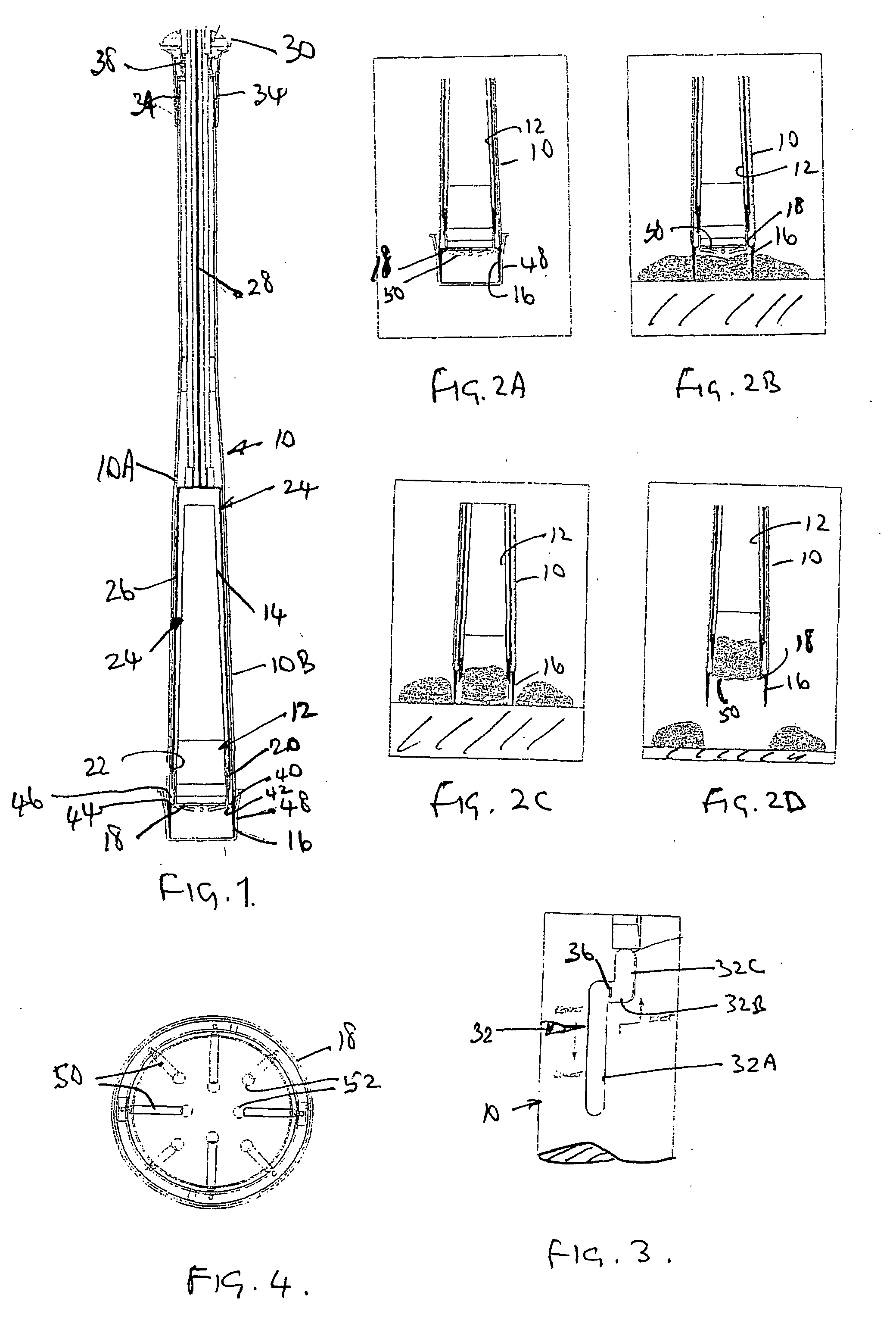
[0006] An embodiment of the present invention will now be described by way of example, with
reference to the accompanying drawing, in which:-
Fig. 1 shows a cross-sectional view of an implement according to the present invention,
showing a baton 10 with a cap in position over a containment ring;
Figs. 2A, 2B, 2C and 2D show in cross-sectional views of the lower part of the baton
a sequence of actions involved in the use of the baton, the containment ring having
the cap thereover, and with the cap removed, the containment ring pushed into faecal
matter to be lifted, a ring member pushed into the faecal matter, and the baton lifted
out of the faecal matter with the faecal matter held on the other side of the ring
member respectively;
Fig. 3 shows an enlarged view of a guideway provided at the upper end of the baton
10; and
Fig. 4 shows an enlarged view of the ring member.
[0007] Referring to the drawings, an implement for collecting animal faeces comprises a
baton 10 in which the lower portion 10A at least is tubular with towards the lower
end 10B being enlarged and having an open end whereat a disposable cartridge 12 is
internally fitted. The cartridge 12 has collecting means with one or a series of apertures
which are in communication with a container 14 located within the baton 10. Means
to eject the cartridge 12 from the baton 10 for disposal after use is provided. The
cartridge 12 has a containment ring 16 positioned externally of the baton 10. The
collection means having a ring member 18 in which is defined the one or the series
of apertures. The ring member 18 is movable relative to the containment ring 16 during
a faecal matter lifting operation.
[0008] The collecting means comprises a tubular body 20 at one end across which the ring
member 18 is provided, the'other end having the container 14, e.g. a bag of plastics
material, and catch means in the form of a continuous or part continuous peripheral
rib 22 to be engaged by gripping means provided at the lower end of an internally
movable sub-assembly 24. The sub-assembly 24 comprises a frusto-conical cone 26 having
an open lower end with the gripping means and a closed upper end connected by a rod
28 to a handle 30 at the top of the baton 10 and mounted for movement relative to
the baton 10. Towards the top of the baton 10, two diametrically opposite guideways
32 are provided having a first elongate part 32A parallel to the longitudinal axis
of the baton 10, a second transverse part 32B at the top of the first part 32A and
a third shorter elongate part 32C parallel to the first elongate part 32A and extending
upwardly. The inside of the handle 30 has two diametrically inwardly extending guides
34 to track the guideways 32. A detent or sleeping policeman 36 is provided in the
second transverse part 32B to prevent accidental movement between the first and third
parts 32A, 32C. The handle 30 is spring-biased by a tension spring 38 away from the
baton 10 and the length of the first elongate part 32A of the guideways 32 determines
the extent of movement of the ring member 18 between a position at the top of the
containment ring 16 and at its bottom, i.e. the extent of its lifting movement. Rotational
movement of the handle 30 causes the guides 34 to move across into the second transverse
part 32B of the respective guideway 32 past the detent or sleeping policemen 36 and
into the third part 32C, the handle 30 moving under the spring-biasing to cause the
gripping means to separate from the catch means and the cartridge 12 to be ejected,
the limit of the handle movement determined by the length of the third part 32C of
the guideway 32.
[0009] The containment ring 16 has an inwardly-directed lip 40 at its upper end and the
tubular body 20 below the ring member 18 has an outwardly-directed flange 42 to engage
the lip 40. The containment ring 16 has a friction-fit shoulder 44 at its upper end
to engage with the bottom end 46 of the tubular wall of the baton 10. This serves
to prevent upward movement of the cartridge 12 as the cartridge 12 is about to be
ejected by upward movement of the sub-assembly 24. A cap 48 is provided to be a friction-fit
over the bottom end and sides of the containment ring.
[0010] The ring member 18 has a series of radial fingers 50 extending inwardly from its
periphery. Eight fingers 50 are in the series, four fingers being longer than the
other four fingers, the longer fingers alternating with the others. The inner ends
of all fingers each have a bulbous end 52.
[0011] The gripping means is a continuous or dis-continuous groove 54 provided internally
of the cone 26, the rib 22 and groove 54 being matable.
[0012] In use, with the cap 48 removed, the containment ring 16 is pushed into the faecal
matter to be lifted and is advantageous since it prevents the faecal matter trapped
therein from spreading outwardly as the ring member 18 is pressed down into and through
the faecal matter and ensuring the trapped faecal matter is all held by the ring member
18. The baton 10 is then used again to lift another portion of the faecal matter,
the second portion of the faecal matter pushing the first portion upwardly into the
container. The baton 10 is used in this way as often as is required to lift all the
faecal matter at the one location and at a series of locations, if necessary, during
an exercising walk with the pet animal, generally a dog.
[0013] The handle may be constructed to have a closable cavity for carrying a disinfectant,
a self-defensive offensive liquid, for example mace, or accommodation for a torch
or an alarm mechanism. Where the cavity holds a liquid, a spray nozzle may be associated
with dispersement of the liquid.
[0014] Variations and modifications can be made without departing from the scope of the
invention described above and as claimed hereinafter.
1. An implement for collecting animal faeces comprising a baton in which the lower portion
at least is tubular with towards the lower end being enlarged and having an open end
whereat a disposable cartridge is internally fitted, the cartridge having collecting
means with one or a series of apertures which are in communication with a container
located within the baton, and means to eject the cartridge from the baton for disposal
after use, the cartridge having an containment ring positioned externally of the baton
and the collecting means having a ring member in which is defined the one or the series
of apertures, the ring member being movable relative to the containment ring during
a faecal matter lifting operation.
2. An implement for collecting animal faeces as claimed in Claim 1, wherein the collecting
means comprises a tubular body at one end across which the ring member is provided,
the other end having the container and catch means to be engaged by gripping means
provided at the lower end of an internally movable sub-assembly.
3. An implement for collecting animal faeces as claimed in Claim 2, wherein the sub-assembly
comprises a frusto-conical cone having an open lower end with the gripping means and
a closed upper end connected by a rod to a handle at the top of the baton and mounted
for movement relative to the baton.
4. An implement for collecting animal faeces as claimed in Claim 1, 2 or 3, wherein towards
the top of the baton, two diametrically opposite guideways are provided having a first
elongate part parallel to the longitudinal axis of the baton, a second transverse
part at the top of the first part and a third shorter elongate part parallel to the
first elongate part and extending upwardly.
5. An implement for collecting animal faeces as claimed in Claim 4, wherein the inside
of the handle has two diametrically inwardly extending guides to track the guideways.
6. An implement for collecting animal faeces as claimed in Claim 4 or 5, wherein a detent
or sleeping policeman is provided in the second transverse part to prevent accidental
movement between the first and third parts.
7. An implement for collecting animal faeces as claimed in Claim 4, 5 or 6, wherein the
handle is spring-biased away from the baton and the length of the first elongate part
of the guideway determines the extent of movement of the ring member between a position
at the top of the containment ring and at its bottom.
8. An implement for collecting animal faeces as claimed in any one of Claims 4 to 7,
wherein rotational movement of the handle causes the guides to move across into the
second transverse part of the respective guideway past the detent or sleeping policemen
and into the third part, the handle moving under spring-biasing to cause the gripping
means to separate from the catch means and the cartridge to be ejected, the limit
of the handle movement determined by the length of the third part of the guideway.
9. An implement for collecting animal faeces as claimed in any one of the preceding Claims,
wherein the containment ring has an inwardly-directed lip at its upper end and the
tubular body below the ring member has an outwardly-directed flange to engage the
lip.
10. An implement for collecting animal faeces as claimed in any one of the preceding Claims,
wherein the containment ring has a friction-fit shoulder at its upper end to engage
with the bottom end of the tubular wall of the baton.
11. An implement for collecting animal faeces as claimed in any one of the preceding Claims,
wherein a cap is provided to be a friction-fit over the bottom end and sides of the
containment ring.
12. An implement for collecting animal faeces as claimed in any one of the preceding Claims,
wherein the ring member has a series of radial fingers extending inwardly from its
periphery.
13. An implement for collecting animal faeces as claimed in Claim 12, wherein eight fingers
are in the series, four fingers being longer than the other four fingers, the longer
fingers alternating with the others.
14. An implement for collecting animal faeces as claimed in Claim 12 or 13, wherein the
inner ends of all fingers each beneficially have a bulbous end.
1. Gerät zum Aufsammeln von Tierkot, mit einem Stab dessen unterer Teil zumindest röhrenförmig
ist und sich zum unteren Ende hin aufweitet und ein oberes Ende besitzt, an dem innen
eine Wegwerf-Kassette angebracht ist, wobei die Kassette ein Aufsammelmittel mit einer
oder mehreren Öffnungen aufweist, die mit einem im Stab angeordneten Behälter in Verbindung
stehen, und einem Mittel zum Ausstoßen der Kassette aus dem Stab zur Entsorgung nach
der Verwendung, wobei die Kassette einen außerhalb des Stabs angeordneten Aufnahmering
aufweist und das Aufsammelmittel ein Ringglied besitzt, in dem die eine oder die mehreren
Öffnungen definiert sind, wobei das Ringglied während eines Kotanhebevorgangs bezüglich
des Aufnahmerings beweglich ist.
2. Gerät zum Aufsammeln von Tierkot nach Anspruch 1, bei dem das Aufsammelmittel an einem
Ende einen röhrenförmigen Körper umfasst, über den das Ringglied vorgesehen ist, wobei
das andere Ende den Behälter und ein Arretierungsmittel aufweist, das durch ein am
unteren Ende einer innen beweglichen Untergruppe angeordneten Greifmittel in Eingriff
genommen werden soll.
3. Gerät zum Aufsammeln von Tierkot nach Anspruch 2, bei dem die Untergruppe einen Kegelstumpf
umfasst, der ein offenes unteres Ende mit dem Greifmittel und ein geschlossenes oberes
Ende aufweist, das durch eine Stange mit einem Griff oben am Stab verbunden ist, der
zur Bewegung bezüglich des Stabs angebracht ist.
4. Gerät zum Aufsammeln von Tierkot nach Anspruch 1, 2 oder 3, bei dem zum oberen Stabende
hin zwei diametral gegenüberliegende Führungsbahnen vorgesehen sind, die einen ersten
länglichen Teil parallel zur Längsachse des Stabs, einen zweiten, in Querrichtung
verlaufenden Teil oben am ersten Teil und einen sich nach oben erstreckenden dritten,
kürzeren länglichen Teil parallel zum ersten länglichen Teil aufweist.
5. Gerät zum Aufsammeln von Tierkot nach Anspruch 4, bei dem das Innere des Griffs zwei
sich diametral nach innen erstreckende Führungen zum Folgen der Führungsbahnen aufweist.
6. Gerät zum Aufsammeln von Tierkot nach Anspruch 4 oder 5, bei dem eine Raste oder Schwelle
im zweiten, in Querrichtung verlaufenden Teil vorgesehen ist, um eine versehentliche
Bewegung zwischen dem ersten und dem dritten Teil zu verhindern.
7. Gerät zum Aufsammeln von Tierkot nach Anspruch 4, 5 oder 6, bei dem der Griff von
dem Stab weg federbelastet ist und die Länge des ersten länglichen Teils der Führungsbahn
das Ausmaß der Bewegung des Ringglieds zwischen einer Position am oberen Ende des
Aufnahmerings und an seinem unteren Ende bestimmt.
8. Gerät zum Aufsammeln von Tierkot nach einem der Ansprüche 4 bis 7, bei dem durch Drehbewegung
des Griffs bewirkt wird, dass sich die Führungen in Querrichtung in den zweiten, in
Querrichtung verlaufenden Teil der jeweiligen Führungsbahn an der Raste oder Schwelle
vorbei und in den dritten Teil bewegen, wobei sich der Griff unter der Federbelastung
bewegt, um zu bewirken, dass sich das Greifmittel von dem Arretierungsmittel trennt
und die Kassette ausgestoßen wird, wobei die Grenze der Griffbewegung durch die Länge
des dritten Teils der Führungsbahn bestimmt wird.
9. Gerät zum Aufsammeln von Tierkot nach einem der vorhergehenden Ansprüche, bei dem
der Aufnahmering an seinem oberen Ende eine nach innen gerichtete Lippe und der röhrenförmige
Körper unter dem Ringglied einen nach außen gerichteten Flansch zum Eingriff mit der
Lippe aufweist.
10. Gerät zum Aufsammeln von Tierkot nach einem der vorhergehenden Ansprüche, bei dem
der Aufnahmering an seinem oberen Ende eine im Presssitz angeordnete Schulter zum
Eingriff mit dem unteren Ende der röhrenförmigen Wand des Stabs aufweist.
11. Gerät zum Aufsammeln von Tierkot nach einem der vorhergehenden Ansprüche, bei dem
eine Kappe im Presssitz über dem unteren Ende und über die Seiten des Aufnahmerings
vorgesehen ist.
12. Gerät zum Aufsammeln von Tierkot nach einem der vorhergehenden Ansprüche, bei dem
das Ringglied eine Reihe von radialen Fingern aufweist, die sich von seinem Umfang
nach innen erstrecken.
13. Gerät zum Aufsammeln von Tierkot nach Anspruch 12, bei dem sich in der Reihe acht
Finger befinden, wobei vier Finger länger sind als die anderen vier Finger, wobei
sich die längeren Finger mit den anderen abwechseln.
14. Gerät zum Aufsammeln von Tierkot nach Anspruch 12 oder 13, bei dem die inneren Enden
aller Finger jeweils vorzugsweise ein knollenförmiges Ende aufweisen.
1. outil destiné à recueillir les matières fécales animales comprenant un bâton dans
lequel la portion inférieure est au moins tubulaire et s'élargit vers l'extrémité
inférieure et présente une extrémité ouverte à l'intérieur de laquelle une cartouche
jetable est ajustée, la cartouche ayant un moyen de collecte avec une ou une série
d'ouvertures qui communiquent avec un récipient situé à l'intérieur du bâton, et un
moyen pour éjecter la cartouche du bâton en vue de sa mise au rebut après utilisation,
la cartouche ayant un anneau de rétention positionné à l'extérieur du bâton et le
moyen de collecte ayant un organe annulaire dans lequel est définie l'ouverture ou
la série d'ouvertures, l'organe annulaire pouvant être déplacé par rapport à l'anneau
de rétention au cours d'une opération de prélèvement de matières fécales.
2. outil destiné à recueillir les matières fécales animales selon la revendication 1,
dans lequel le moyen de collecte comprend un corps tubulaire à une extrémité, en travers
duquel l'organe annulaire est prévu, l'autre extrémité ayant le récipient et des moyens
de réception devant être engagés par des moyens de saisie prévus à l'extrémité inférieure
d'un sous-ensemble déplaçable intérieurement.
3. outil destiné à recueillir les matières fécales animales selon la revendication 2,
dans lequel le sous-ensemble comprend un cône tronconique ayant une extrémité inférieure
ouverte avec les moyens de saisie et une extrémité supérieure fermée connectée par
une tige à une poignée en haut du bâton et montée de manière à se déplacer par rapport
au bâton.
4. Outil destiné à recueillir les matières fécales animales selon la revendication 1,
2 ou 3, dans lequel, vers le haut du bâton, deux glissières diamétralement opposées
sont prévues, lesquelles ont une première partie allongée parallèle à l'axe longitudinal
du bâton, une deuxième partie transversale en haut de la première partie et une troisième
partie allongée plus courte parallèle à la première partie allongée et s'étendant
vers le haut.
5. outil destiné à recueillir les matières fécales animales selon la revendication 4,
dans lequel l'intérieur de la poignée a deux guides s'étendant diamétralement vers
l'intérieur pour suivre les glissières.
6. outil destiné à recueillir les matières fécales animales selon la revendication 4
ou 5, dans lequel un goujon de blocage ou un bossage est prévu dans la deuxième partie
transversale pour empêcher un déplacement accidentel entre les première et troisième
parties.
7. outil destiné à recueillir les matières fécales animales selon la revendication 4,
5 ou 6, dans lequel la poignée est repoussée par ressort à l'écart du bâton et la
longueur de la première partie allongée de la glissière détermine l'ampleur du mouvement
de l'organe annulaire entre une position en haut de l'anneau de rétention et en bas
de celui-ci.
8. outil destiné à recueillir les matières fécales animales selon l'une quelconque des
revendications 4 à 7, dans lequel le mouvement de rotation de la poignée fait se déplacer
les guides en travers dans la deuxième partie transversale de la glissière respective
au-delà du goujon de blocage ou du bossage et dans la troisième partie, la poignée
se déplaçant sous l'effet de la poussée du ressort en provoquant la séparation des
moyens de saisie des moyens de réception et l'éjection de la cartouche, la limite
du mouvement de la poignée étant déterminée par la longueur de la troisième partie
de la glissière.
9. outil destiné à recueillir les matières fécales animales selon l'une quelconque des
revendications précédentes, dans lequel l'anneau de rétention a une lèvre dirigée
vers l'intérieur au niveau de son extrémité supérieure et le corps tubulaire sous
l'organe annulaire a une bride dirigée vers l'extérieur destinée à s'engager avec
la lèvre.
10. outil destiné à recueillir les matières fécales animales selon l'une quelconque des
revendications précédentes, dans lequel l'anneau de rétention a un épaulement à ajustement
par friction au niveau de son extrémité supérieure destiné à s'engager avec l'extrémité
inférieure de la paroi tubulaire du bâton.
11. outil destiné à recueillir les matières fécales animales selon l'une quelconque des
revendications précédentes, dans lequel un couvercle est prévu pour être ajusté par
friction par-dessus l'extrémité inférieure et les côtés de l'anneau de rétention.
12. outil destiné à recueillir les matières fécales animales selon l'une quelconque des
revendications précédentes, dans lequel l'organe annulaire a une série de doigts radiaux
s'étendant vers l'intérieur depuis sa périphérie.
13. outil destiné à recueillir les matières fécales animales selon la revendication 12,
dans lequel huit doigts sont dans la série, quatre doigts étant plus longs que les
quatre autres doigts, les doigts plus longs alternant avec les autres.
14. outil destiné à recueillir les matières fécales animales selon la revendication 12
ou 13, dans lequel les extrémités intérieures de tous les doigts ont chacune avantageusement
une extrémité bulbeuse.