| (19) |
 |
|
(11) |
EP 1 305 596 B1 |
| (12) |
EUROPEAN PATENT SPECIFICATION |
| (45) |
Mention of the grant of the patent: |
|
25.07.2007 Bulletin 2007/30 |
| (22) |
Date of filing: 25.06.2001 |
|
| (51) |
International Patent Classification (IPC):
|
| (86) |
International application number: |
|
PCT/SE2001/001455 |
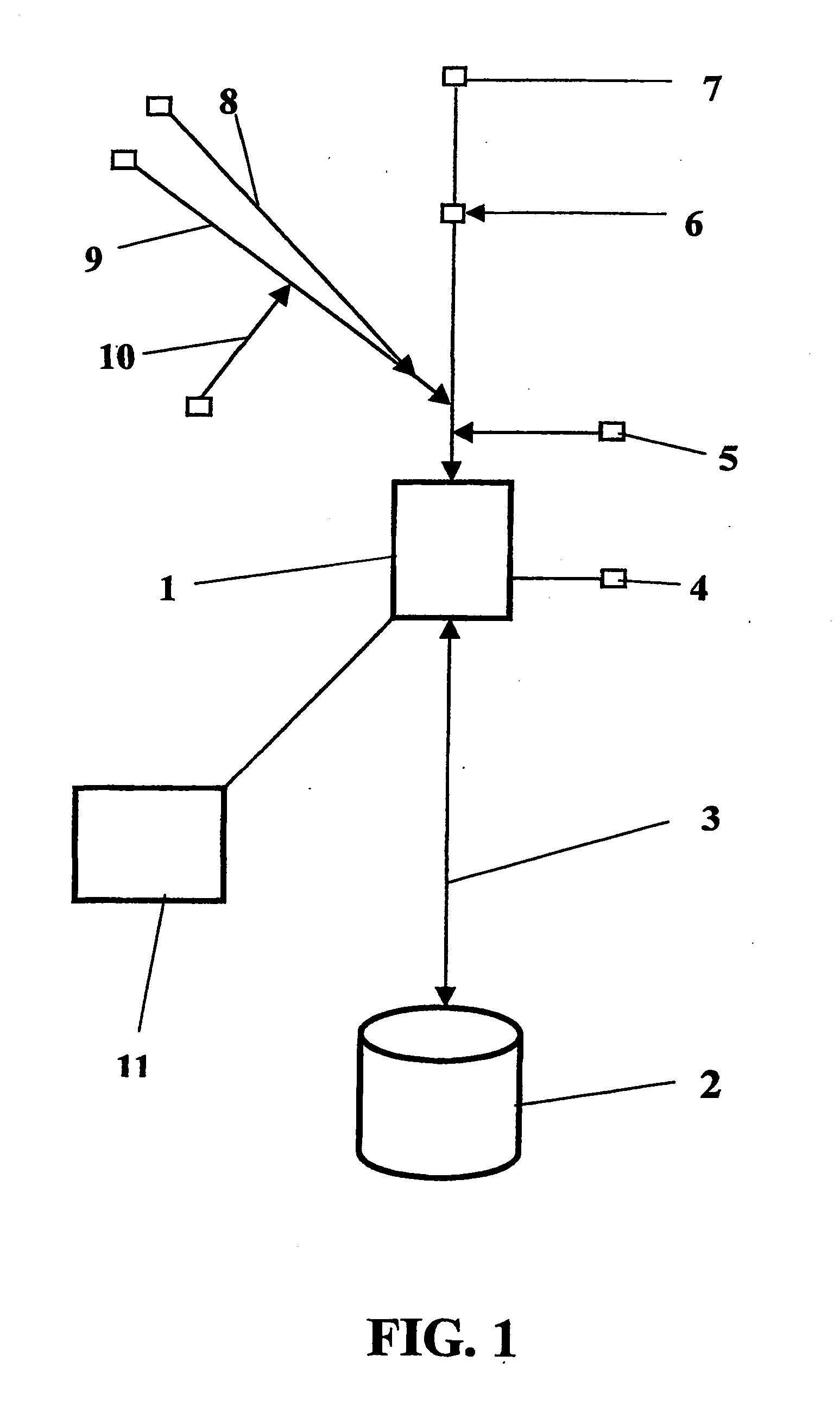
| (87) |
International publication number: |
|
WO 2002/001196 (03.01.2002 Gazette 2002/01) |
|
| (54) |
METHOD AND DEVICE FOR MEASURING TURBIDITY
VERFAHREN UND VORRICHTUNG ZUR TRÜBUNGSMESSUNG
PROCEDE ET SYSTEME DE MESURE DE TURBIDITÉ
|
| (84) |
Designated Contracting States: |
|
AT BE CH CY DE DK ES FI FR GB GR IE IT LI LU MC NL PT SE TR |
| (30) |
Priority: |
26.06.2000 SE 0002403
|
| (43) |
Date of publication of application: |
|
02.05.2003 Bulletin 2003/18 |
| (73) |
Proprietor: Siljan Allards AB |
|
795 32 Rättvik (SE) |
|
| (72) |
Inventors: |
|
- BERNHARDSSON, Sven
S-795 32 Rättvik (SE)
- LILJHA, Johan
S-795 31 Rättvik (SE)
- PELLAS, Leif
S-795 91 Rättvik (SE)
|
| (74) |
Representative: Hedman, Anders et al |
|
Aros Patent AB
P.O. Box 1544
751 45 Uppsala
751 45 Uppsala (SE) |
| (56) |
References cited: :
EP-A2- 0 337 108
US-A- 3 714 444
|
EP-A2- 0 535 624
|
|
| |
|
|
|
|
| |
|
| Note: Within nine months from the publication of the mention of the grant of the European
patent, any person may give notice to the European Patent Office of opposition to
the European patent
granted. Notice of opposition shall be filed in a written reasoned statement. It shall
not be deemed to
have been filed until the opposition fee has been paid. (Art. 99(1) European Patent
Convention).
|
TECHNICAL FIELD
[0001] The present invention relates to optical measuring of solid substance in fluids and
relates more specifically to a method and a system for performing such a measurement
in a manner that is reproducible and constant over time.
BACKGROUND
[0002] For many years, attempts have been made to develop optical methods for measuring
particles, i.e. sludge, in fluids. Within this context, fouling or contamination of
a sampler or tester is a serious problem that risks making the measurement result
entirely or partly useless after a certain operating time. The development of optical
testers has therefore included different alternative methods of cleaning the tester,
such as the use of wind-screen wipers on the glass surface transmitting the optical
radiation, water flushing to keep the surface clean and the use of a brush for mechanical
or manual cleaning. No existing testers have worked satisfactorily, but there has
been clogging and in the case of mechanical cleaning scratches have often developed
on the measuring surface, which has lead to unreliable measurement results.
[0003] The testers have throughout been positioned down in a tank containing sludge or in
a line containing sludge, which has made the tester difficult to reach for inspection
and attendance, for instance by mechanical cleaning.
[0004] As a consequence, this measuring technique has not been working properly and it has
not been possible to measure sludge content in a reliable manner.
[0005] EP 0 337 108 A discloses a method and an apparatus for measuring the opacity of an exhaust gas stream,
by means of a transmitter and a receiver being shielded from the gas stream by respective
windows. These windows become dirty with particulate material from the gas stream;
which interferes with the readings. The solution is here to clean the windows by mechanical
wiping in combination with the spraying of a cleaning solvent onto the windows.
[0006] EP 0 535 624 also relates generally to exhaust gas testing and specifically describes an arrangement
for protecting measuring optics in a gas test device. This document is mainly concerned
with preventing contamination of the measuring optics by the exhaust gas. The document
suggests forming a kind of air curtain that separates the exhaust gases from the measuring
optics, and controlling the speed of the air stream dependent upon the exhaust gas
rate, so as to not influence the latter.
SUMMARY OF THE INVENTION
[0007] The basic object of the present invention is to eliminate the described shortcomings
that are related to the known technique within this field, so that the sludge content
may be measured during long periods of time and with stable results.
[0008] According to the invention, the above stated object is achieved by providing a method
of optical measuring, which uses a combination of pressurized air and water as a jet-beam
by flushing. In this field of application, such a combination has provided a very
powerful cleaning effect without causing scratches on measuring surfaces of glass
or similar materials.
[0009] According to one embodiment of the invention, the method is used in combination with
an intelligent computer based control unit by means of which the frequency of flushing,
sampling and measuring is selected and controlled, the flushing being performed in
a specific sequence providing maximum cleaning effect before the measurement.
[0010] According to another embodiment the sampler is made easily accessible for inspection
and manual attendance by positioning the sampler separated from the actual sludge
tank or sludge line. This considerably facilitates operation and handling.
[0011] According to still another embodiment the sampler is positioned above the sludge-containing
line or container and is connected thereto through a hose or pipe line, the fluid/sludge
mixture being transported up to the sensor/sampler by means of vacuum or pressure.
[0012] According to further embodiments a cleaning agent may be added by difficult combinations
of fluid and sludge; a fouling alarm may be used so that a supplementary manual cleaning
with a brush or a mechanized cleaning with a brush is performed only when needed.
This minimizes the impact on the measuring surface. A cleaning agent may also be added
when the fouling alarm is activated.
[0013] Further embodiments of this first aspect of the invention are specified in the corresponding
dependent claims.
[0014] Another object of the invention is to provide an appropriate system for performing
reliable optical measuring according to the invention.
[0015] According to another aspect of the invention is suggested a system for optical measuring
of the sludge content of a fluid, which comprises an optical sensor and a combined
supply of pressurized air and water forming a jet stream for cleaning the sensor.
[0016] Embodiments of this aspect of the invention are evident from the corresponding dependent
claims.
[0017] According to still another aspect of the invention is suggested the use of a method
as well as a system according to the invention for providing reliable measurement
results for thickening and dewatering processes.
[0018] These and other objects of the invention are achieved by the invention as defined
in the appended claims.
[0019] Briefly, the present invention offers the following advantages:
- Through effective cleaning, reliable measurement results can be obtained even by difficult
conditions;
- Enables effective control of the sequences of flushing, sampling and measuring;
- Improved accessibility and simplified inspection and as a consequence thereof a more
effective and inexpensive operation, by normal conditions as well as when specific
actions are required;
- A minimum risk of scratches or other damages occurring at the measuring equipment.
[0020] Further objects, characteristics and advantages of the invention, as well as further
embodiments thereof, are evident from the following description of exemplary embodiments.
DESCRIPTION OF THE DRAWING
[0021] The invention will now be described in detail with reference to the appended drawing
figure 1, which is a simplified diagram disclosing exemplary embodiments of a measuring
system according to the invention.
DESCRIPTION OF EXEMPLARY EMBODIMENTS
[0022] With reference to the drawing figure, the basic principles of the invention will
now be described by means of a number of presently preferred embodiments of the invention
and at the same time differences compared to conventional technique will be explained.
Example 1
[0023] As was stated initially, the basic object of the invention is to accomplish a sludge
content measurement that is stable over time and therefore reliable. This is achieved
by means of a method for preventing permanent fouling of an optical measuring device
1, while simultaneously eliminating the risk of damages to the measuring device caused
by the cleaning.
[0024] This first embodiment relates to a sludge content measurement where a sensor/sampler
1 is positioned above a sludge container or sludge line 2. Here cleaning is performed
with a jet of pressurized air and water and the frequency of flushing, sampling and
measuring is selected in and controlled by a control box 11. The sensor/sampler 1
is preferably arranged in working height, easy to reach for attendance, visual control
and possible sensor unit replacement.
[0025] According to this embodiment of the present invention, which is shown in the drawing,
this is achieved by connecting the sensor 1 to the sludge-containing line or container
2 through a hose or pipe line 3. A vacuum pump or a pressure generating pump (not
shown) feeds the sludge to the sensor in sequences controlled by the computerized
control box 11 via a system of valves (not shown).
[0026] The measurement sequence begins with flushing of the sensor with a jet (stream) of
pressurized air, supplied through a line 8, and water, supplied through a line 9.
The lines 8, 9 are joined upstream of the optical sensor and the jet formed of pressurized
air and water is directed at an angle to a pipe where the sensor is positioned, i.e.
towards a measuring surface of the sensor that is not specifically shown. The angle
is between 0 and 90 degrees, preferably between 10 and 80 degrees, and the inlet of
the jet stream is positioned as close as possible to the sensor.
[0027] Then, sludge is pumped up to the sensor 1, whereupon a level monitor 5, being capable
of visual fouling evaluation, closes the pump as the sludge has reached the desired
level. Then, the sludge content is measured with the optical sensor 1, for a predetermined
period of time, whereafter flushing with water and pressurized air is performed. This
is then repeated at pre-determined time intervals during the time of measuring, which
lasts for several months.
Example 2
[0028] This example concerns a sludge content measurement where the sampler/sensor 1 is
positioned above the sludge container/line 2. Here, cleaning is performed by means
of a jet stream of pressurized air and water and the frequency of flushing, sampling
and measuring is selected in and controlled by a control box 11. The optical sensor
1 has a detecting or sensing function of a fouling alarm 4 that indicates when manual
mechanical cleaning may be required.
[0029] Although flushing with the combination of pressurized air and water has shown to
be very efficient for cleaning the measuring surface, there may be applications containing
sludge that is very adhesive or sticky to the measuring surface and that consequently
results in fouling after a certain period of time. When this is the case, the fouling
alarm 4 reacts, which is based on optical technique and consists of a combination
of signals from the level monitor and the sensor. An alarm signal is then provided,
whereupon the operator may clean the measuring surface manually using a brush at a
connection 7. Since this cleaning is performed with long time intervals, the measuring
surface is not affected by scratch formation to any appreciable extent.
Example 3
[0030] This example concerns a sludge content measurement, where the sampler 1 is positioned
above the sludge container/line 2. Here, cleaning is performed by means of a jet stream
of pressurized air and water and the frequency of flushing, sampling and measuring
is selected in and controlled by a control box 11. A fouling alarm 4 initiates the
addition of a cleaning agent 10 by emitting the corresponding alarm signal.
[0031] The measurement is performed according to example 1 or 2, but the sludge particles
are very adhesive to the measuring surface. The fouling alarm 4 initiates an addition
of a cleaning agent through a line 10 connected to the water supply line 9. In combination
with flushing with pressurized air and water, the addition of the cleaning agent minimizes
the risk of permanent fouling. Thereby the need for mechanical cleaning is eliminated.
Example 4
[0032] This example concerns a sludge content measurement, where the sampler 1 is positioned
above the sludge container/line 2. Here, cleaning is performed by means of a jet stream
of pressurized air and water and the frequency of flushing, sampling and measuring
is selected in and controlled by a control box 11. A fouling alarm 4 starts a mechanical
cleaning of the measuring surface, with or without the addition of the cleaning agent
10, by means of a power-driven brush 6 or a brush driven by pressurized air/water,
said brush being activated when the fouling alarm 4 is activated.
[0033] Here, the measurement is performed according to example 1, 2 or 3, but the sludge
particles are very adhesive to the measuring surface. The fouling alarm 4 starts a
mechanized cleaning of the measuring surface of the sensor for a pre-selected period
of time. In combination with the flushing with pressurized air and water and a possible
cleaning agent addition, this increases the cleaning effect such that the risk of
permanent fouling is minimized. In this way, a combination of several cleaning methods
is obtained, while mechanical damaging of the measuring surface is minimized.
[0034] Although the invention may be used generally for measuring fluids having a sludge
content, it is presently considered that its most important application concerns thickening
and dewatering equipment where measurement results via the control unit is used to
control the thickening and dewatering processes.
[0035] The man skilled in the art recognizes that various modifications and changes can
be made to the present invention without departing from the scope thereof, as defined
by the appended claims.
1. A method for ensuring reliable measurement values, in connection with measuring the
content of solid substance in a fluid by means of an optical sensor/sampler (1), by
periodical cleaning of the sensor/sampler (1), characterized in that for the cleaning, the sensor/sampler (1) is flushed periodically with a combination
of water and pressurized air in the form of a jet stream.
2. A method according to claim 1, characterized in that the jet stream consisting of a combination of water and pressurized air is applied
to the sensor/sampler (1) directed at an angle to a measuring surface of the sensor,
the angle being between 0 and 90 degrees, preferably between 10 and 80 degrees.
3. A method according to claim 1 or 2, characterized in that the flushing by means of the jet stream is performed in a determined sequence and
in that the frequency of flushing, as well as sampling and measuring, is selected and controlled
by a computer based control box (11).
4. A method according to any of claims 1-3,
characterized in that a sequence comprises the following steps:
a) flushing of the sensor with pressurized air and water before measuring;
b) measuring the content of solid substance in the fluid with the optical sensor (1)
for a pre-determined period of time;
c) repeated flushing with water and pressurized air,
this sequence then being repeated at pre-determined intervals during the time of measurement.
5. A method according to any of claims 1-4, characterized in that the sensor/sampler (1) is arranged above a sludge container or sludge line (2) and
is connected to the container or line through a hose or pipe line (3).
6. A method according to claim 5, characterized in that the sensor/sampler (1) is arranged in working height, easy to reach for attendance,
visual control and possible sensor unit replacement.
7. A method according to claim 4 or 5, characterized in that prior to a flushing sequence the fluid with the solid substance is fed by a vacuum
pump or a pressure generating pump to the sensor (1) in the sequence controlled by
the computer based control box (11)
8. A method according to claim 7, characterized in that a level monitor (5) is used for stopping the pump when the fluid with the solid substance
has reached a desired level.
9. A method according to claim 8, characterized in that by severe fouling of the sensor, an alarm signal is generated in a fouling alarm
(4), which is based on optical technique, by means of signals from the level guard
(5) and the sensor (1).
10. A method according to claim 9, characterized in that when an alarm signal is received from the fouling alarm (4), manual cleaning of the
measuring surface is performed with a brush.
11. A method according to claim 9, characterized in that when an alarm signal is received from the fouling alarm (4), a cleaning agent is
added to the water and pressurized air for the flushing.
12. A method according to claim 9 or 11, characterized in that when an alarm signal is received from the fouling alarm (4), a mechanical cleaning
of the measuring surface is initiated, said cleaning being carried out by means of
a power-driven brush (6) or a brush driven by pressurized air/water.
13. A system for measuring the content of a solid substance in a fluid comprising an optical
sensor/sampler (1) and means for periodically cleaning the sensor, characterized in that said means for cleaning is arranged to flush the sensor with a jet stream of a combination
of water and pressurized air and comprises a line (8) for supplying pressurized air
and a further line (9) for supplying water, said lines being joined upstream of the
optical sensor.
14. A system according to claim 13, characterized in that the jet of water and pressurized air is directed at an angle to a measuring surface
of the sensor (1), the angle being between 0 and 90 degrees, preferably between 10
and 80 degrees.
15. A system according to claim 13 or 14, characterized by a computer based control box (11) by means of which the frequency of flushing, as
well as sampling and measuring, is selected and controlled.
16. A system according to any of claims 13-15, characterized in that the sensor/sampler (1) is arranged above a sludge container or sludge line (2) and
is connected to the container or line through a hose or pipe line (3).
17. A system according to claim 16, characterized in that the sensor/sampler (1) is arranged in working height, easy to reach for attendance,
visual control and possible sensor unit replacement.
18. A system according to claim 16 or 17, characterized by a vacuum pump or a pressure generating pump for feeding the fluid with the solid
substance to the sensor (1) and being connected to the computer based control box
(11) for controlling the feeding in the sequence.
19. A system according to claim 18, characterized by a level monitor (5) adapted to stop the pump when the fluid containing the solid
substance has reached a desired level.
20. A system according to claim 18, characterized by a fouling alarm (4) that is based on optical technique and that is adapted to emit
an alarm signal when receiving signals from the level monitor (5) and the sensor (1)
by severe fouling of the sensor.
21. A system according to claim 20, characterized in that to the water supply line 9 is connected a line 10 for supply cleaning agent when
a corresponding alarm signal is received from the fouling alarm (4).
22. A system according to claim 20, characterized by a power-driven brush (6) or a brush driven by pressurized air/water, said brush being
adapted to be started in order to perform a mechanical cleaning of the measuring surface
of the sensor (1) when a corresponding alarm signal is received from the fouling alarm
(4).
23. The use of a method and a system, respectively, according to any of the preceding
claims for providing reliable measurement results for thickening and dewatering processes.
1. Verfahren zum Gewährleisten verlässlicher Messwerte im Zusammenhang mit dem Messen
des Gehalts von fester Substanz in einem Fluid mittels eines optischen Sensors/Probenentnahmeeinrichtung
(1) durch periodische Reinigung des Sensors/Probenentnahmeeinrichtung (1), dadurch gekennzeichnet, dass der Sensor/Probenentnahmeeinrichtung (1) für die Reinigung periodisch mit einer Kombination
von Wasser und Druckluft in der Form eines Flüssigkeitsstrahls gespült wird.
2. Verfahren gemäß Anspruch 1, dadurch gekennzeichnet, dass der aus einer Kombination von Wasser und Druckluft bestehende Flüssigkeitsstrahl
auf einen Sensor/Probenentnahmeeinrichtung (1) angewandt wird, wobei er unter einem
Winkel auf eine Messfläche des Sensors gerichtet ist, wobei der Winkel zwischen 0
und 90 Grad, vorzugsweise zwischen 10 und 80 Grad liegt.
3. Verfahren gemäß Anspruch 1 oder 2, dadurch gekennzeichnet, dass das Spülen mittels des Flüssigkeitsstrahls in einer bestimmten Abfolge ausgeführt
wird, und dadurch dass die Häufigkeit des Spülens, wie auch des Probenehmens und Messens durch ein
computerbasiertes Steuergerät (11) gewählt und gesteuert wird.
4. Verfahren gemäß einem der Ansprüche 1 - 3,
dadurch gekennzeichnet, dass eine Abfolge die folgenden Schritte umfasst:
a) Spülen des Sensors mit Druckluft und Wasser vor dem Messen;
b) Messen des Gehalts an fester Substanz in dem Fluid mit dem optischen Sensor (1)
während einer vorbestimmten Zeitdauer;
c) wiederholtes Spülen mit Wasser und Druckluft, wobei diese Abfolge dann in vorbestimmten
Intervallen während der Zeit des Messens wiederholt wird.
5. Verfahren gemäß einem der Ansprüche 1 - 4, dadurch gekennzeichnet, dass der Sensor/Probenentnahmeeinrichtung (1) oberhalb eines Schlammbehälters oder einer
Schlammleitung (2) angeordnet ist und mit dem Behälter oder der Leitung über einen
Schlauch oder eine Rohrleitung (3) verbunden ist.
6. Verfahren gemäß Anspruch 5, dadurch gekennzeichnet, dass der Sensor/Probenentnahmeeinrichtung (1) in einer Arbeitshöhe angeordnet ist, die
für Wartung, visuelle Kontrolle und mögliches Auswechseln der Sensoreinheit einfach
zu erreichen ist.
7. Verfahren gemäß Anspruch 4 oder 5, dadurch gekennzeichnet, dass vor einem Spülvorgang das Fluid mit der festen Substanz durch eine Vakuumpumpe oder
eine Druck erzeugende Pumpe dem Sensor (1) in der Abfolge zugeführt wird, die durch
das computerbasierte Steuergerät (11) gesteuert wird.
8. Verfahren gemäß Anspruch 7, dadurch gekennzeichnet, dass ein Niveau-Kontrollgerät (5) verwendet wird, um die Pumpe anzuhalten, wenn das Fluid
mit der festen Substanz ein gewünschtes Niveau erreicht hat.
9. Verfahren gemäß Anspruch 8, dadurch gekennzeichnet, dass durch starke Verschmutzung des Sensors in einer Verschmutzungsalarmeinrichtung (4),
die auf optischer Technik basiert, ein Alarmsignal mittels Signalen von dem Niveauwächter
(5) und dem Sensor (1) erzeugt wird.
10. Verfahren gemäß Anspruch 9, dadurch gekennzeichnet, dass, wenn von der Verschmutzungsalarmeinrichtung (4) ein Alarmsignal empfangen wird,
manuelle Reinigung der Messfläche mit einer Bürste durchgeführt wird.
11. Verfahren gemäß Anspruch 9, dadurch gekennzeichnet, dass, wenn ein Alarmsignal von der Verschmutzungsalarmeinrichtung (4) empfangen wird,
ein Reinigungsmittel dem Wasser und der Druckluft für das Spülen hinzugefügt wird.
12. Verfahren gemäß Anspruch 9 oder 11, dadurch gekennzeichnet, dass, wenn von der Verschmutzungsalarmeinrichtung (4) ein Alarmsignal empfangen wird,
eine mechanische Reinigung der Messfläche initiiert wird, wobei die Reinigung mittels
einer motorisch angetriebenen Bürste (6) oder einer durch Druckluft/Wasser angetriebenen
Bürste ausgeführt wird.
13. System zum Messen des Gehaltes einer festen Substanz in einem Fluid, das einen optischen
Sensor/Probenentnahmeeinrichtung (1) und Mittel zur periodischen Reinigung des Sensors
umfasst, dadurch gekennzeichnet, dass das Mittel zur Reinigung so angeordnet ist, dass es den Sensor mit einem Flüssigkeitsstrahl
einer Kombination von Wasser und Druckluft gespült, und eine Leitung (8) umfasst,
um Druckluft zuzuführen, und eine weitere Leitung (9), um Wasser zuzuführen, wobei
die Leitungen stromaufwärts des optischen Sensors zusammengeführt werden.
14. System gemäß Anspruch 13, dadurch gekennzeichnet, dass der Strahl von Wasser und Druckluft unter einem Winkel auf eine Messfläche des Sensors
(1) gerichtet ist, wobei der Winkel zwischen 0 und 90 Grad, vorzugsweise zwischen
10 und 80 Grad liegt.
15. System gemäß Anspruch 13 oder 14, gekennzeichnet durch ein computergesteuertes Steuergerät (11), mittels dem die Häufigkeit des Spülens
wie auch des Probenehmens und Messens gewählt und gesteuert wird.
16. System gemäß einem der Ansprüche 13 - 15, dadurch gekennzeichnet, dass der Sensor/Probenentnahmeeinrichtung (1) oberhalb eines Schlammbehälters oder einer
Schlammleitung (2) angeordnet ist und mit dem Behälter oder der Leitung über einen
Schlauch oder eine Rohrleitung (3) verbunden ist.
17. System gemäß Anspruch 16, dadurch gekennzeichnet, dass der Sensor/Probenentnahmeeinrichtung (1) in einer Arbeitshöhe angeordnet ist, die
für Wartung, visuelle Kontrolle und möglichen Austausch der Sensoreinheit leicht zu
erreichen ist.
18. System gemäß Anspruch 16 oder 17, gekennzeichnet durch eine Vakuumpumpe oder eine Druck erzeugende Pumpe zum Zuführen des Fluids mit der
festen Substanz zu dem Sensor (1), und die mit dem computerbasierten Steuergerät (11)
verbunden ist, um das Zuführen in der Abfolge zu steuern .
19. System gemäß Anspruch 18, gekennzeichnet durch ein Niveau-Kontrollgerät (5), das ausgelegt ist, die Pumpe anzuhalten, wenn das Fluid,
das die feste Substanz enthält, ein gewünschtes Niveau erreicht hat.
20. System gemäß Anspruch 18, gekennzeichnet durch eine Verschmutzungsalarmeinrichtung (4), die auf optischer Technik basiert, und die
ausgelegt ist, ein Alarmsignal auszusenden, wenn sie Signale von dem Niveau-Kontrollgerät
(5) und dem Sensor (1) aufgrund schwerer Verschmutzung des Sensors erhält.
21. System gemäß Anspruch 20, dadurch gekennzeichnet, dass mit der Wasserversorgungsleitung 9 eine Leitung 10 verbunden ist, um Reinigungsmittel
zu liefern, wenn ein entsprechendes Alarmsignal von der Verschmutzungsalarmeinrichtung
(4) erhalten wird.
22. System gemäß Anspruch 20, gekennzeichnet durch eine motorisch angetriebene Bürste (6) oder eine Bürste, die durch Druckluft/Wasser
angetrieben wird, wobei die Bürste ausgelegt ist, eingeschaltet zu werden, um eine
mechanische Reinigung der Messfläche des Sensors (1) auszuführen, wenn ein entsprechendes
Alarmsignal von der Verschmutzungsalarmeinrichtung (4) erhalten wird.
23. Jeweilige Verwendung eines Verfahrens und eines Systems gemäß einem der vorhergehenden
Ansprüche, um verlässliche Messergebnisse für Eindickungs- und Entwässerungsprozesse
zur Verfügung zu stellen.
1. Procédé destiné à assurer des valeurs de mesures sûres, en liaison avec la mesure
de la teneur en matière solide dans un fluide au moyen d'un capteur/échantillonneur
optique (1), par un nettoyage périodique du capteur/échantillonneur (1), caractérisé en ce que pour le nettoyage, le capteur/échantillonneur (1) est rincé périodiquement avec une
combinaison d'eau et d'air sous pression sous la forme de jet.
2. Procédé selon la revendication 1, caractérisé en ce que le jet composé d'une combinaison d'eau et d'air sous pression est appliqué au capteur/échantillonneur
(1) étant dirigé selon un angle vers une surface de mesure du capteur, l'angle étant
compris entre 0 et 90 degrés, préférablement entre 10 et 80 degrés.
3. Procédé selon la revendication 1 ou 2, caractérisé en ce que le rinçage au moyen du jet est réalisé selon une séquence déterminée et en ce que la fréquence du rinçage, aussi bien que de l'échantillonnage et de la mesure, est
choisie et commandée par un boîtier de commande (11) piloté par un ordinateur.
4. Procédé selon l'une quelconque des revendications 1 à 3,
caractérisé en ce que une séquence comprend les étapes suivantes :
a) rinçage du capteur avec de l'air sous pression et de l'eau avant la mesure ;
b) mesure de la teneur en matière solide dans le fluide avec le capteur optique (1)
pendant une période de temps prédéterminée ;
c) rinçage répété avec de l'eau et de l'air sous pression,
cette séquence étant ensuite répétée à des intervalles prédéterminés pendant le temps
de la mesure.
5. Procédé selon l'une quelconque des revendications 1 à 4, caractérisé en ce que le capteur/échantillonneur (1) est disposé au dessus d'un conteneur à boues ou une
canalisation de boues (2) et qu'il est connecté au conteneur ou à la canalisation
par un conduit souple ou une tuyauterie (3).
6. Procédé selon la revendication 5, caractérisé en ce que le capteur/échantillonneur (1) est disposé à une hauteur de travail facile à atteindre
pour la surveillance, le contrôle visuel et l'éventuel remplacement du capteur.
7. Procédé selon la revendication 4 ou 5, caractérisé en ce que avant une séquence de rinçage le fluide avec la substance solide est alimenté par
une pompe à vide ou une pompe génératrice de pression vers le capteur (1) pendant
la séquence commandée par le boîtier de commande piloté par ordinateur.
8. Procédé selon la revendication 7, caractérisé en ce que un contrôleur de niveau (5) est utilisé pour arrêter la pompe lorsque le fluide avec
la substance solide a atteint un niveau désiré.
9. Procédé selon la revendication 8, caractérisé en ce que lors d'un encrassement sévère du capteur, un signal d'alarme est produit dans une
alarme d'encrassement (4), qui est basée sur une technique optique, au moyen de signaux
provenant de la protection de niveau (5) et du capteur (1).
10. Procédé selon la revendication 9, caractérisé en ce que lorsque un signal d'alarme est reçu en provenance de l'alarme d'encrassement (4),
un nettoyage manuel de la surface de mesure est effectué avec une brosse.
11. Procédé selon la revendication 9, caractérisé en ce que lorsque un signal d'alarme est reçu en provenance de l'alarme d'encrassement (4),
un agent de nettoyage est ajouté à l'eau et l'air sous pression pour le rinçage.
12. Procédé selon la revendication 9 ou 11, caractérisé en ce que lorsque un signal d'alarme est reçu en provenance de l'alarme d'encrassement (4),
un nettoyage mécanique de la surface de mesure est entrepris, ledit nettoyage étant
effectué au moyen d'une brosse à moteur électrique (6) ou d'une brosse entraînée par
eau/air comprimé.
13. Système destiné à mesurer la teneur d'une substance solide dans un fluide comprenant
un capteur/échantillonneur optique (1) et un moyen de nettoyage périodique du capteur,
caractérisé en ce que ledit moyen de nettoyage est arrangé pour rincer le capteur avec un jet d'une combinaison
d'eau et d'air sous pression et comprend une canalisation (8) pour l'alimentation
en air sous pression et une autre canalisation (9) pour l'alimentation en eau, lesdites
lignes se rejoignant en amont du capteur optique.
14. Système selon la revendication 13, caractérisé en ce que le jet d'eau et d'air sous pression est dirigé selon un angle vers une surface de
mesure du capteur (1), l'angle étant compris entre 0 et 90 degrés, de préférence entre
10 et 80 degrés.
15. Système selon la revendication 13 ou 14, caractérisé par un boîtier de commande piloté par ordinateur (11) au moyen duquel est choisie et
commandée la fréquence du rinçage, aussi bien que de l'échantillonnage et de la mesure.
16. Système selon l'une quelconque des revendications 13 à 15, caractérisé en ce que le capteur/échantillonneur est disposé au dessus d'un conteneur à boues ou une canalisation
de boues (2) et est connecté au conteneur ou à la canalisation par un conduit souple
ou une tuyauterie (3).
17. Système selon la revendication 16, caractérisé en ce que le capteur/échantillonneur (1) est disposé à hauteur de travail, facile à atteindre
pour la surveillance, le contrôle visuel et le possible remplacement de l'unité de
capteur.
18. Système selon la revendication 16 ou 17, caractérisé par une pompe à vide ou une pompe productrice de pression pour l'alimentation du fluide
avec la substance solide vers le capteur (1) et connectée au boîtier de commande piloté
par ordinateur (11) pour commander l'alimentation dans la séquence.
19. Système selon la revendication 18, caractérisé par un indicateur de niveau (5) adapté pour arrêter la pompe lorsque le fluide contenant
la substance solide a atteint un niveau désiré.
20. Système selon la revendication 18, caractérisé par une alarme d'encrassement (4) qui est basée sur une technique optique et qui est
adaptée pour émettre un signal d'alarme lorsqu'elle reçoit des signaux de l'indicateur
de niveau (5) et du capteur (1) à cause d'un encrassement ferme du capteur.
21. Système selon la revendication 20, caractérisé en ce que la canalisation d'alimentation en eau (9) est connectée à une canalisation 10 pour
l'alimentation d'un agent de nettoyage lorsque un signal d'alarme correspondant est
reçu depuis l'alarme d'encrassement.
22. Système selon la revendication 20, caractérisé par une brosse à moteur électrique (6) ou une brosse entraînée par air sous pression/eau,
ladite brosse étant adaptée pour démarrer afin d'effectuer un nettoyage mécanique
de la surface de mesure du capteur (1) lorsque un signal d'alarme correspondant est
reçu en provenance de l'alarme d'encrassement (4).
23. Utilisation d'un procédé et d'un système, respectivement, selon l'une des revendications
précédentes, pour fournir des résultats de mesure fiables destinés à des processus
d'épaississement et de déshydratation.
REFERENCES CITED IN THE DESCRIPTION
This list of references cited by the applicant is for the reader's convenience only.
It does not form part of the European patent document. Even though great care has
been taken in compiling the references, errors or omissions cannot be excluded and
the EPO disclaims all liability in this regard.
Patent documents cited in the description