(57) A method for forming relatively small vias in polymers which may have an underlying,
dielectric layer, for example, silicon dioxide or silicon nitride layer is disclosed.
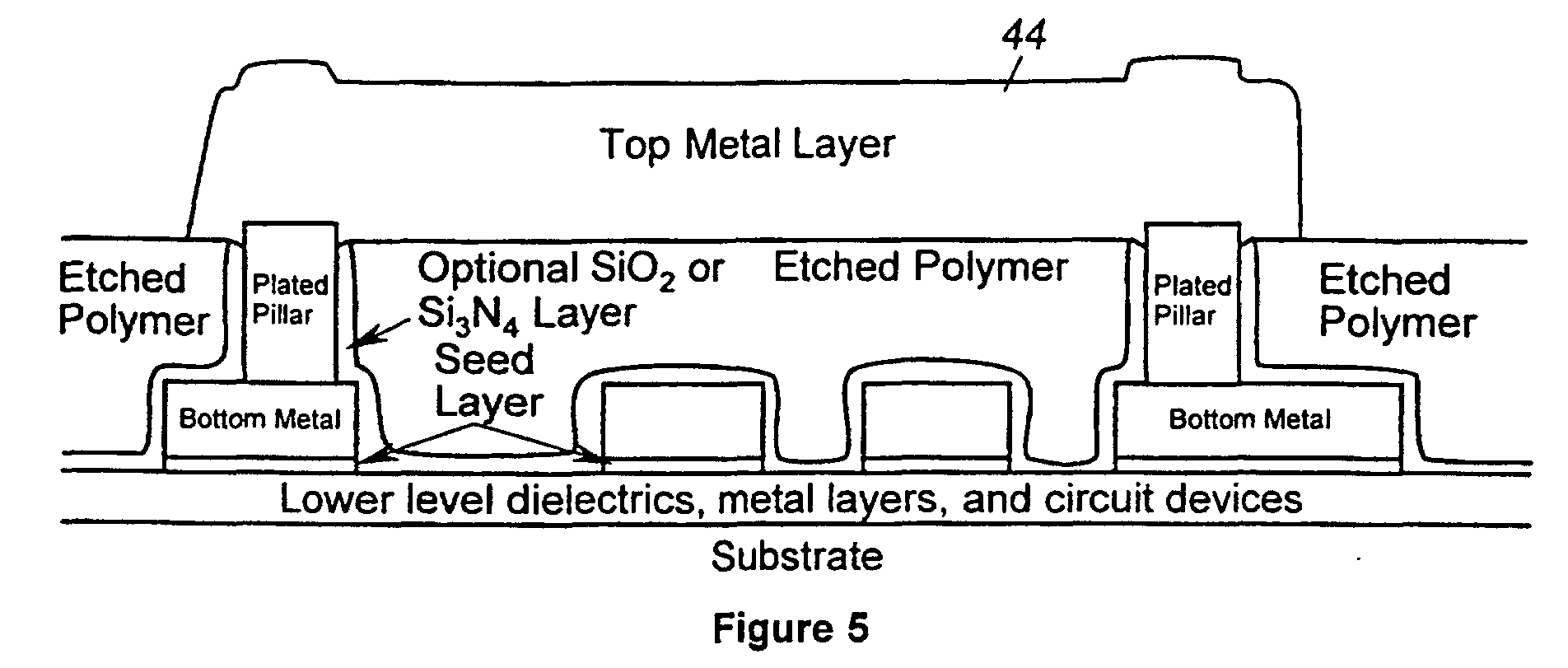
Two embodiments of the invention are disclosed. In a first embodiment (FIGS. 1-15),
plated pillars (34, 36) are formed on a plated bottom metal layer (26). A polymer
(40) is then coated over the first metal layer (26) and the plated pillars (34, 36)
and cured. The polymer (40) is blanket etched to expose the top surface of the plated
pillars (34, 36). A metal layer (44) is formed on top of the polymer layer (44) and
exposed surfaces of the plated pillars (34, 36). In a second embodiment of the invention
(FIGS. 6-10), pillars (56, 58)made from a photoresist are formed over a bottom metal
layer (52). After the photoresist pillars (56, 58) are formed, a polymer layer (60)
is coated over the pillars (56, 58) and the bottom metal layer (52) and blanket etched
to the surface of the photoresist pillars (56, 58). The photoresist pillars (56, 58)
are then removed, for example, by O2 plasma, forming vias. A top metal layer (60) is formed on top of the polymer coating
(60) in the vias to connect to the bottom metal layer (52). Both methods in accordance
with the present invention provide relatively small vias in polymers and are compatible
with semiconductors which include an underlying dielectric layer, such as a silicon
dioxide or silicon nitride layer, under the polymer.
|
|
