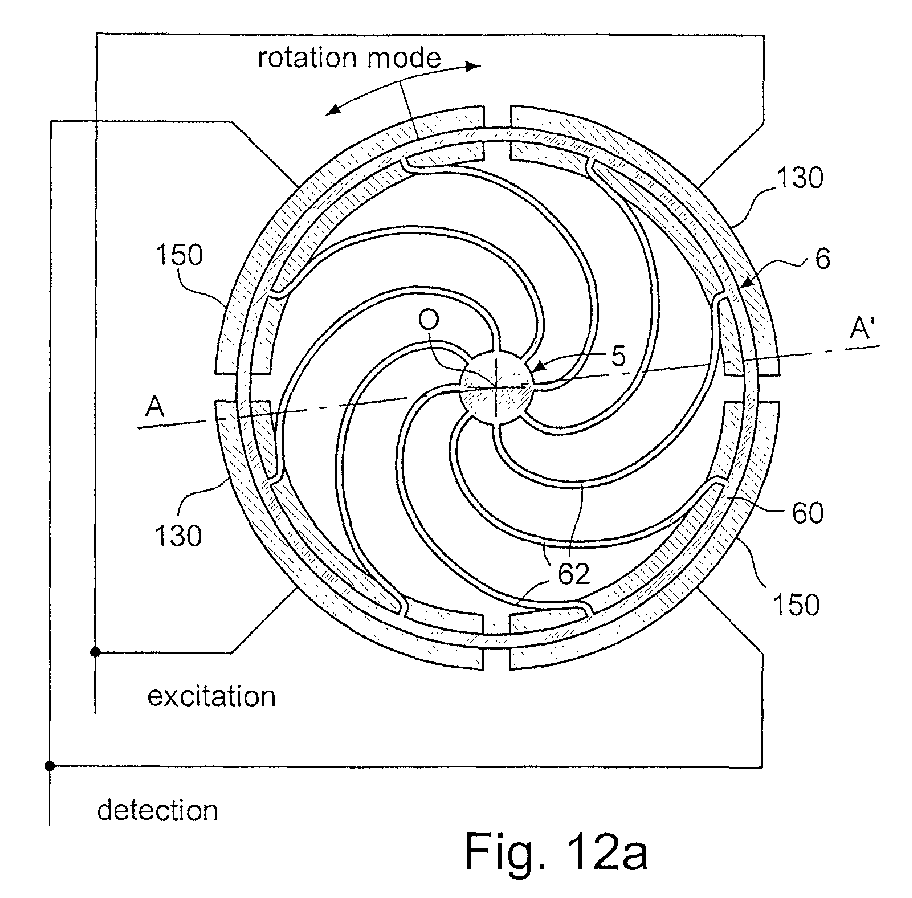
(57) There is described a time base comprising a resonator (4) and an integrated electronic
circuit (3) for driving the resonator into oscillation and for producing, in response
to the oscillation, a signal having a determined frequency. The resonator is an integrated
micromechanical ring resonator supported above a substrate (2) and adapted to oscillate,
according to a first oscillation mode, around an axis of rotation (O) substantially
perpendicular to the substrate, the ring resonator comprising a central post (5) extending
from the substrate along the axis of rotation, a free-standing oscillating structure
(6) connected to the central post and including an outer ring (60) coaxial with the
axis of rotation and connected to the central post by means of a plurality of spring
elements (62), and electrode structures (9; 9*) disposed around the outer ring and
connected to the integrated electronic circuit. Electrodes (100, 120; 130, 150) are
positioned under the free-standing oscillating structure in such a way as to drive
and sense a second oscillation mode in a plane substantially perpendicular to the
substrate and having a resonant frequency which is different from the resonant frequency
of the first oscillation mode, a frequency difference between the resonant frequencies
of both oscillation modes being used for compensating for the effect of temperature
on the frequency of the signal produced by the time base.
|
|
