|
(11) | EP 1 319 039 B1 |

| (12) | EUROPEAN PATENT SPECIFICATION |
|
|
| (54) |
PYRIMIDINE DERIVATIVES AS HARDNESS STABILIZERS PYRIMIDINDERIVATE ALS HÄRTESTABILISATOREN DERIVES DE PYRIMIDINE COMME STABILISANTS DE DURETE |
|
|
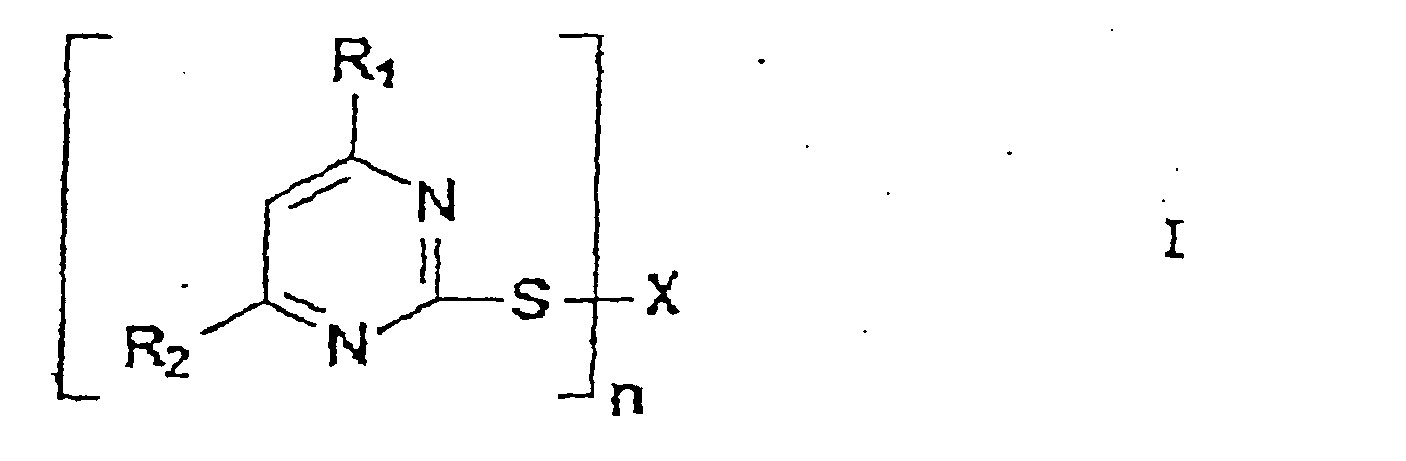
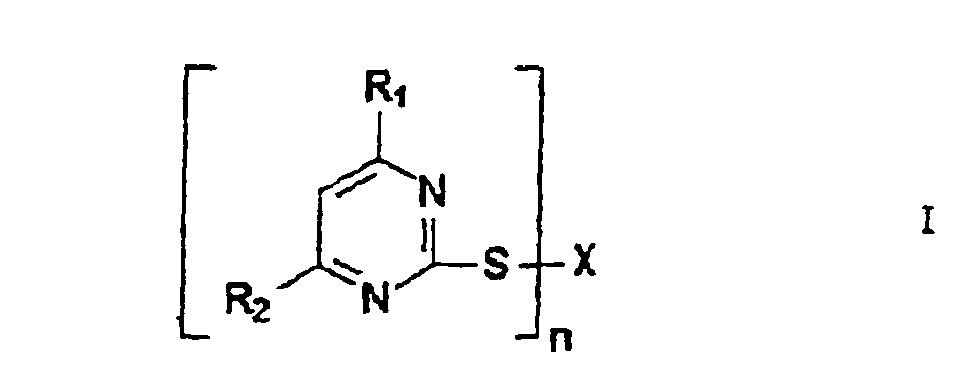
|||||||||||||||||||||||||||||||
|
||||||||||||||||||||||||||||||||
| Note: Within nine months from the publication of the mention of the grant of the European patent, any person may give notice to the European Patent Office of opposition to the European patent granted. Notice of opposition shall be filed in a written reasoned statement. It shall not be deemed to have been filed until the opposition fee has been paid. (Art. 99(1) European Patent Convention). |
[0001] The invention relates to a pyrimidine derivative for use in the hardness stabilization of rubber compounds and a method of improving the hardness stabilization of rubber by adding the pyrimidine derivative and associated accelerators to an unvulcanized rubber composition.
[0002] Vulcanizing rubber compositions by heating a sulfur-vulcanizable rubber composition with sulfur and/or a sulfur donor and a vulcanization accelerator has been known for many years. By this process vulcanizates having acceptable physical properties including tensile strength, resilience, and fatigue resistance can be obtained, but such vulcanizates tend not to have good aging properties. A typical aging phenomenon is hardening, which is explained below.
[0003] Uncured as well as cured rubbers are prone to aging effects. The unsaturated groups in diene rubbers, e.g. styrene-butadiene rubber (SBR) or a blend of SBR with natural rubber, butadiene rubber or with both, make it possible to cure with sulfur, but at the same time they exhibit a sensitivity toward oxygen, ozone, and other reactive substances causing changes such as hardening of the vulcanizate. Unaged diene rubbers contain free double bonds that remain sensitive to the above reactive substances even after vulcanization. Higher temperatures make these effects even more noticeable. Also, since unreacted double bonds are present in the rubber vulcanizate, there is the possibility of further reaction with sulfur causing hardening, i.e. additional crosslinking, of the vulcanizate.
[0004] The use of antioxidants will retard the oxygen-induced aging of the vulcanizate, but will not affect the increase in hardness due to sulfur-induced crosslinking.
[0005] L.H. Davis et al. in Rubber Chemistry and Technology, Vol. 60, 1987, 125-139, disclose the use of 2,2'-dithiobispyridine-N-oxide and the zinc salt of pyridine-2-thiol-N-oxide as a primary accelerator alone or in combination with a low amount of a benzothiazole-2-sulfenamide accelerator in the sulfur vulcanization of polyisoprene, e.g., natural, rubber compounds.
[0006] US Patent No. 3,574,213 discloses rubber vulcanization accelerators comprising pyrimidinylthio-phthalazines, particularly 1-(4,6-dimethyl-2-pyrimidinylthio)-phthalazine, that achieve reduction in scorch.
[0007] C. J. Rostek et al , in Rubber Chemistry and Technology, Vol. 69, 1996, 180-202, disclose the use of novel sulfur vulcanization accelerators based on mercapto-pyridine, -pyrazine, and -pyrimidine. This reference relates to polyisoprene rubbers, which do not harden.
[0008] US Patent No. 3,839,303 discloses the inhibition of premature vulcanization of natural or synthetic diene rubbers by including in the vulcanizable composition accelerating agents, such as thiazole accelerators and a compound comprising certain pyrimidinesulfenamides, such as N-cyclohexyl-4,6-dimethyl-2-pyrimidinesulfenamide. The compound of this reference is formulated so as to be effective in inhibiting premature vulcanization in the vulcanizable composition to which it is added.
[0009] In one embodiment, the present invention comprises a vulcanizable composition comprising a sulfur vulcanizable SBR rubber, a sulfur vulcanizing agent, an accelerating agent selected from the group consisting of accelerating agents other than thiazole sulfenamides and a hardness stabilization agent comprising a pyrimidine derivative of the formula:
Where X=H, R1 through R4 , NR3R4, OR5, SR5, SO2R6, M or (SO3)zM (M=metal ion), and n and z can be the same or different and 1, 2 or 3, depending on whether the respective valence of X and M is 1, 2 or 3, R1 through R4 are the same or different and selected from the group consisting of the substituents H, halogen, OH, NH2, alkyl, cycloalkyl, aryl, alkylaryl and aralkyl, with the substituents alkyl, cycloalkyl, aryl, alkylaryl and aralkyl optionally having additional functional groups selected from the group consisting of NH2, OH, substituted amino, substituted hydroxyl, halogen, and carbonyl containing group, when R3 and/or R4 are one of the substituents alkyl, cycloalkyl, aryl, alkylaryl and aralkyl, they may be in the same constituent in a ring together with N to form a heterocyclic group, R5 is selected from the group consisting of the substituents H, alkyl, cycloalkyl, aryl, alkylaryl and aralkyl, or a radical derived from a carbon based heterocyclic group containing at least one of S or N, or both S and N, R6 is selected from the group consisting of the substituents alkyl, cycloalkyl, aryl, alkylaryl, aralkyl, H, OH, OM, NH2, NR3R4, and OR5, the respective amount of accelerating agent and hardness stabilization agent being effective to not substantially inhibit vulcanization and to stabilize the hardness properties of said rubber upon vulcanization, the amount of accelerating agent in said composition being greater than about 0.6 phr and the amount of hardness stabilization agent being at least about 0.5 phr.
[0010] In a second embodiment, the present invention comprises a method of improving the hardness stabilization of rubber which includes adding the above composition to an unvulcanized rubber composition followed by vulcanization of the rubber composition.
[0011] Other embodiments of the invention encompass specific pyrimidine derivatives, accelerators, details about relative amounts of reactants, and unvulcanized rubber compositions, all of which are hereinafter disclosed in the following discussion of each of the facets of the present invention.
[0012] It has been found that by adding appropriate amounts of certain pyrimidine derivatives and accelerators to a vulcanizable rubber composition comprising natural rubber or other rubbers, vulcanizates, from which, e.g., pneumatic tires can be made, having improved properties can be obtained. These combinations of accelerators and pyrimidine derivatives have the effect of stabilizing the hardness properties of the rubber vulcanizate, e.g., during the service life of a pneumatic tire, without inhibiting or slowing vulcanization, i.e. increasing "scorch" time, in the production of the tire. Thus, hardness stabilization is achieved without slowing of the vulcanization process, thereby avoiding loss in production efficiency.
[0013] In this application, the abbreviation "phr" means the number of parts by weight per 100 parts by weight of rubber. In the case of a rubber blend, it is based on 100 parts by weight of total rubber.
[0014] styrene-butadiene rubber (SBR) or a blend of NR and SBR or NR and SBR with one or more other rubbers can be used in the invention process, it being understood that for purposes of this invention the term "rubber" means an elastomer containing a hydrocarbon unit which is a polymer with some unsaturated chemical bonds. Typically, SBR, a blend of SBR with natural rubber (NR), a blend of SBR with polybutadiene rubber or butadiene rubber (BR), or a blend of SBR with NR and BR is used. The type of rubber or mixture of rubbers will have some affect on the precise amounts of accelerator and pyrimidine derivative appropriate to achieve hardness stabilization without inhibition of the vulcanization.
[0015] The amount of pyrimidine derivative hardness stabilizing agent employed in the process of the present invention will be at least about 0.5 phr. The preferred upper limit is about 10.0 phr, most preferably 3.0 phr.
[0016] In the process of the present invention sulfur and/or a sulfur vulcanizing agent is employed. The amount of sulfur to be compounded with the rubber usually is 0.1 to 10 phr, preferably in excess of about 1 phr. If a sulfur donor is used the amount thereof should be calculated in terms of the amount of sulfur.
[0017] Typical examples of sulfur donors that can be used in the process of the present invention include dithiodimorpholine, caprolactam disulfide, tetramethylthiuram disulfide,and dipentamethylenethiuram tetrasulfide. The reader is referred to W. Hofmann, Rubber Technology Handbook, Hanser Publishers, Munich 1989, in particular pages 231-233.
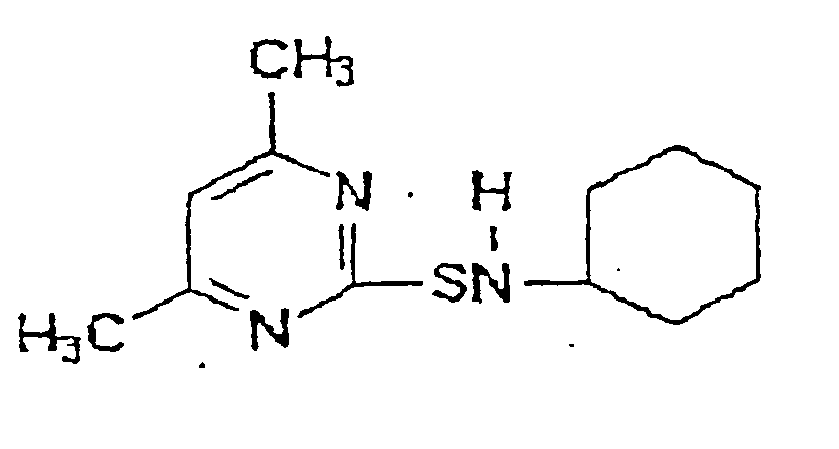
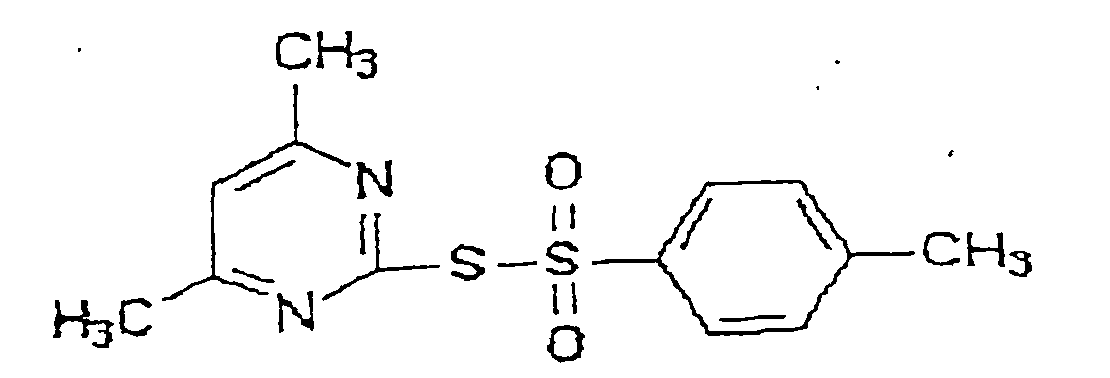
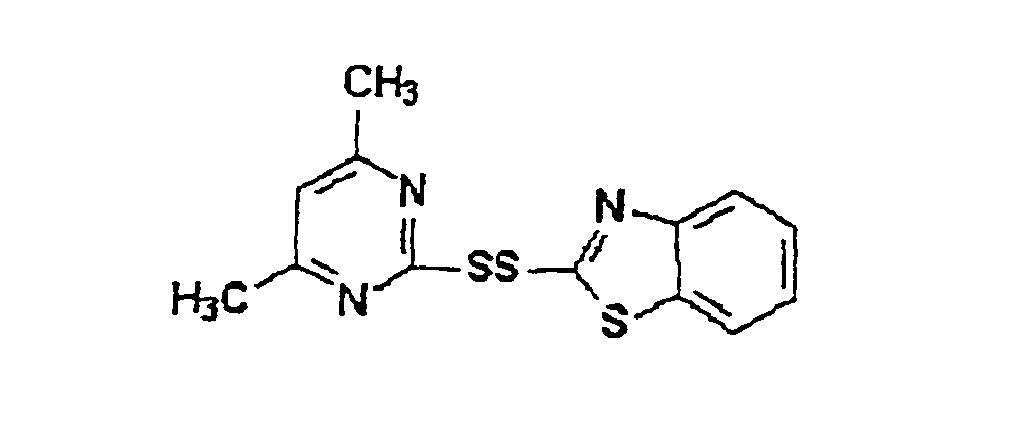
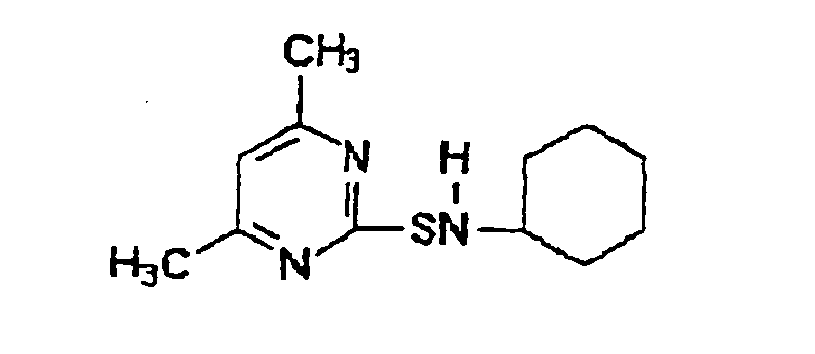
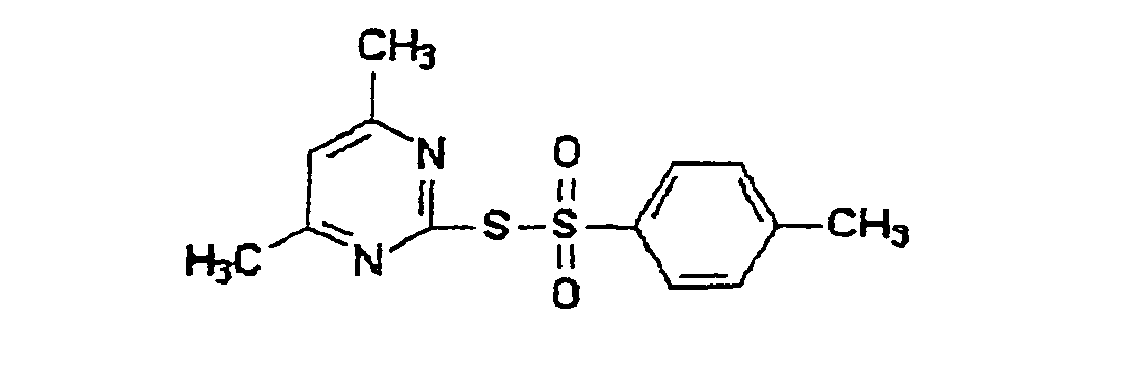
[0018] Particularly preferred pyrimidine derivatives for use in the composition and method of the present invention have the following chemical structural formulas:
2-Benzothiazoyl-4,6-dimethyl-2-pyrimidyl disulfide
N-Cyclohexyl-4,6-dimethyl-2-pyrimidinesulfenamide
; and
S-(4,6-Dimethyl-2-pyrimidyl) p-toluenethiosulfonate
[0019] It is preferred that the alkyl, cycloalkyl, aryl, alkyl aryl and aralkyl groups of the above formula I have from 2 to about 15 carbon atoms and most preferably 2 to about 8 carbon atoms.
[0020] Preferred radicals derived from a heterocyclic group for R5 of formula I are 2-benzothiazoyl and a pyrimidine .
[0021] A further preferred pyrimidine derivative of formula I for use in the composition and method of the present invention is 2,2'-dithiobis[4,6-dimethylpyrimidine] disulfide.
[0022] The preferred metal that may be in the compound of formula I is selected from the group comprising Zn, Ni, Mg, Co and Na.
[0023] The preferred carbonyl containing groups of formula I include carboxylic acid or its salt, ester, amide, ketone or aldehyde.
[0024] Typical vulcanization accelerating agents (accelerators) appropriate for use in the invention include benzothiazole-based accelerators, particularly mercaptobenzothiazoles, thiophosphoric acid derivatives, thiurams, dithiocarbamates, diphenylguanidine (DPG), di-o-tolyl guanidine, xanthates, and mixtures of one or more of these accelerators. Preferably, the vulcanization accelerator comprises mercaptobenzothiazoles, most preferably 2-mercaptobenzothiazole (MBT). A particularly preferred accelerating agent is bis(dibenzylthiocarbarnoyl)disulfide.
[0025] Particularly effective sulfur-vulcanizable rubber compositions in accordance with the present invention include a composition comprising styrene-butadiene rubber, 2-pyrimidinesulfenamide, and a mixture of the accelerators, bis(dibenzylthiocarbamoyl)disulfide and 2-mercaptobenzothiazole, or a composition comprising natural rubber, 2-pyrimidinesulfenamide and the accelerator, 2-mercaptobenzothiazole.
[0026] We have found that with SBR, the amount of accelerator should be greater than about 0.6 phr of accelerator; and for natural rubber at least about 0.5 phr of accelerator, with upper limits in either case preferably about 10.0 phr and most preferably about 3.0. Natural rubber has more reactive allylic sites for crosslinking than SBR and generally requires less accelerator for efficient crosslinking.
[0027] It may be effective, in lieu of directly providing a pyrimidine derivative of formula I in the composition of the invention, to provide precursors of such derivatives. It is particularly preferred to use thiazole derivatives and 2-mercaptopyrimidines that lead to the formation of such derivatives, in situ. A derivative for which in situ formation is particularly useful is 2-benzothiazoyl-4,6-dimethyl-2-pyrimidyl disulfide.
[0028] Conventional rubber additives may also be included in the sulfur-vulcanizable rubber composition in accordance with the present invention. Examples include reinforcing agents such as carbon black, silica, clay, whiting and other mineral fillers, processing oils, tackifiers, waxes, phenolic antioxidants, phenylenediamine antidegradants, antiozonants, pigments, e.g. titanium dioxide, resins, plasticizers, factices, and vulcanization activators, such as stearic acid and zinc oxide. These conventional rubber additives may be added in amounts known to the person skilled in the art of rubber compounding. The reader is also referred to the examples that are described below.
[0029] For further details on these typical rubber additives and vulcanization inhibitors, see W. Hofmann, Rubber Technology Handbook, Hanser Publishers, Munich 1989.
[0030] Finally, in specific applications it may also be desirable to include steel-cord adhesion promoters such as cobalt salts and dithiosulfates in conventional, known quantities.
[0031] The sulfur vulcanization process of the present invention can be carried out using means and equipment that are well known to a person skilled in the art. Suitable vulcanization procedures are described in W. Hofmann, Rubber Technology Handbook, Hanser Publishers, Munich 1989.
[0032] A typical method comprises preparing a masterbatch consisting of rubber, carbon black, a vulcanization activator, and a processing oil, in an internal mixer such as a Banbury mixer or a Werner & Pfleiderer mixer, and subsequently adding a vulcanization system comprising sulfur and a vulcanization accelerator, and the hardness stabilizing pyrimidine derivative in accordance with the present invention to the masterbatch either in a low temperature mixer or on a two-roll mill, i.e. the productive stage of mixing. The uncured rubber composition is then vulcanized by heating, e.g., in a compression mold.
[0033] The invention vulcanization process typically is carried out at a temperature of 110-200, preferably 120-190, more preferably 140-180°C for a period of time of up to 12, preferably up to 6, more preferably up to 1 hour.
[0034] The composition of the present invention is useful in the manufacture of many articles, including pneumatic tires, e.g., for passenger cars and trucks, and industrial rubber goods, which comprise the rubber vulcanizate obtained by the method of the invention.
EXAMPLES
Example I
[0036] This example illustrates the syntheses of two particularly preferred pyrimidine derivatives of the present invention, 2-benzothiazolyl-4,6-dimethyl-2-pyrimidyl disulfide and S-(4,6-dimethyl-2-pyrimidyl) p-toluenethiosulfonate.
[0037] The synthesis of a third particularly preferred pyrimidine derivative, of N-cyclohexyl-4,6-dimethyl-2-pyrimidinesulfenamide, may be found in existing literature.
[0038] To synthesize 2-benzothiazolyl 4,6-dimethyl-2-pyrimidyl disulfide, a mixture of 4,6-dimethyl-2-mercaptopyrimidine (2.8 g), 2-(4-morpholinothio)benzothiazole (5.0g) and trifluoroacetic acid (2.3 g) in tetrahydrofuran (100 ml) was stirred at room temperature for ten minutes and stood over night. The mixture was evaporated under reduced pressure to give a residue which was purified by column chromatography using silica gel and a mixed solvent of ethyl acetate and hexanes to yield 2.4 g (40%) of the product: mp 85-86 C.
[0039] To synthesize S-(4,6-dimethyl-2-pyrimidyl) p-toluenethiosulfonate, a mixture was prepared from N,N-dicyclohexyl-4,6-dimethyl-2-pyrimidinesulfenamide (1.6 g), sodium p-toluenesulfinate (1.8 g) and trifluoroacetic acid (1.1 g) in ethanol (60 ml) and stirred at room temperature for 30 minutes and filtered. The filtered solid was dried to give 0.48 g (33%) of the product: mp 114-6 C.
Example 2
[0040] A masterbatch of rubber, carbon black, stearic acid, zinc oxide, processing oil, and antidegradant was made in an internal mixer. The sulfur, accelerators, and hardness stabilizers were mixed on a two-roll mill at approx. 50-70°C. Rubber compounds were vulcanized by compression molding at 145°C for a period of time equal to 1.7xt90. After cooling the vulcanized rubber sheets for 24 h, test pieces were cut and analyzed.
[0041] The rheological properties were determined on a Monsanto Rheometer MDR2000E, arc 0.5°, 145°C/60 min. Scorch time (ts2) and (t5) are the times to increase the torque 2 dNm and 5 Mu, respectively, above the minimum torque (ML). Optimum vulcanization time (t90) is the time at 90% of the maximum torque (MH). Tend is the time at the rheometer and is set at 1 h. Delta torque (Delta S) is the difference between the minimum and the maximum torque. The slope of a rheogram between ML and MH is a measure of the cure rate (RH). Hysteresis is the percentage of energy lost per cycle of deformation. The ratio of loss modulus to storage modulus is defined as mechanical loss and this corresponds to tangent delta (tan d).
[0042] The rubber test pieces were aged in a hot air circulation oven for 3 days (72 h) at 100°C to simulate hardening during use, for example, as a tire.
[0043] The hardness stabilization characteristics were determined by calculating the so-called modulus stabilization (MS).
[0044] The modulus stabilization is the ratio of the modulus at elongation 200% (Mod200) of the aged and the unaged rubber test pieces and is expressed as a percentage by multiplying this ratio by 100%. The lower the ratio Mod200aged/Mod200unaged, the better the modulus retention or hardness stabilization. The Mod200 was obtained from tensile stress-strain tests which were performed in accordance with ISO 37-1994 (dumb-bell type 2).
[0045] The masterbatch employed in the compositions was compounded as shown in Table 1. The various Stocks comprised the compositions as shown in Table 2. The rheological properties and modulus stabilization (an indication of the hardness stabilizing effect of a pyrimidine derivative) is shown in Table 3.
Table 1: Masterbatch
| phr | ||
| SBR | 137.5 | |
| N-2201 | 60.0 | |
| 6PPD2 | 1.0 | |
| Stearic acid | 2.0 | |
| Zinc oxide | 3.0 | |
| Total | 203.5 |
| 1 Carbon black | ||
| 2 N-(1,3-Dimethylbutyl)-N'-phenyl-p-phenylenediamine |
Table 2: Stock Compositions
| Stock # | 1 | 2 | 3 | 4 | 5 | 6 | 7 | 8 |
| Masterbatch HS | 203.5 | 203.5 | 203.5 | 203.5 | 203.5 | 203.5 | 203.5 | 203.5 |
| Sulfur | 1.8 | 1.8 | 1.8 | 1.8 | 1.8 | 1.8 | 1.8 | 1.8 |
| DPG3 | 0.3 | 0.3 | 0.3 | 0.3 | 0.3 | 0.3 | 0.3 | 0.3 |
| TBBS4 | 0.8 | 1.0 | 1.0 | 1.2 | 0.5 | 0.5 | ||
| MBTS5 | 0.2 | 0.2 | 0.2 | |||||
| CDMPS6 | 1.0 | 0.5 | 0.5 | 1.0 | 1.0 | 1.0 | 1.0 | |
| MBT7 | 0.5 | 0.3 | 0.5 | 0.3 |
| 3 N, N'-Diphenylguanidine | ||||||||
| 4 N-t-Butyl-2-benzothiazolesulfenamide | ||||||||
| 5 2, 21-Dithiobis(benzothiazole | ||||||||
| 6 N-Cyclohexyl-4, 6-dimethyl-2-pyrimidinesulfenamide | ||||||||
| 7 2-Mercaptobenzothiazole |
Table 3: Rheological properties at 145°C/60min and Modulus Stabilization (refer to
Table 2 for Stock compositions)
| Stock No. | 1 | 2 | 3 | 4 | 5 | 6 | 7 | 8 | ||
| Scorch Test | ||||||||||
| t5 @135 C (min) | 13.90 | 21.60 | 18.01 | 23.09 | 16.71 | 21.09 | 14.94 | 19.55 | ||
| t35 @135 C (min) | 19.76 | 29.00 | 24.83 | 31.02 | 20.69 | 26.08 | 19.57 | 25.19 | ||
| Min. Visc. (mu) | 36.69 | 36.05 | 36.55 | 36.61 | 36.45 | 36.55 | 35.66 | 35.96 | ||
| Rheometer @ 145 C | ||||||||||
| Rmax (dNM) | 13.99 | 15.04 | 14.87 | 15.02 | 13.75 | 13.21 | 14.92 | 14.57 | ||
| Rmin (dNm) | 2.21 | 2.18 | 2.18 | 2.23 | 2.24 | 2.22 | 2.23 | 2.25 | ||
| Rmax-Rmin (dNM) | 36.69 | 36.05 | 36.55 | 36.61 | 36.45 | 36.55 | 35.66 | 35.96 | ||
| t2 (min) | 10.44 | 15.18 | 13.16 | 16.17 | 10.86 | 13.64 | 10.22 | 13.04 | ||
| t25 (min) | 11.38 | 16.49 | 14.34 | 17.56 | 11.62 | 14.53 | 11.07 | 13.28 | ||
| t90 (min) | 26.66 | 28.88 | 25.51 | 29.59 | 26.85 | 32.74 | 23.29 | 27.40 | ||
| Peak Rate(dNM/m) | 1.20 | 1.80 | 1.70 | .1.60 | 1.60 | 1.10 | 1.90 | 1.60 | ||
| Stress-Strain Data | ||||||||||
| A. Unaged | ||||||||||
| 1. Tensile (Mpa): | ||||||||||
| Modulus, 100% | 1.63 | 1.91 | 1.88 | 1.96 | 1.60 | 1.58 | 1.87 | 1.79 | ||
| Modulus, 200% | 4.55 | 5.41 | 5.33 | 5.76 | 4.57 | 4.31 | 5.32 | 5.01 | ||
| Modulus, 300% | 9.27 | 10.54 | 10.40 | 11.04 | 9.10 | 8.71 | 10.27 | 9.79 | ||
| Ultimate Tensile | 26.73 | 25.94 | 26.23 | 26.24 | 19.59 | 21.36 | 20.25 | 22.59 | ||
| 2. Elongation (%): | ||||||||||
| Utimate Elongation | 631 | 564 | 582 | 570 | 512 | 550 | 485 | 542 | ||
| B. Aged | ||||||||||
| --- 24 hrs --- | ||||||||||
| 1. Tensile (Mpa): | ||||||||||
| Modulus, 100% | 2.39 | 2.47 | 2.55 | 2.53 | 2.17 | 2.09 | 2.53 | 2.35 | ||
| Modulus, 200% | 6.80 | 7.15 | 7.44 | 7.43 | 6.37 | 5.86 | 7.38 | 6.87 | ||
| Modulus, 300% | 12.33 | 13.01 | 13.30 | 13.29 | 11.78 | 11.00 | 13.07 | 12.41 | ||
| Ultimate Tensile | 24.91 | 22.07 | 23.67 | 22.78 | 17.08 | 19.68 | 19.37 | 17.97 | ||
| 2. Elongation (%): | ||||||||||
| Utimate Elongation | 524 | 453 | 471 | 465 | 400 | 460 | 415 | 400 | ||
| --- 72 hrs --- | ||||||||||
| 1. Tensile (Mpa): | ||||||||||
| Modulus, 100% | 2.77 | 2.85 | 2.89 | 2.98 | 2.51 | 2.53 | 3.04 | 2.70 | ||
| Modulus, 200% | 7.81 | 8.13 | 8.20 | 8.42 | 7.15 | 7.05 | 6.69 | 7.68 | ||
| Modulus, 300% | 13.48 | 14.07 | 14.19 | 14.37 | 12.50 | 12.34 | 14.53 | 13.32 | ||
| Ultimate Tensile | 21.99 | 19.84 | 21.22 | 21.69 | 15.48 | 17.25 | 16.68 | 17.95 | ||
| 2. Elongation (%): | ||||||||||
| Utimate Elongation | 460 | 400 | 421 | 425 | 357 | 398 | 350 | 389 | ||
| Modulus Stability(MS) | ||||||||||
| MS24*, % | 149 | 132 | 140 | 129 | 139 | 136 | 139 | 137 | ||
| MS72', % | 172 | 150 | 154 | 146 | 156 | 164 | 163 | 153 | ||
| * MS24 and MS72 represent MS at 24 and 72 hours of aging, respectively. |
[0046] With reference to Table 2, the Stock having a composition in accordance with the present invention is Stock #5. This stock contains non-thiazole sulfenamide accelerators in an amount effective to accelerate vulcanization and sufficient to not substantially inhibit vulcanization, and an amount of a pyrimidine derivative of formula I, as defined above, effective to improve the hardness stabilization of the rubber upon vulcanization, all of which is shown in Table 3. The total amount of such accelerators is 0.8 phr (0.3 phr DPG and 0.5 phr MBT) and the amount of pyrimidine derivative (CDMPS) is 1.0 phr.
[0047] The control shown in Table 2 is Stock #1, which is a composition containing thiazolesulfenamide accelerator (TBBS) and MBTS, and no hardness stabilizer.
[0048] The data in Table 3, shows Stock #5 achieving no significant inhibition of vulcanization (see Rmax, t2, t25 and t90) as compared to the control, and also enhanced hardness stabilization (see Modulus Stability MS24 and MS72). This may be contrasted with all other Stocks when compared to Stock #1, since no other Stock achieves no significant inhibition of vulcanization and enhanced hardness stabilization. The Stock closest to Stock #5 is Stock #6, since Stock #6 comprises an amount of a pyrimidine derivative of formula I and a non-thiazolesulfenamide accelerator, but the latter not in an amount effective to accelerate vulcanization, nor substantially inhibit vulcanization.
[0049] Stock #2 employs a pyrimidine derivative hardness stabilizer, but unlike as required by the present invention, does not employ non-thiazole sulfenamide accelerators. To the contrary, a thiazolesulfenamide (TBBS) accelerator is employed with MBTS. As shown in Table 3, there is considerable inhibition of vulcanization for this Stock.
Example 3
[0050] Two compounds were formulated and tested for this example, Stock #1 and Stock #2, the composition of which are summarized in Table 4. The rheological properties (Cure data) are shown in Table 5 and modulus stabilization (Stress-strain properties) are shown in Table 6. The primary difference between the compositions of this example and Example 1, is that this example employed natural rubber (NR).
Table 4: Stock compositions
| Stock# | 1 | 2 |
| NR | 100.00 | 100.00 |
| Carbon black | 50.00 | 50.00 |
| ZnO | 5.00 | 5.00 |
| Stearic acid | 2.00 | 2.00 |
| 6PPD* | 1.00 | 1.00 |
| CDMPS* | - | 1.50 |
| MBT* | - | 1.50 |
| CBS9 | 1.50 | - |
| Sulfur | 3.00 | 3.00 |
| *See footnote 2,7 and 8 for abbreviation of 6PPD, CDMPS and MBT, respectively. | ||
| 9 N-Cyclohexyl-2-benzothiazolesulfenamide |
Table 5: Rheological properties at 145° C
| Stock# | 1 | 2 |
| Delta S, Nm | 2.75 | 2.68 |
| ML, Nm | 0.26 | 0.26 |
| Ts2, min | 4.27 | 2.60 |
| T90, min | 10.15 | 7.40 |
| Cure rate, Nm/min | 0.10 | 0.11 |
| Tangent delta, t90 | 0.075 | 0.087 |
| Tangent delta, 60' | 0.068 | 0.075 |
Table 6: Stress-strain properties (Cured @ 150°C/t90)
| Stock # | 1 | 2 |
| A. Unaged | ||
| Tensile (Mpa) | 27.30 | 28.70 |
| Modulus, 100% | 4.78 | 4.49 |
| Modulus, 200% | 11.90 | 11.10 |
| Elongation (%) | 407 | 451 |
| B. Aged (48 hrs at 100°C) | ||
| Tensile (Mpa) | 16.10 | 22.80 |
| Modulus, 100% | 8.28 | 7.03 |
| Modulus, 200% | - | 16.4 |
| Elongation (%) | 172 | 275 |
| C. Modulus stability (MS) based on | ||
| 100% modulus | ||
| MS % | 173 | 157 |
[0051] Stock #2 comprised a non-thiazolesulfenamide accelerator (MBT) in an amount effective to accelerate vulcanization and sufficient to not substantially inhibit vulcanization , shown in Table 5, and an amount of a pyrimidine derivative of formula I (CDMPS) effective to improve the hardness stabilization of the rubber upon vulcanization, shown in Table 6. Stock #1 contained no pyrimidine derivative of formula I and it also contained a thiazolesulfenamide accelerator (CBS).
Example 4
[0052] Two compounds were formulated and tested for this example, Stock #1 and Stock #2, the composition of which are summarized in Table 7. The rheological properties (Cure data) and modulus stabilization (Stress-strain properties) are shown in Table 8. This example compares the properties of Stock #2 which is a composition in accordance with the present invention, and which contains bis(dibenzylthiocarbamoyl) disulfide (TBzTD) as an accelerating agent.
Table 7: Stock Compositions
| Stock # | 1 | 2 |
| Masterbatch HS | 203.5 | 203.5 |
| Sulfur | 1.8 | 1.8 |
| DPG | 0.3 | 0.3 |
| TBBS | 0.8 | 0 |
| MBTS | 0.2 | 0 |
| TBzTD10 | 0 | 0.20 |
| CDMPS | 0 | 3.0 |
| MBT | 0 | 0.5 |
| 10 Bis(dibenzylthiocarbamoyl) disulfide |
Table 8, Cure data at 145° C
| Properties | Stock #1 | Stock #2 |
| Delta S, Nm | 0.95 | 1.16 |
| ML, Nm | 0.16 | 00.15 |
| Ts2, Min | 9.1 | 7.0 |
| T90, min | 25.9 | 20.3 |
| Cure rate, t90 ts2 | 16.7 | 13.3 |
| Unaged | ||
| M 100, MPa | 1.4 | 1.8 |
| M 200, MPa | 3.0 | 4.4 |
| M 300, MPa | 5.7 | 8.2 |
| TS, MPa | 20.9 | 21.6 |
| Elongation, % | 720 | 590 |
| Aged, 2 d/100° C | ||
| M100, MPa | 2.8 | 2.6 |
| M 200, MPa | 7.0 | 6.4 |
| M 300. MPa | 11.7 | 10.8 |
| TS, MPa | 20.1 | 20.1 |
| Elongation, % | 465 | 490 |
| MS, % (based on M 200) | 233 | 145 |
| Unaged | ||
| Fatigue to Failure, Kc | 88 | 128 |
| Tear strength, kN/m | 38 | 43 |
| Abrasion loss, % | 11 | 10 |
| Aged, 2d/100° C | ||
| Fatigue to Failure, Kc | 29 | 35 |
| Tear strength, kN/m | 35 | 43 |
| Viscoelastic | Properties (Cure: 145° C/30') | |
| Unaged | ||
| Storage modulus, E', MPa | 6.18 | |
| Loss modulus, E", MPa | 1.63 | 1.65 |
| Tangent delta | 0.263 | 0.261 |
| Aged, 2d/100° C |
| Properties | Stock #1 | Stock #2 |
| Storage modulus, E', MPa | 7.69 | 7.49 |
| Loss modulus, E", MPa | 1.78 | 1.77 |
| Tangent delta | 0.231 | 0.237 |
| Properties (Cure: 145° C/60') | ||
| Unaged | ||
| M 100, MPa | 1.5 | 1.3 |
| M 200, MPa | 3.4 | 3.0 |
| M 300, MPa | 6.5 | 5.8 |
| TS, MPa | 21.2 | 20.5 |
| Elongation, % | 670 | 705 |
| Aged, , 2d/100° C | ||
| M 100, MPa | 2.5 | 2.1 |
| M 200, MPa | 6.1 | 4.8 |
| M 300, MPa | 10.4 | 8.4 |
| TS, MPa | 20.0 | 18.5 |
| Elongation, % | 520 | 560 |
| MS% (based on M 200) | 179 | 160 |
[0053] Table 8 shows the properties of Stock #2 to be consistent with the goals of the present invention, as compared to Stock #1, i.e. no inhibition of vulcanization and enhanced hardness stabilization. TBzTD appears to be a very effective accelerating agent achieving that goal, particularly when mixed with CDMPS as the stabilizing agent.
1. A vulcanizable composition comprising a sulfur vulcanizable SBR rubber, a sulfur vulcanizing
agent, an accelerating agent selected from the group consisting of accelerating agents
other than thiazole sulfenamides and a hardness stabilization agent comprising a pyrimidine
derivative of the formula:
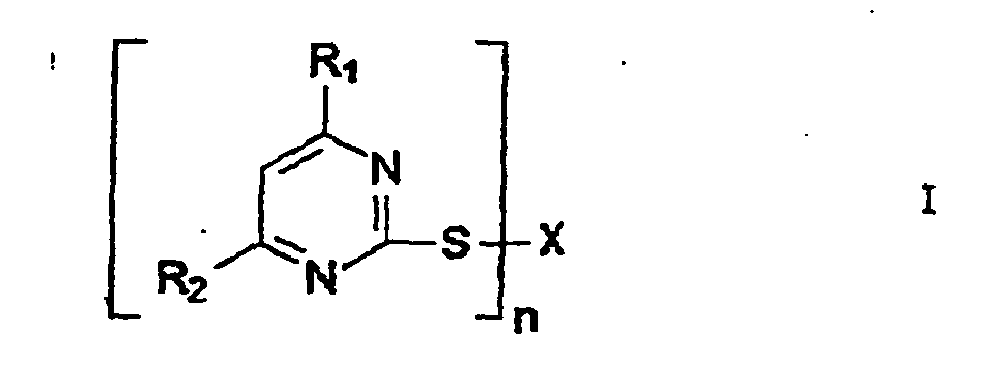
Where X=H, R1 through R4 , NR3R4, OR5, SR5, SO2R6, M or (SO3)zM (M=metal ion), and n and z can be the same or different and 1, 2 or 3, depending on whether the respective valence of X and M is 1, 2 or 3, R1 through R4 are the same or different and selected from the group consisting of the substituents H, halogen, OH, NH2, alkyl, cycloalkyl, aryl, alkylaryl and aralkyl, with the substituents alkyl, cycloalkyl, aryl, alkylaryl and aralkyl optionally having additional functional groups selected from the group consisting of NH2, OH, substituted amino, substituted hydroxyl, halogen, and carbonyl containing group, when R3 and/or R4 are one of the substituents alkyl, cycloalkyl, aryl, alkylaryl and aralkyl, they may be in the same constituent in a ring together with N to form a heterocyclic group, R5 is selected from the group consisting of the substituents H, alkyl, cycloalkyl, aryl, alkylaryl and aralkyl, or a radical derived from a carbon based heterocyclic group containing at least one of S or N, or both S and N, R6 is selected from the group consisting of the substituents alkyl, cycloalkyl, aryl, alkylaryl, aralkyl, H, OH, OM, NH2, NR3R4, and OR5, the respective amount of accelerating agent and hardness stabilization agent being effective to not substantially inhibit vulcanization and to stabilize the hardness properties of said rubber upon vulcanization, the amount of accelerating agent in said composition being greater than about 0.6 phr and the amount of hardness stabilization agent being at least about 0.5 phr.
Where X=H, R1 through R4 , NR3R4, OR5, SR5, SO2R6, M or (SO3)zM (M=metal ion), and n and z can be the same or different and 1, 2 or 3, depending on whether the respective valence of X and M is 1, 2 or 3, R1 through R4 are the same or different and selected from the group consisting of the substituents H, halogen, OH, NH2, alkyl, cycloalkyl, aryl, alkylaryl and aralkyl, with the substituents alkyl, cycloalkyl, aryl, alkylaryl and aralkyl optionally having additional functional groups selected from the group consisting of NH2, OH, substituted amino, substituted hydroxyl, halogen, and carbonyl containing group, when R3 and/or R4 are one of the substituents alkyl, cycloalkyl, aryl, alkylaryl and aralkyl, they may be in the same constituent in a ring together with N to form a heterocyclic group, R5 is selected from the group consisting of the substituents H, alkyl, cycloalkyl, aryl, alkylaryl and aralkyl, or a radical derived from a carbon based heterocyclic group containing at least one of S or N, or both S and N, R6 is selected from the group consisting of the substituents alkyl, cycloalkyl, aryl, alkylaryl, aralkyl, H, OH, OM, NH2, NR3R4, and OR5, the respective amount of accelerating agent and hardness stabilization agent being effective to not substantially inhibit vulcanization and to stabilize the hardness properties of said rubber upon vulcanization, the amount of accelerating agent in said composition being greater than about 0.6 phr and the amount of hardness stabilization agent being at least about 0.5 phr.
2. The composition of claim 1 wherein R5 is a pyrimidine.
3. The composition of claim 1 wherein R5 is 2-benzothiazolyl or pyrimidine .
4. The composition of claim 1 wherein the compound of formula I is 2,2' bis 4,6 dimethylpyrimidyl
disulfide.
5. The composition of claim 1 wherein said accelerators are selected from the group consisting
of benzothiazole-based accelerators, thiophosphoric add derivatives, thiurams, dithiocarbamates,
xanthates, and mixtures of one or more of these accelerators.
6. The composition of claim 1 wherein said accelerators are selected from the group consisting
of mercaptobenzothiazoles, diphenylguanidine (DPG) and di-o-tolyl guanidine, and mixtures
of one or more of these accelerators.
7. The composition of claim 1 wherein the amount of said sulfur vulcanizing agent provides
in excess of about 1 parts per hundred of rubber in said composition.
8. The composition of claim 1 wherein the compound of formula I has the formula
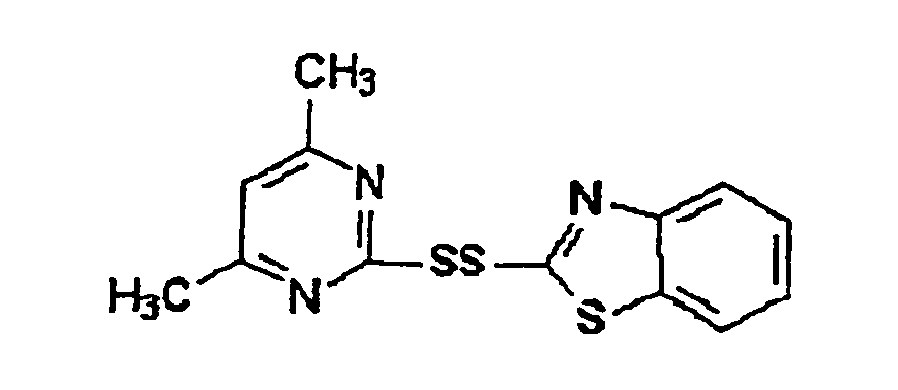
9. The composition of claim 1 wherein the compound of formula I has the formula
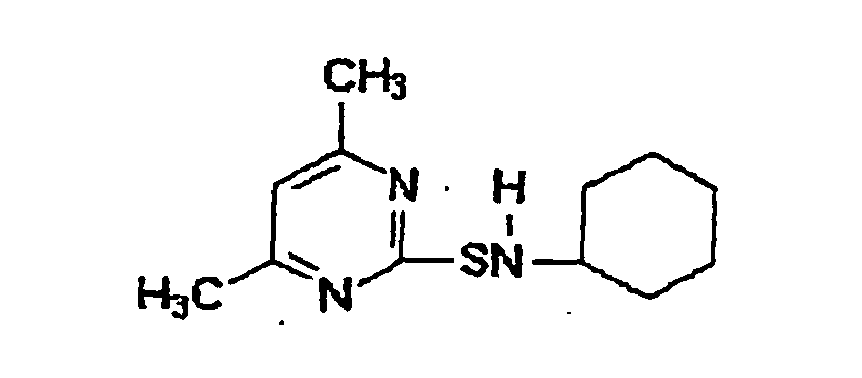
10. The composition of claim 1 wherein the compound of formula I has the formula
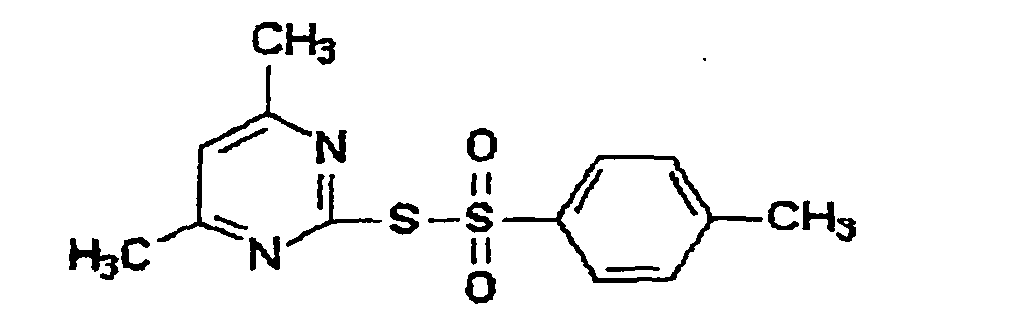
11. The composition of claim 1 wherein said accelerating agent comprises 2-mercaptobenzothiazole.
12. The composition of claim 1 wherein the amount of said compound of formula I is from
at least about 0.5 phr to about 10.0 phr.
13. The composition of claim 1 wherein the amount of said compound of formula I is from
at least about 0.5 phr to about 3.0 phr.
14. The composition of claim 1 comprising 2-pyrimidinesulfenamide, and a mixture of the
accelerators bis(dibenzylthiocarbamoyl) disulfide and 2-mercaptobenzothiazole.
15. The composition of claim 9 comprising a mixture of the accelerators bis(dibenzylthiocarbamoyl)
disulfide and 2-mercaptobenzothiazole.
16. The composition of claim 1 comprising greater than about 0.6 phr to about 10.0 phr
of accelerating agent.
17. The composition of claim 1 comprising greater than about 0.6 phr to about 3.0 phr
of accelerating agent.
18. The composition of claim 1 wherein M is selected from the group consisting of Zn,
Ni, Mg, Co and Na.
19. The composition of claim 1 wherein said carbonyl containing groups are carboxylic
acid, or a salt, ester, amide, ketone or aldehyde of carboxylic acid.
20. The composition of claim 1 wherein said alkyl, cycloalkyl, aryl and aralkyl groups
have from 2 to about 15 carbon atoms.
21. The composition of claim 1 wherein said alkyl, cycloalkyl, aryl and aralkyl groups
have from 2 to about 8 carbon atoms..
22. The composition of claim 1 wherein said accelerating agent comprises bis(dibenzylthiocarbarnoyl)disulfide.
23. The composition of claim 1 wherein said hardness stabilization agent comprises N-cyclohexyl-4,6-dimethyl-2-pyrimidinesulfenamide
and said accelerating agent comprises is(dibenzylthiocarbamoyl)disulfide.
24. A method of improving the hardness stabilization of SBR rubber by adding to unvulcanized
sulfur vulcanizable SBR rubber a composition comprising a sulfur vulcanizing agent,
an accelerating agent selected from the group of accelerating agents other than thiazole
sulfenamides and a hardness stabilization agent comprising a pyrimidine derivative
of formula I of claim1, the respective amount of accelerating agent and hardness stabilization
agent being effective to not substantially inhibit vulcanization and to stabilize
the hardness properties of said rubber upon vulcanization, the amount of accelerating
agent in said composition being greater than about 0.6 phr and the amount of hardness
stabilization agent being at least about 0.5 phr.
1. Vulkanisierbare Zusammensetzung, umfassend einen mit Schwefel vulkanisierbaren SBR-Kautschuk,
ein Schwefel-Vulkanisationsmittel, ein Beschleunigungsmittel, das aus der Gruppe ausgewählt
ist, bestehend aus Beschleunigungsmitteln, die von Thiazolsulfenamiden verschieden
sind, und einen Härte-Stabilisator, der ein Pyrimidin-Derivat der Formel
umfasst, wobei X = H, R1 bis R4, NR3R4, OR5, SR5, SO2R6, M oder (SO3)zM (M=Metallion), und n und z identisch oder verschieden sein können und 1, 2 oder 3 betragen können, und zwar in Abhängigkeit davon, ob die entsprechende Wertigkeit von X und M 1 , 2 oder 3 ist, R1 bis R4 identisch oder verschieden sind und aus der Gruppe ausgewählt sind, bestehend aus den Substituenten H, Halogen, OH, NH2, Alkyl, Cycloalkyl, Aryl, Alkylaryl und Aralkyl, wobei die Substituenten Alkyl, Cycloalkyl, Aryl, Alkylaryl und Aralkyl gegebenenfalls zusätzliche funktionelle Gruppen aufweisen, die aus der Gruppe ausgewählt sind, bestehend aus NH2-, OH-, substituierter Amino-, substituierter Hydroxyl-, Halogen-Gruppe und Carbonylenthaltender Gruppe, wenn R3 und/oder R4 einer der Substituenten Alkyl, Cycloalkyl, Aryl, Alkylaryl und Aralkyl sind, können sie in dem gleichen Bestandteil in einem Ring zusammen mit N vorliegen, um eine heterocyclische Gruppe zu bilden, R5 aus der Gruppe ausgewählt ist, bestehend aus den Substituenten H, Alkyl, Cycloalkyl, Aryl, Alkylaryl und Aralkyl, oder einem Rest, der sich von einer heterocyclischen Gruppe auf Kohlenstoff-Basis ableitet, die wenigstens S oder N oder S und N enthält, R6 aus der Gruppe ausgewählt ist, bestehend aus den Substituenten Alkyl, Cycloalkyl, Aryl, Alkylaryl, Aralkyl, H, OH, OM, NH2, NR3R4 und OR5, wobei die entsprechenden Mengen des Beschleunigungsmittels und des Härte-Stabilisators wirksam sind, um die Vulkanisation nicht wesentlich zu hemmen und die Härteeigenschaften des Kautschuks nach der Vulkanisation zu stabilisieren, wobei die Menge des Beschleunigungsmittels in der Zusammensetzung -größer als etwa 0,6 phr ist, und die Menge des Härte-Stabilisators wenigstens etwa 0,5 phr beträgt.
umfasst, wobei X = H, R1 bis R4, NR3R4, OR5, SR5, SO2R6, M oder (SO3)zM (M=Metallion), und n und z identisch oder verschieden sein können und 1, 2 oder 3 betragen können, und zwar in Abhängigkeit davon, ob die entsprechende Wertigkeit von X und M 1 , 2 oder 3 ist, R1 bis R4 identisch oder verschieden sind und aus der Gruppe ausgewählt sind, bestehend aus den Substituenten H, Halogen, OH, NH2, Alkyl, Cycloalkyl, Aryl, Alkylaryl und Aralkyl, wobei die Substituenten Alkyl, Cycloalkyl, Aryl, Alkylaryl und Aralkyl gegebenenfalls zusätzliche funktionelle Gruppen aufweisen, die aus der Gruppe ausgewählt sind, bestehend aus NH2-, OH-, substituierter Amino-, substituierter Hydroxyl-, Halogen-Gruppe und Carbonylenthaltender Gruppe, wenn R3 und/oder R4 einer der Substituenten Alkyl, Cycloalkyl, Aryl, Alkylaryl und Aralkyl sind, können sie in dem gleichen Bestandteil in einem Ring zusammen mit N vorliegen, um eine heterocyclische Gruppe zu bilden, R5 aus der Gruppe ausgewählt ist, bestehend aus den Substituenten H, Alkyl, Cycloalkyl, Aryl, Alkylaryl und Aralkyl, oder einem Rest, der sich von einer heterocyclischen Gruppe auf Kohlenstoff-Basis ableitet, die wenigstens S oder N oder S und N enthält, R6 aus der Gruppe ausgewählt ist, bestehend aus den Substituenten Alkyl, Cycloalkyl, Aryl, Alkylaryl, Aralkyl, H, OH, OM, NH2, NR3R4 und OR5, wobei die entsprechenden Mengen des Beschleunigungsmittels und des Härte-Stabilisators wirksam sind, um die Vulkanisation nicht wesentlich zu hemmen und die Härteeigenschaften des Kautschuks nach der Vulkanisation zu stabilisieren, wobei die Menge des Beschleunigungsmittels in der Zusammensetzung -größer als etwa 0,6 phr ist, und die Menge des Härte-Stabilisators wenigstens etwa 0,5 phr beträgt.
2. Zusammensetzung gemäß Anspruch 1, wobei R5 Pyrimidin ist.
3. Zusammensetzung gemäß Anspruch 1, wobei R5 2-Benzothiazolyl oder Pyrimidin ist.
4. Zusammensetzung gemäß Anspruch 1, wobei die Verbindung der Formel I 2,2'-Bis-4,6-dimethylpyrimidyldisulfid
ist.
5. Zusammensetzung gemäß Anspruch 1, wobei die Beschleuniger aus der Gruppe ausgewählt
sind, bestehend aus Beschleunigern auf Benzothiazol-Basis, Thiophosphorsäure-Derivaten,
Thiuramen, Dithiocarbamaten, Xanthaten und Mischungen eines oder mehrerer dieser Beschleuniger.
6. Zusammensetzung gemäß Anspruch 1, wobei die Beschleuniger aus der Gruppe ausgewählt
sind, bestehend aus Mercaptobenzothiazolen, Diphenylguanidin (DPG) und Di-o-tolylguanidin
und Mischungen eines oder mehrerer dieser Beschleuniger.
7. Zusammensetzung gemäß Anspruch 1, wobei die Menge des Schwefel-Vulkanisationsmittels
mehr als etwa 1 Teil pro hundert Kautschuk des Kautschuks in der Zusammensetzung ausmacht.
8. Zusammensetzung gemäß Anspruch 1, wobei die Verbindung der Formel I die Formel

hat.
hat.
9. Zusammensetzung gemäß Anspruch 1, wobei die Verbindung der Formel I die Formel
hat.
hat.
10. Zusammensetzung gemäß Anspruch 1, wobei die Verbindung der Formel I die Formel
hat.
hat.
11. Zusammensetzung gemäß Anspruch 1, wobei das Beschleunigungsmittel 2-Mercaptobenzothiazol
umfasst.
12. Zusammensetzung gemäß Anspruch 1, wobei die Menge der Verbindung der Formel I wenigstens
etwa 0,5 phr bis etwa 10,0 phr ist.
13. Zusammensetzung gemäß Anspruch 1, wobei die Menge der Verbindung der Formel I wenigstens
etwa 0,5 phr bis etwa 3,0 phr ist.
14. Zusammensetzung gemäß Anspruch 1, umfassend 2-Pyrimidinsulfenamid und eine Mischung
der Beschleuniger Bis(diphenylthiocarbamoyl)disulfid und 2-Mercaptobenzothiazol.
15. Zusammensetzung gemäß Anspruch 9, umfassend eine Mischung der Beschleuniger Bis(diphenylthiocarbamoyl)disulfid
und 2-Mercaptobenzothiazol.
16. Zusammensetzung gemäß Anspruch 1, die mehr als etwa 0,6 phr bis etwa 10,0 phr des
Beschleunigungsmittels umfasst.
17. Zusammensetzung gemäß Anspruch 1, die mehr als etwa 0,6 phr bis etwa 3,0 phr des Beschleunigungsmittels
umfasst.
18. Zusammensetzung gemäß Anspruch 1, wobei M aus der Gruppe ausgewählt ist, die aus Zn,
Ni, Mg, Co und Na besteht.
19. Zusammensetzung gemäß Anspruch 1, wobei die Carbonyl-enthaltenden Gruppen Carbonsäure
oder ein Salz, Ester, Amid, Keton oder Aldehyd der Carbonsäure sind.
20. Zusammensetzung gemäß Anspruch 1, wobei die Alkyl-, Cycloalkyl-, Aryl-und Aralkyl-Gruppen
2 bis etwa 15 Kohlenstoffatome aufweisen.
21. Zusammensetzung gemäß Anspruch 1, wobei die Alkyl-, Cycloalkyl-, Aryl-und Aralkyl-Gruppen
2 bis etwa 8 Kohlenstoffatome aufweisen.
22. Zusammensetzung gemäß Anspruch 1, wobei das Beschleunigungsmittel Bis(dibenzylthiocarbamoyl)disulfid
umfasst.
23. Zusammensetzung gemäß Anspruch 1, wobei der Härte-Stabilisator N-Cyclohexyl-4,6-dimethyl-2-pyrimidinsulfenamid
umfasst, und das Beschleunigungsmittel Bis(dibenzylthiocarbamoyl)disulfid umfasst.
24. Verfahren zur Verbesserung der Härte-Stabilisierung von SBR-Kautschuk durch Zugabe
einer Zusammensetzung zu dem nicht vulkanisierten, durch Schwefel vulkanisierbaren
SBR-Kautschuk, wobei die Zusammensetzung Folgendes umfasst: ein Schwefel-Vulkanisationsmittel,
ein Beschleunigungsmittel, das aus der Gruppe von Beschleunigungsmitteln ausgewählt
ist, die von Thiazolsulfenamiden verschieden sind, und einen Härte-Stabilisator, der
ein Pyrimidin-Derivat der Formel I des Anspruchs 1 umfasst, wobei die entsprechenden
Mengen des Beschleunigungsmittels und des Härte-Stabilisators wirksam sind, um die
Vulkanisation nicht wesentlich zu hemmen und die Härteeigenschaften des Kautschuks
nach der Vulkanisation zu stabilisieren, und die Menge des Beschleunigungsmittels
in der Zusammensetzung größer als etwa 0,6 phr ist, und die Menge des Härte-Stabilisators
wenigstens etwa 0,5 phr beträgt.
1. Composition vulcanisable comprenant un caoutchouc SBR à base de soufre vulcanisable,
un agent de vulcanisation à base de soufre, un agent d'accélération choisi dans le
groupe constitué des agents d'accélération autres que les thiazole sulfénamides et
un agent de stabilisation de dureté comprenant un dérivé de la pyrimidine de formule
:
où X = H, R1 à R4, NR3R4, OR5, SR5, SO2R6, M ou (SO3)zM (M = ion métallique), et n et z peuvent être identiques ou différents et valent 1, 2 ou 3 en fonction de la valence respective de X et M vaut 1, 2 ou 3, R1 à R4 sont identiques ou différents et sont choisis dans le groupe constitué des substituants H, halogène, OH, NH2, alkyle, cycloalkyle, aryle, alkylaryle et aralkyle, les substituants alkyle, cycloalkyle, aryle, alkylaryle et aralkyle ayant éventuellement des groupes fonctionnels supplémentaires choisis dans le groupe constitué de NH2, OH, un groupe amino substitué, un groupe hydroxyle substitué, un atome d'halogène et un groupe contenant un carbonyle, lorsque R3 et/ou R4 sont un des substituants alkyle, cycloalkyle, aryle, alkylaryle et aralkyle, ils peuvent être dans le même constituant dans un cycle avec N pour former un groupe hétérocyclique, R5 est choisi dans le groupe constitué des substituants H, alkyle, cycloalkyle, aryle, alkylaryle et aralkyle, ou un radical dérivé d'un groupe hétérocyclique à base de carbone contenant au moins un de S ou N, ou S et N ensemble, R6 est choisi dans le groupe constitué des substituants alkyle, cycloalkyle, aryle, alkylaryle, aralkyle, H, OH, OM, NH2, NR3R4 et OR5, la quantité respective d'agent d'accélération et d'agent de stabilisation de dureté étant efficace afin de ne pas inhiber sensiblement la vulcanisation et de stabiliser les propriétés de dureté dudit caoutchouc lors de la vulcanisation, la quantité d'agent d'accélération dans ladite composition étant supérieure à environ 0,6 phr et la quantité de l'agent de stabilisation de dureté étant d'au moins environ 0,5 phr.
où X = H, R1 à R4, NR3R4, OR5, SR5, SO2R6, M ou (SO3)zM (M = ion métallique), et n et z peuvent être identiques ou différents et valent 1, 2 ou 3 en fonction de la valence respective de X et M vaut 1, 2 ou 3, R1 à R4 sont identiques ou différents et sont choisis dans le groupe constitué des substituants H, halogène, OH, NH2, alkyle, cycloalkyle, aryle, alkylaryle et aralkyle, les substituants alkyle, cycloalkyle, aryle, alkylaryle et aralkyle ayant éventuellement des groupes fonctionnels supplémentaires choisis dans le groupe constitué de NH2, OH, un groupe amino substitué, un groupe hydroxyle substitué, un atome d'halogène et un groupe contenant un carbonyle, lorsque R3 et/ou R4 sont un des substituants alkyle, cycloalkyle, aryle, alkylaryle et aralkyle, ils peuvent être dans le même constituant dans un cycle avec N pour former un groupe hétérocyclique, R5 est choisi dans le groupe constitué des substituants H, alkyle, cycloalkyle, aryle, alkylaryle et aralkyle, ou un radical dérivé d'un groupe hétérocyclique à base de carbone contenant au moins un de S ou N, ou S et N ensemble, R6 est choisi dans le groupe constitué des substituants alkyle, cycloalkyle, aryle, alkylaryle, aralkyle, H, OH, OM, NH2, NR3R4 et OR5, la quantité respective d'agent d'accélération et d'agent de stabilisation de dureté étant efficace afin de ne pas inhiber sensiblement la vulcanisation et de stabiliser les propriétés de dureté dudit caoutchouc lors de la vulcanisation, la quantité d'agent d'accélération dans ladite composition étant supérieure à environ 0,6 phr et la quantité de l'agent de stabilisation de dureté étant d'au moins environ 0,5 phr.
2. Composition selon la revendication 1, dans laquelle R5 est une pyrimidine.
3. Composition selon la revendication 1, dans laquelle R5 est le 2-benzothiazolyle ou une pyrimidine.
4. Composition selon la revendication 1, dans laquelle le composé de formule I est le
disulfure de 2,2'-bis-4,6-diméthylpyrimidyle.
5. Composition selon la revendication 1, dans laquelle lesdits accélérateurs sont choisis
dans le groupe constitué des accélérateurs à base de benzothiazole, des dérivés de
l'acide thiophosphorique, des thiurams, des dithiocarbamates, des xanthates, et des
mélanges d'un ou de plusieurs de ces accélérateurs.
6. Composition selon la revendication 1, dans laquelle lesdits accélérateurs sont choisis
dans le groupe constitué des mercaptobenzothiazoles, de la diphénylguanidine (DPG)
et de la di-o-tolylguanidine, et des mélanges d'un ou de plusieurs de ces accélérateurs.
7. Composition selon la revendication 1, dans laquelle la quantité dudit agent de vulcanisation
à base de soufre donne un excès d'environ 1 phr dans ladite composition.
8. Composition selon la revendication 1, dans laquelle le composé de formule I a la formule
9. Composition selon la revendication 1, dans laquelle le composé de formule I a la formule
10. Composition selon la revendication 1, dans laquelle le composé de formule I a la formule
11. Composition selon la revendication 1, dans laquelle ledit agent d'accélération comprend
le 2-mercaptobenzothiazole.
12. Composition selon la revendication 1, dans laquelle ledit composé de formule I est
compris dans la plage allant d'au moins environ 0,5 phr à environ 10,0 phr.
13. Composition selon la revendication 1, dans laquelle ledit composé de formule I est
compris dans la plage allant d'au moins environ 0,5 phr à environ 3,0 phr.
14. Composition selon la revendication 1, comprenant le 2-pyrimidinesulfénamide, et un
mélange des accélérateurs disulfure de bis(dibenzylthiocarbamoyle) et 2-mercaptobenzothiazole.
15. Composition selon la revendication 9, comprenant un mélange des accélérateurs disulfure
de bis(dibenzylthiocarbamoyle) et 2-mercaptobenzothiazole.
16. Composition selon la revendication 1, comprenant de plus d'environ 0,6 phr à environ
10,0 phr d'agent d'accélération.
17. Composition selon la revendication 1, comprenant de plus d'environ 0,6 phr à environ
3,0 phr d'agent d'accélération.
18. Composition selon la revendication 1, dans laquelle M est choisi dans le groupe constitué
de Zn, Ni, Mg, Co et Na.
19. Composition selon la revendication 1, dans laquelle lesdits groupes contenant un carbonyle
sont un acide carboxylique, ou un sel, un ester, un amide, une cétone ou un aldéhyde
d'un acide carboxylique.
20. Composition selon la revendication 1, dans laquelle lesdits groupes alkyle, cycloalkyle,
aryle, alkylaryle et aralkyle ont de 2 à environ 15 atomes de carbone.
21. Composition selon la revendication 1, dans laquelle lesdits groupes alkyle, cycloalkyle,
aryle, alkylaryle et aralkyle ont de 2 à environ 8 atomes de carbone.
22. Composition selon la revendication 1, dans laquelle ledit agent d'accélération comprend
le disulfure de bis(dibenzylthiocarbamoyle).
23. Composition selon la revendication 1, dans laquelle ledit agent de stabilisation de
dureté comprend le N-cyclohexyl-4,6-diméthyl-2-pyrdimidinesulfénamide et ledit l'agent
d'accélération comprend le disulfure de bis(dibenzylthiocarbamoyle).
24. Procédé d'amélioration de la stabilisation de la dureté d'un caoutchouc SBR en ajoutant
au caoutchouc SBR à base de soufre non vulcanisé, une composition comprenant un agent
de vulcanisation à base de soufre, un agent d'accélération choisi dans le groupe des
agents d'accélération autres que les thiazole sulfénamides et un agent de stabilisation
de dureté comprenant un dérivé de la pyrimidine de formule I selon la revendication
1, la quantité respective d'agent d'accélération et d'agent de stabilisation de dureté
étant efficace afin de ne pas inhiber sensiblement la vulcanisation et de stabiliser
les propriétés de dureté dudit caoutchouc lors de la vulcanisation, la quantité d'agent
d'accélération dans ladite composition étant supérieure à environ 0,6 phr et la quantité
d'agent de stabilisation de dureté étant d'au moins environ 0,5 phr.